- Italiano
- English
- magyar / magyar nyelv
- dansk
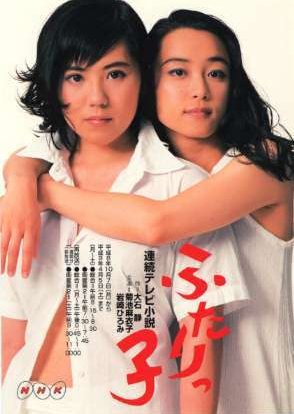
- Titolo Originale: ふたりっ子
- Conosciuto Anche Come: Twin Sisters , Twins
- Sceneggiatore: Oishi Shizuka
- Regista: Nishitani Shinichi
- Generi: Romantico, Vita, Drama
Cast & Ringraziamenti
-
") Iwasaki Hiromi Ruolo Principale
Iwasaki Hiromi Ruolo Principale -
") Kikuchi MaikoNoda ReikoRuolo Principale
Kikuchi MaikoNoda ReikoRuolo Principale -
") Mikura ManaNoda Reiko [Young]Ruolo di Supporto
Mikura ManaNoda Reiko [Young]Ruolo di Supporto -
") Mikura KanaNoda Kyoko [Young]Ruolo di Supporto
Mikura KanaNoda Kyoko [Young]Ruolo di Supporto -
") Ihara TsuyoshiKuroiwa MasaoRuolo di Supporto
Ihara TsuyoshiKuroiwa MasaoRuolo di Supporto -
") Yamamoto TaroKaito ShoheiRuolo di Supporto
Yamamoto TaroKaito ShoheiRuolo di Supporto






Recensioni

Questa recensione può contenere spoiler
This shogi piece only moves forward...
"Futarikko" is my 37th asadora watched. After finishing "Hiyokko" in May, words can't express my happiness that there are still asadoras for me to watch. "Futarikko" is quite an interesting asadora, veering away from the set patterns of the time to tell a thoroughly modern story. It also brought asadoras out of a ratings slump at the time. This fact is no surprise when you watch it. Though most asadoras can be described as "addicting," I think this one embodies the word the most. One episode after the next. I never got bored watching it. Yes, there were storylines I didn't particularly like, but I was never bored and I just needed to keep watching.One of the core themes of "Futarikko" is finding happiness. Despite setback after setback, each character in this asadora finds happiness in their chosen path. Strangely, it took me until the next to final week to actually understand this. I was being a bit judgey, questioning why certain characters ended up where they were or how they made their choices. Happiness is hard to win. You may accomplish your dreams and find complete contentment in that. Or you may not accomplish your dreams, but you may find happiness in a different place. "Futarikko" highlights the different paths a person can take. I'll be summarizing this asadora a bit, because that's the only way I can talk about it right now.
Unconventionally for an asadora, it follows a pair of twins, Kyoko (Iwasaki Hiromi) and Reiko (Kikuchi Maiko). These two are played brilliantly in the first two weeks by child actresses Mikura Mana and Kana. The twins' personalities are perfectly established by Mana and Kana, before being taken over by Hiromi and Maiko. Kyoko is a slightly clueless tomboy whom becomes enamored with the game of shogi. Reiko is the intelligent honor student who secretly longs for a lavish lifestyle. The entire series changes with Reiko's decision to live with their rich grandparents, whom her mother has not seen in twenty years. Poor Kyoko, meanwhile, is terrible at school and decides to drop out. She apprentices for her father briefly, before deciding to pursue a career in professional shogi.
As with most asadoras, the love interests are usually one of the most interesting aspects. And boy is this part juicy in "Futarikko." Prepare yourself for major spoilers. Reiko's first boyfriend is Kaito Shohei (Yamamoto Taro), a rich boy she meets in college. She basically lies about her entire background and Kaito breaks up with her, which he later regrets. Reiko then becomes interested in Kaito's friend Moriyama Shiro (Uchino Seiyou), whom Kyoko is in love with. Moriyama seems completely uninterested in being in this love triangle [lol], though he does ultimately pick Kyoko. Reiko shows that she's a good sister after all by convincing Kyoko to follow her feelings. She then chooses ever loyal neighbor Masao (Ihara Tsuyoshi) to marry since he understands her twisted personality and doesn't judge her for it. Of course, the troubles don't stop here...
After the time skip, Reiko is shown to be taking Masao for granted. Kaito reenters the picture and apparently still loves Reiko. She nearly marries Kaito (in a sacrificial act actually), but stays with Masao and turns into an ordinary housewife. Her twins Remi and Mami (also played by Mana and Kana) mirror her and Kyoko's personalities. Much like herself years earlier, Mami judges Reiko's choices. In a powerful moment, Reiko declares that her dreams failed but that her current life has made her the happiest. Meanwhile, Kyoko has divorced Moriyama in order to focus on shogi completely and after a traumatizing event. I personally nearly tapped out at this point. However, I will concede that while I don't like it, what their relationship turns into is ultimately more meaningful than just being married.
One final note on Masao. He's one of those dumb idiotic childhood friends you'll often see in asadoras. I thought he was a little creepy at first tbh. However, I slowly warmed up to him. He doesn't ignore Reiko's feelings and seems to be aware that she's mostly using him (for rides, comfort, etc.). Masao accepts their relationship as is and doesn't expect more until Reiko proposes to him. This is a rare case where the dumb idiot earns the love of the heroine.
Okay, now to a storyline I greatly dislike even if it was entertaining. The twins' parents, Koichi (Danta Yasunori) and Chiaki (Tezuka Satomi), eloped twenty years before the series starts. Chiaki left her rich lifestyle to help Koichi with his tofu shop. Despite this, Koichi never seems to let go of his insecurities. And let me tell you, male insecurities are one of the most annoying things to watch. Of course, I sorta understand what eventually drove him to run away with another woman. But... that doesn't mean I like it at all. Especially when his wife swallows her pride but he ignores her... Anyway, part of me really wanted to hate Aurora Teruko (Kawai Michiko), the singer he left with. But, after hearing her story later on, it's hard not to feel sorry for her or blame her for seizing her happiness even at the expense of others. Of course, Koichi and Chiaki get back together though I wonder if it would've been better for them to stay apart. [Or maybe not drag the story so long...]
This review is already getting too long so I won't get into the plethora of wonderful side characters. I will say that some of my favorites were from the shogi side of the series, including Amamiya (Taguchi Hiromasa) and Hashiba (Shigeyama Motohiko).
"Futarikko" is an amazing experience. It's a look at a different kind of asadora, completely different from the asadoras of the last twenty or so years. The two heroines are so unique and I loved them even if I didn't always like them. I'm so happy we have subs for this series, even if they're incomplete. My tip if you're Japanese isn't good is to use the Google Translate app while watching the episodes and scenes missing subtitles. You'll get the gist of what they're saying.
My Asadora Ranking: https://kisskh.at/list/LAlqpp21
Questa recensione ti è stata utile?

Questa recensione può contenere spoiler
TW: Domestic Violence
Here's my list of pros and cons:Pros: the relationship between Kyoko and Reiko, the way they walked this fine line of enemies, friends and acquaintances, and never truly felt close as sisters theoretically should. But above all, the relationship between Kyoko and Moriyama, in every corner when I thought he'd disappoint me, he always managed to surprise me, meaning the writers did a great job with his character development despite him not being one of the leads. The ending in particular was my favorite part of their relationship, it's not always that we see men be supportive of their girlfriends not only being great at what they do, but being better than them, and it's also not every day that we see a couple decide to follow an alternative way of being together and it be successful, and I'm a firm believer that if more people decided to not stick to the norm of living together, sleeping in the same bed, having kids, etc., they'd be much happier.
Pros and cons: The world of Shogi, which is something I didn't know about and loved to learn, and how Kyoko broke into its patriarchal system. However, I wish we had seen her open the doors not only to her, but to other women too, the teen Shogi player we see near the end of the story could've been a girl, or one of her nieces could have followed her path, especially the one who resembled Reiko so that it wasn't too obvious, or maybe we could have seen her start training female Shogi hopefuls.
Cons: the relationship between Reiko and Masao. I was already weirded out by the fact that Masao had feelings for Reiko since she was a child, then add that to the fact that he hit her across the face and the whole thing completely lost me. I didn't feel any comradery or understanding or any love between them, it all felt from beginning to end like she settled for him. And speaking of settling for a man who doesn't deserve you: the story between the girls parents Chiaki and Kyoichi. I was livid that after all the abuse she endured by him, not only did the story brough them back together, but it was all heavily supported by their daughters, who themselves were also victims of his behavior, since they were abandoned by him, ignored by him and mistreated by him. And when I put that plot together with the rest of the drama, the respect Moriyama had for Kyoko's ambitions and decisions for their relationship, the way women's participation in professional Shogi was at the forefront of the story, it just doesn't add up to the writer purposely advocating for a woman to allow a man who played in her face to return to her life. It was embarrassing and disgusting to watch, and that's the reason why my rating, which initially was a 9, ended in an 8.
Questa recensione ti è stata utile?