





 1
1 1
1 1
1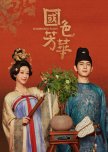




 'The Double' actress Wu Jin Yan and Miles Wei team up for new Chinese drama
 Le commerce de pivoines de He Wei Fang est toujours aussi florissant, après avoir reçu l'aide du haut fonctionnaire Jiang Chang Yang et ce, malgré l’opposition de certains membres du gouvernement local. Mais après le décès de sa mère, Wei Fang ne sait plus quoi faire de sa vie et décide finalement d’ouvrir une clinique pour fournir des soins aux personnes dans le besoin. Dans le même temps, Chang Yang prépare une rébellion pour redonner le pouvoir au peuple, mais cette entreprise lui fait courir un grand danger. Wei Fang pourra-t-elle aider Chang Yang à ramener la paix dans le royaume ? Et parviendront-ils à reprendre leur histoire d’amour ? (Source : Viki) ~~ Adapté du webroman "Guo Se Fang Hua" (国色芳华) de Yi Qian Chong (意千重). Modifier la traduction
- Français
- 中文(简体)
- Русский
- हिन्दी
- Titre original: 锦绣芳华
- Aussi connu sous le nom de: Flourished Peony Part 2 , Guo Se Fang Hua , Jin Xiu Fang Hua , 国色芳华 , 國色芳華 , 錦繡芳華 , Flourished Peony 2
- Scénariste: Zhang Yuan Ang, Jia Bin Bin
- Réalisateur: Ding Zi Guang
- Genres: Historique, Affaires, Romance
Distribution et équipes
-
") Yang ZiHe Wei Fang / Mu Dan / Jiang Xiao HuaRôle principal
Yang ZiHe Wei Fang / Mu Dan / Jiang Xiao HuaRôle principal -
") Li XianJiang Chang Yang / Sui ZhiRôle principal
Li XianJiang Chang Yang / Sui ZhiRôle principal -
") Miles WeiLiu Chang / Zi ShuRôle Secondaire
Miles WeiLiu Chang / Zi ShuRôle Secondaire -
") Zhang Ya QinLi You ZhenRôle Secondaire
Zhang Ya QinLi You ZhenRôle Secondaire -
") Gloria GuanZhu FuRôle Secondaire
Gloria GuanZhu FuRôle Secondaire -
") Amelie XuXiao Xue XiRôle Secondaire
Amelie XuXiao Xue XiRôle Secondaire
Critiques

Cette critique peut contenir des spoilers
I had expected this to be a successful second season to a beautifully written drama.. Even if not better than the first but at least close to it.. But honestly, it wasn’t.. And I totally understand the low ratings.. I really do.. I am not going to blame the story itself.. If this had been a standalone drama or not a continuation, it would have actually been an excellent one.. But it wasn’t.. After watching 34 eps and waiting 5–6 months, you shouldn’t have to sit through another 12 eps of push and pull between the main leads.. Especially letting someone like Liu Lang who is a complete nobody affect their relationship.. The court politics, the mutiny and everything else were solid, but most of what happened in the first 12 eps felt totally unnecessary.. The foundation for the characters was already built.. What they needed to do was move the story forward.. Instead they were still stuck in the same loop.. Repeating what had already happened in the first season.. Honestly I respect the commitment the writing shows, it knows what it wants.. But I didn’t quite get the fulfillment I was hoping for.. I am only whining because I expected more..If it were possible to erase someone from the story.. It would be Liu Lang.. Enemies?? Yeah I hate them.. But what about people who stay close to you and backstab you?? He literally got his life back and is living well because of the FL and yet he tried to destroy her relationship out of jealousy?? He was supposed to be like a younger brother to her.. His sister did the same thing and now he followed right in her footsteps.. And the fact that this guy hit the ML and still got let off?? I was honestly disappointed at how easily he was forgiven and also how his stupidity and jealousy were sugarcoated as concern for the FL.. Sure he got his redemption arc but he didnt pay for his mistakes..
Liu Chang was pathetic in the first season but here he completely turned into a character unworthy of any pity.. He did some truly nasty things.. It was actually satisfying when the FL hurt him repeatedly, the stabbing scene especially felt good.. But honestly, he still didn’t suffer enough.. That’s why I wasn’t satisfied with how things ended for him.. He should have suffered more pain..
I actually felt sorry for Princess You Zhen.. The cycle of her life was truly sad.. Hurt by the men around her, including her own father.. I am glad she didn’t die in the end.. It meant she had another chance at life, another opportunity to start over..
Ep 19.. I think they were too hasty in confronting Prince Ning.. I mean he literally crushed their decade old plan in just a few days, it felt way too easy.. And the final confrontation, the war could have been handled much better.. It just goes to show how little attention was given to the parts of the story that didn’t have the FL on screen..
While I wasn’t completely satisfied, this was still a watchable conclusion to an amazing story.. In the first season even though Mu Dan was the anchor, the others mattered too.. But in the second season, it became all about her.. No one else had a satisfying storyline.. Even the ML felt underused and sidelined, just to elevate Mu Dan’s character to glory.. I really wished everyone had a meaningful presence..
Cet avis était-il utile?

Cette critique peut contenir des spoilers
A beautiful tale of resilience, sisterhood & patient love, but S2 suffers from inconsistencies.
I just want to start off by saying that I absolutely loved season one of Flourished Peony. While the story itself wasn't anything new, the delivery was refreshing and it really resonated with me. I was captivated by the complexity of the characters, the pacing, the cultural richness of the Tang dynasty, the mature relationship and healthy communication between Mudan and Jiang Chang Yang, and the nuanced female friendships. Flourished Peony was incredibly well-written with beautiful cinematography and fantastic acting, and if the story had ended with just the first season, I would've been perfectly content with that.Maybe that was why I was disappointed when I started watching In the Name of Blossom and realized that it was lacking many of the elements that I previously praised. For more than half of season two, the healthy communication between Mudan and Jiang Chang Yang was replaced with cliches and overused tropes, such as angsty misunderstandings — the foolish idea that you must push someone you love away in order to "protect" them. This extended the slowburn romance for even longer than it was necessary and dragged down the plot's already slow pace.
On top of that, there was a decline in the quality of storytelling / writing as well. For instance, there was a plot twist that occurred at the midway point, and although it was supposed to be a pivotal moment for Mudan, it was so poorly executed and underdeveloped that it became a jarring experience instead of a meaningful one. So much of season two was wasted on the miscommunication and unspoken feelings between our main characters, and I felt the writers could've used this time to establish the important plotlines in this story more effectively instead. Had I not known that season one and two were filmed together, I would've assumed they were produced by two completely different groups of creatives.
Despite my frustrations with season two though, I did appreciate that the story at least stayed true to its values and themes until the very end. The strong performances of the actors, the stunning cinematography, the message of fighting for a better tomorrow even when it felt like all hope was lost, the main couple's fate despite its rocky journey, and the inspiring female friendships — all of this made a weak narrative more tolerable for me and I found myself enjoying the second half of the season even with all of my criticisms.
At its core, Flourished Peony (and In the Name of Blossom) was a story about women empowerment and the beauty of sisterhood. It taught us the significance of women having their own identities, dreams and purpose — regardless of their relationships with men. It shed light on the brutality of domestic abuse and it encouraged us to offer hope and support to those struggling in toxic cycles. It reminded us that strong women came in many forms: some are physically strong like Zhu Fu, some are resilient like Shengyi, some are compassionate like Lv Geng Chun, some are graceful like Consort Shu, some are generous like Xiao Xuexi, some are independent like Aunt Feng, and some are intelligent like Mudan. We should celebrate our differences and strengths as women instead of seeing them as reasons for competition and division.
One singular message was constant throughout both seasons: Life is filled with hardships, and there will be times when it feels like there is no way out of the darkness. But you don't have to suffer in the silence alone. It is okay to seek help; it is okay to accept it. The strength of others can be a beacon of hope that reduce your worries, aid you in overcoming your challenges, and help you find your way back to the light.
In the end, In the Name of Blossom paled in comparison to Flourished Peony, but I do think it is still worthy of watching for those who are invested in the main characters' journeys and want to see how their stories conclude. However, I only recommend it for those who have the patience and tolerance for the criticisms I mentioned above.
Cet avis était-il utile?