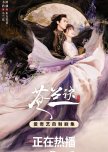









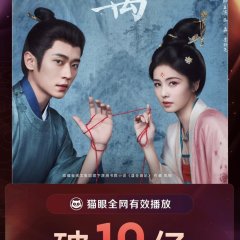
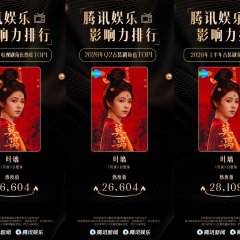
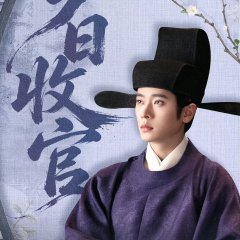
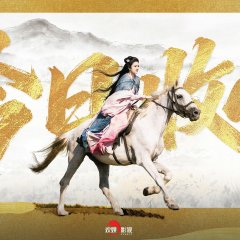
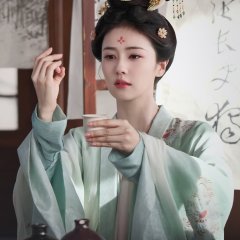



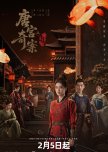


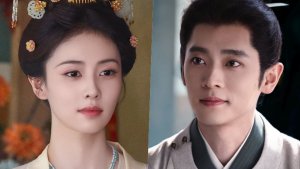
 Bai Lu and Ryan Cheng's Chinese historical drama 'The First Jasmine' announces premiere date
 Lishan, Ye Li cherche secrètement à se venger de ceux qui ont fait du tord à son clan. Suspectée par son mari, Mo Xiu Yao, qui cache lui aussi un plan de vengeance, le couple devient peu à peu allié. Pendant ce temps, le prince Jing Lei complote pour s'emparer du trône. Ye Li et Mo Xiu Yao unissent leurs forces pour vaincre les ennemis et rétablir la paix dans l'empire. (Source : Anglais = DramaWiki || Traduction = kisskh) ~~ Adapté du roman "Sheng Shi Di Fei" (盛世嫡妃) de Feng Qing (凤轻). Modifier la traduction
- Français
- 中文(简体)
- ภาษาไทย
- Русский
- Titre original: 莫离
- Aussi connu sous le nom de: Mo Li , 莫離
- Réalisateur: Lin Yu Fen, Leung Sing Kuen
- Scénariste: Xiao Xiang Dong Er
- Genres: Historique, Romance, Drame
Où regarder Mo Li
Distribution et équipes
-
") Bai LuYe LiRôle principal
Bai LuYe LiRôle principal -
") Cheng LeiMo Xiu Yao / Prince DingRôle principal
Cheng LeiMo Xiu Yao / Prince DingRôle principal -
") Cai Zheng JieMo Jing Li / Prince LiRôle Secondaire
Cai Zheng JieMo Jing Li / Prince LiRôle Secondaire -
") Yang Shu YiYe Ying [Ye Li's half-sister; second branch]Rôle Secondaire
Yang Shu YiYe Ying [Ye Li's half-sister; second branch]Rôle Secondaire -
") Feng Xue YaQing Shuang [Ye Li's maidservant]Rôle Secondaire
Feng Xue YaQing Shuang [Ye Li's maidservant]Rôle Secondaire -
") Lin Mu RanHan Ming XiRôle Secondaire
Lin Mu RanHan Ming XiRôle Secondaire
Critiques

PeachBlossomGoddess
48 personnes ont trouvé cette critique utile
The Heart Will Go On
Ye Li is summoned from the elite Lishan Academy to prepare for her wedding to Mo Xiuyao, a crippled and unfavored prince. Her younger sister Ye Ying is now engaged to her former fiancé, Prince Mo Jingli. Ye Li is unfazed by the groom swap and blithely oblivious to her new husband's frosty glowers and suspicious side-eyes. True to Xiuyao's suspicions, there is more to Ye Li than meets the eye. She has secrets and has returned to the capital with a higher purpose than marriage—one focused on righting injustices against the former Prince Ding and Lishan Academy. As it turns out, both Ye Li and Mo Xiuyao were collateral damage in a power play at the highest level of imperial authority. Their common cause draws them together, but in order to truly work together, they must confront the past and put it behind them.Though set in the fictional dynasty of Dachu, the setting for The First Jasmine is clearly inspired by Wu Zetian's controversial ascent, and the costumes, political dynamics, and social structures are distinctly Tang dynasty. While the political plot is not particularly special, the past intrigue is revealed in a way that draws you in, like pieces of a puzzle gradually falling into place. Everyone is an unreliable narrator, divulging their own role in the multiple betrayals eight years ago from their own point of view. The plot does not bother to fully explain itself, leaving the audience to speculate on and eventually piece together what happened with a growing sense of dread.
The problem is that the drama reaches its emotional peak a little too early, and after that, there is a sense of anticlimax heading into the finale. The final plot arc is rushed and fails to deliver a sense that justice was served or that the country is in better hands.
That said, this is a very solid character-driven story about healing. Both Ye Li and Mo Xiuyao are deeply damaged by past trauma, and the way their relationship evolves makes sense given what they endured. Ye Li is a deeply traumatized and complicated protagonist who appears functional only because of the coping mechanisms she relies upon to get through her difficulties. As a character, perhaps Ye Li is too capable, but she embodies the ethos of the elite Lishan Academy, and through her, the heart will go on. That said, the Lishan backstory unveil took too long and left me emotionally exhausted.
While Bai Lu pulls off a memorable and heartbreaking portrayal of Ye Li's trauma, her final showdown lacked sufficient impact. Her cold, resting-death-face missed the mark, and I felt that Xiuyao—no less a victim—deserved to be in on the final confrontation. I am fine with sidelining the male lead in the finale of female-centric storylines, but the actress has to be able to rise to the moment. That didn't happen here.
There were many interesting character arcs that didn't play out. I expected Han Mingxi to play a more consequential role and saw potential in his hilarious interactions with Ye Ying. But to me, Mo Jingli was the biggest missed opportunity. He is a cunning and layered character who pursued a just cause via questionable means. I did not like how the narrative diminished his cause, his motivations, and his intelligence heading into the finale.
Ultimately, this drama tries to combine too many themes. It is difficult to mix romance into a heavy revenge story, so I didn't mind so much that they didn't really try. Where it falls down most for me is how the main revenge plot failed to deliver closure or transformation. The story introduces so many interesting characters who seem to have agency and free will, only to have them go down the path of tired tropes. Screenwriter Zhao Na strikes again - her dramas always start well on the inspiration from borrowed works but she is really building a track record in not knowing how to end her plot arcs properly.
This starts out as an 8.5-level drama, but with the ending, it only earns an 8.0+. Still, it has enough unique aspects to make it an enjoyable and recommended watch.
Cet avis était-il utile?

Cette critique peut contenir des spoilers
A Story of Mental Survival
At first glance, Mo Li (First Jasmine) feels like a standard revenge drama, giving you that satisfying taste of payback right from the start. But as the story unfolds, it transforms into something deeper and more reflective. This shift in pacing might frustrate those waiting for bigger revenge moments, but it allows the story to deliver justice with more depth and realism. That being said, the last few episodes might feel disappointing to some, but I see them as an important part of the characters’ growth, despite the noticeably slower pace can feel dragging at times.Its most refreshing element is its exploration of mental illness, a theme more commonly associated with modern dramas than historical ones. Both leads suffer in different ways, physically and emotionally, and their relationship is built on mutual healing and understanding. The romance is mature. They heal each other, support each other, and stand by each other. It’s not the kind of romance that makes your heart race, but the kind that makes you feel safe.
On the downside, some of the heavy Tang dynasty-inspired style makeup on side characters felt excessive and distracting, especially compared to the leads. As for the acting, if I’m being honest, while I enjoyed the leads, it didn’t feel particularly remarkable, especially Bailu.
Cet avis était-il utile?