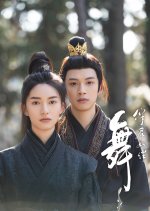
De niños, el príncipe heredero Chu Ying forja una inesperada amistad con el joven eunuco Xiao Man, y ambos crecen siendo inseparables. Cuando el difunto emperador fallece, Chu Ying asciende al trono, mientras que Xiao Man es expulsado del palacio. Diez años después, Xiao Man regresa disfrazado, haciéndose pasar por un hombre. Aunque en apariencia mantienen una relación cercana, ambos permanecen en guardia, probándose mutuamente en silencio. Tras enfrentar juntos las intrigas de la corte, su relación comienza a transformarse, y sentimientos largamente ocultos emergen poco a poco... (Fuente: WeTV) Edit Translation
- Español
- Русский
- English
- Português (Brasil)
Dónde ver Bailar a Su Lado



Reparto y créditos
-
") Wu HaiChu YingPapel principal
Wu HaiChu YingPapel principal -
") Lin LinXiao Man / Xiao Cong RongPapel principal
Lin LinXiao Man / Xiao Cong RongPapel principal -
") Guo Wan DongChu Wu JuPapel secundario
Guo Wan DongChu Wu JuPapel secundario -
") Wang Chen XuSun GongPapel secundario
Wang Chen XuSun GongPapel secundario -
") Ma Li YaYun Shu YanPapel secundario
Ma Li YaYun Shu YanPapel secundario -
") You Yi ZeJia YiPapel secundario
You Yi ZeJia YiPapel secundario







Reseñas

This review may contain spoilers
Better Than It Had Any Right To Be
This one ambushed me. I pressed play with zero expectations and suddenly I’m emotionally invested in palace politics at 2 a.m. Life comes at you fast.From the first minute, I was immersed. The cinematography? Gorgeous. Symbolic. Intentional. The color palette feels curated with surgical precision, the framing is poetic without trying too hard, and the BGM hums beneath everything like it knows secrets we don’t. The director clearly had a vision and delivered it confidently—even within budget limits.
The plot isn’t reinventing the wheel. We’ve got politics, revenge, power struggles—the usual royal buffet. But execution is king. This drama trusts its audience. It doesn’t spoon-feed; it lets visuals speak. It layers meaning instead of announcing it. That alone earns points.
I also need to say: the cross-dressing women and those lowkey GL undertones? Rare territory for cdramas, and I loved that it was handled with subtlety rather than spectacle. There’s something deeply satisfying about women supporting women in a space usually dominated by suspicion and rivalry.
Now, romance. It’s definitely not the central axis of the story, and honestly, that works in its favor. The bond between the leads feels pure—less fiery passion, more kindred spirits stitched together by circumstance and mutual understanding. The ML, our Emperor, deserves his flowers. He’s sincere in a way that feels disarming. He cherishes the FL regardless of gender, openly values their connection, and—thankfully—is not as clueless as the early narrative might suggest. He’s a surprisingly self-aware, almost gentle soul for someone sitting on a throne built on blood and strategy. And the dynamic with the Grand Princess? That twist of energy caught me off guard in the best way.
Let’s address the ML's wig. Both the child and adult versions. In a drama that is otherwise so visually meticulous, the wig blending was… not it. It pulled me out more than once. It’s a small complaint, but when everything else is shot so beautifully, details matter.
The pacing is mostly tight, the dialogue restrained. The random dancing? It took me a minute. Or several. I never fully acclimated, but thematically it tracks, so I made peace with it. The cast delivers—emotionally grounded and convincing across the board.
The second half dips slightly for me—too many flashbacks (sometimes of scenes we just saw), and a stretch of miscommunication that tested my patience. But then the leads actually sit down and communicate openly. No dragged-out angst. Just honesty. I almost applauded. Communication? In this economy?
It’s not flawless. But it’s immersive, intentional, and emotionally sincere.
I’m on episode 19 and hoping it sticks the landing. If it does, this might quietly become one of those dramas that lingers longer than expected.
Also, I’ve seen people compare it to Dominion and Devotion. I haven’t watched that one yet, but now I’m tempted—even knowing the ending might hurt.
✨UPDATE✨
All in all, I genuinely love the themes this drama explores—especially what the dancing represents. It’s not random spectacle; it becomes a language of memory, identity, resistance, refuge. Once that clicked for me, it felt intentional rather than ornamental.
And to be fair, aside from a few mid-series episodes where the leads temporarily forgot how to communicate (a brief relapse into dramaland tradition), the pacing and overall quality remain surprisingly consistent through to the end. That alone is rare across cdramas of any genre.
The brother’s death? As unnecessary as it was predictable. I saw it coming, and it still annoyed me.
One of my favorite dynamics, though, has to be the relationship between the ML and his aunt. There’s warmth, loyalty, and an unspoken understanding there that quietly elevates the emotional core of the story.
This one hit me in the feels more than I expected. Lines like, “Can we let time take care of everything?” lingered.
If you’re looking for sweet romance and skinship, this isn’t that kind of drama. But what it gives instead is something softer and steadier—and yes, we do get a happy, beautiful ending for the leads.
In conclusion: a beautiful cinematic experience I absolutely did not expect from a mini drama of all things. And somehow, it earned it.
¿Te ha parecido útil esta reseña?

This review may contain spoilers
They Danced, They Loved, and I Cried.
Shall We Dance was such a beautiful short drama. It was beautifully shot, well made, and the costumes did not scream low budget. I had never seen any of the four leads before, but they all did a really good job, especially with such an emotional story.This is a tale of vengeance, betrayal, love, friendship, and so much sadness. There is a heaviness that runs through the entire story, but instead of making it difficult to watch, it quietly sucks you in. I became emotionally invested in all of the characters, especially the four leads and their intertwined stories.
I also have to mention the beautiful OST. The music fit the story so well and added another layer of emotion to so many scenes. The main song was especially moving when the ML and FL would escape into their own little world and dance together. Those were the moments when they seemed genuinely free and at their happiest, away from all the sadness surrounding them. Oh Lord, here comes the waterworks again!
And those last two episodes had me in tears. The pain, the betrayals, and everything these characters had endured finally came crashing together. It really was heartbreaking to watch. The FL's brother and the Grand Princess's story in particular will make you cry your eyes out.
I will say this: if short dramas continue to be produced this well, long dramas are going to have some serious competition. Chinese short dramas are really coming into their own in 2026, and Shall We Dance is a perfect example of just how good they can be when the production, acting, and storytelling all come together.
I binge-watched this drama, and it was so worth my time. For such a short series, it managed to tell a compelling and deeply emotional story that stayed with me after it ended. Beautifully filmed, solidly acted, with a beautiful OST that perfectly complemented the story.
Definitely worth watching.
¿Te ha parecido útil esta reseña?