This review may contain spoilers
A karma for dismissing what's not special
"Don't judge a book by its cover." That's exactly what the characters in this story are about. The plot is tightly written, with no unnecessary dragging.I wouldn't call it a masterpiece nor would I say the story is entirely unique. Some of plot twists were predicable and a big plot twist at the end was expected to some extent. However, the ending could be considered the unique essence of the story.
What I loved most is how it portrays the contradictions in a person's character, what one person finds special and what another doesn't. That would apply to the viewers as well, at least for me. That's because the motive behind the final revelation didn't feel all that strong, or should I say, special enough drive the whole thing - for me. But for the person involved, it was deeply painful. I guess that's the point.
Was this review helpful to you?

This review may contain spoilers
everyone needs therapy
Dare I say I don't like Mun Oh at all?I knew Mun-oh was a jackass the moment he scribbled "trash" on someone's writing. That single scene told me almost everything I needed to know about him.
As a teacher, you have no right, neither ethically nor morally, to crush a student's confidence like that. If you want to criticise someone's writing, do it properly. Explain what's wrong, point out what can be improved, and help them grow. There's absolutely no need for crude, dismissive remarks that serve no purpose other than humiliating the person in front of you.
Bad writing is still writing. Every writer starts somewhere, and your role as a teacher is to guide them, not belittle them just because you think you're above them. That scene immediately soured me on Mun oh, and everything that followed only reinforced my first impression.
I didn't like either of these characters from the very beginning, and I'm glad I didn't. Otherwise, I would've been pulling my hair out from all the second-hand embarrassment later on.
Even then, I like Lee Kang way more than him. That's saying something because Lee Kang is also a terrible human being. The bar is already in hell, so he isn't exactly reaching far above the threshold of being decent. He's a creep. Spying, eavesdropping, leeching off people, exploiting them, manipulating them, voyeuristically peeping into their lives, stalking, and constantly invading everyone's privacy. That definitely doesn't help his case.
But Mun oh? Somehow, he's even more unlikable.
He's hypocritical, hot-tempered, emotionally stunted, insecure, manipulative, exploitative, deranged, selfish, dismissive, and constantly imposes himself on others. I'm just sitting here watching one guy who's years away from death act less mature than someone who's barely beginning adulthood.
The acting was great. Nothing extraordinary, but it was consistently convincing, and I was more than satisfied with the performances.
I also couldn't pay much attention to the technical aspects of the show because the plot completely carried my attention. It was intense, immersive, and constantly kept me engaged, which is exactly what I want from a thriller. That alone makes it a great watch.
One thing the show absolutely got right was its length. Six episodes were the perfect choice. Any longer and I think the tension would've started to wear off. The pacing remained consistently strong throughout, and I was impressed that it never felt like it was dragging or rushing.
My biggest issue with the writing is Lee Kang's characterisation. I still don't know what kind of person he is outside of this entire situation.
With Mun Oh, I at least have some idea of who he is as a person, even though his character wasn't explored much beyond the central conflict. Lee Kang, on the other hand, remains a mystery until the very end. I understand that the writers wanted to focus on a single plotline. Still, because so much of the story was built on deception and fabricated narratives, I never got a genuine sense of who Lee Kang actually was.
I know his motives. He's deceptive, resentful, obsessive, manipulative, and eventually deranged. But who is he when those motives are stripped away? What kind of person is he in ordinary life?
The only meaningful interaction we get that isn't directly tied to Mun Oh is his brief conversation with the director. Beyond that, his entire existence revolves around orchestrating Mun Oh's downfall. He remains so mysterious throughout the series that, by the end, I found it more frustrating than intriguing.
Because of that, I also hesitate to label either of them as morally grey. One extraordinary situation isn't enough for me to judge someone's entire character. People are capable of doing incredibly irrational and horrifying things under certain circumstances without necessarily being monsters in every aspect of their lives. Human beings are far more complicated than a single incident can capture, so I don't feel comfortable making a definitive judgment about either of them.
One thing I absolutely loved was Mun Oh's wife. She's soft spoken, elegant, intelligent, and emotionally perceptive. Imagine being trapped in a marriage with someone like Mun Oh. I'd be livid. It helps that she's a therapist and figures things out fairly quickly. I would've hated it if she had remained completely in the dark the entire time.
Which brings me to Mun Oh himself.
Why is this man so unnecessarily aggressive toward his wife? She remains calm, polite, and composed even when she's hurt and furious, yet he's the one throwing tantrums like a toddler. For someone who's supposedly emotionally sensitive, he's incredibly emotionally unavailable.
The woman is literally in pain, and instead of asking what's wrong or suggesting they see a doctor, he wants her to stay home. Why? So he can continue obsessing over someone else's wife? If that isn't emotional cheating, I don't know what is.
The only peeping I support in this show is his wife secretly observing all of his ridiculous shenanigans.
Another thing that drove me insane: how does nobody suspect the random guy who's been sneaking around the house and peeping through every corner for weeks? OH, wait, that was fabricated lol.
And why would you even let a stranger stay in your house like that in the first place? I understand they were close, but treating him like family and letting him practically live there felt incredibly unrealistic.
Why didn’t Mun Oh question even once about these stories when everything seemed so idealistic and cinematic? Why didn't he question that even after Se Hyun’s dad committed some crime, he never sent Lee Kang away, after all the serious crimes he committed? The man had so much to lose and still kept him around. Do I admire the audacity or laugh at the sheer stupidity?
The thing that frustrates me most about Mun Oh is how completely oblivious he is to his own hypocrisy.
He exploits Lee Kang, barely seems to care about him as a person, and only becomes invested when their conversations or his own work are affected. What did I expect from a man who can't even be bothered to care about his own wife's health?
The show clearly wanted him to be morally grey, but he just comes across as deeply unlikeable.
Honestly, I enjoyed watching him get deceived. He deserved it. Watching him make a fool of himself was incredibly satisfying.
And the ending? I loved it.
Lee Kang did the dirty work. He wrote practically everything, while Mun Oh fabricated a few things toward the end and suddenly acted like the novel was his. That's not how authorship works.
Sure, Lee Kang manipulated the story to suit himself and ultimately betrayed Mun Oh. But their relationship never had trust to begin with. They were exploiting each other from the very start.
Even on the forum, Lee Kang wasn't completely lying. He took liberties with the truth, just like Mun Oh had done with Se Hyun’s dad. Karma really is a bitch.
If I had to define hypocrisy using a fictional character, I'd point to Mun Oh.
Lee Kang was the mastermind all along. Both of them used each other. The only difference is that Lee Kang took things far beyond what anyone could justify.
Watching Mun Oh also reminded me that maturity doesn't automatically come with age. How can someone be so revoltingly clueless about their own actions while constantly acting betrayed whenever the consequences catch up to them?
His resentment is so one-sided that it genuinely feels like he believes the entire world wronged him while he's the only victim.
Even though what Lee Kang did in the end was undeniably more deranged, I still couldn't bring myself to feel sorry for Mun-oh at all.
The final episode especially delivered. Everything unravelled in a way that genuinely felt worthy of a finale. The storytelling served what it promised, and I couldn’t have been more satisfied.
In the end, both seemed to enjoy the thrill of it, so it's a "happy ending" ig?
Was this review helpful to you?

Perfect storyline with great actors.
This drama removed the writing block that I was having as a writer myself. I picked a pen during 2nd episode,paused the drama and started writing immediately.In other words, this drama is a masterpiece. I have been waiting for it release and it didn't disappoint.
I am very picky when it comes to feedback,I chose to do it because in my opinion it's a masterpiece.
Perfect storyline with great actors.
I have nothing else to write but since there should 500 words then I am writing whatever coming in my mind
Was this review helpful to you?

This review may contain spoilers
What a ride my lord
Oh my my. I for a second thought in the second episode he was trolling the prof. However soon that feeling faded and I wanted him not to get caught by his friend's parents. The last episode was cherry on the top and the last scene has me wondering if there'd be season two or is the prof still gullible enough to be played again by his student.Was this review helpful to you?

The Manuscript of Faust
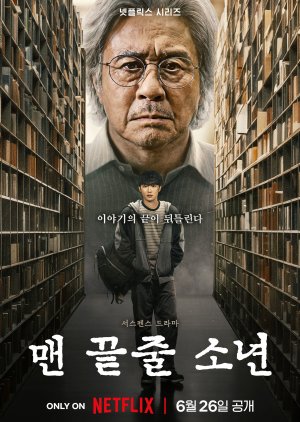
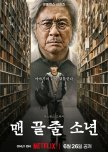
The Boy in the Last Row is a psychological thriller that plunges us into an ambiguous relationship between a teacher and his student. But the real question from the very beginning is not so much who the teacher is, but rather who truly is the teacher, and who is the student. Very quickly, the series goes beyond this initial framework to become a thriller focused not on the events themselves, but on how they are told and interpreted. You are handed an invitation, and it is up to the viewer to determine the share of truth and lies being delivered. Directed by Kim Kyu-Tae, who is far from a novice and offers a strong résumé with dramas such as The Trunk, Our Blues, Live, and Moon Lovers: Scarlet Heart Ryeo, works that have all left their mark, we already know we are in for effective direction and full immersion from the very first minutes. Without spoiling anything, and unless you are completely unfamiliar with the genre, a high-level duel awaits between these two men.Heo Mun-Oh (Choi Min-Sik) is a professor of Korean literature at university. A failed writer (he has only published one novel), over time he has become a very harsh, stubborn, and irritable man with those around him, especially his wife, Jo Hyeon-Suk (Jin Kyung), a talented psychologist/therapist. They look more like roommates than a real couple. In his youth, when he was still a student, his rival was Kim Su-Hun (Heo Jun-Ho), who has since become a wealthy and famous writer. The worst for Mun-Oh is that this man married his crush, Ahn Eun-Joo (Kim Yunjin). During one of his classes, he becomes drawn to an unusual student sitting in the last row, the young Lee Kang (Choi Hyun-Wook). Very quickly, Mun-Oh detects talent in him and pushes him further. His interest in Kang’s essays keeps growing, but when Kang admits that he does not invent anything and simply recounts what he experiences in real life, Mun-Oh’s shock turns into obsessive curiosity as he becomes emotionally involved.
The main interest of the drama does not lie in the multiplication of secondary plotlines, but in the focus on a small number of characters. This choice immediately strengthens immersion and gives the impression of being trapped in a closed system where every interaction matters. This makes sense given the limited number of episodes. Without giving too many specific indications, there is one essential, even crucial element to pay attention to as time goes on. It is not just about spotting false appearances, but above all about paying attention to what is said, and who says it. The thriller is built precisely on this confusion, constantly misleading and sustaining doubt at all times. Its strength lies in the power of its narrative and the way it is delivered. What sets the series apart is its use of storytelling itself as a dramatic tool. The story feels filtered, constructed, sometimes fragmented, creating a constant tension between what is shown and what is understood. The viewer is never certain of having access to an objective truth, only to a possible version of events. Hum...Have I said too much? :)
The plot revolves around the Mun-Oh / Kang duo (duel), which initially appears straightforward. But the relationship between the two men gradually becomes ambiguous, making us doubt everything. Trust turns into dependency and evolves into a form of role confusion. One of them seems to control the narrative, while the other gradually loses critical distance. The series thus explores a dynamic in which obsession with a story can alter the perception of reality itself. The Boy in the Last Row is a cerebral thriller where everything relies on perception and interpretation. Rather than multiplying spectacular twists, the series builds its strength on constantly questioning what we think we understand. Reality, imagination, and illusion constantly overlap, forcing us to reconsider each piece of information as it appears. To put it simply, do not believe everything you see or hear. Confusion becomes the key word of the story, and each new piece of information forces us to reconsider the previous ones, reinforcing the addictive aspect of the whole. We are constantly building theories, to the point where it becomes almost playful. And the fast pacing sometimes prevents us from thinking too clearly.
But the series also relies on a very controlled execution. Indeed, it could not work without its essential core, which rests on the two main protagonists. And here I’ll just say it: bravo, gentlemen! On one hand, there is one of the giants of Korean cinema, not for the quantity of works he has participated in, but for their quality: Choi Min-Sik. This actor does not need to speak; his charisma allows him to fully embody the character like no one else. Opposite him, the rising star of K-dramas, Choi Hyun-Wook, who already has an impressive résumé despite his young age, delivers a convincing and powerful performance. The chemistry between these two generations of actors is sublime and elevates the entire story. To complete the cast, the presence of two other “monuments,” Heo Jun-Ho and Jin Kyung, makes this an exceptional quartet of talent. Kim Kyu-Tae knows how to highlight his actors in a convincing and immersive way through carefully crafted direction. The atmosphere is unsettling, heavy, mysterious, and increasingly suffocating. All of this is enhanced by visuals that serve the drama and emphasize the contrast between reality and perception.
If for me it is almost a flawless narrative, I cannot deny being slightly disappointed by the ending, or at least by certain aspects of it. Not because, like in Very Bad Trip, everything is revealed as the “behind the scenes”, but because of the motive and the triggering element of this masterfully orchestrated trap. Like the spinning top in Inception, the ending does not simply aim to provide answers. It invites the viewer to reinterpret the entire story from a different angle and leaves enough subtle doubt to extend the experience beyond the credits. Yes, many times I found myself wondering whether I had fully understood it, or even whether multiple interpretations were possible during the final sequences. The soundtrack appropriately accompanies all these moments of tension and constant doubt, in a dark tone and perfectly integrated into the narrative. For some, a degree of skepticism may dominate, but the strength of the writing cannot be ignored. Before closing the manuscript, one essential point must be retained: it is the viewer themselves who is invited to write the final chapter and decide who is the winner and who is the loser.
Was this review helpful to you?

Heo Mun O, Just how real do you want your story huh?!?
What a fascinating, well written, well acted show! It is a commentary on the life of authors/writers and how impactful emotions, events and words can be. Whether it be college rivals or a callous adult towards a child. The power of story telling, emotional manipulation and dark desires. If you do not address your issues, don't be surprised when they become weapons in the hands of others.Choi Min Sik as Heo Mun O was spectacular as he spiraled into madness. Choi Hyun Wok as Lee Gang was sly as he wove a web of entrapment through story, basically every single character nailed their parts.
6 episodes was perfect and I liked the teaser of potential future seasons.
Was this review helpful to you?

This review may contain spoilers
Emojis are the way to go with this one
My honest review of this show using emojis:ep1 🤨🤔
ep2 🫢
ep3 🫢😨
ep4 😨😱
ep5 😱😨😵
ep6 😵😨😏
btw Choi Min-sik, you are a LEGEND
Choi Hyun-wook, you deserve an award for this acting!
I was hooked from episode 1, and the ending was SO SATISFYING. Tasted his own medicine, huh? And almost choked on it, lol 😅😅
Was this review helpful to you?

From the Reader’s Point of View
Have you ever started a story without thinking much and suddenly it’s 5 AM, you’re 8 hours deep into the story and cannot stop until you’ve reached the end? That’s what happens to Heo Mun-Oh, only much worse. What started with the simple curiosity of a novel story, turns into a gripping obsession that slowly eats away at his personal life.Heo Mun-Oh is a washed-up author who has settled into a bitter and stagnant life as a university professor, but his monotonous life finds a renewed spark when he comes across Lee Kang, an unpolished gem in the literary world, ready to shine under his mentorship.
Notes from the Last Row establishes Heo Mun-Oh as our narrator and tells the story as he experiences the events through Lee Kang’s words. Through Kang's writing, Mun-Oh experiences the fascination of a young boy as he encounters unfamiliar warmth, his curiosity and intrigue of meeting a seemingly perfect family. But as the plot thickens, cracks appear and secrets unfold - with every new chapter flowing in, Mun-Oh slowly sinks deeper into the quicksand of a compelling story without ever questioning his escalating descent until fiction bleeds into reality and conflates with real events.
The storytelling in this drama is really fascinating; it starts from a narrow point and slowly we can see the perspective change and widen as new information comes in and blur the lines between fiction and reality. The acting is also phenomenal and everyone including the main and supporting cast did a wonderful job portraying their characters which allowed the viewers to fully immerse into the story. The cinematography and music direction used is simple but effective and successfully creates the eerie atmosphere of a psychological thriller that makes you feel that everything can go wrong at any moment and constantly keeps you at the edge of your seat.
All in all, I did enjoy my time watching this drama, even if I’m not entirely sure how I feel about it yet. While I did not go into this with any expectations, it was engaging enough that I was pretty much hooked to my screen at times but there were also times when I felt that I wanted something more.
Overall, Notes from the Last Row is definitely an interesting watch. In its essence, this drama portrays the intimate and powerful relationship between a writer and his reader and the captivating allure of a unique story. It's fairly engaging, entertaining and a little unsettling, and provides a somewhat different perspective to our mystery and psychological thrillers.
Was this review helpful to you?

This review may contain spoilers
Background Motive is the only trash.
A trauma experienced by an 8-year-old child can certainly leave a wound, but it is highly unlikely to turn into deep-seated resentment. In particular, I don't believe that a brief, hours-long encounter leading to dissatisfaction in an 8-year-old would escalate into a deeply rooted trauma. A 13-year-old teenager would be a different story. Based on Child Psychology and Mindset Development, I analyze that it wouldn't naturally escalate to this extent.However, reflecting on my dissatisfaction with Episode 6, the narrative flow itself reveals that the events and the story being told by the boy do not feel like a novel written with a meticulously planned beginning, middle, and end that was later refined. Instead, it feels more like a travelogue or a collection of memo notes, unfolding spontaneously day by day based on whatever happens next. Therefore, given the twists and turns of the plot, I can only conclude that the Professor is just a big fool—blindly believing every single line and fully romanticizing everything created by the storytelling prowess of that boy.
Was this review helpful to you?

This review may contain spoilers
A frustrating finale that completely killed my interest for Season
From the very beginning, I struggled with how derogatory his language was toward his student. that immediately put me off. However, it was the ending that I hated the most.The plot point of his wife sleeping with someone over 30 years younger than her made me incredibly uncomfortable. Even though they are both technically consenting adults, the romantic execution felt entirely wrong. That being said, it doesn't excuse the husband's actions either. He was a terrible partner who remained deeply obsessed with his first love long after marriage, even going as far as to steal competition questions just to fulfill his own selfish wishes. Still, if his wife had truly fallen out of love, she should have left him properly instead of cheating with someone young enough to be her son.
What broke the character dynamics for me completely was the interaction regarding Lee Gang. After everything Lee Gang did to him, I couldn't understand why he was still willing to sit there and listen to another one of his stories; if it were me, I would have punched him and walked away. Furthermore, what he said to his wife about young Lee Gang's story was completely inhumane. Just because a tragic situation isn't entirely "unique" doesn't mean he had any right to dismiss it so callously.
Ultimately, the finale made the entire journey feel meaningless. Instead of building excitement for Season 2, it completely killed any interest I had left..
Was this review helpful to you?

The hate that drives us
Hating someone so much that the idea of their downfall injects life into you. That sums up our main character, played by Choi Min Sik (Oldboy). Playing alongside him is Choi Hyun Wook (D.P. 2), the cunning student who schemes beyond what ordinary minds can fathom........a puppet master, if you will.The acting is nothing short of amazing. Should we have doubted that in the first place, given the actors behind this? It's also great that the script didn't let them down. The dialogue was fun to watch, and the characters feel lived-in and real. These are complicated people. You feel pity for them, but never quite enough to support the actions they take.
The story was solid. Albeit slow, but there was never any filler. So, I recommend this. It's very bingeable.
Was this review helpful to you?

To Be Continued
The plot was so twisted that it literally left my stomach in knots after the finale. I even gagged once I fully pieced everything together. Having watched countless suspense thrillers that I managed to predict few twists halfway through. But the writer still had the upper hand. I didn't truly grasp how deep and layered the story was until the very last episode. The background music was hats off. It blends so perfectly with every scene. This is exactly the kind of drama I love which does not become predictable halfway through. It keeps you hooked from start to finish.Was this review helpful to you?