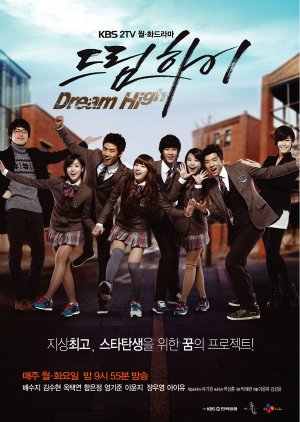
K-Drama


Both dramas have this 'special class'. In Dream High it's a class who's planning to debut someday while in Dragon Zakura it's a class who wants to go to Tokyo University / Toudai.

The same genre just just without music, classmates, friends who are graduating, dreams about future...



Both k-dramas:
-Revolves around music (songs, choreographies, performances).
-Highlights topics of the Kpop industry within young idols.
-Produced by KBS2 TV.
-Acted by popular k-idol actors.
-Love triangle romance.
-------------------------------------
also pls don't copy my words. If you need help with writing just message me :)
-Revolves around music (songs, choreographies, performances).
-Highlights topics of the Kpop industry within young idols.
-Produced by KBS2 TV.
-Acted by popular k-idol actors.
-Love triangle romance.
-------------------------------------
also pls don't copy my words. If you need help with writing just message me :)

"Dream High" and "A-Teen" share several similarities:
1. **High School Setting**: Both dramas are set in a high school environment, focusing on the lives, relationships, and personal growth of students.
2. **Youth and Ambition**: They explore themes of youth and ambition. "Dream High" follows students striving to become successful performers, while "A-Teen" deals with the everyday experiences and dreams of high school students.
3. **Friendship and Romance**: Both series highlight the importance of friendships and romantic relationships. They depict how these connections influence the characters' personal development and high school experiences.
4. **Coming-of-Age**: Each drama features coming-of-age themes, addressing the challenges and milestones of adolescence, including self-discovery, identity, and navigating personal goals.
These similarities make both dramas appealing for viewers interested in stories about teenage life and the pursuit of dreams and relationships during high school years.
1. **High School Setting**: Both dramas are set in a high school environment, focusing on the lives, relationships, and personal growth of students.
2. **Youth and Ambition**: They explore themes of youth and ambition. "Dream High" follows students striving to become successful performers, while "A-Teen" deals with the everyday experiences and dreams of high school students.
3. **Friendship and Romance**: Both series highlight the importance of friendships and romantic relationships. They depict how these connections influence the characters' personal development and high school experiences.
4. **Coming-of-Age**: Each drama features coming-of-age themes, addressing the challenges and milestones of adolescence, including self-discovery, identity, and navigating personal goals.
These similarities make both dramas appealing for viewers interested in stories about teenage life and the pursuit of dreams and relationships during high school years.

in the School 2013 Special they mentioned Dream High since both dramas take place in a school and are about the problems young adults face and how teachers help them. Well and that's also pretty all they have in common as Dream High had romance while School 2013 did not have any romance ( but bromance).

This work is a “misaligned, heart-fluttering romantic comedy” centered on Amami Haru, an eccentric and handsome young man whose only best friend is an AI, and Karashima Naho, a work-driven woman employed at a game company.
One day, Naho bumps into Haru at a park and ends up spilling coffee all over the vintage clothes he is wearing. Unable to afford compensation, Naho agrees to Haru’s proposal to settle the matter with “30 homemade boxed lunches,” and the two enter into a strange contract.
Although Naho is thrown off by Haru’s unpredictable words and behavior, as they begin spending their 50-minute lunch breaks together, the distance between them gradually closes. However, Naho soon discovers Haru’s true identity: he is a game creator attracting attention from around the world. Moreover, the company he belongs to turns out to be a rival of Naho’s own company, forcing their relationship to become a secret that must be kept hidden.
One day, Naho bumps into Haru at a park and ends up spilling coffee all over the vintage clothes he is wearing. Unable to afford compensation, Naho agrees to Haru’s proposal to settle the matter with “30 homemade boxed lunches,” and the two enter into a strange contract.
Although Naho is thrown off by Haru’s unpredictable words and behavior, as they begin spending their 50-minute lunch breaks together, the distance between them gradually closes. However, Naho soon discovers Haru’s true identity: he is a game creator attracting attention from around the world. Moreover, the company he belongs to turns out to be a rival of Naho’s own company, forcing their relationship to become a secret that must be kept hidden.

"Koisuru Caster" is a love comedy set on the news floor that condenses the "conflict," "growth," and "heart-pounding" moments that aren't fully depicted in the main story of Motohashi Yusuke, an assistant director (AD) in his second year in the workforce who aspires to be a reporter but is frustrated because he can't achieve what he wants to do.

"Koisuru Caster" is a love comedy set on the news floor that condenses the "conflict," "growth," and "heart-pounding" moments that aren't fully depicted in the main story of Motohashi Yusuke, an assistant director (AD) in his second year in the workforce who aspires to be a reporter but is frustrated because he can't achieve what he wants to do.