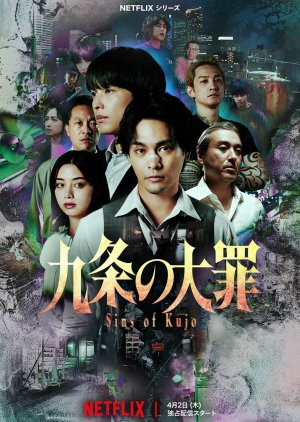
De bandidos a membros da yakuza, Taiza Kujo defende o pior da sociedade. Karasuma, seu colega advogado, questiona sua ética, mas se junta a ele para encarar o abismo. (Fonte: Netflix; editado por Zucch em kisskh) Editar Tradução
- Português (Brasil)
- Arabic
- Українська
- Русский
- Título original: 九条の大罪
- Também conhecido como: Kujo no Taizai , Kujou no Taizai , Kujou's Deadly Sins , くじょうのたいざい
- Diretor: Nobuhiro Doi, Yamamoto Takeyoshi, Adachi Hiroshi
- Roteirista: Nemoto Nonji
- Gêneros: Thriller, Psicológico, Direito, Crime
Onde assistir Os Pecados de Kujo

Subscription (sub)
Elenco e Créditos
-
") Yagira YuuyaKujo TaizaPapel Principal
Yagira YuuyaKujo TaizaPapel Principal -
") Matsumura HokutoKarasuma ShinjiPapel Principal
Matsumura HokutoKarasuma ShinjiPapel Principal -
") Ikeda ElaizaYakushimae HitomiPapel Secundário
Ikeda ElaizaYakushimae HitomiPapel Secundário -
") Machida KeitaMibu KengoPapel Secundário
Machida KeitaMibu KengoPapel Secundário -
") Otoo TakumaArashiyama YoshinobuPapel Secundário
Otoo TakumaArashiyama YoshinobuPapel Secundário -
") Muro TsuyoshiKyogoku KiyoshiPapel Secundário
Muro TsuyoshiKyogoku KiyoshiPapel Secundário









Resenhas

6/10 Show about "a good lawyer but a bad man"
I am a huge fan f K- and J-dramas. I watch much of what Netflix makes available unless they are really silly... OR really violent. I do not deal well with disturbing, gory violence.There has to be a counter-weight to help me from turning it off.
(see bottom of this review for an addendum)
I fear this series is falling into the really violent category.
Don't get me wrong. This series has all the earmarks of being right up my alley. An eccentric (or two?) lead, a good ensemble cast, and it's a legal drama with a moral message.
The two male leads are intriguing and of course attractive.
It is a series about (as he describes himself) "a good lawyer, but a bad man". The character ("Kujo") is played by the impressive Yûya Yagira. I am mindful it has to be challenging taking on a role from Manga and Yûya Yagira does well.
We will see, I'm sure, as the series progresses exactly what this comment he makes about himself means: if he is indeed a bad man and if so if he is redeemable.
So this show is at its heart a character study with a legal framing. Will he transform or just be recontextualized?
There is not a lot of warmth in this show. And the lead character seems to be emotionally distant as well as emotionally complex. He appears to be morally compromised. The character of Kujo is of course intriguing.
His counterpart (played by Hokuto Matsumura) is more straightforward. He is less ambiguous. More morally grounded. He's not a foil so much as a counter-balance to Kujo. I would NOT say this is a buddy show, per se. The two characters rotate around each other like satellites.
I am about half-way through the series and I'm not sure I will finish it. The level of intense violence does not seem to let up and the plots -- the cases -- are depressing. There are incredibly disturbing scenes. I don't see this changing.
I realize this is based on a popular Manga (at least according to the information available). So many in the Japanese audience may be clued in to what they are about to see, but I am in the international audience and was not clued in.
I do want to mention that the production itself is really impressive. From the opening credits on, the camera work and the direction, and the music and editing are very good.
This is a high class production.
I don't know as I write this that I will watch it to the end. I am intrigued by the characters, would like to see further examination of the Kujo character, but I am not comfortable with the cases. If this was a K-drama (like "Pro Bono") I would be confident that there would be healing and redemption at the end. But this is a J-drama and we might expect the answer to "I'm a bad man" to be "So what?".
I'll update this if I come to any further conclusions.
Addendum: I did watch all ten episodes. I won't change my initial rating and my comments still stand. And I won't spoil anything. But the ending (for me) is difficult. I realize some may think how it ends is bold, even realistic, and intellectually satisfying. But for me the show chooses psychological truth over comfort and a "soft landing". Kujo is not redeemed but rather exposed.
If you are into dark, unresolved and ambiguous storytelling, this series may be for you.
Esta resenha foi útil para você?

A Promising Mix of Law and Yakuza — But the Bromance Fell Flat; Stayed for Machida
I’d been looking forward to this series for three very specific reasons. First, Machida Keita — he’s become one of my go-to Japanese actors lately. Even in a supporting role, he tends to steal focus, so my expectations were quietly high. Second, the genre mix: yakuza undercurrents, legal drama, detective work, a bit of action and moral ambiguity. That blend is very much my thing. And third, I was hoping for a solid dose of bromance — ideally a mentor – trainee dynamic with some emotional weight and unspoken loyalty.On the first point, no complaints whatsoever. Machida delivers. His character, Mibu, is calm, restrained, slightly opaque, and written with enough moral ambiguity to keep things interesting. He’s not exactly squeaky-clean, but he’s compelling and, crucially, believable. That kind of stoic presence can easily fall flat, but here it lands.
The plot, though, sits somewhere around a 7/10. It’s watchable, occasionally gripping, but not something that completely pulls you under. One issue is emotional investment: I didn’t really care about the clients or victims in many of the cases. Some of them are morally dubious at best, which makes the whole “defence” angle feel a bit… unearned. You’re watching, you’re following, but you’re not exactly rooting for anyone. Still, it’s entertaining enough to keep going.
What really threw me off, however, is the structure. After ten episodes, the story feels oddly fragmented, almost as if it just… stops mid-thought. It’s unclear whether this is meant to lead into a second season or if something got lost in the editing. Either way, the lack of narrative closure is frustrating.
Now, the bromance — arguably one of the main selling points for me — was a mixed bag, leaning towards disappointment. I actually liked Kujo: composed, purposeful, clearly driven by something beneath the surface. There’s a sense that he’s playing a long game, and that works well.
But the dynamic with Karasuma didn’t click at all. And this is very much a “type issue” for me. I struggle with the trope of the inexperienced junior who immediately starts questioning, lecturing, and emotionally demanding things from a seasoned mentor. Karasuma comes across as whiny, entitled, and oddly confrontational for someone with very little standing. The constant moralising and need for validation just grated on me. Instead of a loyal, perceptive partner trying to understand his superior, we get someone who feels more like a disruption than support.
Ironically, the secondary bromance (with Mibu) had far more potential. There’s a quieter, more understated connection there — shared history, mutual understanding, minimal words. You get the sense that something significant happened between them, something that shaped their relationship. I would have happily watched more of that, but it remains underexplored.
All in all, it’s a solid, fairly engaging watch with a few standout elements — mainly the performances and the genre blend — but also some noticeable shortcomings in character dynamics and narrative payoff. I enjoyed it, even if parts of it didn’t quite land for me. If you’re into legal dramas with a yakuza edge and don’t mind a slightly uneven character setup, it’s definitely worth a try. And if there’s a continuation, I’d be curious to see where it goes — this story feels like it still has something up its sleeve.
Esta resenha foi útil para você?