Editorials

This review may contain spoilers
This was not a groundbreaking series by any means, but it had heart. You just have to get past all the clichés and stereotypes. It’s not easy, because there was a lot of those. There was the usual cancer, amnesia, and blindness clichés. There was your stereotypical CEO male lead who was trying much too hard to look cool. There was your stereotypical crazy stepfamily with an evil plan so dumb yet no one saw through it. Then there was your stereotypical selfless admirer who went above and beyond what’s humanly reasonable to ensure our heroine’s happiness.
What kept this series grounded was our heroine herself. Choi Ji Woo was so natural that it didn’t feel like she was acting at all, like she was just being herself. It made you wonder if she was just as kind and warm in real life. Her innate goodness was actually shown, not preached, to the viewers. It was easy to see why two men were so crazy about her, and it was not because she’s the female lead.
Kwon Sang Woo was incredible in the sad scenes. He was so immersed in his character that you will feel with him and weep along with him. Shin Huyn Yoon was also good in that he made an unbelievably nice Tae Hwa felt like a real person, and not an idealization. Kim Tae Hee was beautiful, but weirdly cartoonish in her portrayal of the wicked Yuri. The kids who played the young Jung Suh and Song Joo were perfectly cast. They matched the mannerism and feel of their older counterparts, so you have that nice continuity and emotional connection from the very start of the story.
The pacing was slow, as was expected of most melodrama. I slogged through it hoping to see a happy ending. That didn’t quite happen, but it was still beautiful and made sense in the overall theme of the story. Many years later it still made me cry.
Was this review helpful to you?

Was this review helpful to you?
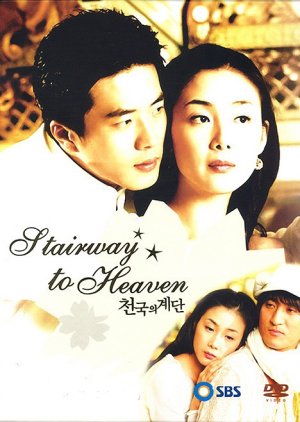
I discovered this drama back when I spent loads of money on boxed Kdrama DVD sets and sometimes the special features included preview episodes of other dramas. I watched the first episode and it was the first time I was straight up bawling during the first episode and I immediately ordered the whole thing. Stairway to Heaven has all the well-known Kdrama tropes: first love, separation, amnesia, jealous second leads and more, all tied up in a pretty package.
Cast:
Back then, it seemed like Choi Ji Woo was in everything and pretty much everything she did back then was golden. Her younger version was played by Park Shin Hye and I really enjoyed watching her and I somehow knew that she would be going places. Kwon Sang Woo was so lovely to look at. It took me a long while to warm up to anything with Kim Tae Hee because of her character's bulging angry eyes in this, but I guess that's what makes for a good villian. Shin Hyun Joon's character was just heartbreaking, and when I see him I always think of Chul-su oppa who would never get the girl although he tried his damndest.
Music:
I love this OST so much. Kim Bum Soo's I Miss You ???? is probably one of my all time favorite songs and whenever I hear the instrumentals, it totally brings me back to the feels.
Rewatch Value: This is definitely one to keep in the reserves in case you want to have a good cry.
Was this review helpful to you?
Legendary!
This was what started it all for me. The first Asian drama I ever watched. Having only watched telenovelas and western series/films, I was not ready for all the tears and anguish I could feel watching a K drama. This opened up a whole new world for me and I will never forget it. Also, one of the best OSTs I've ever heard!Was this review helpful to you?

Jung-suh (played by Choi Ji Wo) is an admirable heroine with her heart on her sleeve.Every man easily could fall in love with her,as her beauty is inside and out.Her strength and bravery and care-free nature is what lures Song-joo into her net,he is her beloved child-hood friend..and her lover and soulmate.Even falling into the clutches of amnesia,her heart still belonged to Song-joo.
"From the moment i saw you,i thought you were Jung-Suh and that thought hasn`t changed at all...I look like a crazy fool,huh?I think i am gonna go crazy,I don`t think i can live anymore!What should i do?What do i have to do?Do something to me!" - Song Joo
Song-joo (played by Kwon Sang Woo) is a hero to die for and i love him so so so much.The actor playing him is so deliciously handsome,and showed the eternal love and longing Song-joo have towards Jung-suh so well that i cried for him.He can`t live without her,and we all root for him to find his beloved Jung-suh again,after she was so cruelly taken away from him.
"I...I`ll wait here.If you still haven`t sorted out your feelings after going in...then when you come out,don`t look at me and just go.If you...If you have some doubts and come back to me...I won`t let you go until i die.Even if you hate me...I still won`t let you go". -Tae Hwa
Tae-hwa (played by Shin Hyun Joon) is the step-brother of Jung-suh and is one of the best supporting characters i have ever stood upon.His soul is so haunted and lonely..and lives and breathes only for Jung-suh.Its so heartbreaking watching a second male lead love the heroine this much...and i kinda hated the pain he went through with his unrequited love for her.I believe that Jung-suh loved Tae-hwa more than she love herself,but not in any romantic way.
The younger actors of that time Park Shin-hye,Baek Sung Hyun and Lee Wan played the younger versions of these characters very well,and i have to say that Shin-hye and Lee Wan indeed has got the better chemistry in their characters,which surprised me.I understood why they got their own drama later on in "Tree of Heaven" two years later with the same director.I also recommend that drama,which is a heart-shattering tale as well.I also have to mention that the OST´s of "Stairway to Heaven" are extremely beautiful and catchy,my favourites are "That`s the only One" and the song about Tae-hwa`s unrequited love for Jung-suh "Heaven`s Memory".
Was this review helpful to you?

This review may contain spoilers
Yes, you were my first love, and first love never, ever dies
Among the many dramas that have left their mark on Korean television, some continue to move viewers with a power that transcends any purely narrative explanation. Not because they defy the conventions of their genre, but because they still touch the heart even when every plot twist is familiar. Stairway to Heaven undoubtedly belongs to this rare category.More than twenty years after its original broadcast, it remains one of Korean television's most iconic melodramas and, arguably, one of its most disarming. Its plot alone contains many elements now dismissed as clichés: an all-consuming love that defies time, a family turned into a place of rivalry and oppression, a shattered identity, a fate that relentlessly thwarts every chance of happiness, and a final sacrifice that carries the melodrama to the edge of legend.
To regard Stairway to Heaven merely as one of the seminal works of the so-called ‘Dramaverse’, however, would be reductive. Rather than inventing a formula, the series belongs to a much older tradition, rooted in the 19th-century novel, the feuilleton, cinematic melodrama and the fairy tale. It moves across these traditions without losing their emotional power.
This continuity is precisely what makes it feel surprisingly modern. What stands out is not the presence of familiar melodramatic devices, but the way they are orchestrated. The accident, amnesia, mistaken identities, lies and twists of fate do more than surprise the viewer: they trigger a chain of consequences that forces every character to confront what they are willing to lose, conceal or sacrifice.
The melodrama thus moves beyond artifice to become a story of responsibility, guilt and the difficult search for a truth that no one can reach without paying the price.
Perhaps this is its greatest achievement: transforming a chain of seemingly improbable events into the only outcome that, once fulfilled, seems inevitable. From a distance, Stairway to Heaven may appear a succession of coincidences, tragedies and twists of fate. Yet the melodrama seeks not statistical plausibility but emotional truth. On screen, those coincidences lose their arbitrariness and acquire the weight of necessity. The improbable becomes inevitable, and it is this inevitability, more than the events themselves, that generates catharsis.
The credibility of Stairway to Heaven lies not in the probability of its events but in the coherence of their consequences. Every choice, even the most impulsive, irrevocably alters the fate of others, setting off a chain of cause and effect that reaches far beyond those who first set it in motion.
Jung-suh’s accident, the amnesia, Tae-hwa’s deception, and the manipulations of Yuri and her stepmother are not merely melodramatic devices but the first links in a moral progression that ultimately involves every protagonist. Each event becomes part of a rigorous causal pattern leading to the only ending we can accept as emotionally and morally necessary.
Great melodrama compels us not because what it depicts is probable, but because, once it begins, no other conclusion seems possible. This is perhaps why Stairway to Heaven continues to resonate across generations: not because it repeats familiar narrative forms, but because it breathes authentic life into them, creating a story where every choice has consequences and every character must ultimately face the moral weight of their actions.
These are narrative forms that have endured across centuries of literature, theatre and cinema, finding here a vitality that never feels merely allusive.
This structure draws much of its strength from the characters. Rather than serving only the plot, they belong to the archetypal world inherited from melodrama, the novel and the fairy tale. Yet they are never static: each must confront the consequences of their choices, turning archetype into genuine human experience.
Jung-suh embodies the classic melodramatic heroine, yet her path gradually moves beyond the comfort of the fairy tale. Deprived of her family, love, memory and even her own name, she struggles to reclaim her identity. Just as she seems to succeed, the story confronts her with an even greater trial: illness.
From that moment, her journey acquires an almost ascetic dimension, where reclaiming her life paradoxically means gradually renouncing it. The melodrama restores everything that had been taken from her, yet denies her the time to live it. This choice—both cruel and consistent—removes Stairway to Heaven from the logic of the consolatory fairy tale, bringing it closer to a tradition in which sacrifice is not a denied reward, but the fulfilment of a human journey.
Jung-suh’s tragedy lies not in losing everything, but in regaining it when she can no longer hold on to it. Hers is not the story of a woman who dies too soon, but of one who completes her journey at the very moment life is taken from her again.
Even more compelling is the relationship between Tae-hwa and Yuri. Raised by the same mother in the same oppressive environment, they initially share the inability to recognise the other as a person. Both seek control over Jung-suh’s life: Yuri through violence and usurpation, Tae-hwa through deception made possible by amnesia. From this common origin, however, their paths begin to diverge.
Tae-hwa’s love for Jung-suh predates the tragedy, making his guilt all the more painful. When the accident erases her past, he chooses not to restore it, turning her amnesia into his only chance to remain by her side. His deception springs not from malice, but from a desperate inability to surrender the only possibility of being loved.
That original guilt makes his journey so tragic. Unlike Yuri, Tae-hwa is forced to confront the consequences of his choices. He comes to realise that love cannot grow from possession, and that no feeling, however sincere, can justify a life built on lies.
His final sacrifice does not erase the past, but becomes his last attempt to restore what he helped take away. By giving Jung-suh the chance to see, he finally accepts that he must disappear from her life.
His redemption lies not in death, but in the renunciation of possession. His tragic greatness stems from the fact that sacrifice does not erase guilt—it reveals it.
While Tae-hwa transforms possession into renunciation, Yuri follows the opposite path. Convinced that happiness can be achieved by appropriating the lives of others, she builds every success on Jung-suh’s loss of love, identity and social standing. Yet each victory leaves her no closer to the fulfilment she seeks.
Her tragedy lies not in being exposed, but in her inability to stop the mechanism she set in motion. Every lie demands another; every act of violence leads to the next. When the truth emerges, Yuri loses not only Song-joo and the privilege she pursued, but also the identity she has constructed. Her story shows that the desire to possess everything ultimately deprives those who yield to it of what truly matters
Of all the characters, Mira embodies the most radical distortion of maternal love. Her actions spring from genuine affection for Yuri—and, conversely, contempt for Tae-hwa—but this love becomes a force capable of justifying any violence. Every lie and every abuse becomes, in her eyes, the price of securing the future she believes Yuri deserves.
That same logic leads to her downfall. In trying to spare her daughter every suffering, Mira leaves her unable to distinguish desire from oppression or happiness from possession. Her tragedy lies in realising too late that evil committed in the name of love remains evil. The madness that ends her journey is not an exemplary punishment, but the outcome of a conscience that, in seeking to control every destiny, destroys what it meant to save.
While Jung-suh represents the reclaiming of identity and Tae-hwa the path to redemption, Song-joo embodies loyalty taken to its ultimate extreme. His journey lies not in finding the woman he loves again, but in refusing to let time, death or lies replace her. While the others learn to adapt to a changed reality, he continues to recognise in Jung-suh a presence no absence can erase.
This is why the grand mural dedicated to her acquires a meaning beyond a romantic gesture. Like any monument raised against oblivion, it bears witness to the desire to make a feeling eternal despite time's relentless trials.
His journey culminates in accepting that love does not necessarily mean possession. The final marriage represents not love's victory, but its fulfilment. When Song-joo stands alone by the sea, he clings not to the memory of lost happiness, but to the truth of a love that death has failed to disprove.
In a genre that often relies on exaggeration to convey emotion, Choi Ji-woo portrays Jung-suh with remarkable dignity. Her pain is never displayed, but gradually internalised. The actress captures the nuances of resignation, resilience and quiet strength, making her character’s tragedy even more devastating. We do not witness the suffering of a victim, but the emergence of a woman who faces her fate with a composure capable of transforming melodrama into genuine tragedy. Queen of (our) tears.
Kwon Sang-woo avoids the stereotype of the flawless heroic protagonist. His Song-joo exists between stubbornness and vulnerability, continuing to believe even when every sign points otherwise. His performance gives credibility to the absolute loyalty that forms the drama’s moral core, naturally tracing the passage from youthful impulse to painful maturity.
Shin Hyun-joon embraces the series’ most delicate role with extraordinary dedication. Through a gaze suspended between desire, remorse and melancholy, he makes Tae-hwa’s slow awakening believable without ever asking the viewer to absolve him. It is precisely this restraint that gives authenticity to his journey of redemption.
Although still at the beginning of her career, Kim Tae-hee ensures that Yuri never becomes a mere antagonist. Her achievement lies in making emptiness desirable. Behind her impeccable elegance and polite smiles, she reveals a constant unease that gives credibility to the character’s gradual deterioration, suggesting that her ambition stems not from strength, but from a fragility that has never healed.
Rather than relying on individual performances, Stairway to Heaven draws its strength from the harmony of the entire cast. Each actor fully understands the nature of their character and avoids self-indulgence, creating a rare balance in which even melodrama’s excesses acquire natural credibility.
Whilst the characters form the heart of the story, it is the imagery that reveals its deepest meaning. Stairway to Heaven belongs to the tradition of melodramas that do not rely solely on dialogue or plot twists, but create a symbolic language destined to outlive the narrative itself. Certain images remain in the viewer’s memory long after the series ends because they do not merely illustrate a scene: they embody its meaning.
One of the most emblematic moments is the sequence marking the transition from young Jung-suh (Park Shin-hye) to her adult self, played by Choi Ji-woo. The director avoids an obvious break: the carousel’s circular motion crosses the frame, briefly concealing the protagonist’s face, and when it appears again, time has already passed. It is an ellipsis of extraordinary elegance, where technique and symbolism perfectly coincide. The merry-go-round continues to turn while the characters’ lives change irreversibly, transforming its movement into a silent metaphor for time that never stops.
Even more striking is the large mural dedicated to Jung-suh. Conceived within the story as a declaration of love, it continues to exist beyond it, transforming a place such as an entertainment complex into a space of memory. This is an exceptionally rare phenomenon: the melodrama does not merely evoke an image, but inscribes it into reality itself. The mural does not simply celebrate a sentiment; it represents an attempt to resist oblivion, giving permanence to what life continues to take away. Art thus becomes the place where memory resists the passage of time.
While the mural represents the desire to preserve the past, Tae-hwa’s final painting looks towards the future. A simple flight of steps fading into light, two barely sketched figures, no realistic references: it is perhaps the most essential image in the entire series and, precisely because of this, the most universal. Tae-hwa does not paint suffering. He does not paint death. He paints a direction. An ascent towards something that no longer belongs solely to the protagonists, but becomes the shared destiny of the entire story. It is not merely a painting. It is melodrama in its purest form.
The carousel, the mural and the painting are not mere symbols scattered throughout the narrative. They are images that continue to live beyond the story, transforming time, memory and love into something visible. Through this ability to condense an entire story into a few visual gestures, Stairway to Heaven transcends the boundaries of television melodrama, approaching that universal imagination in which cinema, painting and literature ultimately speak the same language.
Who knows, perhaps this is the fate of great melodramas: when the story ends, what remains are not only the characters, but the images through which we have learnt to recognise them.
Perhaps because Stairway to Heaven never asks us to believe in its events, but in the feelings that flow through them. Its archetypes belong to melodrama; its images to a tradition spanning literature, cinema and fairy tales. What keeps it alive is the consistency with which each character accepts the weight of their own choices.
That is why, more than twenty years later, that staircase continues to rise.
Not towards a specific place, but towards that part of ourselves which, despite everything, continues to believe that some loves can survive time, memory… and even oblivion.
10/10
Was this review helpful to you?
I did like the plot. The story idea is great for a tv show or a movie, but I didn't like how they used the idea here. Idk, maybe this show was great 15 years ago, but I don't like it as something I would watch today. I watched 9 episodes, but dropped it eventually.
Also, the episodes took too long to finish. They took one hour, but they good easily shorten them into 30 minutes or something. Sometimes the characters were only running, or staring at each other for 5 whole minutes! That's just too long. Or they zoom in at a person, and in the next shot they do exactly the same thing at exactly the same person! They use the same camera movements in a row! As a film-student I can really annoy me because of that.
But anyways, the camera movements weren't the biggest problem. I didn't enjoy watching this show. I might've even finish it if they shorten the episodes (And editted those 5-minute runs, or stares out of it) but I really got bored. This show is really too time consuming as I didn't even like it.
Nice idea for a plot, but not in this show.
Was this review helpful to you?
This review may contain spoilers
Amazing plot
Must say it is an amazing drama. The plot is extremely intriguing, thrilling, and well-made. During the show, audiences experience various feelings - sadness, anger, curiosity, thrill, and romance.There is something that stuck in my head after watching this show - the character Tae-hwa. From the beginning until the end, he doesn't have anything - an awful mother who doesn't love him, a cruel sister, a father who is always in debt, and a struggling financial- work situation. But most importantly, he had a person that he loves more than anything, yet he must hide a huge secret from her. In the end, he gave up everything, and it's literally everything, to make her happy. From this character, we see that love is not about having a fancy wedding or always being happy together, it's about sacrificing anything you can to make the other happy. And indeed, we see Tae-hwa's sacrifices throughout the drama - the moment he gave up his life to live a secret life with her, the moment he sold his painting to have some money to save her, when he gave up his own happiness to get her to be with Song-joo, and the super-duper sad ending.
So yeah, I genuinely feel bad for this character. He basically grows up to be an amazing man from a trauma young kid. And that's all because of his love to Jung-suh. I love how they create this character that involves his mindset and actions throughout the show based on realizing moments that he must be better to make the woman that he loves happy. And most importantly (must say this again), the fact that he was truly happy when seeing Jung-suh with Song-joo, although he loves her so freaking much. The ending was really sad for him, because he didn't have anything much throughout his life. But I truly understand his decision - Jung-suh is the one that helped him see what happiness looks like.
Was this review helpful to you?

This review may contain spoilers
& 15 years later after I first saw this drama & it still remains my favorite K-drama. STH Made me feel so much from happiness, to frustration, to joy to sadness & finally absolute heartbreak. The ending is one of the saddest I've ever witnessed and even though I wish Song-Joo and Jung-Suh would/should have gotten a happy ending after all the pain they went thru, it just wasn't meant to be. He waited 5yrs for her and she lost herself for that many years. Just when they think they can finally be happy together BOOM! tragedy is just around the corner: sigh.
I love star-crossed lovers/best friends who fall in love sl's even if they break my heart and this one is one of the best imo. The cast was perfectly cast here. Years later Cha Song-Joo still remains my favorite of all of Kwon Sang-Woo's roles. He did an excellent job esp since this was his first melodromatic, protagonist role and boy did he pull it off. He stole the show imo. Choi Ji-Woo was also amazing as the tragic and innocent Han Jung-Suh. Yeah she was a damsel but I love the spark and strength she added to her character despite being the typical protagonist.
Not to mention the amazing chemistry between KSW & CJW til this day I don't think they've had better acting partners than each other. I never get tired of watching them together. The kids(teens) who portrayed young Jung-Suh and Song-Joo were excellent too, it was up to them to sell the love story between CSJ & HJS and they did it. Plus it was awesome to see Park Shinye rise to fame after her work on Stairway to Heaven.
No matter how many times I rewatch this drama I never get tired of it and would highly recommend it to anyone who still hasn't seen it.
Oh forgot to mention the OST is a Masterpiece too. Everytime I listen to Bo Go Shipda or Ave Maria I can picture the scenes. 10/10 overall in everything from me.
Was this review helpful to you?

TOTALLY RECOMMENDING THIS!
I rewatched this series too many times and Im crying river everytime. Im actually shocked that the rate were this low because this series really deserved a solid 10/10. If you're reluctant to continue bc of the step sister and the stepmother dont worry there will be a justice in the near end but sadly... The main character... You'll know when you finish it.SPOILER ‼️
Actually you'll have a love and hate relationship with her step brother especially in the part where he did a big sacrifice for her without her knowing.
Was this review helpful to you?

Cliche, Dramatic but Iconic
I started watching this drama from tiktok, loving the old korean cliched aesthetics and I was even looking for a typical romatic drama. And here it is!The first 2 episodes are worth watching, the entire child cast did an awesome job too glue me to the chair, there were many funny cheesy lines and I loved some! It was wierd watching a childhood romance but it was not bad. I'd say it is indeed quite SLOW once the actors age up so you might have to speed it up and skip many dialogues which I had to. Some scenes were very redundant and not one episode went by without the actors crying and bursting. I used to wonder how much tear practice the actors had to take up. The twists this drama brought up made me scream and laugh out of frustration, because everytime one problem another one sprung up quite beautifully. And yes this is the drama where you'd find the fml almost facing every possible trouble in the world and tries to make it more complicated by trying to keep it to herself when she absolutely cannot do anything about it.
One thing that irked me or made me hysterically go crazy was how the fml finds every possible way to traumatize the poor second lead with the lamest excuses, keep him by her straw into emotional blackmail when that guy was possibly trying to move on. Now there are many flaws in the story line, which obviously were there to drag the show but I felt one time watch to this one legend of a drama for that era if you feel like going back to old kdrama eras then this is one of a gold show.
I would suggest at the end to go ahead and watch this series atleast till the time fml gets diagnosed a condition (till 13 ig) because from then on its just too sluggish and overdone. But the first 2 episodes were gripping. So it was fun watching these legendary actors!
Was this review helpful to you?

popped the cherry
If there’s anything bad to say about this series it won’t be on my review. This was my first dorana ever when I was starting college, they were airing it in a local channel and what can I tell you, got hooked. At first… funny because it was almost finish so I went to Youtube to watch it, but then they aired it again so I’ve watched this like 3-4 times 😂 cried everytime but love how the OST helps to catch you.About the characters, they were all good I just hate how mean stepsister and stepmom were to her without sense
Was this review helpful to you?