















 Park Seo Joon and Won Ji An's new JTBC K-drama confirms its official cast
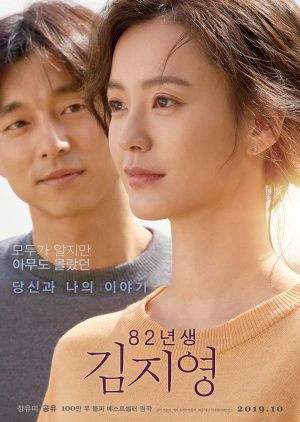
 Kim Ji Young tiene uno de los nombres femeninos más comunes para las personas de su edad. Ella trabaja en una agencia de relaciones públicas. Kim Ji Young se casa y tiene una hija. Para poder criar a su hija, Kim Ji Young deja su trabajo. Lleva una vida ordinaria hasta este punto. De repente, Kim Ji Young comienza a hablar como su madre, su hermana mayor y otras personas. Parece poseída por otras personas. ¿Qué le ocurrió a ella? (Fuente: Asianwiki) Edit Translation
- Español
- 中文(台灣)
- 中文(简体)
- Русский
- Título original: 82년생 김지영
- También conocida como: 82nyeonsaeng Kimjiyoung , 82年生的金智英 , Kim Ji Young, Born in ’82 , Kim Ji Young, Nata Nel 1982 , Kim Ji Young: Nacida en 1982 , Kim Ji Young: Nascida em 1982
- Director: Kim Do Young
- Guionista: Yoo Young Ah
- Géneros: Psicológico, Vida, Drama, Familia
Dónde ver Kim Ji Young: Nacida en 1982

Subscription (sub)

Subscription (sub)

Subscription (sub)

Ppv (sub)

Gratis (sub)

Purchase (sub)

Subscription (sub)
Reparto y créditos
-
") Jung Yoo Mi Papel principal
Jung Yoo Mi Papel principal -
") Gong Yoo Papel principal
Gong Yoo Papel principal -
") Kim Mi KyungMi SukPapel secundario
Kim Mi KyungMi SukPapel secundario -
") Park Sung Yun Papel secundario
Park Sung Yun Papel secundario -
") Lee Bong RyungHye SooPapel secundario
Lee Bong RyungHye SooPapel secundario -
") Kim Sung ChulJi SeokPapel secundario
Kim Sung ChulJi SeokPapel secundario
Reseñas
La historia del libro ayuda a exponer y retratar, a través del personaje Kim Ji Young la sociedad coreana y principalmente la realidad de las mujeres en Corea del Sur. Sin embargo, no siento que esto haya sido algo que se haya respetado en la película. Kim Ji Young en la película ha sido relegada a un segundo plano para dejar espacio y el papel más principal al personaje masculino (me duele decir esto porque está protagonizado por mi marido Gong yoo, pero la verdad es la verdad). Por lo tanto, creo que este es el principal y peor error de la película. La historia intenta exponer la realidad de las mujeres en una sociedad machista y al dar más protagonismo al hombre que a la mujer vuelven a caer en lo mismo, en el machismo que hay en todos los ámbitos. Utilizaron el tirón y la importancia de este libro y la historia que cuenta para realizar una película que la gente quisiera ver sin saber cómo la iban a destrozar. Por lo tanto, ver esta película fue un fracaso total. La puntuación no es tan baja porque a fin de cuentas si siguen la historia del libro pero más desde el punto masculino que desde el femenino, dejando a la mujer muchas veces retratada como una loca (cayendo en otro tópico).
Por lo tanto, no es una película que recomiende al 100%, si quieren saber más sobre esta historia les recomiendo totalmente el libro antes que la película.
¿Te ha parecido útil esta reseña?

unterwegsimkoreanischenD
A 35 usuarios les ha parecido útil esta reseña
This review may contain spoilers
Showing simple normalcy for generations of SK women being gagged&bound by society's endemic sexism
"Kim Ji-young: Born 1982" puts every die-hard Korea fan through their paces: how far does the love for country and culture actually go? The KMovie also does away with any illusion surrounding romanticized and socially idealized yearnings that revolve around the concept of 'in love-engaged-married-happy family'."Kim Ji-young: Born 1982" broke the 2 million mark worldwide as a bestseller (by author Cho Nam-joo). It is also considered the most borrowed book in two consecutive years after publication. The KMovie was also extremely successful. In South Korea, between October 2019 and November 2020 around 3.6 million people went to the movies to watch. In addition, numerous prizes were awarded throughout Asia.
Calmly, unagitatedly and almost objectively distant, the camera focuses on the ordinary life of a typical South Korean woman, wife and mother in her 30s. Actually, she doing quite well. We accompany her in her everyday life between laundry and kindergarten, with her (actually quite attentive, loving) husband, with her in-laws, with her family of origin, with friends, with flashbacks of her childhood and at work, and finally with the therapist. This could all be any live of many a South Korean woman. That's not special at all. It's so cruelly normal that it even hurts. By showing simple normalcy, the story also becomes an outcry for several generations of women gagged and bound by society's endemic sexism.
Gagged and tied up by such a conservative, rigid, discriminatory socialization that is literally burned into flesh, so hardly anybody even considers alternative role models and self-images. There is a lack of role models that give women something like self-love and self-confidence that go beyond identifying with role expectations by family and society. Women somehow grow up as prisoners of those restrictive expectations - in a prison with doors, that technically are not closed, yet in practice barricaded by the mercilessly experienced sexism since early childhood. Accordingly, there is a lack of awareness of human dignity beyond gender roles. For women and men alike. And as we all know, such awareness would be the first path to any change...
In this respect, "Kim Ji-young: Born in 1982" holds up a merciless mirror in a calm, objective and non-judgmental manner, which focuses on the great evil that everyone simply takes for granted. Apparently, around 68 percent of cinemagoers were women. At least, the other 32 percent were men, supposedly.
In one of the last scenes, (which, like all the others in the film, gains its power from the simple, unquestioned und yet unbelievable normality) the underlying emotional muteness is finally allowed to speak up - not loudly and rudely though, but objectively subjectively and, despite all the justified anger, consistently in all modesty calmly, too.
In the face of the spilled coffee, instead of accepting the comments and accusations of her social environment with shame, concern and apologetic words, the FL has her outspoken objections. She eventually stands up for herself... actually, you should think, quite simply, as if it were a matter of course. And yet: downright unheard of. Because: Shameless in the best sense of the word... she no longer lets others shame her for what and who she is. She is slowly but surely developing a somewhat healthy approach to her own self-confidence as a person with self-worth and self-love beyond gender - a person who cannot be reduced by tradition to just a family concerned role concept within a hierarchical society. From this, the FL nurtures a new attitude towards those who traditionally believe they have more value in the social ranking.
Just a comparatively small, handy book; just a two hour movie. The story of Kim Ji-young, born in 1982, has sparked a lot of discussion throughout South Korea. The common, everyday (South Korean) madness shown knows how to touch and quietly infuriate. For me in faraway Germany, too, the KMovie wasn't boring for a minute.
-------------------------------------------------------
--- Outlook ---
'If everyone would act up like that... where would we end up?' - In this sense, the book and the film also led to a horrified outcry within conservative circles in the country. The main actors in the KMovie, for example, had to endure hateful comments for even taking part in it. Just this factual inventory of normal madness of just about every woman in the supposedly modern, innovative South Korea got conservative minds going...
...on the other hand, women affected finally received the balm of cross-class compassion, which for a moment opened up the space for solidary, cross-generational sisterhood. As insignificantly common and simple as Kim Ji-young, born in 1982, may be, the social impact was equally great - the consistently overlooked, completely disregarded reality that has been systematically carried out for countless generations out of principle and tradition, discrimination against (in this specific case) South Korean women.
South Korean society is already shrinking. Earlier than expected. And much faster than expected. No wonder.
Women born in the 1980s by now increasingly began to feel painful about their corsets. A milestone!
Those who were born in the 1990s and 2000s, some among them started to increasingly openly dare to actively shake up the social corset - simply by no longer accepting their 'certain' female role. Another milestone!
However, there is still a long way between shaking up and breaking out or even redefining. Eventually, women can only take this step together with men, who also urgently need to work on their role models, their attitude towards women and a new social self-image. Only then can the shrinking of South Korean society be stopped - a shrinking that, in my eyes, is an expression of a massive imbalance between innovative, turbo-capitalist high-speed in the global fast lane on the one hand, and an ignorant, sexist conservatism on the other, which acts like a lead foot screwed onto the brakes. Nevertheless, growing forces are apparently pushing for an urgently needed, integral, truly progressive transformation of existing values.
¿Te ha parecido útil esta reseña?