
 K-Drama

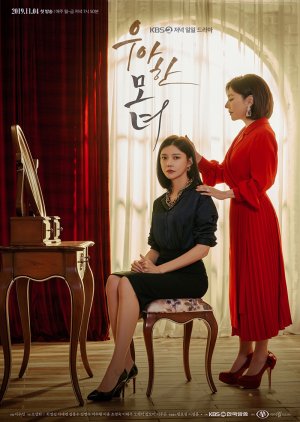
Gracious Revenge
우아한 모녀 ‧ Drama ‧ 2019 - 2020
Many viewers finish Gracious Revenge feeling frustrated and let down by the ending. Carrie endured the worst tragedies imaginable—losing her husband, having her child taken away, and being wrongfully imprisoned. She spent 30 years in hiding, carefully planning her revenge. She even had concrete audio evidence of Jaemin instigating murder, and enough proof to completely ruin Eunha for her medical negligence and baby-switching scandal. Yet in the end, she chose to stop, letting both major villains avoid full legal and social ruin.
Many viewers dismiss this as lazy writing, a weak “satisfying ending,” or even illogical plot forcing a family-friendly conclusion.
But when viewed within the drama’s complex relationships, chaebol background, and ethical dilemmas, Carrie’s choice becomes completely understandable.
I. Let's untangle the 30-year knot of tragedy
Everything began with a tangled web of identities and fates across generations:
- Gu Jaemin started as a low-level employee at J Cosmetics. He married Yunkyung after accepting a strict prenuptial agreement in which he promised not to have his own children, and agreed that the company would be inherited only by Chairman Zhao’s bloodline.
- Yunkyung’s biological son died due to Seo Eunha’s negligence and medical error. Under pressure from her father—the hospital director—Eunha switched the babies, giving Carrie’s newborn son to Yunkyung while falsely declaring Carrie’s child dead.
- Jaemin knew nothing about the switch. Later, he stole the cosmetics patent belonging to Carrie’s husband, Han Myeong-ho. To cover his crime, he hired gang members to stage a car accident and finished Myeong-ho off in the hospital. To silence Carrie, he fabricated evidence to frame her for embezzlement, sending her to prison for two years.
- Then, Carrie faked her own death during a fire, took her dead cellmate’s identity, and fled to Canada. For her revenge, she kidnapped Eunha’s 1-year-old daughter Yura, raised her, and trained her as a tool for vengeance.
- For 30 years, Eunha lived in agony over her missing daughter, searching obsessively and neglecting her second daughter Sera, who grew up twisted and bitter. Carrie suffered between hatred and guilt toward her adopted daughter, haunted by nightmares until her health nearly collapsed.
- Only late in the revenge arc did everyone make the shocking discovery: Gu Haejun, Yunkyung’s son and heir to J Group, was actually Carrie’s real son who had been switched at birth. And Han Yujin was none other than Eunha’s kidnapped eldest daughter.
By then, all grudges had twisted into an ethical knot too explosive to publicly untangle.
II. The first to be destroyed would be her biological son Haejun
Carrie held the recording of Jaemin ordering Han Myeong-ho’s murder and enough evidence to expose Eunha’s medical malpractice and baby switching.
But if she revealed everything, Haejun’s life would shatter instantly:
First, he would be branded the “adopted son of a murderer” and permanently lose his legitimacy at J Group.
The elders supported Haejun only because they believed he was Yunkyung’s biological son and the blood heir of the founding family. Once the truth came out, everyone would know:
He was not Zhao’s blood at all. He was the son of the victim Han Myeong-ho, raised for 30 years by a killer.
In the chaebol world, bloodline and status are everything. Overnight, he would lose all foundation and be pushed out completely.
Second, Haejun would face unbearable public and ethical destruction.
- “The former chairman is a patent-stealing murderer.”
- “Wow… his adoptive father killed his biological father.”
- “His birth mom is a kidnapper who disguised herself as an investor to take revenge.”
- “His wife is the daughter of the woman who switched babies…”
Scandals like this would destroy him socially, making it nearly impossible for him to stay in South Korea with any dignity.
Third, he would be trapped forever in the blood debt of the previous generation.
The man he respected as his father for 30 years was his biological father’s killer. The mother who raised him was a deceived victim. His biological mother was the woman who planned to destroy the entire family.
Going public would nail Haejun to an ethical cross, forcing him to live a lifetime of division and contempt.
Carrie spent 30 years displaced, living under a false identity. The last thing she wanted was for her son to walk the same miserable path.
III. Yujin would also be dragged into an ethical hell
If Carrie fully punished Eunha, Yujin’s true identity could not stay hidden:
- She was a baby kidnapped by her adoptive mother.
- Her adoptive mother raised her to take revenge on her biological parents.
- Her biological mother was responsible for medical negligence and baby-switching, indirectly causing everyone’s suffering.
For Yujin, this would not be justice—it would be total collapse.
She had finally found love with Haejun, built a family, and reconciled with Carrie after the truth. If exposed to the public, she would be labeled “the kidnapper’s adopted daughter” and “the sinner’s daughter,” unable to hold her head up for the rest of her life.
Carrie’s love for Yujin had long outgrown her original revenge plan.
She could hate Eunha, but she could not bear to let the girl she raised for 28 years pay for the sins of the previous generation with her entire life.
IV. Yunkyung’s silence follows the same maternal logic
Yunkyung was the most innocent victim in the entire show:
- Her lover died before their child was born.
- Her biological son died as an infant.
- She was betrayed and manipulated by her most trusted friend for 30 years.
- She unknowingly raised another woman’s child as her own.
She had every right to destroy Eunha. But when Eunha threatened, “If you pursue me, I will reveal Haejun’s real identity,” Yunkyung broke.
Haejun was her only reason to live.
She could endure the loss of her biological son, the humiliation of betrayal—but she could not destroy her child’s life.
And so two mothers, both broken and deeply wronged, made the exact same choice:
Swallow their blood-soaked grudges, and protect their children’s lives.
V. Eunha and Jaemin were not let off easy—their punishments simply took different forms
Many viewers think the villains escaped because they didn’t go to jail or face public ruin. That is not true.
Eunha’s punishment was lifelong suffering. The law never judged her, but fate already destroyed her:
- Her eldest daughter Yura was kidnapped by Carrie at age 1, and she searched obsessively for 28 years.
- Her second daughter Sera grew up bitter and unstable, and her family nearly fell apart.
- Her beloved Yura, emerged as a revenge tool who intended to destroy her life; despite learning the truth, Yura decided to sever ties with her.
- Carrie utterly crushed her hospital, career, and ambition, reducing her from a distinguished hospital director to a frail, immobile old woman.
- After a lifetime of pride and refusal to apologize, she ultimately pretended to suffer from dementia to protect her remaining family, spending her later years in humble atonement.
Jaemin’s punishment was losing everything he ever cared about:
- He lost the J Group, the company he obsessed over his whole life, and was stripped of his chairmanship.
- He was disowned and kicked out, falling from a powerful chaebol to a homeless thief.
- His cherished illegitimate son left him for Dubai.
- The adopted son he always looked down on finally abandoned him and owned the J Group.
- He was sentenced to only six years in prison, which seems light—but for a man who valued pride and power above his own life, complete ruin was already the cruelest fate.
VI. Carrie’s surrender was the end of revenge, and the beginning of motherhood
I’ve often wondered: if Carrie and Yunkyung had chosen to reveal everything, could Haejun, Yujin and Carrie fled abroad and found peace? Maybe returned to Canada to live out their long-held dream of opening a café together?
But the truth is, even if they left South Korea, the weight of the truth and its ethical baggage would have followed them everywhere.
Here’s why:
South Korea’s shame culture has a powerful transnational reach. Korean diaspora communities in Toronto, Vancouver, Los Angeles and beyond are tightly knit. A scandal this explosive—“former J Group chairman is a murderer, his heir is the son of his victim, raised by the man who killed his father”—would spread like wildfire through these networks. For Haejun, trying to build a career in North American business, this identity would be an inescapable shadow hanging over him forever.
Yujin’s fate would be even crueler. Her adoptive mother was a kidnapper, her biological mother a negligent doctor who swapped babies. If the full story of how she was raised as a “revenge tool” came to light, she would be hounded by tabloids and gossip for years. This is not something you can outrun by simply moving to another country.
This is exactly why both mothers made the choice they did. Carrie and Yunkyung understood this reality all too well. They knew how unforgiving Korean society could be, and they knew how fragile their children’s hard-won happiness was. Their silence was not cowardice—it was the only optimal choice they could make, rooted in a clear-eyed understanding of the world.
Carrie could have burned everything down, making her enemies pay in blood (and she absolutely would have, if Haejun were not her son). Yunkyung could have exposed Eunha’s medical crimes and destroyed her completely.
But for the children they loved, they chose the harder, more painful path: let go of perfect justice, swallow their own bitterness, so Haejun and Yujin could live with dignity, peacefully, and happily.
This brings us back to the original question: why does the ending of Gracious Revenge feel so hard to accept?
Because it refuses to give viewers the easy satisfaction of tit-for-tat justice.
We all secretly hope for the fairy tale ending: the good guys get their happy ever after, and every villain gets exactly what they deserve. We wanted Carrie to grow old surrounded by her children and grandchildren. We wanted Jaemin and Eunha to rot in prison for their crimes.
But what the writer gave us instead is something far more honest, and far more tragic:
- Carrie paid the ultimate price for her own sin of kidnapping and manipulating Yujin with her life, yet her quest for revenge was never fully completed.
- Jaemin lives, but he has lost absolutely everything he ever cared about.
- Eunha lives, but she has lost her mind, her career, and the daughter she spent 28 years searching for.
- Both mothers chose to swallow the deepest bitterness for the sake of the next generation.
This ending feels uncomfortable precisely because it is a true tragedy—not the melodramatic “terminal illness/car crash” tragedy of old Korean dramas, but a tragedy in the ancient Greek sense: a story where good people are forced to make impossible choices in a world of moral gray areas.
Aristotle wrote in Poetics that the highest form of tragedy is not when a wicked person suffers, but when a good person, faced with an impossible dilemma, chooses love over justice.
Carrie and Yunkyung are the perfect embodiment of this.
They were not incapable of revenge.
They chose love instead.
edited
Details
- Title: Gracious Revenge
- Type: Drama
- Format: Standard Series
- Country: South Korea
- Episodes: 103
- Aired: Nov 4, 2019 - Mar 27, 2020
- Aired On: Monday, Tuesday, Wednesday, Thursday, Friday
- Original Network: KBS2
- Duration: 33 min.
- Genres: Romance, Drama, Melodrama
- Tags: Revenge, Rich Family, Smart Female Lead, Forbidden Love, Soap Opera, Family Relationship, Multiple Mains, Mother-Daughter Relationship, Multiple Couples
- Content Rating: 15+ - Teens 15 or older
Statistics
- Score: 7.2 (scored by 369 users)
- Ranked: #9818
- Popularity: #9376
- Watchers: 1,375
- Favorites: 0
Top Contributors


Popular Lists
Related lists from users




+90 Episode Drama
139 titles 64 loves





Impostor/Gender Bender/Undercover/Cross-Dressing
443 titles 50 loves 2





Long KDrama
509 titles 74 loves 15
Recently Watched By


