News


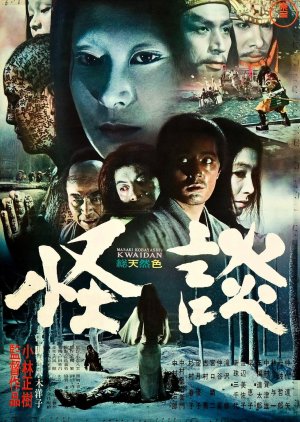
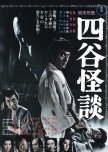
Le film est composé de quatre épisodes : Les Cheveux noirs, La Femme des neiges, Hoïchi sans oreilles et Dans un bol de thé. Chaque épisode raconte une histoire de fantômes, issue du folklore traditionnel japonais et adaptée du recueil qu'en a fait Lafcadio Hearn. Le film jugé trop long pour être exploité en salle fut raccourci, et le deuxième conte (La Femme des neiges) fut supprimé de la version mise en circulation. (Source: Wikipedia) Edit Translation
- Français
- Русский
- English
- magyar / magyar nyelv
- Native Title: 怪談
- Also Known As: Ghost Stories , Kaidan
- Director: Kobayashi Masaki
- Screenwriter: Mizuki Yoko
- Genres: Horror, Drama, Fantasy, Supernatural
Where to Watch Kwaïdan

Subscription (sub)

Ppv (sub)

Subscription (sub)

Subscription

Subscription
Cast & Credits
-
") Nakadai Tatsuya Main Role
-
") Mikuni Rentaro{Kurokami} HusbandMain Role
-
") Kishi Keiko{Yuki-Onna} YukiMain Role
-
") Aratama Michiyo{Kurokami} First wifeMain Role
-
") Nakamura Katsuo{Miminashi Hoichi no Hanashi} HoichiMain Role
-
") Amamoto Hideyo{Chawan no Naka} [Ghost samurai]Support Role





Reviews

"It was no dream"
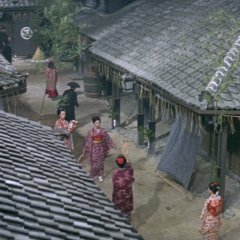
Kwaidan is a 1964 film that contained four unrelated ghost stories. The film drew most of its material from Lafcadio Hearn’s 1904 book called Kwaidan: Stories and Studies of Strange Things. Director Kobayashi Masaki crafted each stylized story much like a painting. The skies were often brightly painted backgrounds with each vignette taking place primarily on a soundstage. These were not terrifying or gory tales, more like eerie, karmic, Twilight Zone episodes.1) The Black Hair/Kurokami (B)
An impoverished ronin discovers what goes around comes around aka payback is a bitch when he leaves his loving wife to marry up and take a new position.
2) The Woman of the Snow/Yuki Onna (B+)
A young woodcutter is spared by a snow witch on the grounds that he never tell anyone he saw her. He learns the lesson to never betray a woman.
3) Hoichi the Earless/Miminashi Hoichi no Hanashi (B)
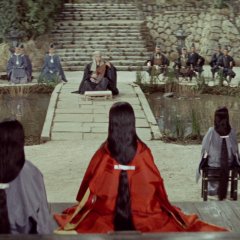
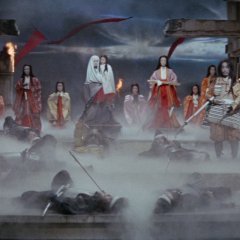
Blind, kind, Hoichi is a young monk at a temple not far from where an epic battle took place 700 years before. The ghostly Heike clan calls upon him to sing the tales of their failed battle night after night. He pays a painful price for his freedom.
4) In a Cup of Tea/Chawan no Naka (B-)
Can you swallow someone’s soul when drinking a cup of tea? A writer receives a proper punishment for writing an open ending to his story.
I enjoyed the stylized view of each of the stories with most having a stage production look and feel. They often appeared surreal, especially Yuki Onna’s swirling eyes in the sky. Each varied in length with Hoichi the Earless being the longest (maybe too long) and In a Cup of Tea being the shortest (maybe not long enough).
The cast for each story was strong. Nakadai Tatsuya played the naïve woodcutter and Kishi Keiko played the complicated Yuki in Yuki Onna. I love his wild eyes though he was the babe in the woods in this segment. Shimura Takashi as a Buddhist priest tried to help the blind Hoichi who was bound to his ghostly visitors each night. Too bad his character didn’t have a strict attention to detail.
Each of the four stories took a different approach to the supernatural though all of the main human characters paid a price for their encounters. Kwaidan had strong performances, taut stories, and a mesmerizing artistic appeal to it. There was an almost poetic rhythm to the moralistic storytelling. While these were technically horror stories, they were the type you could see people telling around a campfire, preferably with any powerful talisman available hanging around their neck.
3 October 2024
Was this review helpful to you?

Subtle Horror
Kwaidan, directed by Masaki Kobayashi and released in 1964 is a gorgeous, stylized, film anthology consisting of four horror stories. It is based on stories from complications of Japanese folk tales by Lafcadio Hearn. The four stories in the film are:1. “The Black Hair,” about a faithless Samurai who receives a kind of eerie retribution,
2. “The Woman of the Snow,” my favorite, about a young laborer and his unusual marriage,
3. “Hoichi the Earless,” about a young blind musician at a Buddhist temple who performs for a group of ghosts, and
4. “In a Cup of Tea,” a story framed very interestingly — there is a story within the story that ends up creeping into reality.
All of the stories successfully convey a gentle, subtle, sense of dread that blooms into horror, though with the exception of the first story, it is subtle.
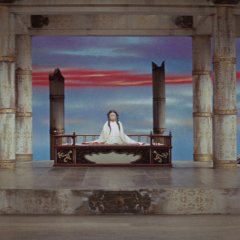
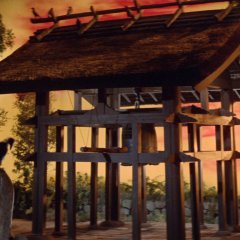
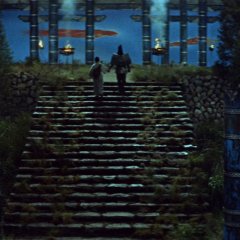
The sets are incredible. For the middle two stories they have almost a surreal quality to them: incredibly vivid colors, unnatural elements to the landscapes, such as a giant eye on the horizon, and a frozen forest. The film sets definitely have a staged appearance which adds to the atmosphere. They were very meticulously designed. They evoke some of the aesthetics of Japanese woodblock prints from the 19th century. This is especially obvious in the 3rd story, when a famous battle is recreated, the battle of Dan-no-ura. The faces of the Samurai warriors vividly recall these prints, with wild hair and exaggerated expressions. The acting is superb as well. I was especially impressed with Tatsuya Nakadai and Keiko Kishi of “The Woman of the Snow.” As the woman in the snow, Keiko Kishi had a smooth, unnatural way of moving across space that enhanced the eeriness of her performance. The film is, of course, a classic, winning the Special Jury Prize at Cannes in 1965.
Was this review helpful to you?