- Português (Portugal)
- magyar / magyar nyelv
- dansk
- Norsk
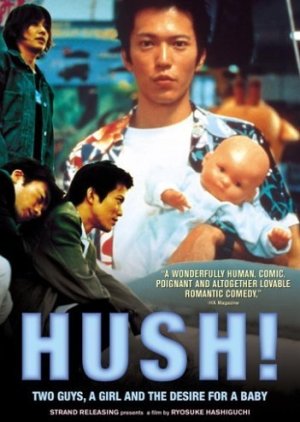
- Título original: ハッシュ!
- Também conhecido como: ハッシュ!
- Roteirista e Diretor: Hashiguchi Ryosuke
- Gêneros: Vida, Drama
Elenco e Créditos
-
") Tanabe Seiichi Papel Principal
Tanabe Seiichi Papel Principal -
") Takahashi Kazuya Papel Principal
Takahashi Kazuya Papel Principal -
") Kataoka ReikoFujikura AsakoPapel Principal
Kataoka ReikoFujikura AsakoPapel Principal -
") Mitsuishi KenKurita Katsuji [Katsuhiro's brother]Papel Secundário
Mitsuishi KenKurita Katsuji [Katsuhiro's brother]Papel Secundário -
") Akino YokoKurita YokoPapel Secundário
Akino YokoKurita YokoPapel Secundário -
") Matsunaga Daishi[Hiro's boyfriend]Papel Secundário
Matsunaga Daishi[Hiro's boyfriend]Papel Secundário









Resenhas

I am not quite sure what the film is about. Is it about gay life in the year 2000, with all that it entails? Is it about heteronormativity, and its consequences for women and queer people alike? Is it about lonely people who try to find comfort in a harsh and hectic society?
Is it about he question what a *family* is?
And I'm not sure if they put too much into the script (there are several scenes and side stories that don't advance the main plot at all, the scene where they try to mate two dogs in front of a kid is still burnt into my brain), so it's core theme isn't clear -- or if it's done intentionally, because, well, life is messy and everything is intertwined. I tend towars the latter reading, especially with the more than hectic beginning and the parallel telling of the story lines of the three main characters.
Whichever it is, for me, the most intriguing thing was not the gay couple -- their story is interesting as well -- but the three women who encounter the restriction of society's expectations in their own way.
There's, of course, the film's main character: Asako. Who has had different sexual partners in her life (not always by choice, as the film makes very clear; cw for an on-screen non-con sex scene), and is shamed by medical professionals for it. Confronted with the possibility of infertility, she tries to take desperate measures to become a mother -- outside of society's norm of marriage.
By contrast, we meet Katsuhiro's sister-on-law Yoko, who tells us that her marriage was arranged and she didn't have a choice in it. That her mother-in-law expected a grandson. Yoko has resigned herself with this kind of life, and has started to identify with it. She, like her mother-in-law, perpetuates the toxic ideas of a "good woman" and of "family". Because if she didn't, her whole life would be meaningless.
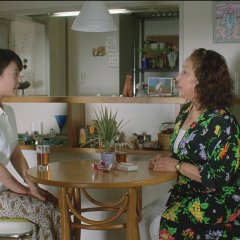
And this comes to head in a climactic scene, where both women meet and their views clash. One of the exchanges stayed with me:
Asako says: I wanted to choose a family the way you choose lovers and friends!
And Yoko replies: You don't choose your family, they are just there.
And in addition to their contrasting worlds, there's a third woman, a co-worker of Katsuhiro's, whose attempts at pursuing him become more desperate over time. She suffers not only from the expectation to marry and start a family -- her disability also makes it much harder to find a partner at all, so she latches on to the only man who treats her kindly.
Core themes aside, the film is gloriously messy. No single character is perfect here, no motivation is "green" -- even Naoya, who is a sweet man, chooses his partner not because he is in love with him, but because Katsuhiro is the one who stayed. There are many things that stay unsaid or unresolved, some character arcs never get what I would call a stopping point.
The cinematography and the side stories give the film a hectic and disrupted feeling -- and occasionally this will be contrasted with slower scenes.
While there are light-hearted scenes, which are occasionally very funny, and while the film gives us an overall optimistic outlook about three people who carve out their own space in this world, this doesn't make the film gentle or light -- it's more that we find laughter and happiness *in spite of* reality, not because of it.
I'm not sure if I *liked* the film, but it certainly stayed with me for weeks now, and that is always a good thing. If I ever have another chance to watch this again, I will definitely do so.
Esta resenha foi útil para você?

The story is basically about the social structure of Japan, about three people seeking warmth in that society and about intimacy. While it is a serious theme, there are many comedic elements in it. Not in the usual Japanese comedy style, but just situations that turn out funny or strange and that will make you laugh because it's genuinely funny, not because it's overacted or crazy. The whole story idea is actually cute, only the ending a bit too serious for the rest of the movie.
The characters are lovable and I really like how they portrayed the relationship to the family members or how the relationship between the gay couple and Asako develops. It was all nicely paced and I enjoyed watching the movie. They have some bed scenes in it, so the movie is not for the younger audience, but it's discretely done, so it should be fine to watch it, if you know that they are in there somewhere.
I gave this movie 4* because I wasn't too fond of the ending. But if you want to see a serious film, like gays and want to learn about Japanese society, this will be your movie!
Esta resenha foi útil para você?