











 Drama & Film Winners Of The 61st Baeksang Arts Awards
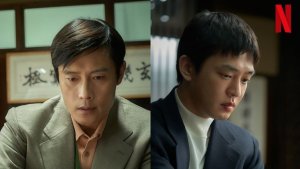
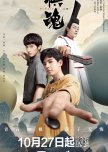
 Dois lendários jogadores de Go vão de professor e aluno a rivais ao se enfrentarem em um duro, mas inevitável duelo. (Fonte: Netflix) Editar Tradução
- Português (Brasil)
- Українська
- Русский
- Română
- Título original: 승부
- Também conhecido como: À Altura , A Partida , L'Ultima Partita di Go , Seungbu , Showdown , Матч
- Roteirista: Yoon Jong Bin
- Roteirista e Diretor: Kim Hyung Joo
- Gêneros: Drama, Esportes
Onde assistir À Altura

Subscription
Elenco e Créditos
-
") Lee Byung HunCho Hun HyeonPapel Principal
Lee Byung HunCho Hun HyeonPapel Principal -
") Yoo Ah InLee Chang HoPapel Principal
Yoo Ah InLee Chang HoPapel Principal -
") Go Chang SeokCheon Seung Pil [Go reporter]Papel Secundário
Go Chang SeokCheon Seung Pil [Go reporter]Papel Secundário -
") Hyun Bong ShikLee Yong Gak [Chang Ho's relative]Papel Secundário
Hyun Bong ShikLee Yong Gak [Chang Ho's relative]Papel Secundário -
") Moon Jung HeeJung Mi Hwa [Hun Hyeon's wife]Papel Secundário
Moon Jung HeeJung Mi Hwa [Hun Hyeon's wife]Papel Secundário -
") Kim Kang HoonLee Chang Ho [Young]Papel Secundário
Kim Kang HoonLee Chang Ho [Young]Papel Secundário
Resenhas

Não é só sobre vencer, é sobre provar que você sempre esteve à altura
Assisti À Altura esperando um filme esportivo… e recebi um tratado sobre superação, orgulho ferido e o peso de carregar um país nas costas. Aqui não tem herói perfeito, não tem jornada bonitinha. O que tem é suor, conflito interno e um duelo pessoal entre o que somos… e o que o mundo espera da gente.O filme acompanha a rivalidade (e admiração escondida) entre dois atletas da elite do salto com vara e, sim, o esporte é só o pano de fundo. O que brilha mesmo é a intensidade emocional desses personagens, que lutam contra a gravidade e contra suas próprias inseguranças.
Os treinos, as disputas, o silêncio antes do salto, tudo é filmado com uma tensão quase poética.
Mas o melhor é o que acontece fora da pista: a pressão da mídia, os dilemas familiares, o medo de falhar. E ali, naquele ar rarefeito entre o chão e o céu, a gente vê o quanto chegar ao topo pode ser solitário… e o quanto cair às vezes é necessário pra se reerguer.
🎽 “Nem todo salto é pra ultrapassar o sarrafo.
Alguns são pra sair da sombra de si mesmo.”
À Altura me fez pensar sobre quantas vezes eu deixei de tentar por medo de não alcançar.
E como, às vezes, tudo o que a gente precisa… é correr, cravar firme e voar, mesmo que por apenas um segundo.
Esta resenha foi útil para você?

Esta resenha pode conter spoilers
Because sometimes the quietest films leave the deepest marks — through glances, silence, and soul
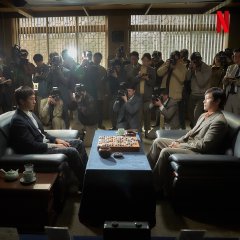
The Match – A Silent Duel and the Echo of a GameA board, 361 intersections, two players — and between them, an entire life: The Match is many things at once. A biographical drama about two icons of South Korean Go. A quiet tragedy about pride and letting go. And not least, a poetic exploration of a game that, in Korea, means far more than victory or defeat.
What captivates critics and fans alike is the film’s restraint. No dramatic bombast, no artificially inflated tension. Glances speak, cuts breathe, and silence lingers. Experts praised the precision: how actually real matches were re-enacted with exacting detail, and how the psychological depth of competition was rendered authentically. It is a film that resonates long after the credits roll because it speaks in subtleties: of ambition, betrayal, affection, and quiet determination.
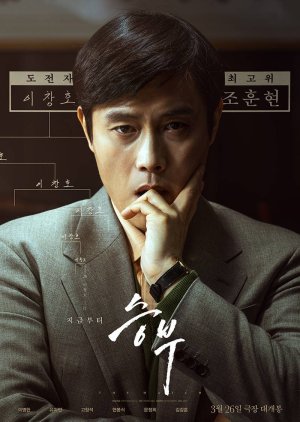
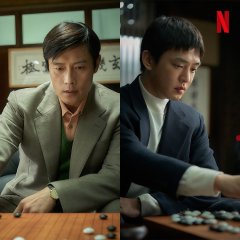
At its heart: Lee Byung-hun as the driven veteran Cho Hun-hyun, defending his throne from his own protégé — and Yoo Ah-in as the gentle, reserved Lee Chang-ho, who speaks only through the board. Both deliver brilliant performances without pathos. Their glances are statements. Their hands speak louder than words. Especially striking: a scene where Cho sits alone in the dojang, sensing his student’s shadow — in silence. Yet thus he reveals everything. Supporting actors like Kim Kang-hoon (as young Lee) or Heo Sung-tae blend seamlessly into this atmosphere of quiet intensity.
So what is The Match really about? Not just Go. It’s about the fragile bond between mentor and student. About the question: when does leadership become control? When does gratitude become a shackle? And perhaps: how do you respond when your own “clone” becomes better — and turns your strategies into revolution?
Only against this backdrop does Baduk in The Match reveal its true meaning. It’s no coincidence that Korea's national heroes are born not on soccer fields, but at the Go board. Because here, the game is not mere competition, but a quiet cultural treasure — a space where personality reveals itself, even when lips stay silent. The Match is not just a story of two players — it’s an explanation of why that story matters.
------------------------------------- side note on baduk ---------------------------------------------------
MORE THAN A GAME: BADUK IN KOREA
It’s fascinating how such a quiet sport can shape the thinking of a society. To outsiders, it might look like a dry ritual: two players leaning silently over a wooden board, fingers poised over black or white stones, a soft click on lacquered wood — and seemingly not much happening. But in Korea, Baduk is far more than a game. It’s a mindset. A way of life. A mirror of character. And for some, a destiny.
Its roots reach back to the 1st century BCE, yet it’s more alive than ever — on TV screens, in schools, street cafés, and quiet dojangs. Millions watch live tournaments on television, narrated by experts who analyze every stone like a line of poetry. Children attend Baduk academies while their peers elsewhere take to soccer fields. Because here, it’s not about goals — it’s about thinking in long arcs.
What makes Baduk in Korea so unique is its philosophical depth. It shows how character takes shape: Who takes risks? Who builds with foresight? Who sacrifices wisely? It rewards patience and long-term strategy — often across dozens of moves. Koreans don’t call it “waiting,” but ´insight´.
The rules are simple — capture by encirclement, passing, the K.O. rule — and yet it unfolds into a universe with more possible games than atoms in the cosmos. No match is the same. And when two evenly matched players meet, something poetic happens: a poem in black and white.
In a country marked by speed, change, and technology, Baduk feels almost anachronistic. And yet that’s where its power lies. It represents the contemplative, disciplined, and introspective Korea. It teaches us to leave space — and still be present. To anticipate setbacks — and turn shadows into strength. To play Baduk is to learn more than rules: it’s to learn posture.
Lee Chang-ho, around whom The Match revolves, was known as the master of silence. He didn’t win through aggression — but by avoiding mistakes. His style was almost invisible, yet unstoppable — like water. It’s no wonder he became a hero. And the film, a mirror of that quiet greatness.
Esta resenha foi útil para você?