


To give credit where due, this the analysis of a very knowledgeable XHS blogger. I am too lazy to accurately translate their post it but am summarizing and modifying and/or adding my own observations. Here is the original post in case anyone wants to read/google translate it.
Background/Context
Reform of the historical Kaizhongfa (grain-for-salt) to the Zhesefa (silver-for-salt) systems.
The "Yan merchants" (雁商) and "An merchants" (安商) correspond historically to the Western merchants (西商, from Shaanxi/Shanxi) and Huizhou merchants (徽商, from Anhui).
Under the old grain-for-salt system, Western merchants had a geographical advantage because they were close to the northern borders, so they dominated the market in the early-to-mid Ming. Huizhou merchants were far from the frontier, but the silver-for-salt reform eliminated their geographical disadvantage.
This background explains how much pressure Zhao Ling (赵凌) is under.
Point 1: Does the emperor really favor Zhao Ling?
The blogger argues no — the Emperor's attitude is: "Trusts him but does not protect him; uses him but does not support him."
In Episode 19, the Emperor publicly brings up Zhao Ling's marriage, which seems like a favor but actually violates Zhao's wish to shield FTY from the political spotlight. This pulls FTY into the game, forcing Zhao Ling to rely completely on the Emperor to protect his family — making him more obedient.
When Grand Secretary Yu proposes the salt reform, the Emperor knows "everyone in the room has their own agenda." Instead of deciding himself, he throws the question to Zhao Ling, forcing him to take a public stance.
Once Zhao Ling takes the stance, the Emperor immediately gives him powers: audit accounts, arrest people, execute first and report later — but the blogger interprets this as:
Giving him the power to arrest makes him the one who offends everyone.
Demanding results without caring about the process means Zhao Ling has to bear all the resistance, backlash, slander, and danger alone.
Most importantly: "The nine-border grain depots must be full" is a practically impossible order that conflicts with the silver-for-salt system itself — because if merchants no longer transport grain to the borders and just pay silver to the salt offices, the treasury fills up but the frontier granaries empty out. The Emperor wants both, which is a structural contradiction.
The blogger concludes that the Emperor's attitude is "appreciation and trust, but also use and check-and-balance." In front of imperial power, personal loyalty is unreliable. If Zhao succeeds, the Emperor gets credit for wise appointment; if Zhao fails, he becomes a scapegoat. Zhao Ling has no deep-rooted faction in court and must rely entirely on the Emperor — using him to challenge the entrenched literati-official families is classic "imperial art" (帝王术).
Point 2: How does Grand Secretary Yu deal with Zhao Ling?
Grand Secretary Yu's assessment of Zhao Ling is very precise: "If you suppress a wildfire, it's just sparks; if you indulge it a little, it will burn the sky."
Yu knows Zhao Ling is in a desperate position with no way back, hungry for power, and forced to take risky paths. So Yu's strategy is: "praise-kill" (捧杀), indulgence, and setting up a stage.
Yu proposes changing the salt law from Kaizhong to Zhese on the surface for legitimate reasons (empty treasury, salt corruption).
But in reality, the reform harms the border merchants, especially the Northwestern salt merchants — and the Northwest is exactly where Zhao Ling built his power base. Yu knows the Emperor will 90% assign this task to Zhao Ling, which means Zhao will have to cut off his own arms and turn against the Northwest.
Also, the salt reform touches a vast corrupt network, making Zhao Ling a target for everyone. Yu doesn't even need to act against him directly.
The blogger notes that historically, after the reform, border merchants declined, while inner merchants (like Huizhou merchants) rose, and border grain supplies suffered. The reform itself had real flaws. Yu likely proposed it not to actually solve the problem, but to push Zhao Ling into a quagmire where he makes enemies everywhere — and possibly fails. I have the impression in pushing this reform, Yu also hurts his own interests in the salt monopoly but its not clear to me how badly yet.
Point 3: The Archery Gathering - intimidation and countermeasures.
The archery gathering (射柳会) is described as a carefully planned "Hongmen Banquet" (a trap). Various factions show their hands:
Yan merchants first threaten a market shutdown, then flatter Jin Yuanbao's vanity to make him help setthe stage for a "live pigeon and gourd" target — originally meaning "blessings and rising to greatness" — but the pigeon they shoot down is dead. This is a hidden warning: if the first cut of the salt reform doesn't favor the salt merchants, things won't proceed, and Zhao Ling won't have a smooth ride.
Jin Yuanbao owes his life to Zhao Ling and is usually radical and loyal. But the fact that he organized this gathering and it became a platform for merchants to pressure Zhao Ling shows either (a) he was co-opted by merchant interests, or (b) he has no real authority. Either way, he can no longer be fully trusted.
Zhao Ling's countermeasures:
He kicks Jin Yuanbao down to "kill the chicken to warn the monkey" — establishing authority and showing he won't spare old ties.
He invokes the Ministry of Justice to warn the Yan merchants that the could intervene violently.
He pressures Grand Secretary Tian to take his side; when that fails, he threatens Lady Wei, pointing at a sparrow and calling it a pigeon — using the Grand Secretary's name to force alignment.
He gives the Yan merchants a 30% concession — enough to avoid a market shutdown but also prevent the An merchants from pushing back too hard.
The blogger claims Zhao Ling barely won this round, but it was through power tactics, leverage, and interest exchanges — not an institutional victory.
Point 4: Zhao Ling's overall pressure
Imperial pressure: The Emperor gives him only one year.
Structural trap: If he protects the border merchants, the An merchants and Ministry of Revenue are unhappy; if he cracks down on corrupt officials too hard, he makes enemies everywhere; if he doesn't crack down hard enough, the Emperor deems him useless.
The final verdict: Zhao Ling looks like he's rising, but he's actually "roasted on fire." His troubles are just beginning. At the end of Episode 20, An merchants (likely represented by "Mother Wu") come to see him — probably using seduction as a tactic to get benefits for the An merchants — and his family is about to face a crisis. The blogger looks forward to seeing how Zhao Ling navigates this.
My own thoughts - does this make sense?
Yes, it makes a great deal of sense — historically, logically, and dramatically.
Historical accuracy:
The Hongzhi salt reform (1492) and the shift from Kaizhongfa to Zhesefa are real historical events.
The decline of Western (Shaanxi/Shanxi) merchants and the rise of Huizhou merchants after the reform is a well-documented phenomenon in Chinese economic history.
The structural contradiction between filling the treasury with silver and keeping frontier granaries full was indeed a real problem that plagued the Ming after the reform.
Political logic:
The Emperor's behavior — using a "trusted" minister as a tool, granting power but not protection, making him the point of attack — is classic autocratic governance. It's consistent with how Ming emperors often operated.
Grand Secretary Yu's strategy of "proposing a reform that sounds good but is actually a trap for his enemy" is also a highly plausible tactic in court politics.
Where I slightly don't agree with the blogger is their comment that the Emperor's demand for "full granaries" is a "structural contradiction" with the silver-for-salt system. This is mostly correct, but historically, the government did try to use the silver collected to purchase grain locally near the borders — so it wasn't impossible in theory, but in practice, it often failed due to corruption, transport costs, and market manipulation. So it is true that it was an extremely difficult but not a sure lose situation for Zhao Ling.
I think Zhao Ling's arc is getting better but I haven't really like FTY's arcs lately - I feel they were written by a different writer and focuses on small things. What I like least is she set Zhao Ling on this path and to be honest, saying no the emperor is not an option. So idk why this supposedly political savvy noblewoman is making so much drama about it and acting as if Zhao Ling had a real choice. But in any case, in Ming dynasty's suffocating feudalism its hard to write outstanding roles for female characters that are not built around what are ultimately petty women's issues and cat fights.
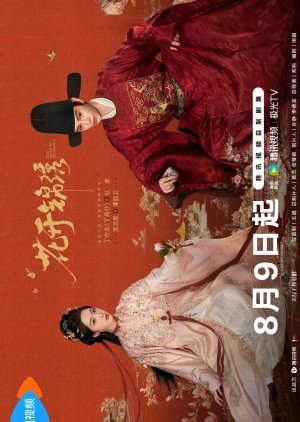
Details
- Title: The Road to Splendor
- Type: Drama
- Format: Standard Series
- Country: China
- Episodes: 36
- Aired: Aug 9, 2026 - ?
- Aired On: Monday, Tuesday, Wednesday, Thursday, Friday, Saturday, Sunday
- Original Network: Tencent Video
- Duration: 45 min.
- Genres: Historical, Romance, Drama
- Tags: Emotionally Strong Male Lead, Fugitive Male Lead, Age Gap [Real Life], Determined Female Lead, Hardworking Male Lead, Difficult Adulthood, Noble Woman/Common Man, Nice Male Lead, Skilled Fighter Male Lead, Physically Strong Male Lead
- Content Rating: Not Yet Rated
Statistics
- Score: 8.5 (scored by 1,115 users)
- Ranked: #574
- Popularity: #2411
- Watchers: 10,457
- Favorites: 0


Popular Lists
Related lists from users












Recently Watched By


