










 2
2







 A New Wave of Talent: Discovering the Rising Stars of South Korea
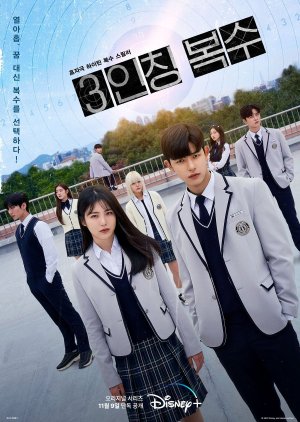
 Ok Chan Mi é uma estudante do ensino médio de 19 anos. Ela costumava ser uma atiradora de um time do ensino médio. Um dia, o irmão gêmeo de Ok Chan Mi morre. Ela persegue a verdade relacionada a sua morte. Ela se envolve com Ji Soo Heon. Em nome dos alunos intimidados, Ji Soo Heon se vinga de seus algozes. (Fonte: Inglês = AsianWiki || Tradução = ChrisRegina em kisskh) Editar Tradução
- Português (Portugal)
- ภาษาไทย
- Русский
- Українська
- Título original: 3인칭 복수
- Também conhecido como: 3inching Bogsu , Third Person Revenge
- Roteirista: Lee Hee Myung
- Diretor: Kim Yoo Jin
- Gêneros: Ação, Thriller, Mistério, Drama
Onde assistir Vinganca em Terceira Pessoa

Subscription

Subscription (sub)

Subscription (sub)

Subscription
Elenco e Créditos
-
") Shin Ye EunOk Chan MiPapel Principal
Shin Ye EunOk Chan MiPapel Principal -
") LomonJi Soo HeonPapel Principal
LomonJi Soo HeonPapel Principal -
") Seo Ji HoonSeok Jae BeomPapel Principal
Seo Ji HoonSeok Jae BeomPapel Principal -
") Chae Sang WooKi O SeongPapel Principal
Chae Sang WooKi O SeongPapel Principal -
") Lee Soo MinKook Ji HyunPapel Principal
Lee Soo MinKook Ji HyunPapel Principal -
") Jung Soo BinTae So YeonPapel Principal
Jung Soo BinTae So YeonPapel Principal
Resenhas

Favoritado
Vou dizer com tranquilidade que esse é o meu drama favorito no quesito de retratar bullying. Outros que assisti sempre me incomodavam com a fantasia exagerada, com lutas e personagens psicopatas, mas Revenge of Others me ganhou DEMAIS. Acho que ele consegue balancear muito bem o núcleo de bullying e o mistério, e até o penúltimo episódio conseguiram segurar um plot twist muito bom. Vi alguns comentários dizendo que já imaginavam, mas me enganaram direitinho. Não exageraram na quantidade de personagens, cada um é importante pra história. A protagonista tem alguns momentos que irrita, mas ela perdeu o irmão, né? É normal. Agora, falando sério, precisava do Ji Sooheon ter uma doença? Pensei agora e não serviu muito pra história, né? Era pra Chanmi ter pena e confiar nele? Não sei. Mas eu gostei muito mesmo, terminei ontem e até agora estou pensando na história, minha vontade é ver tudo de novo agora mesmo. Foi favoritado sem esforço.Esta resenha foi útil para você?

A sad & highly topical social issue, dealt with in a palpable, exciting, sensitive, touching way
"Revenge of Others" is set in the world of South Korean high school students. No teenage squabble, but a story with substance and depth. With flexibly intertwined subplots, it offers a sad and highly topical social issue, dealing with it in a palpable, exciting, sensitive and touching way. Should you watch? Yes!"Revenge of Others" (like "Weak Hero Class 1" in 2022) deals with the topic of mobbing /bullying. In Korean, the slang term 'wang-ta' is quite common, and for me helped for a better understanding of the special and increasingly dramatic situation surrounding bullying at South Korean schools, which can even lead to suicide. (See side note below.)
This KDrama spotlights a Seoul high school where there appears to have happened a suicide. Everyone is shocked. Some know more. But if the sister of the victim, who has been living separated from her brother for many years, would not try to get to the bottom of it, then this would be a sad case of suicide without a murmur. It probably happens all too often in one way or another that fundamental questions in an apparently obvious case are left unanswered. However, this KDrama bravely wants to get to the bottom of the matter and its circumstances - here in the person of Ok Chang-mi.
As so often in the context of bullying, the adults don't look too good and don´t offer anything promising for making a difference regarding those fatal peer group dynamics. They are left outside. The high school students have to find a way for themselves to get along with their classmates - if possible highly adjusted underneath the social wang-ta radar (or at least with a solid network).
"Revenge of Others" is a production for the international streaming market. Things rarely get too brutal at Disney, though. The amount of violence is therefore limited (compared to e.g. "Weak Hero Class 1") and instead there is more room for relationship dynamics in side plots, causal connections and shades of gray.
By the way, in connection with "Revenge of Others" there is also a whole series of promising actors to admire!
---------------------------------
SIDE NOTE: --- Wang-ta in South Korea ----
With Wang-ta, the focus is not so much on the 'act' - bullying or harassment - but rather on the entire context of active and violent marginalizatin of an outsider. For example, it can be used as a swear word for the excluded person or as a description of the bullying activity. In a collectivist society like South Korea, group affiliation and group interest is paramount. This applies not only to the family, but also to the school class and also to the peer groups within the class or school. Unfortunately, this value system results in a fatal situation when it comes to actual bullying: bringing shame on the group, the outsiders are at the bottom of the social hierarchy. Whether it's because of school performance, family background, origin, belonging to an undesirable minority, looks, dress, a handicap, an unusual belief or an abnormal inclination: Wang-ta is a label that no one wants to personally be confronted with. Everyone agrees on that. At the same time, Wang-ta becomes a free pass for more or less cruel mobbing/bullying. Worryingly, perpetrators, victims, and witnesses alike accept the premise: all forms of bullying, almost anything related to Wang-ta, is permissible. The perpetrators take advantage of this, the victims immediately feel even more inferior in terms of their shortcomings (of whatever kind), and the bystanders silently nod the action as justified - or even actively join in. There is no moral barrier against this specifically cultural, collectivist background. It can even get out of hand. There are cases where the entire school has ended up participating in one person's wang-ta. From a Western, individualistic point of view, this is perhaps difficult to understand, because apart from group norms there are other socially recognized ethical principles that could be introduced as a serious confrontation of wang-ta behavior. Unfortunately, this hardly is the case at South Korean schools with a collectivistic social culture.
--------------------------------------
SIDE NOTE: In connection with this KDRama also an additional side note on
--- Punishment vs. Suffering of Victims ---
The psychological trauma for the bullying victims are with long-lasting effect. Unfortunately, the punishment of perpetrators is not proportionate to this day. Punishment is rather harmless - it may be annoying to the perpetrators, but not really a deterrent. Far too much must have happened before expulsion actually occurs. A corresponding entry in the files is actually completely deleted two years after graduation. In fact, nothing is left behind on the perpetrators' side. On the other hand, from the memory of the victims the experience cannot be so easily erased ...
The documented cases of wang-ta in South Korean schools (yet many are not officially reported) have steadily increased over the past three decades. According to a study by the Ministry of Education, between 2013 and 2017 the cases have more than doubled from 11.749 to 31.130. There are also increasing numbers of victims who saw suicide as their only way out. It has now been empirically documented that South Korean pupils with a personal Wang-ta experience are more suicidal than those without. Suicide is by far the most common cause of death among 10 to 24 year olds. Almost 1.000 young people took their own lives in 2020 alone.
In respect of the lack of serious consequences for the perpetrators in Wang-ta cases and their comparatively unsatisfactory punishment, a kind of vigilante justice has been established among the families of the victims concerned. "Revenge of Others" picks up on this (similar to "Angry Mom" a few years earlier) as a theme in variation.
In fact, facing a lack of serious alternative punitive measures it seems not uncommon for relatives of victims to pay someone of the same school age to take care of an appropriate 'punishment' - i.e. 'undercover'. Clearing up violence with violence is of course a dubious solution. Sadly, this seems to be the only way to show real consequences to the perpetrators and give the victims at least minimum size satisfaction. ...Although it should be probably considered more of a satisfaction for the relatives of the victims, because the victims themselves still have to deal with their psychological wounds and scars for a long time. Revenge does not undo the painful experience of mentally and physically harassing exclusion...
Esta resenha foi útil para você?