One of the sweetest Psychopath movies ever!
Generally psychopath movies rely on a lot of tropes for a tight thriller. Murderer Report thankfully avoids most of them. It does a good job of reeling in the viewer. And the aesthetics of cinematography, background score, sparing dialogues and obviously great acting swing a home run once you're invested.Jung Sung-il & Cho Yeo-jeong play their parts to perfection vibrating tension and the writing in-tandem sews up the mystery to keep it from getting boring. That's what the real triumph of this movie is in my opinion, the mystery and the twist, I didn't see it coming and neither will anyone because the writing throws a few red-herrings here and there.
Finally the short-time ensures no time is spent unnecessarily on a back on forth on morality which the psychopath is clearly unbothered about.
Was this review helpful to you?

One Of The Best Korean Movie In This Year
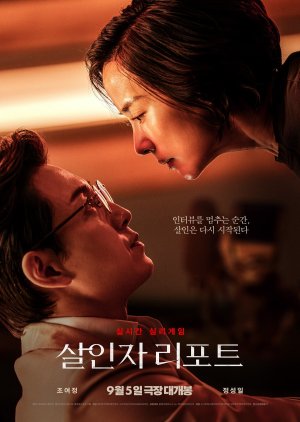
"Murder Report" is a 2025 South Korean psychological film about a desperate journalist who receives a phone call from an unknown person claiming to be a serial killer and wants to interview him.The film is a kind of film (one room) that such films are characterized by a stable environment and relies on dialogue and flashbacks (characters' past) to create an emotional and enjoyable environment series) is
The film gets into another mold in the second half when the events and the stories of the characters are generally connected and the director takes us into a whirlwind of emotional events and stories that completely turn the story around and offer us a wonderful plot twist
After All , Murder Report is a very good and unique film that, in my opinion, was one of the best Korean films of the year and absolutely worth seeing and trying out
Was this review helpful to you?

When Justice Breaks, the Mind Speaks in Extremes
Murderer Report (2025) is not a comfortable film, nor does it intend to be. It is a work that forces the viewer to confront what society often prefers to ignore: moral erosion, unresolved pain, and the fragility of the systems we call justice. Beneath the surface of a psychological thriller lies a far deeper meditation on responsibility, guilt, and the limits of human reparation.One of the film’s most powerful pillars is the figure of the doctor—a character who resists any simplistic division between good and evil and instead inhabits a morally complex, deeply human space. His cause does not arise from impulse or empty cruelty, but from an accumulation of silence, negligence, and wounds that were never acknowledged. From a psychological and psychiatric perspective, his behavior can be understood as the extreme manifestation of chronic trauma: when pain is not heard, the psyche seeks desperate ways to give it meaning.
The film does not superficially justify his actions, yet it contextualizes them with an honesty that is deeply unsettling. And it is precisely there that a strong, almost unavoidable support for his cause emerges—not for the violence itself, but for the cry that precedes it. Murderer Report poses a disturbing but necessary question: what happens when the system fails repeatedly, and justice ceases to be a refuge, becoming instead a broken promise?
From a psychiatric standpoint, several characters display clear signs of emotional dissociation, internalized guilt, and extreme defense mechanisms. The journalist, for instance, embodies the conflict between professional ethics and a dangerous fascination with the abyss; her gradual emotional destabilization reveals how prolonged exposure to horror can erode even those who believe themselves to be mere observers. The doctor, in contrast, represents a mind that has already crossed that threshold—a psyche that has rationalized pain as method, not out of cruelty, but out of moral exhaustion.
The boundary between justice and revenge is portrayed as dangerously thin. The film suggests that both are born from the same place—the desire for balance—but diverge the moment society decides whom it listens to and whom it silences. When there is no reparation, revenge disguises itself as justice; when there is no justice, revenge becomes the last possible language.
Visually restrained and narratively tense, Murderer Report avoids excess and opts for an oppressive, almost clinical atmosphere that reinforces its psychological reading. Every dialogue carries weight, every silence accuses. There are no clear heroes or absolute villains—only fractured human beings attempting to make sense of the irreversible.
Ultimately, this is not a film about crime, but about consequences. About what happens when pain is archived, when victims become statistics, and when those who once sought to heal are later branded as monsters. Murderer Report unsettles because it offers no easy answers, but that is precisely its value: it reminds us that true violence often begins long before the final act, in collective indifference.
It is a work that demands to be viewed with critical empathy, with an open mind, and with the courage to accept that sometimes the line between order and chaos does not reside in the criminal—but in the system that created him.
Was this review helpful to you?

This review may contain spoilers
Yet another "psychological thriller"
I'm afraid I expected too much for better or for worse. The synopsis was interesting enough to reel me in, and so I went in with higher expectations than I probably should have.I wasn’t utterly disappointed, to my relief, though, I must say the movie was nothing groundbreaking.
I have a personal beef with someone who labels a show psychological when it doesn’t have the content to back it up. That’s exactly what I felt while watching this. It’s not a psychological drama; it’s just a drama. But a decent one.
When it comes to the acting, it was fine overall, but inconsistent at times. I can’t say I hated the FL’s performance, but I definitely wasn’t impressed. I could, unfortunately, tell when she was acting. In the scene where the ml reveals the mystery behind her daughter’s change in behaviour, she didn’t seem fully in her zone. The reaction felt underwhelming, to be euphemistic. To be blunt, the scene felt poorly acted. Another instance is in the final scene, where she has a long back and forth with the detective; it felt unnatural and a little awkward to watch. As for the ml, his performance was consistent throughout. His role wasn’t particularly demanding, but he handled microexpressions well and did a solid job overall.
As for the story, the concept is intriguing, but this is my issue with screenplays with intriguing storylines: they often fail to execute it. A serial killer wanting a one on one interview with a journalist? What a compelling start! But did the movie sustain the intrigue throughout? Arguably, no. It ends up following the same thriller tropes of a benevolent psychopath. I'm afraid writers aren’t audacious enough to fully commit to portraying a true psychopath as a protagonist. Then again, you can argue that this isn’t that kind of story. Fair enough. Not everything needs to reinvent the wheel.
I have criticised the movie enough that my review is starting to feel biased. Can’t have that, can we? On the bright side, the cinematography was one of the film’s strongest aspects. There was enough interesting camera work to keep me engaged, and the use of multiple TVs to create tension was handled smoothly. It did a lot of the heavy lifting in otherwise dull scenes.
The consistent pacing was another good aspect of the movie, but that’s also its downside. For a psychological thriller that you claim to be, I didn’t feel that rush of adrenaline in the climax. Or can it be called a climax? The experience ended up feeling somewhat anticlimactic.
By the end, though, I didn’t feel like I had wasted my time. It’s a solid project, and I would still recommend watching it, especially if you don’t have any other psychological thrillers lined up. Just lower your expectations a bit, and you should be good to go.
Was this review helpful to you?

estava na minha lista
Esse filme ficou desde o lançamento na minha “wishlist” e eu não conseguia encontrar lugar nenhum com legendas em ptbr e não queria me aventurar em canais alternativos pra ver. aí me reparo com ele na HBO BR, logo dei play.A história é muito interessante, imaginar que um SK está disponível pra dar entrevista a uma jornalista a instigando a comparecer para que ela possa salvar uma vida foi uma ideia muito boa. Mas a dúvida que pairou por um bom tempo seria “qual a vítima então?”
O suspense se mantém por praticamente todo o filme, apesar de não mudarem tanto de cenários, a química dos protagonistas é intensa e te deixa impactado.
O roteiro segue às vezes até imprevisível pq vc está tão imerso que não para pra pensar em qual será o próximo passo do SK?
O plot twist é muito interessante e te deixa surpresa em ver o “motivo” dele ter acontecido.
Também gostei muito da discussão final, te faz pensar por um momento que seria um final diferente, mas a natureza segue seu fluxo.
🇧🇷💖
Was this review helpful to you?