
 News
News 


Hello! I'm Tym, also known as 听雨眠, a Chinese descendant from Singapore. I write cultural analyses of Chinese dramas to bridge the cultural gap for international viewers.
This post incorporates Parts 1-4 of my Pursuit of Jade cultural analysis series. Fan Changyu, Xie Zheng, Bonds & Relationships, and the Drama OST.
PART 1: FAN CHANGYU (5 Layers)
#1 Jade Symbolism
樊长玉
(fán cháng yù)
长 (long-lasting): Enduring, tenacious.
玉 (jade): The ‘jade’ in ‘Pursuit of Jade’.
But it’s more than just a literal meaning of chasing jade.
Changyu carries the embodiment of jade itself. Both her character design and her name are tightly bound to three layers of jade symbolism.
Raw Jade: 璞玉 (pú yù)
Virtues of Jade: 玉德 (yù dé)
Jade That Shatters Than Yield: 玉碎不屈 (yù suì bù qū)
Raw Jade (璞玉)
Changyu begins as the humble daughter of a common market butcher, rough on the surface but pure at heart. The story is what carves her.
Virtues of Jade (玉德)
There are a total of five virtues of jade.
I. Benevolence: Despite being poor and struggling herself, she rescues an injured stranger (Xie Zheng) in the snow and nurses him back to health.
II. Righteousness: Fan Changyu’s strongest virtue, she has a very clear sense of right and wrong. Refusing to be bullied, repays debts honestly, defends people against authority and repeatedly risks herself for justice.
III. Wisdom: Changyu isn’t much of a scholarly strategist like Xie Zheng, yet she adapts quickly, survives hardship, and grows into military leadership despite lacking formal education.
IV. Courage: Her most visible virtue. She fights bandits, enters battlefields, protects others from physical harm and repeatedly confronts powerful people without fear. Yet, her courage isn’t just reckless heroism. It’s endurance.
V. Sincerity: Changyu remained fundamentally genuine and straightforward throughout the series. She doesn't conceal affection, and never manipulates morality for gain.
Jade That Shatters Than Yield (玉碎不屈)
Changyu’s character displays absolute resolve in which she would rather be destroyed than compromised. That is the quiet, unbreakable core of her character.
#2 The Jade and The Craftsman
陶太傅
(táo tài fù)
Grand Tutor Tao is more than just a strategist, Xie Zheng’s life mentor, or Fan Changyu’s godfather.
PART 1 — HIS IDENTITY
Most people read 'Grand Tutor' as teacher. That's the smallest part of what he truly is.
In Chinese, his title is 帝师 (dì shī), Imperial Tutor. One of the most powerful positions in the entire court, not because of rank alone, but because of what the role requires.
Educator of Rulers: Not just in literature or history, but in governance, ethics, and statecraft. He shapes how the emperor thinks before the emperor makes a single decision.
Moral Compass: Confucian ideals placed enormous weight on virtue, which means he wasn’t just teaching facts. He was responsible for the character of the man who ruled the empire.
Political Advisor: His counsel reaches policy. His words move the direction of the state.
Court Authority: In moments of factional conflict, he can intervene. His voice carries the kind of weight that doesn’t need to be raised.
Symbol of Legitimacy: His presence signals that power is guided by wisdom and moral orthodoxy. That the ruler has been properly formed.
This is not a mere academic figure.
Grand Tutor Tao was someone adjacent to the throne, a kingmaker. On the surface, he’s a moral scholar. But on the inside, he’s one of the sharpest political minds in the empire.
In the finale, when Grand Tutor Tao confirms the authenticity of the Tiger Seal, it isn’t a ceremonial gesture. It decides the outcome.
PART 2 — THE JADE AND THE CRAFTSMAN
When Fan Changyu meets Grand Tutor Tao in a labor camp, she doesn’t know who he is. To her, he is Old Man Tao, an elderly scholar doing forced labor alongside her.
At the dam, he switches his lot with hers without telling her anything. He sends himself toward certain death to keep her alive. A man of his position, one who shapes emperors, chose to die in place of a butcher’s daughter he had known for a few days.
Grand Tutor Tao scorns Fan Changyu at first, but soon recognises her true worth. He imparts words of wisdom that force her to confront a decision — return to Lin'an, or go to war.
“你们都是良善之人,但只能算是小善。焉知覆巢之下安有完卵啊。”
“You are all good people — but yours is only a small act of kindness. Don't you know that when the nest is overturned, no egg can remain whole?”
(Hidden Meaning: Individual survival becomes impossible when the larger system protecting everyone has already fallen apart.)
“乱世之中,避战换不来安宁,小善救不了苍生。”
“In times of chaos, avoiding war cannot bring peace. Small acts of kindness cannot save all people.”
He doesn't tell her to be brave. He doesn't invoke duty or loyalty. He reframes her goodness as insufficient—not wrong, but too insignificant for the scale of what is happening. Small acts of kindness requires a world where the nest is still intact. It is not.
The only path to the peace she wants is through the war she is trying to avoid.
#3 Jade Forged Through Trial
玉不琢,不成器
(yù bù zhuó, bù chéng qì)
Jade unworked cannot become a vessel of use. A person untested cannot achieve their potential.
Through every obstacle Fan Changyu faces, we watch her character take shape. The jade, being polished.
The Beginning (初为璞玉)
Born an orphaned daughter of a common market butcher, she raises her family and protects her younger sister entirely on her own.
Her nature is fierce and unfiltered, naturally stubborn, naturally kind, and her only ambition is to live quietly and keep her small household safe.
She is raw jade, untouched by the world, shaped by nothing yet.
The Trial That Breaks the Stone (劫难破璞)
Catastrophe strikes: her home is destroyed, and lives are lost. Her husband is torn from her.
She then learns the truth of her bloodline, that she descends from a loyal and wronged family, and carries a deep-seated debt of vengeance.
The peaceful life she built collapses entirely. Forced out of the market's comfortable smallness, she is thrown face-to-face with the cruelty of fate.
The Battlefield That Carves the Jade (沙场琢玉)
She goes to war as herself, no disguise, no borrowed identity, with her butcher's knife.
In the military camp she endures, and quietly, the street-sharpened skills of a butcher's daughter are remade into the instincts of a soldier. She survives close-quarters life and death.
The rawness falls away. Courage and tactical cunning take its place.
What began as a pursuit of personal vengeance expands, until it becomes something larger: a heart that carries the weight of the nation.
Jade Fully Formed (守心成玉)
Drawn into the treacherous currents of court politics, she is framed, pressured, threatened, and never once bows her head or yields.
She guards her conscience and her integrity without compromise, forging the unyielding character of jade that shatters before it bends.
From an ordinary, solitary girl, she is ground and refined into a woman of strength, principle, and breadth of spirit. A true heroine in every sense.
Pursuit of Jade’s story at its core is about Fan Changyu’s choices, in the midst of a broken world, to live as a piece of good jade.
Guarding her innocence, guarding her righteousness, guarding the truth of who she is.
#4 Courtesy Name
字
(zì)
A courtesy name is a traditional name given to individuals at adulthood, age 20 for men, and at marriage for women. It complements the birth name, and is how peers and equals address one another.
In imperial China, a person's birth name was private. Public address used courtesy names, titles, or kinship terms. Using someone's true name without permission was a social violation.
山君
(shān jūn)
山 (mountain): Steadfast, towering, unyielding, immovable. A shield and bastion. One who stands with roots, unbowed and proud.
君 (lord/sovereign): Not merely a person of virtue, but a ruler of a domain, sovereign by strength. In ancient usage, 山君 was itself an alternate name for the tiger.
Combined Meaning: The fierce tiger, the mountain sovereign. Courageous, untameable, skilled in battle. A fierce general on the battlefield; a formidable heroine.
In ancient China, women were almost never granted the character 君 (jūn). It denotes sovereignty, authority, lordship. The domain of men in positions of power.
By bestowing 山君 upon a butcher's daughter, the Grand Tutor breaks from convention entirely. He does not judge Fan Changyu by her gender or her origins.
He does not give her a name that softens her or places her in relation to someone else. He names her as an independent force to be reckoned with.
A sovereign in her own right.
#5 Qin Liangyu
秦良玉
(qín liáng yù)
Fan Changyu's battlefield arc wasn't written from imagination.
It was inspired from history.
Qin Liangyu (1574–1648) was a military general of the late Ming dynasty. She led one of the most feared armies in China's southwest, won battles against overwhelming odds, and earned the respect of an emperor who wrote poems in her honor.
The emperor called her the equal of any man. Then asked why a general had to be a man at all.
Throughout thousands of years of Chinese history, notable women were recorded in the 'Biographies of Exemplary Women' (列女传). Praised for chastity, virtue, and filial piety.
Qin Liangyu is the only woman in all of Chinese dynastic history to be recorded differently. Not among exemplary women, but among generals and ministers.
She earned her place in history on the same terms as the men.
She also never pretended to be one.
No disguise. No borrowed identity. She went as herself, and the records noted her gender the same way they noted any other general. Almost as an afterthought, buried beneath the long list of her victories.
The author of Pursuit of Jade, 团子来袭, is from Shizhu, Chongqing. The same region Qin Liangyu called home.
That's not a coincidence.
(Tian Xiwei, the actor playing Fan Changyu, is also from Chongqing)
Fan Changyu, a butcher's daughter who picks up a knife and walks into a war zone as herself, is her fictional descendant.
Different era, different weapon. The same refusal.
PART 2: XIE ZHENG (5 Layers)
#1 Disguised Warrior
谢征
(xiè zhēng)
PART 1 — BIRTH NAME
谢 (restraint): Refined and courteous, who understands propriety. Inherently reserved, restrained and can be difficult to approach emotionally.
Xie is a prestigious aristocratic surname historically associated with noble figures like Xie Xuan, who were refined yet iron-blooded.
征 (conquest): Great ambition, determination and decisiveness. A commanding presence. Strategic depth and the willingness to relentlessly pursue a goal.
It refers to “expedition” or “campaign,” directly foreshadowing his fate as both a ‘God of War’ and avenger.
Combined Meaning: To pursue one’s relentless goal beneath the guise of humility and restraint. One who never flaunts, and remains controlled, calculating and quietly advances his plans from the shadows.
PART 2 — FICTIONAL NAME
The fictional name, Yan Zheng, that Xie Zheng gives Fan Changyu is actually a wordplay from his own.
言正
(yán zhèng)
言: Speech
正: Righteous
Combined Meaning: It suggests someone that is righteous in speech and conduct. A character that pursues justice, correcting right from wrong.
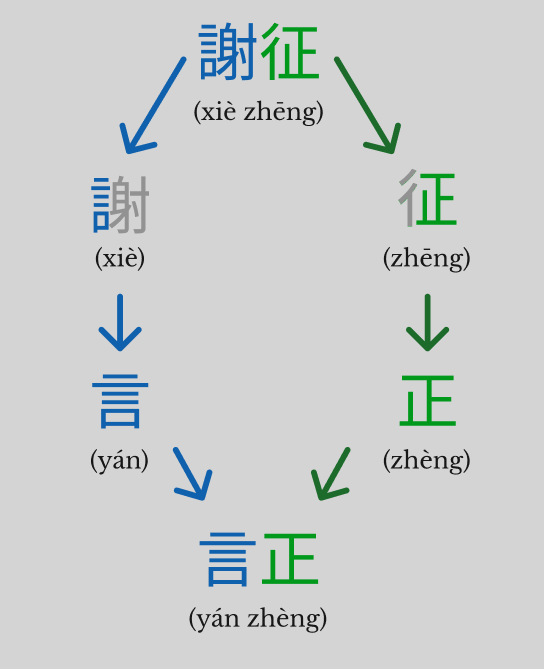 In ancient times, the word 征 was also written as 正, and the ‘彳’ radical was only added later. The alias is not only a disguised identity of his real name, Xie Zheng, but also a lingering trace of 征’s original meaning.
#2 Medal of Valor
翎子
(líng zǐ)
Pheasant plume. The two long feathers that dangle up high during Marquis Wu’an’s iconic entry scene. This appearance often remind people of figures like Sun Wukong or Lü Bu, and would assume they were the blueprints for it.
They weren’t.
PART 1 — THE ORIGINS
The feathers were first bestowed by King Wuling of Zhao upon his bravest warriors, during the Warring States, ~300 BCE. That’s more than two thousand years ago from now.
During those periods, it wasn’t just a costume, but a medal of valor. King Wuling used the feathers of the Brown-eared Pheasant, a “warrior bird” that would fight to the death rather than retreat. Wearing those plumes meant you were the fiercest soldier on the field.
It was only during the Ming Dynasty that figures like Lü Bu, who lived 500 years after the monarch, were finally reimagined for the opera stage.
By the time Sun Wukong reached the screens centuries later, the pheasant plume had evolved from a soldier’s badge into a visual shorthand for rebellion and peerless power.
PART 2 — MODERN ELEVATION
In the modern day, depictions in Chinese drama and opera often use the feathers of the Reeves’s Pheasant, notably because they were much longer reaching up to 2 metres, and more fitting for the elevation of visuals.
“Pursuit of Jade does not pursue strict archaeological reconstruction but rather a xieyi-style Eastern aesthetic expression. Through Xie Zheng's pheasant plume, we sought to break the barrier between the stylized theatricality of traditional opera and the sense of realism in film and television. This plume is an extension of Xie Zheng's soul, the spine [strength, courage and assertiveness] that refuses to bow in turbulent times.”
— Director Zeng Qingjie
So, when you see those feathers dancing in modern dramas, you’re not just looking at a character trait.
You’re looking at a 2,300-year-old lineage of “fighting to the end”.
#3 Courtesy Name
九衡
(jiǔ héng)
九: The number nine
衡: Balance
The courtesy name that Grand Tutor Tao bestowed upon Xie Zheng carries three, purposeful layers.
First Layer — 九 (Nine)
九 is the ultimate yang number. The apex of Heaven. The position of the sovereign.
Grand Tutor Tao looked at Xie Zheng and saw someone cold and sharp in bearing, born under a solitary and calamitous fate, carrying the grief of a massacred clan.
He was never destined for the mold of an ordinary subject. An ordinary name could neither contain him nor be worthy of him. Only the extreme number “nine” could match his innate pride, his fate, and the position of power he was always going to occupy.
Second Layer — 衡 (Balance)
Xie Zheng's birth name contains 征 (zhēng), whose original meaning is conquest, aggression, a blade-like sharpness. Left unchecked, this nature tends toward extremism and ruthlessness.
衡 (héng) is the scales. The law. The principle of balance.
The intention is to bind his ferocity and killing edge with the law of Heaven and Earth. To keep him from losing himself to hatred.
Third Layer — 九衡 (Jiuheng)
It was as if Grand Tutor Tao was blessing Xie Zheng:
“You were born with the bearing of the highest order. You will one day stand at the apex of power. May you stand there, uphold what is right, redress the injustices of the world, powerful without bias, unyielding without madness.”
It's not merely to "think carefully before acting."
It is to stand at the highest place and still hold the scales of justice. A spirit noble enough to deserve great power. An edge sharp enough to need restraint. And buried wrongs that only someone standing at the very top could ever bring to light.
Grand Tutor Tao also bestowed the name Jiuheng to Xie Zheng so that he would always reconsider nine times before making a serious decision.
#4 Elite Authority
武安侯
(wǔ ān hóu)
武: Martial force
安: Peace and stability
“武安” (Wu’an) is an elite military honorific title that is often bestowed upon the bravest generals who are able to bring peace and stability to the nation through their martial prowess and leadership.
The rank of Marquis (侯) is the second highest of the five noble ranks, excluding royalty, that sits above all.
Xie Zheng is not just an honorary Marquis. He holds real military power, territory and court political weight. In the drama, we often hear Xie Zheng say “本侯” (běn hóu) or the Princess say “本宫” (běn gōng). The subtitles translate it as “I”, causing most people to miss the full unspoken authority and character subtlety.
When Xie Zheng says 本侯, he is not simply saying "I." He is speaking from his full Marquis authority. Every instance is a formal stance, his highest identity used to back his words, suppress conflict, and make final rulings. No one in that court can override what follows.
To outsiders, officials, or enemies, he uses 本侯 (běn hóu). Hierarchy maintained. Noble distance held. Authority asserted without raising his voice.
本侯 (běn hóu) can sound arrogant to non-natives. In Chinese culture, it is the opposite. Inborn aristocratic restraint. Calm, self-disciplined, naturally prestigious. Not loud. Not performative. Just born to hold that rank, and carrying it accordingly.
But when he’s alone with Fan Changyu, he sets it down.
He is a supreme noble to the nation, but only an ordinary man in front of her. Most viewers read the same word "I" throughout, and they never see him lower his rank for her.
#5 Matrilocal Marriage
赘婿
(zhuì xù)
A live-in husband.
In imperial China, it was the most humiliating arrangement a man could enter.
Associated with poverty. With weakness. With the inability to provide a household of one's own. Men who entered 入赘 marriages were documented as such in the Tang Code, the Song Dynasty records, and the Ming Code. The stigma was written into law.
To the people of Lin'an, he was just Yan Zheng. A man of no particular standing, agreeing to an arrangement they would have expected of someone like him.
A man who privately knew himself to be second in the entire nobility ranking, accepting the most stigmatized marital role in the social order under a borrowed name.
No one saw the gap. Only he carried it.
Not only did Xie Zheng lower his rank for her, he also entered an agreement that would bring humiliation to him without second thought.
The neighbors didn't know it was strategic. They just saw a man of supposed low standing accepting an arrangement that the entire social order considered beneath any man of dignity.
That’s all they ever saw.
He left as Yan Zheng, as a live-in husband. He left as the man no one looked twice at and casually returned as Prince Regent.
PART 3: BONDS & RELATIONSHIPS (7 Layers)
#1 Strings of Fate
缘分
(yuán fèn)
Most people reach for "fate" as the translation. It's not wrong. It's just not enough.
Yuanfen is a predestined encounter. The right person, the right moment; a meeting that was always going to happen. It's the invisible thread, not the whole story. Yuanfen creates the beginning. It doesn't promise anything after.
Fan Changyu finding Xie Zheng in the snow is Yuanfen.
宿命
(sù mìng)
If Yuanfen is the encounter, Suming is the weight you were born carrying.
Suming is an inevitable destiny. Not a path you chose, but a burden written before you arrived. The consequences of past actions, leading toward a fixed point. It follows you regardless of what you love, what you build, what you leave behind.
Xie Zheng’s blood debt, his 17-year mission of revenge, is his Suming. A blood debt he cannot put down.
命运
(mìng yùn)
Mingyun is the path of life. Every event, every turn, from the moment you arrive to the moment you don't.
But unlike Yuanfen or Suming, Mingyun can be forged. Most of it is already laid out. And yet the decisions you make, the direction you fight toward, the effort you pour in — are the variables that can bend it.
Fan Changyu carved out her own Mingyun with her butcher’s knife. When two paths intersect without intentional decisions to do so, it’s also considered as Yuanfen.
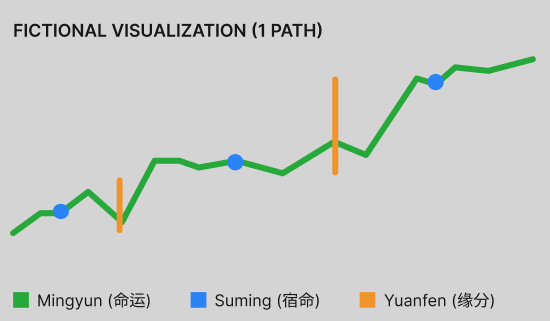 You might be asking, can all three of them align simultaneously?
The answer is, yes.
Yuanfen (缘分): Fan Changyu found Xie Zheng in the snow.
Suming (宿命): Xie Zheng's 17-year revenge was connected to Fan Changyu's father, Wei Qilin.
Mingyun (命运): His life path was always leading back to the capital. She carved her way there. Both paths converged, before they chose to bend them back toward the village. Together.
Xie Zheng & Fan Changyu are a perfectly matched cosmic pairing, and Grand Tutor Tao saw it before either of them did.
An easier way to remember this. You have YSL for lipstick, and YSM for fate:
Y = Yuanfen (缘分)

S = Suming (宿命)

M = Mingyun (命运)
#2 Cosmic Pairing
天生一对
(tiān shēng yī duì)
A match made in heaven.
Most people know ‘yin and yang’ as a symbol. Two teardrop shapes, black and white, curling around each other. White for ‘yin’, black for ‘yang’.
The bathtub scene is merely the tip of the iceberg.
In Chinese cosmology, it is a framework for how the universe holds together.
Yin and yang are not opposites. They are complements. Two forces, each governing its own domain, neither complete without the other. Where one is present, the other is waiting. They don't cancel each other out. They hold each other up.
PART 1 — CORRECTING IMBALANCES
Xie Zheng (谢征) → Jiuheng (九衡)
Xie Zheng’s nature contains strong masculine and martial symbolism. Conquest and aggression. This translates to a strong Yang. Grand Tutor Tao’s intent was to balance his Yang with Yin: his Courtesy Name.
Fan Changyu (樊长玉) → Shanjun (山君)
Changyu’s nature is gentle, refined and inwardly reserved. Despite being born in the Year of the Tiger and possesses immense natural strength, the character 玉 (jade) softens and suppresses her sharpness. This translates into a strong Yin.
By bestowing her Shanjun (that contains Yang energy), Grand Tutor Tao sought to help Changyu reveal what the jade had been hiding; her bold and powerful true nature.
With their Courtesy Names, Xie Zheng primarily represents Yin, and Changyu represents Yang.
PART 2 — COSMIC PAIRING
Xie Zheng: Yin, Heaven, the civil path.
Fan Changyu: Yang, Earth, the martial path.
One commands the balance of Heaven’s law, the other guards the pulse of the Earth and its mountains.
They perfectly complement each other, forming a harmonious yin-yang pairing not only in name symbolism, but also in personality and fate.
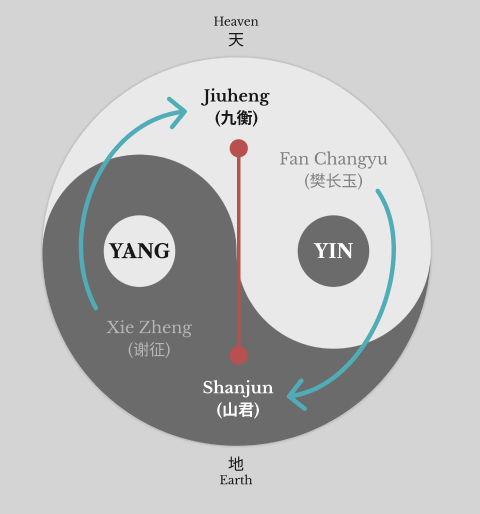 During the bathtub scene, Xie Zheng was in white robes, and Fan Changyu in black. This correlates with their cosmic fate and pairing, both a reflection of their intended representations.
Xie Zheng commands from the center and steadies the court. Fan Changyu governs outward and protects the nation.
Grand Tutor Tao wasn’t just bestowing Courtesy Names, he was blessing them with a perfectly matched pairing.
#3 Intimacy
在下
(zài xià)
PART 1 — SAVIOR
When Xie Zheng first wakes up after being saved from the snow, he introduces himself as Yan Zheng. But what most people miss is the exact way he did so.
在下 (zài xià) is a highly polite, humble, and formal way to say "I" or "me" when introducing yourself in Chinese.
It literally translates to "under" or "below" (下) "here" (在). By using this term, you are figuratively placing yourself below the person you are speaking to, showing respect and modesty. This is often used in imperial China when speaking to an official, or someone of a higher rank.
Xie Zheng used this term not only to lower himself when speaking to her, it is also a form of respect for saving him. Even when he returned as a Marquis, he never once pulled his weight on her (refer to Part 2 of the Pursuit of Jade series).
PART 2 — SPIRITUAL SURRENDER
In imperial China, a person's birth name was private. Public address used courtesy names, titles, or kinship terms.
If Xie Zheng allows Changyu to use his given name, not his pseudonym ‘Yan Zheng’, not his title ‘Marquis of Wu’an’; it is not a nickname. It is legal and spiritual surrender.
It means: I belong to you.
PART 3 — SCARCITY OF VOICE
When Xie Zheng teaches Changyu to read and write, he’s not simply providing her education.
Communication was scarce during wartime and letters were proof of life. Exchanging ink was a form of intimacy that exceeded beyond physical restriction.
By teaching her, he is also opening a door, elevating her status and bringing her into his world.
#4 Love Language
过招
(guò zhāo)
In the martial world, your techniques are not just skills.
They are secrets.
How you move. How you read an opponent. Where your instincts go under pressure. These are things martial artists guard carefully, because an enemy who has seen you fight knows exactly how to end you.
When Xie Zheng spars with Fan Changyu at the riverbank, he shows her how he moves. He shows her how he reads an opponent. He shows her where his instincts go.
For a man of his caliber, that is not a casual exchange. That is full exposure. In the martial world, you only do that for someone you trust completely.
PART 1 — SOFTNESS OVERCOMING HARDNESS
He starts with one hand.
Two people sparring, and he is using half of what he has. Not because he underestimates her. Because he is giving her room.
Then she nearly falls back into a branch. He pulls her toward him without hesitation. And in that moment, he stops defending himself entirely.
He's not parrying. He's not reading her next move. He's not protecting himself. He is only making sure she doesn't get hurt. She knows it immediately. She strikes him in the abdomen while his guard is completely open, while he is still pulling her back.
A man who has survived seventeen years of hiding, of calculation, of never leaving himself exposed, drops every instinct the moment she is in danger.
The way he moves throughout the spar is its own layer.
His arms and wrists redirect her force rather than meet it. He goes with the flow of her attacks, absorbing and deflecting rather than resisting. In Chinese martial philosophy, this is 以柔克刚 (yǐ róu kè gāng). Softness overcoming hardness. The principle that yielding is not weakness. That the softest force, applied correctly, can redirect the strongest blow.
It is the same principle encoded in his courtesy name Jiuheng (九衡). Balance over brute force. Restraint as the highest form of control.
PART 2 — LOVE LANGUAGE
And then Changyu says it herself.
She had to test his abilities before she could fight him properly.
She was reading him the entire time. Every move she made in the first half of the spar was assessment, not full commitment. She respects him enough to take him seriously as an opponent.
Two people who can genuinely fight, and he is deflecting instead of striking. Absorbing instead of pushing back. Using everything he knows to make sure she doesn't get hurt in the process.
That is not technique. That is care, expressed in the only language they are both fluent in at that moment.
He showed her everything. She studied everything he showed.
Most audiences watch it as a fight scene. They see the choreography. They see the river. They see two people who are clearly good at this.
What they don't see is what is actually being exchanged.
#5 Animal Symbolisms
海东青
(hǎi dōng qīng)
In Chinese literary tradition, how a person is described in animal terms tells you everything about how the world sees them.
And sometimes, how they see themselves.
PART 1 — SOLITARY WARRIOR
Xie Zheng is associated with the 海东青. A gyrfalcon, one of the largest birds of prey in the falcon family. In ancient times, it was known as the “god among ten thousand hawks.” It is also classified as a first-class nationally protected animal in China.
Solitary. Fierce. Loyal only to its own nest.
It does not flock. It does not follow. It circles alone at heights other birds cannot reach, and when it strikes, it does not miss.
This is the animal the story assigns to the man who spent seventeen years in hiding, planning, waiting. An eagle with nowhere to land. Power with no home to return to.
PART 2 — LIVELY PIG
Fan Changyu is associated with a little pig.
Simple. Warm. Grounded. The kind of creature that makes noise and takes up space and fills a household with life.
In the opening of the drama, we see a pig leaving tracks in the snow. Throughout the series, we also see pig imagery everywhere: pig-shaped lanterns and pig-themed signs outside the butcher shop. Xie Zheng uses a little piggy as a gavel when preparing her for court.
PART 3 — MATERNAL WARMTH
The contrast is not accidental. The gyrfalcon and the pig exist at opposite ends of every imaginable register. One is the symbol of imperial hunting culture. One lives in a market butcher's yard.
Having lost his mother at seven and born into the army, Xie Zheng grew up emotionally deprived.
The matrilocal marriage, albeit fake, allowed him to subconsciously return toward maternal protection through Fan Changyu’s warmth and domestic liveliness.
The home he never had.
#6 The Phoenix
“北雁南飞,遍地凤凰难下足”
(běi yàn nán fēi biàn dì fèng huáng nán xià zú)
During the scene where we see Song Yan harassing Fan Changyu, Xie Zheng steps in to intervene with just one line.
“北雁南飞,遍地凤凰难下足”
“As the wild goose flies south, it finds the ground covered with phoenixes that there is no place for it to land.”
PART 1 — THE PHOENIX
In Chinese culture, the “phoenix” represents nobility, or high ranking elites. The “wild goose” represents a commoner or a scholar traveling to the capital.
But in this context, Song Yan is the northern goose.
Xie Zheng is mocking Song Yan for overestimating himself and chasing a status he can never truly belong to. The implication is not just that Song Yan is outranked. It is that he doesn't belong here by nature.
Fan Changyu is the phoenix.
PART 2 — HIDDEN PRAISE
The phoenix in Chinese mythology does not land just anywhere. It perches only on the Wutong (梧桐) tree. It drinks only from sacred springs. Its presence is supremely selective.
A butcher's daughter being called a phoenix by a hidden Marquis isn’t just a simple rebuttal, and he’s not only protecting and standing up for his wife.
It’s a highly regarded praise.
In Chinese culture, the phoenix isn’t just a bird. It’s the highest symbol for an outstanding woman.
When Xie Zheng calls Changyu a phoenix, he’s saying:
She is noble in temperament, elegant and extraordinary.
She has dignity, inner strength and great character.
She stands above average people, like a royal.
She’s one-of-a-kind, rare and incomparable.
It’s the highest form of compliment.
Xie Zheng is praising her for being ethereal, noble and an extraordinary woman that no one can match her.
#7 Harmony Over Vengeance
以大局为重
(yǐ dà jú wéi zhòng)
To prioritize the greater picture above all else.
In Chinese cultural thinking, the nation comes before the individual. The family comes before the self. Collective stability comes before personal grievance. This is a moral framework woven into centuries of storytelling, philosophy, and ideals of what it means to lead well.
Hatred exists. But it is held. Restrained for the sake of what is larger than any one person's pain.
Wei Yan is not just an enemy. He is family. In Chinese culture, the maternal uncle holds immense familial authority: one of the highest bonds of trust that exists. For an uncle to orchestrate the massacre of his own nephew's clan is not just a crime. It is one of the deepest ethical violations the culture recognizes.
Xie Zheng knows this. He has carried it for seventeen years.
When Xie Zheng chooses to spare Wei Yan, he’s not forgiving him. He’s not letting him go. He’s absorbing the hatred. Containing it.
Choosing the stability of the court, the survival of the innocent, the preservation of order, over the one thing he has wanted since he was a child.
That’s not weakness. It’s the highest form of strength Chinese cultural values recognize.
Not the strength of emotional release. Not the strength of the blade. The strength of carrying unresolved hatred and not letting it become destruction.
In Chinese cultural narratives, this is what separates a great man from a powerful one.
The ideal leader does not act on what he feels. He acts on what the world needs.
Not because the anger is absent.
Because the responsibility is greater than the self.
PART 4: DRAMA OST (5 Layers)
#1 Careful with Fate 我对缘分小心翼翼
我对缘分小心翼翼
(wǒ duì yuán fèn xiǎo xīn yì yì)
PART 1 — PREDESTINED
缘分 (yuán fèn) is a predestined encounter.
In Part 3, I briefly mentioned what Yuanfen is and how it differs from the two other types of fate.
What I didn’t mention was how precious and rare it is.
It’s not a guaranteed encounter. Some people never experience it throughout their lives at all. Some people do, but never have it amount to anything significant.
It’s a mere start, and how you handle it depends on you.
Therefore, the title isn’t just being “careful with fate”.
It’s Xie Zheng handling it delicately, almost fearfully and afraid of breaking what destiny barely allowed for bringing Fan Changyu into his life.
PART 2 — MELODY WEAVES THE WORLD
The melody is light, yet the lyrics carry the weight of unresolved fate.
The song opens with war as an environment, not an occurrence.
乱世马蹄 谁还留在风雪里
Amidst the chaos of war and thundering hooves, who would remain in the wind and snow?
This isn’t just about war. It’s the inequality of survival in chaos. Some people move with power and armies. Others are left in the cold “wind and snow” of consequences.
而家园硝烟起 谁能遗世独立
When smoke rises over our homes, who can remain detached from the world?
In chaos, there is no outside. Once the center collapses, there is no neutral position left in the system.
Remember the words of wisdom that Grand Tutor Tao told Fan Changyu? “When the nest is overturned, no egg can remain whole.”
This frames the world as unstable, merciless and emotionally cold.
As it progresses, human warmth slowly returns. But it’s not what you might think. It’s remembrance.
梧桐细雨 檐下春燕衔着泥
Gentle rain falls over the Wutong tree, spring swallows carry mud under the eaves.
In Chinese poetry, the Wutong tree in this context is often associated with loneliness. It refers to a type of quiet sorrow and lingering absence. When swallows build nests using mud, it represents the rebuilding of life.
The emotional core reveals itself when the chorus arrives.
我对缘分小心翼翼不放弃
I treat fate carefully without giving up.
It means, “I treasure this bond delicately, because I know how easily fate can take it away.”
This song isn’t just about fate, it’s about navigating through chaos. It’s about choosing to remain tender, to treasure fate and human warmth in an era designed to destroy them.
#2 Searching Endlessly Amongst the Crowd 众里寻他千百度
众里寻他千百度
(zhòng lǐ xún tā qiān bǎi dù)
PART 1 — LOVE POEM
This song was inspired by one of China’s most celebrated classical poems, 《青玉案·元夕》 (Green Jade Table: Lantern Festival Night) by Xin Qiji.
The following is an English verse translation by master translator, Xu Yuanchong, that captures both the rhythm and the poem’s romantic climax:
One night's east wind adorns
a thousand trees with flowers,
And blows down stars in showers.
Fine steeds and carved cabs
spread fragrance en route;
Music vibrates from the flute;
The moon sheds its full light,
While fish and dragon lanterns dance all night.

In gold-thread dress, with moth or willow ornaments,
Giggling, she melts into the throng with trails of scents.
But in the crowd once and again
I look for her in vain.
When all at once I turn my head,
I find her there where lantern light is dimly shed.
On the surface, the poem describes a person searching through a Lantern Festival crowd for another.
But beneath the strokes, there is a deeper symbolism.
Its original meaning was never just romance. It weaves the solitude and persistence of a figure searching through a bustling world into its lines. It’s wandering through crowds, enduring life’s trials until you finally meet the one person.
PART 2 — LYRICAL COMPRESSION
When its depth is applied to the series, it aligns with the storyline closely. It’s not a separate soundtrack. It’s a lyrical compression of the entire emotional architecture between Xie Zheng and Fan Changyu.
But not in the way you might expect.
The surface reading stops at fated reunion. Two people, separated by war and circumstance, finding their way back to each other. That reading isn't wrong. It's just not where the poem's real weight lives.
The first half of the poem is deliberately overwhelming. Lanterns. Music. Wealth. Perfume. Everything the world considers brilliant, present and present loudly.
Then, the edge. Where the noise doesn't reach.
The poem is not about finding someone in a crowd. It is about the kind of person who was never in the crowd to begin with.
That is where Xie Zheng lives. Seventeen years hidden, restrained, psychologically outside everything surrounding him.
And Fan Changyu is the one who sees through him.
The emotional climax is not that the person appeared. It is that she finally recognized someone who had always been there. Past the disguise, the status, the controlled exterior. The person the world walked past without stopping.
This isn’t just searching for someone through a crowd.
It’s searching for someone who shares your inner world. Someone who understands what you are without being told. Someone who is real in a world full of performance.
Editor’s Note: Even though the poem incorporates the word “他”, it can apply to either gender. The word “她”, which translates specifically to “her” was only invented in the 20th century.#3 Storms Arise 风云起
风云起
(fēng yún qǐ)
The music tells you exactly who they are.
Full orchestra. Brass. Timpani. Vocals that sound like they belong on an opera stage. The production team used musical genre itself to say: what is happening right now is operating on a different scale.
But when you read the lyrics, it contains eight lines repeated twice.
The lyrics don't describe the characters. They describe the world that produced them.
PART 1 — XIE ZHENG
悬壶济世 (xuán hú jì shì) is a classical idiom for practicing medicine to serve the people. It comes from ancient itinerant physicians who roamed from place to place, hanging a gourd outside wherever they stopped to heal. They worked without recognition. They moved on. Their purpose was never for one person: it was for whoever the era had broken.
That's Xie Zheng. Seventeen years in hiding. Moving through the world under a false name, carrying a mission no one around him could see.
Doing it because someone had to.
Every other character gets a melody that matches their feelings. He gets operatic orchestration, the genre of fate, of national tragedy, of a man whose personal story has been swallowed by history.
The music doesn't follow him. It contains him.
PART 2 — FAN CHANGYU
When he forges her twin swords. When she strikes the Drum of Appeal alone.
Not his theme borrowed for her moment. Her moment, recognized by the same music. That distinction matters.
The opening word of the entire song is 茫茫.
茫茫 (máng máng): vast, boundless, hazy. The image of a world so immense and uncertain that what lies within it cannot yet be seen clearly.
It’s also the condition Fan Changyu begins in. Orphaned daughter of a disgraced military family. Living among commoners. Carrying a butcher's knife instead of a sword. Nothing about her surface tells you what she is.
It references back to Fan Changyu when she was a raw, uncut jade, 璞玉 (pú yù).
#4 Irreversible Consequence 木已成舟
木已成舟
(mù yǐ chéng zhōu)
PART 1 — IDIOM
“The wood has already been made into a boat.”
Once the tree is cut and carved into a vessel, it cannot go back to being a tree. The shape is fixed. The decision, irreversible. What was done cannot be undone.
木已成舟 is not a phrase of regret. It is a phrase of reckoning.
It names the exact moment a threshold was crossed. Not when the feelings arrived. Not when someone admitted them. The moment the structure of everything changed, quietly, without announcement, and neither person could return to what they were before.
In the drama, that threshold is the marriage.
It began as a transaction. An arrangement between two people with separate agendas and no intention of staying. And then, somewhere inside it, the wood became a boat. Not through a confession. Not through a declaration.
Through accumulated days, shared silences, small recognitions that added up to something neither of them planned.
By the time either of them noticed, it was already done.
PART 2 — LONGING
The song knows something the characters are still figuring out. It opens in the chaos that made them.
Out of that disaster, they found each other.
And then the wood became a boat. Quietly. Without announcement. Neither of them planned it.
长河中泪刚落 便要投身星河
Tears barely dry before being cast into the Milky Way.
星河 (xīng hé), the Milky Way, is where lovers are separated in Chinese mythology. Two people who finally found each other, and then lost each other to war before they could even say so.
When the song places this separation inside 星河, it is not being poetic. It is saying: what happened to them belongs to the same weight as the oldest love story in the culture.
#5 A Single Thought 一念
一念
(yī niàn)
In Buddhist philosophy, 一念 is the smallest possible unit of consciousness. The infinitely brief moment a thought arises before you can choose or refuse it. Smaller than a second. Smaller than a breath.
一念之间 (yī niàn zhī jiān). The space of one thought, where a decision is made. A feeling is born. A fate is sealed.
That is the threshold this song is named after.
一生风雨 片刻花期
A lifetime of storms, for a fleeting moment of bloom.
The Lin'an arc is the flower. Everything else is the storm that brackets it.
为一眼灵犀
For a moment of mutual understanding.
灵犀 (líng xī) comes from Li Shangyin's Tang dynasty poem. In ancient belief, the rhinoceros horn was thought to conduct energy between two beings without speech. 灵犀 became the word for perfect, wordless understanding. Two people who read each other completely, across distance, across silence.
The sparring scene. The writing scene. Every moment where neither of them said what they meant, and both of them already knew.
这一生 目所及 耳所栖 生死相抵
This life: everything the eyes see, everything the ears hold. Life and death, balanced against each other.

这一程 心所系 皆是你 魂牵又梦系
This journey: everything the heart is anchored to. All of it, you. Soul tethered, dreams bound.

这一别 情所钟 爱所惧 一念成疾
This parting: where all feeling concentrates. Where love turns to fear. A single thought becomes illness.
生死相抵 (shēng sǐ xiāng dǐ). Life weighed against death, and neither wins. The scale doesn't tip. Everything seen and heard in a lifetime, and it still cannot settle what is owed.
魂牵又梦系 (hún qiān yòu mèng xì). Not choosing to think of someone. Being unable to stop. Waking up and the thought is already there. Falling asleep and it follows you in.
The sparring scene. The writing scene. Every moment where neither of them said what they meant, and both of them already knew.
情所钟 爱所惧 (qíng suǒ zhōng ài suǒ jù). Where all feeling concentrates. Where love turns to fear.
The deeper the love, the heavier the fear. Not fear of the feeling itself. Fear of what it costs. He carries a hidden identity and a blood debt, exposure endangers her.
She carries her own family's history, and fears it may one day be turned against him. Both of them afraid of dragging the other into the wreckage of their own lives.
一念成疾 (yī niàn chéng jí). In classical Chinese medicine, lovesickness was a documented condition. Not a metaphor. One single thought of the person, and the illness begins. The thought itself is the disease. No cure except the person who caused it.
我欲与你同归去 生死不离
I wish to be with you wherever you return to. Inseparable through life and in death.
It’s not simply “I want to be with you forever.”
It is “I would rather die alongside you than live without you.”

Thank you for this in depth look into the drama. I am an international viewer, and I watch for more than just entertainment.
When looking at this drama through the lens of women's history would you say that it is divided into three parts with homages to: Empress Wu, Mulan, and Zhou Ying? I can also see the other woman soldier that you discussed above instead of Mulan, but I chose Mulan as she is internationally known and did go to the battlefield in place of her dad which is what Fan Changyu did. She went instead of her husband.
Also, I feel the four main couples represent the history of how women have been seen throughout history.
Platinum Fox:
Thank you for this in depth look into the drama. I am an international viewer, and I watch for more than just entertainment.
When looking at this drama through the lens of women's history would you say that it is divided into three parts with homages to: Empress Wu, Mulan, and Zhou Ying? I can also see the other woman soldier that you discussed above instead of Mulan, but I chose Mulan as she is internationally known and did go to the battlefield in place of her dad which is what Fan Changyu did. She went instead of her husband.
Also, I feel the four main couples represent the history of how women have been seen throughout history.
I'm not the author of the novel nor the screenwriter of the drama series, so I can't confirm nor deny if there is homage paid to those mentioned women of history.
What I did with the above post is identifying significant cultural points within the series that carries strong perceptions of Chinese culture symbolism and metaphors which resonates best with the series context.
Your mention of reputable women recorded in ancient Chinese history by name seems to imply an interest in inspirational women in the history of China.
But the way you referred to Qin Liangyu, the female general which the character Fan Changyu was inspired from as "the other woman soldier" and whom the author of the novel had personally confirmed, is quite appalling. The mention of Qin Liangyu (and not Mulan) isn't a personal choice I made, but a direct inspirational reference that the author used in creating the Fan Changyu character.
 cats are government spie:
 I apologize for my badly worded sentence about Qin Liangyu. As an international viewer who doesn't know about Qin Liangyu, I now have her on my list of women to research. So thank you for the information and cultural references to the drama. I greatly appreciate it.
No worries, I'm glad I could contribute to your list of inspirational women. :)
Tym, I greatly appreciate your perceptive cultural analysis of my favorite Chinese drama. I had a thought about the insightful analysis of jade. Throughout the novel, Xie Zheng is associated with jade far more often than Changyu is. He is almost always described as having a face like jade. and that visual descriptor is repeated many, many times. (It is also why all those criticisms of Zhang Linghe as "the foundation general" are ill-informed--his flawless face is essential to the character.) Changyu herself also compares him to uncut jade, which, if she found it, she would have to return even if she carved her name onto it. In the end, he does refer back to that statement when he says that she is his jade. Given the way the two of them are carefully balanced, with her learning to match his strength and prowess and stand beside him even as he learns to share her compassion while joining into her world, wouldn't it be appropriate to view them each as the jade that the other pursues and cherishes and that their worlds come to value after initially rejecting them both as too flawed to embrace?
Another thought about jade. When Changyu's name is explained, the jade reference is to the color first, rather than the stone. Her jade is green like the terraced fields are as the grain grows. Xie Zheng's primary jade association is also to color--he is as fair as jade, his face is flawless jade. In other words, he is white jade--of the highest "mutton fat" value. Those two kinds of jade are both valued, but aren't they associated with somewhat different meanings?
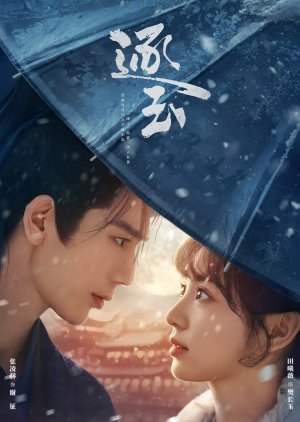
Details
- Title: Pursuit of Jade
- Type: Drama
- Format: Standard Series
- Country: China
- Episodes: 40
- Aired: Mar 6, 2026 - Mar 26, 2026
- Aired On: Monday, Tuesday, Wednesday, Thursday, Friday, Saturday, Sunday
- Original Network: iQiyi, Tencent Video
- Duration: 45 min.
- Genres: Historical, Mystery, Romance, War
- Tags: Fake To Real Lovers, Physically Strong Female Lead, General Male Lead, Female Lead Saves Male Lead, Marriage Of Convenience, Sisters' Relationship, Hidden Identity, Righteous Male Lead, Fake Marriage, Skilled Fighter Female Lead
- Content Rating: 13+ - Teens 13 or older
Statistics
- Score: 9.1 (scored by 45,374 users)
- Ranked: #42
- Popularity: #169
- Watchers: 88,010
- Favorites: 0


Popular Lists
Related lists from users



All Time Favorite Dramas
914 titles 2206 loves 40
Upcoming Chinese Dramas
73 titles 321 loves 8

Happily Ever After Fantasy Romance
113 titles 285 loves 6
Recently Watched By


