This review may contain spoilers
Simply Beautiful, poetic and a beautiful Story !
I decided to give it that Headline because this time writers did really amezing job, for once we get a well balanced story, both in narriting and the telling.And OMG the acting is perfect. Actors (i mean all actors) did a very Good job they portrayed the emotions of their characters really well.
Of course Mile and Apo never fail to deliver the amezing job.
Im just heart broken for the death of Victor and Veera. I think the Death of Victor was inevitable when you put it in political perspective, for Trin character to have a purpose i think it explains that outcome for Victor.
Yet im glad Neran and Krailert made out alive given that the general knew about them from the beginning (and his wife) the sacrifice Krailert have indure just to keep Naran safe is the ultimate love you can give someone you love as a last gift, i hate Dhevi (a character) may she never be happy either.
Was this review helpful to you?

More than just a bl series
The acting in this series is brilliant. The soundtrack was one of the best I have ever heard in a bl. The direction, the sets, the settings, the fashions, the cars...etc all captured the era. The script itself is also very good. I did take a 1/2 point off, because I really was hoping for a happy ending for everyone. It is a show not to be missed.Was this review helpful to you?
must watch
really well written and acted, this is not a good bl but a seriously good drama period a serious must watch! I was really surprised at how good this really was the acting, plot it was so done not a boring moment, I just wanted to keep watching.you do not have to be a bl fan to watch it is about love and relationships and touches on a historical time in Thai history although a piece of fiction I think it provides great insight into how far Thailand has come. I am not sure why the reviews have to be so long it is very excessive.
Was this review helpful to you?

This review may contain spoilers
Three months later, I still think about this show everyday
Shine is beautifully written, with a top-tier cinematography, and tackles topics that are, to a certain extent, still relevant today. The characters (and their relationships) are complex, nuanced, and there is an explanation for all of their actions — which makes them painfully human.Trin is the character that stole my heart the most. By the end of the fist episode, I was already attached to him, and my love for him kept growing after that. He’s endearing, touching, and even if I found him a little frustrating at times, I could always see the deeper reason behind his actions/reactions, and I could never stay mad for long. Thank you to Apo Nattawin for bringing him to life so brilliantly — his acting was flawless and he should get an award yesterday.
I could say the same about Tanwa: I adore him, and i believe that even the moments where I felt like he was annoying me were proof of how well-written his character is, because as soon as I’d take what I knew about his character into account, I would completely understand him. Mile excelled in this role too, I love how there was no trace of his previous character.
Maybe it’s because Kinnporsche wasn’t my cup of tea, but it was in Shine that Mileapo really came into their own in my eyes. This time, I could fully appreciate their chemistry, and I was taken aback. This is one of the reasons why I have to disagree with most of the comments I’ve seen, saying that SonEuro stole the show. The other reason is that Trintanwa have everything I like in a romance (a fictional one, at least.) They made me cry, they made me laugh, they made me melt — sometimes all at the same time — and they kept me at the edge of my seat until the very end. I can’t say I disagree with those who said they wished we could’ve seen more of them, but I also feel like what we got is enough to see how beautiful their love is.
Though I can’t say the same for Krailert and Naran, I like their characters individually, I liked the idea of their relationship (enemies (kinda) to lovers, forbidden love, doomed because they are on opposites sides…you name it.) and the actors really did have great chemistry. Even if this is the kind of love story that I generally stop finding interesting after the characters get together, that didn't make me love the series any less, as I at least liked the angst.
However, in the last episode, I couldn’t help but feel like their ending was a little drawn out. It was heartbreaking and also beautiful in its own way, but I wish some scenes weren’t as long so we could’ve seen more of Trin and Tanwa. But despite it’s flaws, the last episode (and the series in general) still gave me everything I wanted or needed.
And last but not least: Victor. If Trin is my favorite character, he and Tanwa both come in a close second. What I liked the most about him was his relationship with Trin; the love and protectiveness they had for each other was beautiful and touching, even if Victor’s romantic feelings always remained clearly unrequited (especially because of it, in my opinion.)
As for the political aspect of the series, it was fascinating, and like I said, still relevant today. I love how it showed different sides, how conflicts were represented at the intergroup level and at the intra-individual level, with characters questioning themselves, torn between their social position, the duties weighing on them and/or the orders they have learned to follow, the pressure from society and their families; and what they think is right or wrong, their morals, their loved ones — their hearts.
Shine also shows us the reality of the damage homophobia has done in the past in a raw, sometimes really brutal and graphic way. Therefore, some scenes are quite heavy and hard to watch, but even if they make us want to look away, I think they should make us reflect on how homophobia is still rampant nowadays, on the damage it still does.
One one hand, this series isn’t for an audience that needs to be spoonfed to be able to understand the plot and/or the characters, or that there’s more to a love story than the ship, who’s top and who’s bottom and etcetera. On the other hand, this is the kind of series that is always worth watching, for the message it carries and for all the things it teaches us.
Was this review helpful to you?

Raw and Real
The truest depiction of queer struggles I have seen in a Thai BL. I struggle to even call this a BL and the cast has said the same thing. This fits much more in the realm of queer drama, which Be On Cloud has always had more of a foot into than the other main production houses.The beauty and pain of these characters made my heart aches in way I haven't felt since Love In The Big City or Let Free The Curse Of Taekwondo.
I hope Thailand can continue to follow Korea in risking it on these more drama-based stories that don't necessarily end happy.
Was this review helpful to you?

Standing Ovation
First and foremost, I have to state my utmost respect to Mile and Apo. They leveraged their clout, brand, and fan base to not only bring a stellar work to fruition, but to hand over the spotlight to other actors and cast themselves as supporting characters. The humility and commitment to their acting community, authentic and damn good storytelling, and the audience's experience should be loudly noted. This type of generosity should be resoundingly applauded and acknowledged.This should not be billed as a BL- not because it is lacking in BL romance and spice (oh, it brings it all) but because the representation of gay and bisexual love is incidental representation- gay and bisexual humans have existed throughout history, lived that history, and had to find ways to love and survive in that history. The history and the lived experience is what SHINES in this production. The human experience- gay, straight, and bi, young, old... human- is represented beautifully.
The storytelling does not paint villains and heroes easily. Instead, it leans into the moral ambiguity that often exists when fighting for what you believe. Living the consequences of your choices is a major theme to the piece, and instead of moralizing by assigning "happy endings" or "just desserts" to characters, the storytelling firmly takes the position that making the choice is what is important; to do nothing, to not choose, is the greatest sin we commit. This is a thematic statement that feels incredibly poignant to me as an American at this time and place in my nation's history.
The acting and delivery is truly next level, the production values are top notch including the sound engineering (a particular pet peeve of mine with regards to many Thai productions), and no budget was spared in recreating this indelible moment in Thai history. The script, directing, and execution are award-winning worthy.
Early in its run (as episodes were dropping) a great deal of negative reaction was popping up on social media. For some, I think they were expecting a redux of the Kinn Porsche aesthetic and storytelling. For others, I think they expected to be spoon fed important histocultural details that makes the viewing experience a little easier. It doesn't take much time to hop on Google and get some context to this period in Thai history so you can understand the sociopolitical implications as you watch. If we are going to embrace the art of a culture, don't we have a little bit of an obligation to do our homework and meet the storytelling halfway when we are lacking prior knowledge to enhance our understanding? I firmly believe the answer to that question is, "yes." For every 20 BLs that require no effort on the part of the international audience in order to understand and enjoy, you will find that beautiful treasure- like Shine- that requires a little more effort to participate. Take five minutes to gather some prior knowledge as it will truly make this viewing experience better.
I will rewatch this someday. But for now, I just want to sit with it in my heart and in my brain and give myself some time with it before I rewatch.
Was this review helpful to you?

This review may contain spoilers
Love & Revolution, anyone?
Dear Readers,Let me preface this by saying, I am not the same person I was before I started watching this. No- like legitimately I was in the TRENCHES! The last two episodes were like machine guns going off - even till the end. The only fault I can highlight in the show, is the first episode, which felt overly convoluted. I think they should've spread the introduction of the characters instead of piling it up. The story-boarding for this production was amazing: everything from the pacing to the colouring really highlighted what each scene sets out to depict. I think because of that every character's emotions were amplified. I loved the set- design too for the news room which felt lived in and authentic of the time. I can tell they put in a lot of effort to the costumes and the hair designs - all of it places you in that time period.
Regarding the OST, some of the songs felt out of time and don't even get me started on the song Tanwa sang which honestly if you think about sounds like Scooby Doo. This was especially hard because Victor was actively dying.
Victor
Victor my love, Victor my sweet darling- you were gone too soon!!!!!!!! America was waiting and I was waiting.
Historically, the martyrs have always been the young and the charismatic, headstrong orators. His populist ideology though resonating with masses were not really achievable in the short period of his life. What's more depressing is that even though he is risking his life fighting on the front lines for the rights of the oppressed , his mix-race status still makes him an 'outsider'.
And this is the cruel reality this show captures well. His puppy love for Trin manifest in ebbs and flows through the conversations that essentially placed them on different sides of the same coin in their diversely inherent worldviews.
Sometimes when I mourn over Victor's death, I think it is because that he appears to me in the image of young Max Nattapol.
Trin/ Tanwa
Trin is a very 'polished' guy a complete 180 from who Tanwa is - which essentially is what drew them together. Trin is able to let shed a lot of his shell because of Tanwa. With his interactions with Victor he became more headstrong and understood the consequences of remaining stationery with the privilege. After interacting with his students and getting involved with the youth activists he began to realize the importance of his own position and the disillusionment of power.
Tanwa is a self- proclaimed hippie trying to escape from his own privilege. He's also so deeply depressed in a way that he doesn't even recognise how depressed he is. I think in a way he needed Trin to lead him out of that trance he constantly puts himself into. Tanwa's time stopped once his mother passed away and since then he's just been existing and constantly antagonising his dad. In my opinion, he should've antagonise his dad more! All this to say, Tanwa's a rich kid with a world of chances given him, yet its given to someone who wont seek out anything greater for others. This juxtaposition of Trin's status and privilege versus Victor's lack of, is depressing to say the least.
Krailert/Naran
Guys, love can bloom from within the pages of the newspaper!
Their story almost reads as a early 2000s romcom- minus the comedy and we are in the 60s. Everything is viewed through a rose colored (weed) lens yet the reality of the common people are drenched in fear and blood.
I really loved how the screenwriters introduced them. Naran, a man behind the camera, while Krailert, a man always in the headlines. Inadvertently, both start interacting through their differing opinions about music and its connections to current affairs. Their interest in each other both in real life and the interactions through the newspaper are both laced in with some hate. Every interaction between them is a dance of passion and antagonism. Though both parties are aware of their positions in society, they are willing to pursue a doomed relationship in hopes of achieving some freedom in their own ways. Perhaps the most heartbreaking aspect of this relationship is watching these two people find each other during a turbulant time. In the moments they're together, they try their best to keep the outside from "leaking" in, but the outside finds a way. No matter how tightly sealed they can keep this relationship, reality is inevitable. Krailert's guilt feels so deep rooted when I watched him not fight back with Devhi. He wanted to repent and also keep Naran safe. I think Naran deep down also knew that they wouldn't find that freedom he talked about in that last note. I hope Trin told Naran about what happened instead of Naran believing that Krailert's wasn't brave enough to come to him. Trin also should've smuggled uncle out! Why would Trin say their room was beautiful, but also not try to do more for him? Fighting our own battles is great and all, but I feel like Krailert's ending is the most tragic. He's basically imprisoned for the end of his days.
Devhi, Veera (+Moira)
I understood Devhi's plight, but I don't understand her reactions to her reality. It was her who chose a prison of her own making. She chose to be with a man who will never like her back. She strives for his love, but both of them just end up hating each other more and more. She's trapping herself and him to have an ideal life that she thinks will make her happy. In this relationship, there's more hate than love. She thought Krailert would keep up the pretenses of being a married man, but he never does despite all she did to secure this marriage. What I don't understand more is how she didn't internalize how it felt to be liked by someone like Veera. Why would you want to go back to a marriage where you're not loved? Veera loved her even in hiding. Sadly, despite his love, Veera met such a harsh death. Veera's death mostly pushed her to a harsh reality where she finally realizes that she can continue to imprison herself and Krailert like she has done this entire time. Moira is the only perceptive character in the entire show. Moira knows all the secrets and tries to guide everyone towards a happier path. However, you can lead a horse to water, but you can't make it drink.
Overall, it's a show worth watching, but make sure you don't have any pressing things to get through the next few days cause man, this show hurts like a bitch!
Was this review helpful to you?

The greatest production of the highest quality BL with the most intriguing storyline - Shine
I am at loss of word on how to review this masterpiece. I am remember seeing a comment in MDL calling it boring and that just made me realize a series with depth, artistry and whirlwind is not for everyone.The storyline, the plot, everything about this made my head hurt. The stripped down display of corruption of the system, the homophobia, the conflict of ideologies and lastly how little to no value human life holds to those in power. This was downright the realest political drama I have watched in a while. Kudos to the script writer and their amazing mind for linking real historical events so naturally to the timeline. The moon landing of 1969, and then the next year Thailand sending Ms. Thailand for Ms, Universe and lastly the Coup Detat of 1971 and the student protest against Military junta. The amount of research went is commendable. The conflicting opinions throughout the series from various characters made this drama amazing, and it's a rare characteristics to hold because we mostly end up with one sided support that yes only the student revolting is right, the other side is wrong. The characters were given so much of depth and dimension and they upheld ideologies that were closer to reality than fiction. I loved how romance was the sub focus of the storyline while focused more on philosophy and politics. The characters goes beyond the box of good, bad, red flag, green flags etc. They were true people whom I loved, got frustrated on and had my eyes twitching.
I usually don't have much to say on cinematography but this deserves a dedicated paragraph. The color grading made it 100x times better because it truly felt like watching a period piece from the 1960s with the grainy filter. The use of music and ost is immaculate, it elevated the entire scenario. The OSTs alone deserves a column. The styling felt exactly at the right place. The direction was good however at the beginning in some places it felt the cuts were not tying up properly. Still it is one of the greatest production of all time.
The amazing actors and actresses who brought the characters to life, my kudos to them for their incredible job. Mile made me belief he is not the same guy from KP. Apo absorbed his character so well that he truly felt like the man who just came back from France to Thailand. Son did amazing as Colone. Euro showcased his emotions accurately as the angry journalist and I might have a celeb crush on him. I wish we had more of Bump, Fuaiz, Mio and JJ but even with little screentime they made me remember their scenes. Truly such amazing young actors. Senam's first series and I am already rooting for her. Now lastly, Peter as Victor was revolutionary because there is no way this is first series and he made me go through a roller-coaster. The actress playing Moira is so gorgeous. The entire cast is stunning.
This drama cannot be confined as just a BL production. It goes beyond that. It is a true queer media upholding multiple dimensions, that will make you pause, think and realize. Truly the masterpiece.
Was this review helpful to you?
This review may contain spoilers
as of ep 5:
for a drama thats supposedly abt the political turmoil in the set period and the resistance associated with it, the two lead characters surely isnt as involved in that aspect of the plot at all.its like watching two different shows w the 1st and 2nd couple. feels like the 2ndlead of the love triangle even forgot what hes fighting for bec of the triangle.
Was this review helpful to you?

Stop it Apo and Mile
I am so, so done with them. They have set my bar for BL series impossibly high, so high that nothing else even comes close. Their acting carries such depth that it does not just move you, it seeps into the soul. I do not even know how to explain it, but even the production house operates at an exceptional level. They know exactly who they are casting, as if they understand the magnitude of the stars they are bringing together. Two perfect constellations aligning in the same sky.And the depth they have infused into the story feels painfully real. Watching their series has always felt like stepping into the realm of ApoMile, as if you are crossing a threshold into a world that breathes, aches, and lives on its own. And if I speak honestly, it is not just about the acting. It is the flawless storytelling, the striking cinematography, the intentional use of music, and a supporting cast that delivered their roles with grace and precision, each element working in quiet harmony.
Watching them together in a storyline so distinct from what we are used to feels less like viewing a show and more like inhabiting it. It opens doors to emotions we never knew existed and teaches us feelings we never realised we were capable of experiencing, feelings they made tangible simply by existing together on screen. I do not even know what I am rambling about anymore, but watching this series has been nothing short of a beautiful and unforgettable journey for me.
Was this review helpful to you?
It exceeds my expectations
So far, I'm loving the difference between the two couples in the series. While one is passionate, rushed, and secretive, the other couple is the opposite, with slow burn and outdoors. I love how the script has been written so that each episode has a connection to a song; that's beautiful. I have a lot of faith that the quality will be maintained until the end, and I hope there will be at least a happy ending for most of the characters.Was this review helpful to you?
When the history in a series overwhelms the romance...you get Shine.
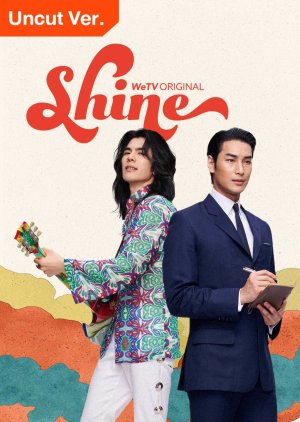
Shine is an outstanding historical drama. The series opens in July 1969, its initial scenes set during the very moment of Neil Armstrong’s “great leap for mankind,” and that timeline places its events in a Thailand struggling to make democratic principles viable amidst a military dictatorship. This reviewer lacks the expertise in the history of Thailand to comment on the accuracy of the events portrayed across the series’ 10 episodes as a reflection of that country’s past. But I am not sure accuracy was ever a goal of the producers. They set out instead to create a triptych of a turbulent time—one panel devoted to politics and protest, one to cultural transformation and ferment, and the third to romance and lust. The blend of history, politics, and romance--atypical for a series created by any company known for BL productions—yields a series with strong characters and a compelling narrative. It is thoughtful, complex, and nuanced.As a work of historical drama, Shine shines for its ability to evoke the zeitgeist of that period. Not just Thailand, but the whole world was inspired by mankind’s first steps on the moon. Not just Thailand, but the whole world felt the rush of new trends in music and fashion. Not just Thailand, but the whole world grappled with the implications of the Sexual Revolution, still unfolding. Not just Thailand, but many countries struggled to balance rapid industrialization with quality of life. Not just Thailand, but many western-allied countries struggled to balance fidelity to democracy to protecting against communist influence. The late 1960s were a turbulent era for cultures spread across many continents. What Shine does is convey a sense of how that era looked and felt in Thailand; how the people of Thailand might have behaved and believed. In this regard, Be On Cloud’s production succeeds in evoking the spirit of those times. The genius of Shine is that it may be specific to Thailand, but in many respects its depiction of 1969 has universal overtones.
Be On Cloud made a name for itself as a producer of BL series, notably 2022’s Kinn Porsche. Indeed, cast in lead roles for Shine are the same duo who headlined Kinn Porsche, Mile Phakphum Romsaithong and Apo Nattawin Wattanagitiphat. To rally the support of that series’ and duo’s considerable fanbase, marketing for Shine made clear that Mile’s and Apo’s characters would again become romantically involved. A clear expectation existed among the fandom that Shine would be a BL. The reality is somewhat more complicated. The only notable romances are indeed between male characters, and (typical of Be on Cloud’s production ethos) the sex scenes sizzle with steamy encounters between actors wearing very little clothing indeed. Nevertheless, the production team clearly had ambition beyond the romance-centered storylines commonly associated with the BL genre. Neither of the two principal romances drives the action. Neither evinces the sort of idealized fantasy romance commonly typical of BL. Indeed, the second-class status (and less, even, in 1969) of same-sex relationships bespeaks tropes associated with LGBT genre series more so than BL. The vibe is closer to “love that dares not speak its name” than to “idealized fantasy romance.” The "curse episode" (a customary BL trope) so plausibly, so effectively, uses a clandestine queer relationship against the characters that one feels queasy watching the plot unfold. In the end, pinning down Shine’s genre as either BL or LGBT strikes me as an irrelevancy. Its real purpose seems to be the portrayal of a moment in Thai history where protest helped wrest back control of the country from a military dictatorship. The romance never spurs the plot forward; a desire to discredit authoritarian government does.
The Thailand of 1969 was still modernizing. In economic terms modernization meant rapid industrialization, even where “progress” might impose harm on ordinary people. In social terms, modernization meant transitioning between a traditional social structure where oligarchic families concentrated power (economic, political, military) in their own hands (as the nobility once had) and a democratic society that rewarded individual brilliance regardless of the social class that birthed the person. Such transitions create contradictions and tensions, and Shine captures effectively the ensuring discomfort. The military justifies its control of society by the need to preserve order. Industrialists justify the development of industry as keystones to the nation’s future, even if their efforts cause harm to people living in the present. Students seeing the injustice of both (and certainly aware of student protest movements elsewhere in the world during the 1960s), take to the streets to protest all of the above.
The characters in Shine fit into all these groups, some more than one. Here, Apo portrays Trin, an intellectual groomed for a future serving his nation in government ministries. Trin returns from France in the first episode, having obtained the best western education possible. He will be snapped up for a position as an architect of the country’s economic development. Paraded like a prize at a high-society social event on his first day back Trin encounters Tanwa (Mile), the disaffected scion of an industrialist family. Tanwa is a classic long-haired slacker: he has deliberately failed out of college, refuses to be drawn into his father’s desired career path, and plays in a rock band. He smokes and drinks constantly, befitting that Sixties rocker vibe. (His hair and wardrobe also scream “San Francisco, Summer of Love” another element in how this series recreates the vibe of an era, albeit a style so on-the-nose for 1969 San Francisco that it may not yet have reached Bangkok that quickly.) Tanwa takes an immediate shine to Trin, and they engage a smoldering game of off-and-on flirtation for the remainder of the series. (Having professionally known many high achievers like Trin in my career, I am skeptical that consummate professional Trin would ever be so strongly attracted to a chronic underachiever like Tanwa, but after all, anything is possible. Perhaps the “idealized fantasy romance” in Shine derives from accepting that a high-achiever feels a spark with a slacker.) At any rate, most fans of the MileApo ship will feel satisfied by the actors’ interactions despite the plausible hesitance of the plot to commit to TrinTanwa.
As a side hustle, Trin also finds himself teaching a university class. That serves the narrative purpose of bringing him into contact with a group of students who have decided to take their discontent to the streets. The fictional bugaboo that focuses their energy is a power plant project construction contract awarded by the army to the company owned by Tanwa’s father. The students mistrust Trin, since his family background and professional training position him as an opponent of their cause. Yet, his political sympathies prove more expansive than they expect. Even as he critiques their faith in socialist ideology, he acknowledges where their critiques of capitalism have validity. His willingness to listen, even as he challenges them, wins their trust. Trin becomes a de facto mentor to the group. Here, an element of Trin’s backstory becomes crucial. He was present in Paris during the student protests of 1968. Those upheavals scarred French society deeply, an historical analysis the script shortchanges. Understandably, since the story is about Thailand; yet, I cannot help but think that a deeper dive into Trin’s experience of Paris 1968 might have made his choices in Bangkok 1969 resonate even more deeply. When he chides the would-be revolutionaries for their naïve approach to the danger inherent to protesting, that caution speaks to what he witnessed in Paris. Lives were lost in the City of Light in ’68, and lives are at stake in the Great City of Angels in ’69. (Indeed, anyone conversant with the general history of student protests against military dictatorships can by Shine’s middle episodes anticipate the tragedy looming ahead.) Trin’s involvement with the younger generation also creates a love triangle when one of the students becomes enamored with the professor. Victor is the half-farang offspring of a dissident Soviet émigré. (At some point, nearly all the adult characters challenge the students’ beliefs, but their objections represent the “establishment.” Victor’s Dad’s cynicism about the communist leanings of the student protestors springs from his own disillusionment with Soviet Communism; so, his warning resonates quite differently than the objections of the capitalist characters. His character’s point of view adds a nuance to the political discussion that demonstrates that the Cold War dichotomy “capitalism versus communism” had drawbacks no matter which side a developing nation might pick.) Victor becomes the viewpoint character for the student protestors. In fact, I would argue, that he may actually be the most important character in the whole story. Victor’s various storylines thread through all thematic elements of the triptych. Certainly, his arc proves the most compelling to follow. The part was portrayed by debutant Ukranian-Thai actor Peter Deriy, and one can only hope the role springboards his career to leading man status.
Finally, Shine also features a second couple. Krailert is Trin’s uncle, but he is also an army colonel. In fact, he is the army’s public face, as press spokesperson. For the sake of his career, Krailert married a former commander’s daughter. Their marriage, at least on his end, is in name only. Flashbacks make clear he was maneuvered into the arrangement, because a prior romance with a male film star would have disgraced not just himself, not just his family, but (more importantly to the commander) the service. Inevitably, in a genre known for “idealized fantasy romance,” Colonel Army Press Spokesman will be drawn into an affair with a reporter hostile to the military dictatorship. Naran is a champion of liberal democracy and the free press, deeply suspicious of the government. He is also often at odds with his own editor, whose job entails not getting the paper shut down by the authorities if they openly oppose or subvert the regime. I shall eschew details of how Krailert and Naran transition from professional antagonists to torrid secret romance, but suffice it to say their relationship provides the most compelling romantic storyline Shine has to offer. Orchestrated via coded message, their rendezvous scenes convey danger, intrigue, mystery, desperation, and desire. Of course, 1969-70 is a bit premature to expect a same-sex couple to experience acceptance; so, that sense of impending doom that looms over the student protestors also haunts Krailert and Naran as their bond deepens. Lives are, indeed, at stake.
In closing, Shine offers a narrative rich in character detail, ripe with flavors of the time period, and textured with complex, nuanced political statements. Its queer romances provide emphasis and distraction; they do not drive the action forward. But those romantic yearnings do rather tie together the disparate threads into a whole. Journalist Naran has professional connections with the student protestors; Soldier Krailert has the familial connection to Trin; and both colonel and reporter tangle with economic project overseen by Tanwa’s father’s conglomerate. So, all three elements of Shine’s thematic triptych weave together into a cohesive series. It’s all fiction, of course. But it’s a fiction that seems to slot right into the world of 1969 Thailand. From beginning to end, Shine is a compelling watch.
Was this review helpful to you?