
 News
News 

Someone on X posted this:
This is a post written by the Weibo account, which won the 'Most Influential Film Influencer' award two years in a row, dedicated to #XuKai after watching #EightHundred
I've watched the finale of "Eight Hundred" but I'm still buzzing with excitement. So, I'll write another review. This is dedicated to Chen Hui, who has no way back, and also to actor Xu Kai, whose future holds endless possibilities. Of course, the ending was expected. From being swept up in the drama from the beginning to his loss of control when deciding to kill Hai Ge, everything foreshadowed Chen Hui's bleak and fatalistic fate. But even so, watching to the end still left me heartbroken and deeply saddened. If you ask why, it's probably because you know Chen Hui was also a pitiful child. Growing up in a seemingly perfect family, his father's profession shaped him, leaving him feeling deeply scarred. His father's work and high-pressure environment prevented any real closeness between father and son; there was only the estrangement of a "police officer to his son." Even with Gao Songge, from the moment Songge was adopted, he was forced to grow up and learn to be sensible. Having grown up with her since childhood, he had long been accustomed to giving in to her and protecting her, subconsciously regarding "taking care of Songge" as his responsibility. So, while he appeared normal in his childhood, he had actually built an emotional island within his heart.
Needless to say, after adulthood, he dropped out of school to work, taking odd jobs and working in entertainment venues to earn money. When all the family's income went towards medical expenses, his strong sense of responsibility transformed him from a child being cared for into the family's pillar of support. Throughout this process, the value of his struggles and efforts lay not in self-realization, but in being inextricably linked to Songge's life. Songge was his lover, but this love was never healthy from the start, burdened by enormous medical bills and anxieties about life and death. HE dared not lose her, even if it meant ruining his life! Therefore, when you understand Chen Hui's growing pains and the shackles binding him, you will hate his descent into depravity, but you will also feel sorry for his struggles. Of course, the reason the audience empathizes and remains deeply moved is because actor Xu Kai's acting skills brought the character to life. How did he portray Chen Hui? He didn't focus all his attention and explosive moments on a few highlight scenes, but rather integrated the characters' tension, struggle, and decline into every moment of his life.
This is the professionalism an actor should possess. He doesn't deliberately focus on momentary memorable performances or create dramatic scenes. Instead, he immerses the audience in his situation, showing their cowardice and humility when he fails to kill at the beginning, their panicked coughing when their necks are being choked, and the awkwardness of calmly wishing their mother a happy birthday after confronting their father.
And in the final few episodes, the transition from instinctively backing away after the first murder to weeping uncontrollably overwhelmed by guilt; the excitement of hearing that Songge was finally a match, his voice softening and trembling slightly; even the New Year's Eve dinner scene, where he finally faces his father honestly, no longer pretending, revealing a rare childlike helplessness and vulnerability. Such poignant, such desolate helplessness, is incredibly moving. The final scene of eating dumplings in prison is equally brilliant. In fact, this scene is pivotal moment in the script, but Xu Kai uses a seemingly effortless acting style to portray Chen Hui's release of pent-up stress after a long period of intense pressure throughout the series. The performance is understated, yet the details are profoundly moving, showing us not only the bitterness of Chen Hui reaching the end of his life but also a redemption of breaking free from his cage and achieving self-liberation.
So, I say, "Eight Hundred" has ended. Chen Hui was destined to never escape that 800-meter radius, never escape the struggles and fate of his life. But what does that reveal about Chen Hui's unsolvable life also reveal Xu Kai's infinite potential? It's his immersive empathy for the character, his effortless performance, not reveling in the character's explosive moments, but instead portraying the character's predicament, drifting, and swaying like duckweed. The series has ended, but Xu Kai's future is full of promise. His passion for acting, his control over his roles, all indicate that his acting career will never be confined to that 800-meter radius but will extend to the vast expanse beyond.
edited

Weibo Account: Ideological Focus 34.6M fans
Xu Kai used three highlights to complete the real transformation
of the actor to chase "Eight Hundred Meters Radius", I didn't expect that one day, I would be crying by Xu Kai's drama, from the beginning I just opened it casually, but I didn't expect to be completely shocked by Chen Hui, played by Xu Kai.
He really faded away the exquisite aura of idol dramas this time, and played a small town young man who was trapped in a gray fate and slid into the abyss step by step, which was particularly three-dimensional and particularly heart-wrenching.
The first paragraph is the fifteenth episode of Chen Hui accidentally killing Tian Jinhai, which is the most breathless part of the whole play. When he was arguing and confronting, his eyes were full of desperately suppressed anger, and the despair of being cornered, his whole body was tense, and he was on the verge of losing control at first glance. The moment he did it, it was an instinctive impulse, but also a determination, and when it was confirmed that Tian Jinhai had no breath, his whole person's calmness was shattered all at once, there was no numbness, nor indifference, but a huge, turbulent, and complete collapse, and the whole person trembled violently, panicked, fearful, remorseful, despair, sweat and tears all mixed together, completely overwhelmed, without any buffer. An ordinary person committed a felony with a single thought, and finally regained a stable life, and the sense of helplessness and collapse that was completely destroyed in an instant was played by him too impactfully, and it was also this high-intensity emotional scene that made me call Xu Kai's acting skills really good.
The scene of the finale Chinese New Year's Eve dinner is another way of acting and poking, the family is lively and reunited, only Chen Hui knows in his heart that his sins will tear apart the stability and happiness in front of him at any time. Facing his father, in the face of his father's step-by-step debunking, he pretended to be calm and smiled far-fetched at the beginning, and then his eyes were dodging and uneasy, and finally he was full of guilt and reluctance. Carefully hiding his thoughts in front of his relatives, greedy for the last bit of ordinary warmth, and clearly knowing that he can never turn back, that kind of restrained and forbearant look, those subtle and cramped small movements, the inner torment and struggle are played particularly delicately to the bone, this section is not very hoarse, but the silent place is more impressive to us audiences who watch the play.
The farewell scene of eating dumplings in the detention center can be said to be the most emotional scene in the whole play. At first, he was very calm and restrained throughout the whole process, eating dumplings in a big gulp, and it could be seen that he was desperately trying to stabilize his emotions, not wanting to make his parents more uncomfortable, and held on until his parents held his hand, and then he gently said the sentence "You have to be good", and the tears slipped down instantly. His mother distressed him not to cry and wiped away his tears, and at that moment his emotions that had been tense for so long finally burst completely, and he couldn't hold it anymore and cried bitterly. Finally, he waved goodbye to his parents, and said to his parents calmly, smilingly, and seriously: "I will always love you." From calm forbearance, to moving tears, to breaking down and crying, the emotions pushed forward layer by layer, gentle and sad, and the regret of half a lifetime, the family affection and the final attachment engraved in the bones were all performed. This scene really made me break the defense directly, all three of them acted well, and it was also this scene, which made me cry, and I also thought in my heart, Xu Kai, Xu Kai, you really want to act in this drama more, how good!
When I watched Xu Kai before, I always felt that he was the handsome male protagonist in idol dramas, but I didn't expect him to be so suitable for dramas. He caught all of these high-intensity emotional scenes in "Eight Hundred Meters Radius" that particularly tested his acting skills, and he acted very infectiously, and his acting skills and lines were much more mature than before. From the ultimate collapse and loss of control after the murder, to the sadness of forbearance on Chinese New Year's Eve, to the gentle and broken true feelings when saying goodbye on the deathbed, Xu Kai really tore off the idol label this time.
In this drama, he really interpreted complex human nature with his heart, and with a delicate and explosive performance, he handed over an answer sheet that far exceeded expectations, and also let many people see his unlimited potential as a powerful actor, Chen Hui "ended", but the road belongs to Xu Kai, there are infinite possibilities, really, he deserves more expectations!
Weibo account Disciple Movies
"Eight Hundred Meters" has caught up with the finale, but this momentum has indeed not eased yet. So write another drama review. Give it to Chen Hui, who has no turning back, and also to the actor Xu Kai, who has a road full of scenery.
Of course, this ending is expected, from being trapped in it at the beginning to falling deeper and deeper, to the loss of control when he decided to kill Brother Hai later, it was destined to greet Chen Hui with a fateful ending. But even so, I will still be worried and distressed for him when I see the end.
If you say why, it may be because you know that Chen Hui is also a poor child. When he was young, he grew up in a seemingly happy family, but in fact, his father's professional habits determined that he grew up in imprint. The father's work status and high-pressure atmosphere have never been close to the father and son, only the sense of alienation from the "police to his son". Including between him and Gao Songge, from the beginning of Songge's adoption, he was forced to grow up and learn to be sensible. Growing up with her, he was accustomed to letting her and protecting her early on, and subconsciously regarded "taking care of Songe" as his responsibility. Therefore, when he was a child, he seemed normal, but in fact, he had already built an emotional island in his heart.
Needless to say, when I became an adult, I dropped out of school to work, did odd jobs, and went to entertainment venues to make money. When all the family's income was invested in medical expenses, his strong sense of responsibility made him change from a child under care to a person the whole family could rely on. In this process, the value of his struggle and hard work is never self-realization, but is closely bound to Songe's life. Songe is his lover, but this love is not healthy from the beginning, wrapped in huge medical expenses and life and death anxiety. He didn't dare to lose her, even if he didn't hesitate to let himself go black to the end!
So when you understand Chen Hui's growing pains and the shackles on his body, you will hate him for sinking all the way, but you will feel even more sorry for his struggle. Of course, the reason why the audience empathizes and can't get out for a long time still can't be forgotten, this is actor Xu Kai using his acting skills to support the role.
How did he shape Chen Hui? It never puts all the focus and breaking points in the character's highlight scenes, but integrates the tension, struggle and sinking of the characters into the character's state at every moment. This is the professionalism that an actor should have. Do not deliberately obsess over the acting skills of famous scenes for a while, and do not pursue to create a shot explosion. On the contrary, it allows the audience to immerse themselves in his situation, such as the cowardice and humility of the attempted murder at the beginning, and the coughing and panic when the neck is choked to suffocation; After confronting his father, he calmly wished his mother a twist on her birthday.
There are also the final episodes, from subconsciously retreating when killing for the first time, to crying bitterly under the surge of guilt; After learning that Songe was finally successfully matched, his tone slowed down and his voice trembled slightly. Including the scene of the Chinese New Year's Eve dinner, I was finally able to face my father calmly, no longer deliberately disguised, revealing a rare childlike sense of powerlessness and vulnerability. So sad, so helpless, especially touching.
In fact, this scene is the highlight at the level of the play, but Xu Kai used a light performance to interpret Chen Hui's sense of relief after a long period of high pressure in the whole play. The performance is understated, but the details are met to the core, allowing us to see not only Chen Hui's misery at the end of his life, but also a kind of salvation to break free from the cage and achieve self-liberation.
So I said, "Eight Hundred Meters" is over. Chen Hui was destined that he would not be able to walk out of this radius of 800 meters, and he would not be able to get out of the fate of a lifetime of struggle. But what? What Chen Hui's incomprehensible life reveals is not Xu Kai's infinite possibilities. It is his immersive empathy role and performance that lifts weight, not intoxicated by the explosion of the character's highlight moments, but interprets the character's duckweed like duckweed. The series has come to an end, but Xu Kai's road ahead is full of scenery. His enthusiasm for acting and his control of the role are destined to be his path as an actor never in a radius of 800 meters, but in the vastness after crossing mountains and seas.
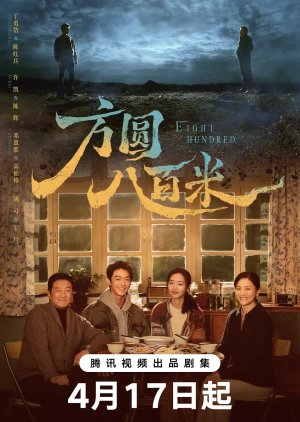
Details
- Title: Eight Hundred
- Type: Drama
- Format: Standard Series
- Country: China
- Episodes: 20
- Aired: Apr 17, 2026 - Apr 27, 2026
- Aired On: Monday, Tuesday, Wednesday, Thursday, Friday, Saturday, Sunday
- Original Network: Tencent Video
- Duration: 45 min.
- Genres: Adventure, Thriller, Mystery, Crime
- Tags: Web Series, Suspense, Police Officer Supporting Character, Police Officer Male Lead, Cold Case, Doctor Supporting Character, Flashback To Past, Family Relationship, Smart Male Lead, 1990s
- Content Rating: Not Yet Rated
Statistics
- Score: 7.5 (scored by 724 users)
- Ranked: #6704
- Popularity: #5701
- Watchers: 3,195
- Favorites: 0


Popular Lists
Related lists from users



Which C-Drama Are We Watching Next?
749 titles 318 loves 37





Historical C-Drama Chronology sorted by Historical Periods
2762 titles 360 loves 71


Chinese Dramas with no air date..till now..
483 titles 39 loves 5
Recently Watched By


