
 News
News 


Source ( 🍓 strawberrymoon 🐷 🦋 🐮 on X)
1) OP: Chen Hui is a stark contrast to the characters you’ve played in the past! you deliberately "stripped away the polish" to portray a young man from a mining community. to better inhabit this role, what adjustments did you make to your daily habits and body language?
Xu Kai : the styling was actually finalized in consultation with the directors during the makeup and costume fitting session; we agreed that Chen Hui couldn't be portrayed as a clean-cut, pristine figure. after the initial haircut, we felt the hair was still a bit too long, so we gave it a few more rough snips, and just like that, it felt like we had truly captured the authentic "Chen Hui vibe." in terms of physicality, Chen Hui is likely in a constant state of guardedness, which is why he sometimes hunches his shoulders
edited
OP: you once mentioned that this character was "quite tragic." while portraying Chen Hui's journey from a sunny youth to a cornered beast in his descent, which specific emotional turning point did you find the most difficult to detach yourself from once the cameras stopped rolling? when a character becomes completely alienated by fate, how do you strike a balance between "empathy" and "detachment"?
Xu kai : the scene i found hardest to detach from was the one where Chen Hui kills Tian Jinhai—it marked a major turning point for the character. up until that moment, Chen Hui might have still harbored a glimmer of wishful thinking; but with that single act, there was absolutely no turning back for him. i felt quite heavy-hearted after filming it. Chen Hui is a morally ambiguous character—someone existing in the "gray zone"—and i was worried that i might portray him as a purely evil villain. of course, he isn't a "good guy" either; rather, he is someone who simply took one wrong step after another
Xu Kai : i felt deeply unsettled after filming Chen Hui’s final scene. i didn’t try to project too many thoughts onto him. i had no intention of pitying him, nor did i wish to condemn him. on the day we wrapped, i posted a black-and-white photo on my WeChat Moments showing Chen Hui crouching in a corner; perhaps, in that very moment, Chen Hui truly yearned for a fresh start—and for me, it served as a solemn farewell
3) OP: Chen Hui is a character open to multi-faceted interpretation: legally speaking, he is a criminal; in his mother's eyes, he is a dutiful son; and for his lover, Gao Songge, he serves as a safe harbor. beyond these aspects, one particular symbol constantly surrounds him—that of the "hero"—a motif reflected in the names of the roller rink and internet café, as well as the posters adorning his bedroom walls. i’d like to ask the actor, Xu Kai: what significance does this symbol of the "Hero" hold for the character of Chen Hui?
Xu Kai : as i interpret him, Chen Hui is a man with a "hero complex"—the posters in his room and the name of his roller-skating rink all serve as proof of just how desperately he yearns to become a "hero." he wanted to shoulder Songge's medical expenses all by himself; he wanted to rely on his own wits to make his way in the world; and he wanted to open an internet café to demonstrate his foresight and forge a new life for himself. however, he took a wrong turn; his understanding of what it truly means to be a "hero" became distorted, leading him down a path of escalating errors until he found himself trapped in a corner from which there was no return
OP: brother XK, i heard that prior to filming, you consulted a vast amount of reference material from the 1990s—searching for era-specific markers like pagers and "Big Brother" mobile phones—in order to better bring your character to life. could you tell us if you discovered any specific props or set pieces on set that felt particularly crucial for capturing the authentic atmosphere of that era?
Xu Kai : Chen Hui's roller rink was incredibly true to life, especially those double-row skates; they really brought back memories of my childhood. the same goes for the layout of our home set, particularly that landline telephone, it felt exactly like the house i grew up in. stepping into these scenes felt just like actually being transported back to the 1990s
OP: you crafted numerous physical details for the character Chen Hui: his hunched posture with shoulders drawn inward, the trembling of his hands while lighting a cigarette, and his physiological reactions when being physically strangled. among these "physical memories," which specific detail do you feel most effectively externalizes Chen Hui's inner sense of being torn apart? after filming the pivotal scenes in the final four episodes, how long did it take you to truly detach yourself from Chen Hui's emotional state?
Xu Kai : i believe it was a trembling of the hands. when Chen Hui strangled Brother Hai, he stared at his own shaking hands, he could scarcely believe that *these very hands* were the ones that had committed the deed. in that moment, he knew there was no turning back. in the presence of others, he was perpetually wearing a mask—never daring to let his guard down—but in that specific moment, he finally cast that mask aside. he was terrified, filled with regret, and had completely lost his composure
Xu Kai : actually, when we were filming, we shot out of chronological order; every time i finished a heavy emotional scene, i would remain in a somber mood for a while afterward. from Chen Hui's perspective, he is utterly desperate; he never imagined that things would spiral to this point. there’s a saying that puts it well: "excusable but unforgivable”
OP: anyone witnessing this ending would feel heartbroken for Chen Hui. if one were to look back at his initial choices through the lens of his ultimate fate—were he given the chance to start over—would he still unhesitatingly embark on this path once again?
Xu Kai : in Chen Hui's eyes, giving up on his family is simply not an option. he is unwilling to lose Songge, just as he is unwilling to burden his parents with exorbitant medical bills. he would still leave Fengyang, firmly and decisive, but perhaps he would choose a new path: one marked by fewer regrets
OP: in the drama, the dynamic between Chen Hui and his father, Chen Hongbing, plays out like a game of "open cards"—his father is in the light, while he remains in the shadows. in every scene facing his father, you had to simultaneously convince him that you had done nothing wrong, yet still convey your underlying tension and guilt to the audience. i’d love to ask: how did you approach performing these scenes opposite your father?
Xu kai : deep down, Chen Hui is terrified that his father will discover the truth; he constantly evades and shrinks away in his father's presence. in fact, whenever i was performing opposite the actor playing my father, i would fully immerse myself in Chen Hui's mindset—even incorporating subtle mannerisms, such as averting my gaze. Chen Hui is a character who requires restraint; he walks through life wearing a mask in front of everyone, which necessitates a minimalist approach to the performance—doing "less" rather than "more."
OP: the character Chen Hui has constantly been swept along by the currents of fate, invariably choosing the most intense path at every crossroads. as the actor portraying him, i’d like to ask: while immersing yourself in and grappling with Chen Hui’s inner turmoil, did you ever find yourself contemplating, on his behalf, that alternative possibility, that "what if"?
Xu kai : as bystanders, we have undoubtedly entertained the thought—what if there were a turning point? however, from Chen Hui’s perspective, the struggle at every crossroads represented a decision he was compelled to make in that very moment. in the scene where he strangles Tian Jinhai, Chen Hui looks down at his hands on the floor and asks himself, "how did i end up like this?"—in that instant, he truly was wondering, "is there no other way?" but by then, there was no turning back
Translation source by strawberrymoon 🐷🦋🐮 on X
OP: in the finale, specifically the scene where Chen Hui shares his final meal of dumplings with his parents just before his execution, you devoured those dumplings ravenously, swallowing them down along with your tears. all the while, you wore a forced smile of ease on your face to comfort your parents, before finally turning back to say, "i will love you both forever." this moment moved countless viewers to tears and has been hailed as the most heart-wrenching, tear-jerking moment in the entire series. what was going through your mind when you were filming that scene?
Xu Kai : this scene was a major emotional centerpiece. on set, we all reached a consensus that Chen Hui shouldn't shed tears; instead, he should face his family with a smile. this choice served a dual purpose: it marked a final farewell to his parents, and it signified that he would finally be free from the constant fear and anxiety he had endured. in my view, Chen Hui is a man of strong character, someone who likely wouldn't utter words he considers overly sentimental, such as "i love you," to his parents. yet, in the very last moments of his life, he ultimately found the strength to say: "i will love you both, forever."
Xu Kai : when we were filming this scene that day, everyone was completely immersed in the emotion of the moment. my father’s eyes welled up, and i didn't dare look at him at all—i was afraid that i, too, would lose my composure and break down crying. if that happened, Chen Hui wouldn't be Chen Hui anymore
edited
Translation source by strawberrymoon🐷🦋🐮 on X platform
OP: the character Chen Hui is far from being a one-dimensional figure defined merely by black-and-white morality; rather, he possesses a complex and multifaceted inner nature. i’d like to ask Kai Kai: how did you interpret Chen Hui’s moral choices and human struggles while confined within such a limited space? furthermore, when shaping this role, which specific details did you choose to emphasize in order to convey the true state of mind hidden beneath his outward demeanor?
Xu kai : as i interpret it, Chen Hui’s fundamental nature is one of intelligence and kindness—it is simply that his cleverness was misdirected. he knows full well the difference between right and wrong; that is precisely why he lives in fear of being discovered by his father, engaging in a constant battle of wits against him. yet, each of his "wrong" choices—viewed within the context of the moment—seemed like the only path forward. he erred with full awareness, yet he had no other choice
Xu Kai : for instance, he originally intended to tell his mother that his father had locked him up at the police station, hoping she would intervene to disrupt his father's investigation. however, just before speaking, he grew concerned for his mother's health, fearing the distress it would cause her, and ultimately, he said nothing at all. in the scene where he kills Tian Jinhai, his hands were trembling, and his voice quivered; he was overcome with panic. in that moment, he realized there was no turning back, that he was destined to descend ever deeper into darkness. such details serve to demonstrate that he is not truly evil at heart
Finished watching this drama,
Xu Kai ‘s brilliant in emoting his emotions with his eyes and facial expressions, sometimes with subtle seriousness and stares.
We feel heartbroken when we see Chen Hui going down with no returning back.. and when he says he loves his parents .. it’s extremely emotional .. but Xu Kai as an actor , won big time for making us to believe him as Chen hui..
♾️❤️🙏🏽
-So 🦋🪷
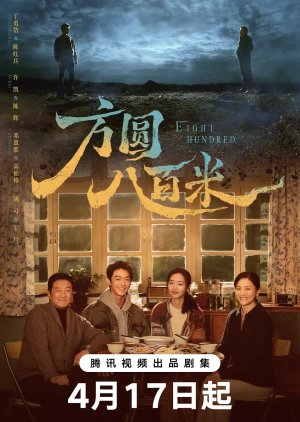
Details
- Title: Eight Hundred
- Type: Drama
- Format: Standard Series
- Country: China
- Episodes: 20
- Aired: Apr 17, 2026 - Apr 27, 2026
- Aired On: Monday, Tuesday, Wednesday, Thursday, Friday, Saturday, Sunday
- Original Network: Tencent Video
- Duration: 45 min.
- Genres: Adventure, Thriller, Mystery, Crime
- Tags: Web Series, Suspense, Police Officer Supporting Character, Police Officer Male Lead, Cold Case, Doctor Supporting Character, Flashback To Past, Family Relationship, Smart Male Lead, 1990s
- Content Rating: Not Yet Rated
Statistics
- Score: 7.5 (scored by 724 users)
- Ranked: #6704
- Popularity: #5701
- Watchers: 3,195
- Favorites: 0


Popular Lists
Related lists from users



Which C-Drama Are We Watching Next?
749 titles 318 loves 37


Historical C-Drama Chronology sorted by Historical Periods
2762 titles 360 loves 71

Chinese Dramas with no air date..till now..
483 titles 39 loves 5
Recently Watched By


