

Cinderella Game

Episode 87 is a masterclass in dramatic irony, but not in the way the writer likely intended. It’s the episode where the drama’s central promise—that family love can heal all wounds—is quietly but decisively proven false.
When Gu Ji-seok’s world collapses after the Richard reveal, he is offered comfort by the person who loves him most: his sister, Ha-na. And in that moment, we see with painful clarity why their bond, though deep, is structurally incapable of reaching the part of him that is truly broken.
To understand why Ha-na’s comfort fails, we have to go back to Episode 26.
1. The Ghost of Episode 26: The Comfort That Worked
In EP 26, after the disastrous memorial where Ji-seok smashes the offerings and fights with his family, he gets drunk and collapses. Se-young finds him and takes him home. The scene then flashes back to their time in the US. Ji-seok wakes up from a nightmare about his parents, crying. Se-young doesn’t ask questions. She doesn’t give advice. She simply wipes his tears and says:
“It must be really hard for you. Every time you dream of your parents, you cry ... Don’t cry alone anymore. I’m here with you, OK?”

She kisses him softly.
And in that moment, Ji-seok—the cold, calculating avenger—smiles. It’s a small, almost imperceptible smile, but it’s real.

Later, back in the present timeline, when he wakes up and sees her, his first instinct is not to push her away, but to pull her closer.
He stumbles out of bed, wraps his arms around her waist, whispering, “Do you want to stay the night?”

Then he leans his head on her shoulder.

This scene is crucial because it establishes what Ji-seok actually needs when he is at his most vulnerable: not a lecture, not a solution, but permission. Permission to be weak, to be sad, to be held without judgment. Se-young’s comfort works because it is purely emotional. It doesn’t try to “fix” his grief; it simply sits with it.
2. The Failure of Episode 87: The Comfort That Cannot Reach
Now, fast-forward to EP 87. Ji-seok’s breakdown is far more severe. This isn’t just grief; it’s an existential crisis. His mentor is a fraud, his revenge is contaminated, and his entire life’s purpose has been rendered absurd.

He stumbles home, drunk and shattered, and for the only time in the series, he verbalizes his collapse to Ha-na:
“What is the meaning of my revenge now?”
“I took revenge on my enemy, but I was helped by my enemy’s husband.”
“I don’t know what to do anymore. Everything is a mess. It feels like a nightmare.”
This is a raw, desperate plea for someone to see the abyss he has fallen into.
And Ha-na’s response is a textbook example of why love is not enough. She says:
- “It’s not your fault. Some connections are beyond our control.” (An attempt to reframe Richard’s five years of deliberate deception and manipulation as “a trick of fate.” )
- “He saved your life anyway.” (A moral argument that imposes a debt of gratitude.)
- “Mom and Dad would probably think the same way.” (She invokes their parents' memory as an emotional trump card, attempting to override his crisis of meaning with the undeniable value of his own life.)
- “It’s okay now.” (A denial of his current reality, which is that nothing is okay.)
 Every one of these lines comes from a place of deep love and concern. But they are all aimed at managing his pain, not holding it.
Ji-seok is a high-pride, high-defense, highly rationalized character. He has spent a decade compressing his trauma into a meticulously controlled revenge plan. For a man like him, the greatest fear is not failure, but shame—the shame of being weak, of being used, of being a fool. When he finally cracks, he doesn’t need someone to tell him what is “right” or “mature.” He already knows those things better than anyone.
What he needs is someone to give him permission to be wrong. He needs someone to say:
- “Yes, this is disgusting. You have every right to feel contaminated.”
- “Yes, you were used. It’s okay to be furious.”
- “You don’t have to figure it out right now. You don’t have to be the strong one. Just fall apart. I’m here.”
He needs emotional containment, not moral education.

While many viewers adore Ji-seok—the strong, intelligent avenger; the cold-on-the-outside, warm-on-the-inside tsundere—they don’t truly know him.
His deepest wound isn’t just "my parents died." It’s "since then, I’ve never been allowed to be weak again."
What truly broke him wasn’t just grief—it was being forced into a twisted state of premature adulthood after losing them. His older sister was sacrificing everything for the family, and he had to grit his teeth and hold it together. Crying, helplessness, dependence, confusion—these emotions weren’t absent; they were long buried, forbidden.
He knew he was hurting. He just didn’t allow himself to show it.
That’s why Se-young’s line in the flashback—"It must be very hard for you" "Don’t cry alone anymore, I'm here with you"—mattered so much: she made those forbidden emotions legitimate again.
In other words, Se-young couldn’t change the traumatic event, but she temporarily changed how Ji-seok related to his trauma. That’s a huge win in itself.
In EP 26, when Ji-seok wakes up and pulls her close, begs her to stay, rests his head on her shoulder—he’s not suddenly healed. He’s finally gone from "someone who has to hold it together" to "someone who can be held for a moment."
That’s the key difference: Se-young didn’t offer solutions, but she offered a container for his emotions. So many people—including Ha-na—do the opposite. They try to give moral direction, standard answers, reasons to "cheer up," but they don’t make space for Ji-seok’s brokenness.
For someone with trauma, high defenses, and a fragile ego, whether comfort works doesn’t depend on how strong the other person is, how capable they are, or if they can fix things. It depends on something simpler: will they let me be messy without demanding I be normal right away?
Ji-seok’s vulnerability isn’t a weakness—it’s a wound. And Se-young was the first person to kneel down and say, "It’s okay to hurt." That’s why their connection cuts deeper than any revenge plot: she didn’t just love him; she saw him. And in a world where he’s spent years being a weapon, being seen is the most radical act of all.
Ha-na cannot provide this. She is the family’s caretaker, its moral center, its substitute mother. Her entire identity is built on holding things together. Her instinct is to fix, to soothe, to restore order. She can pat his back, but she cannot enter his chaos.
The blocking of the scene confirms this failure. Ha-na keeps looking at him, touching him, speaking to him. But Ji-seok never meets her gaze. His body keeps rigid, his eyes are distant. He is physically present, but emotionally absent. He is not being reached. The comfort doesn’t loosen him; it forces him to pull himself back together, to push the emotions back down.
The contrast with EP 26 is devastating. With Se-young, he smiled. He leaned in. He asked her to stay. With Ha-na, there is no smile, no release, no leaning in. He cannot collapse in front of her because she is the very person he has spent his life trying to protect.
3. The Tragedy of the Goo Siblings: A Bond of Duty, Not Intimacy
This is why the Goo family’s love, while real, feels so hollow in the end. Ji-seok and Ha-na are two people standing back-to-back, fighting off the world, but never turning around to look into each other’s eyes.
Ji-seok can tell Se-young why he is cold to Ha-na after the death of their parents while in the US (because he can’t bear to watch her sacrifice herself), but he can never say it to Ha-na in the whole drama. He can never tell her about his suicide attempt, his humiliation by Choi, or the full story of his relationship with Se-young. These are his most shameful wounds, and he keeps them locked away from the person who is supposed to be his closest family.
And Ha-na, in turn, never truly opens up to him about her own heartbreak after Jin-gu’s betrayal. She performs strength for him, just as he performs strength for her.
Their bond is deep, but it is a bond of duty, not intimacy. They can share a mission, but they cannot share a soul.
4. The "Fake Daughter" Arc: Their Bond Is Never Allowed to Be Honest
Another reason this sibling bond never becomes truly intimate is that the script repeatedly refuses to let their trust be tested in the one place it absolutely should have exploded: the Fake Daughter arc.
Ji-seok learns the truth around EP 52, yet he keeps Ha-na in the dark for roughly ten episodes while watching her continue to struggle with her identity, continue to be manipulated by Shin, humiliated by Se-young, and subjected to Choi's machinations. This is not a small omission; it is a deliberate strategic choice that treats Ha-na’s identity and dignity as something he can manage on her behalf. He even goes as far as helping her adopt En-cong specifically to use the child as a "card" to suppress Shin, telling Richard he wants Ha-na to become the true heir of Hyesung Group. When Ha-na, confused by her own childhood memories, comes to him for the truth, he feigns ignorance and brushes her off, hoping she never finds out.
In any emotionally honest drama, this would trigger a catastrophic rupture between the siblings—because it isn’t “protection,” it is manipulation.
The hypocrisy of this "protection" reaches a peak in Episode 63. When Jin-gu comes to Ha-na's house and wants to apologize, Ji-seok reacts with explosive rage, punching him and accusing him of ruining Ha-na’s life. Logically, however, Ji-seok was a silent accomplice to the very same project. While Jin-gu was still naive enough to believe that Shin could be a protective, maternal figure for Ha-na, Ji-seok knew exactly who she was—a cold, predatory capitalist. He was fully aware that by letting an oblivious Ha-na enter that house, he was throwing her into a den of vipers where Choi and Se-young would inevitably target and threaten her. Yet, he allowed his sister to be entangled in the dangerous succession battle anyway, prioritizing his strategic leverage over her actual safety.
The fact that Ha-na and the rest of the Goo family never learn that Ji-seok was complicit in this deception is a massive narrative failure. It means their relationship remains “tight” only because it is never permitted to be fully truthful. The writer essentially seals off the one conflict that could have forced real emotional reckoning: not just about Shin’s cruelty, but about Ji-seok’s own willingness to sacrifice Ha-na’s agency for the sake of a larger plan. Se-young and Jin-gu also know that Ji-seok had already figured it out, yet they do not tell Ha-na either. The script needs Ha-na to remain morally clean, and it needs Ji-seok to remain the protected hero, so it quarantines the truth where it cannot do damage.
Once Ha-na learns that her beloved brother knowingly withheld the truth, the drama would be forced to deal with rage, betrayal, and the limits of forgiveness. Instead, the show skips that settlement, and as a result, “family love” stays a slogan rather than becoming the kind of intimacy that can survive honesty.
4. Conclusion: The Promise the Drama Couldn't Keep
EP 87 is the moment the drama had a chance to prove that family love could truly heal. Instead, it proved the opposite. It showed us that Ji-seok’s deepest wounds could only be touched by someone who was not part of his "duty" structure—and it had systematically destroyed that person, turning Se-young into a functional villain.
What’s left is a protagonist surrounded by people who love him, but no one who can truly hold him. The drama tells us he is healed by family, but it shows us he is simply contained by it.
He is not saved; he is managed.
And that is the quiet tragedy at the heart of Cinderella Game. It’s a story that mistakes responsibility for intimacy, and endurance for healing. It shows us a family that can survive anything together, except for the truth of what they feel when they are alone.
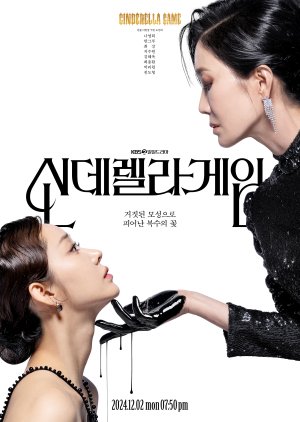
Details
- Title: Cinderella Game
- Type: Drama
- Format: Standard Series
- Country: South Korea
- Episodes: 101
- Aired: Dec 2, 2024 - Apr 25, 2025
- Aired On: Monday, Tuesday, Wednesday, Thursday, Friday
- Original Network: KBS2
- Duration: 32 min.
- Genres: Mystery, Romance, Family, Melodrama
- Tags: Fake Parent, Orphan Supporting Character, Tour Guide Female Lead, Death Of An Adoptive Mother, Chairwoman Female Lead, Power Dynamics, Company President (CEO) Male Lead, Age Gap [Drama Life], Age Gap [Real Life], Death Of A Father
- Content Rating: 15+ - Teens 15 or older
Statistics
- Score: 7.3 (scored by 669 users)
- Ranked: #8919
- Popularity: #6100
- Watchers: 2,816
- Favorites: 0
Top Contributors


Popular Lists
Related lists from users









Recently Watched By


