
 Celebrity


We are back at the age old dilemma of age gap relationships in media. And I’m a firm believer that age gaps can be (and lowkey are) weird and problematic irl. Do I feel the same about fiction? Absolutely not.
And since we’re having this discourse about how uncomfortable it is to even portray certain age gap relationships as romance, even though they’re fictional, I want to take a step back and ask: how much other uncomfortable, morally ambiguous, or outright problematic material are we going to strip away from art in the name of it being “wrong”?
I believe there has to be some common ground where we can accept that art can be deeply uncomfortable and problematic as long as we’re willing to engage with how it is being portrayed. And what does “the right way” even mean? I don't think it necessarily means explicitly spelling out, “this is wrong,” but instead, letting the work itself communicate the discomfort, power dynamics, or consequences present in what it portrays.
That also has to be taken with a grain of salt, because sometimes the uncomfortable element is deliberately presented through the perspective of someone who endorses it. "Lolita", for example, is probably one of the clearest examples of this. The reader is essentially inside the mind of someone trying to make his own actions sound more acceptable than they are. The novel doesn't step outside his narration and explicitly tell you that what he's doing is wrong. Because the disturbing narration itself is part of the art that the reader is meant to interpret critically...or not.
At the same time, I do think artists have some responsibility for the framing of what they create, especially when they are deliberately romanticising the subject matter. But I don't think that responsibility extends to controlling how every individual interprets their work. Art has historically been misinterpreted, and I wonder if that itself has become a part of being an artist, but I don't have a dog in the fight, so I'll stop there. As a consumer of art, though, the audience also has a responsibility to distinguish between depiction and endorsement, particularly when we're talking about fiction.
And this becomes even more complicated (and disproportionately talked about) in romance, because the genre has always played with morally questionable dynamics. Obsession, possessiveness, or age gaps are only a few drops in the bucket. People (and I) who do enjoy these things as fictional devices because they create tension, fantasy, or a moral dilemma (without affecting real people) are the people who don't want anything remotely similar to this irl.
Which brings me back to age gaps. Yes, an age gap relationship can be problematic. But that problematic dynamic itself can be a subject for fiction, whether someone uses it as a plot device, romanticizes it, critiques it, or plainly uses it as a form of artistic expression. And because it is fiction, I think it's even more important to approach it with some degree of separation between what is being depicted and what we believe should happen irl.
What I will say, tho, is that creators should know their audience. If you're deliberately making something morally complicated for an audience you know is likely to interpret it entirely at face value (so common), I think it's reasonable to question the way you've chosen to frame it. That's not the same as saying artists must spoon feed a moral lecture to their audience; it's more about recognizing that framing and context influence how a work is received.
In the end, what I think becomes grating for people who DO enjoy these kinds of stories is the moral policing that happens around the discourse. Finding an age gap romance uncomfortable and arguing that the story romanticizes something unhealthy is perfectly reasonable.
But “I find this morally uncomfortable” and “this should not be portrayed or enjoyed as fiction” are two wildly different arguments. The latter is a claim about what kinds of stories artists should be allowed to explore and what kinds of fiction audiences should be allowed to enjoy, and I don't think personal discomfort alone is enough to police either artistic expression or someone else's engagement with fiction.
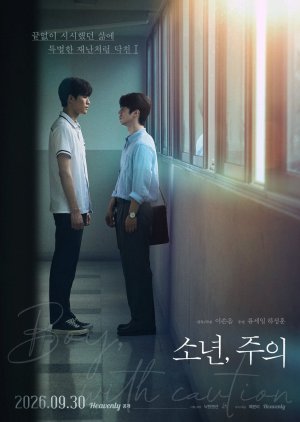
Details
- Title: Boy, with Caution
- Type: Drama
- Format: Web Series
- Country: South Korea
- Episodes: 8
- Aired: Sep 30, 2026 - Oct 21, 2026
- Aired On: Wednesday
- Duration: 25 min.
- Genres: Romance, Drama
- Tags: Web Release, False Rumor, Abusive Parent, Student Supporting Character, Contract Employee Male Lead, Loan Shark Supporting Character, Age Gap [Drama Life], Age Gap [Real Life], Teacher Male Lead, Gay Romance
- Content Rating: 18+ Restricted (violence & profanity)
Statistics
- Score: 7.9 (scored by 475 users)
- Ranked: #3171
- Popularity: #4112
- Watchers: 5,254
- Favorites: 0


Popular Lists
Related lists from users



Korean BL Master List
481 titles 1575 loves 19





gay/bl (Korean)
309 titles 396 loves 10





currently airing BL dramas (updated : 10/04)
35 titles 614 loves 184
Recently Watched By


