- Português (Brasil)
- Français
- magyar / magyar nyelv
- dansk
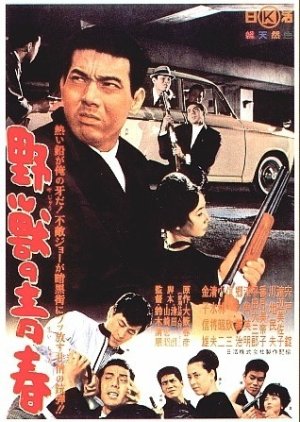
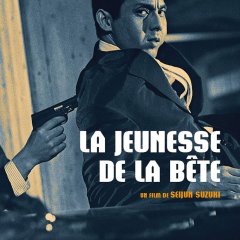
- Título original: 野獣の青春
- Também conhecido como: Wild Youth , Yaju no Seishun , Yajuu no Seishun
- Diretor: Suzuki Seijun, Seizun Suzuki, Horikawa Hiromichi
- Roteirista: Shirasaka Yoshio, Yamazaki Tadaaki, Ikeda Ichiro
- Gêneros: Ação, Mistério, Crime
Onde assistir Youth of the Beast

Purchase (sub)
Elenco e Créditos
-
") Shishido Joe Papel Principal
Shishido Joe Papel Principal -
") Watanabe MisakoTakeshita KumikoPapel Secundário
Watanabe MisakoTakeshita KumikoPapel Secundário -
") Uenoyama KoichiHisano MasaoPapel Secundário
Uenoyama KoichiHisano MasaoPapel Secundário -
") Go EijiTakechi ShigeruPapel Secundário
Go EijiTakechi ShigeruPapel Secundário -
") Kobayashi AkijiTatsuo NomotoPapel Secundário
Kobayashi AkijiTatsuo NomotoPapel Secundário -
") Kiura YuzoMinegishi TakeoPapel Secundário
Kiura YuzoMinegishi TakeoPapel Secundário


Resenhas

Esta resenha pode conter spoilers
“More than expressing myself, I destroy—in my own way.”
Within the highly prolific period of the so-called Nikkatsu Action—particularly between 1960 and 1962—"Youth of the Beast" (1963) stands as one of the most significant turning points in the trajectory of Seijun Suzuki.Some critical readings—often shaped by a rather rigid, auteur-driven perspective—tend to interpret Suzuki’s cinema as inherently pessimistic rather than programmatic, drawing on the ideas of another “outsider,” only seemingly distant, such as Jacques Rivette, who believed that cinema should strip the viewer of clichés and project them into a destabilizing, even unsettling dimension.
A strong idea, one that aligns surprisingly well with Suzuki’s aesthetic: a cinema that does not build, but dismantles, that does not reassure, but exposes. And yet, it is interesting to observe how the so-called B-movies of the late 1950s—apparently indebted to American hard-boiled aesthetics—would, in retrospect, prove to be among the most transformative moments of his career.
From an initially and inevitably imitative model, a gradual stylistic and cultural hybridization emerges, allowing Suzuki to introduce increasingly bold formal shifts: jump cuts not far removed from the lessons of the Nouvelle Vague (particularly Jean-Luc Godard), often eccentric widescreen compositions, sudden visual allegories, and an expressive use of color—elements that break away from the linearity of contemporary productions, which were generally more aligned with international trends (unsurprisingly, these were also the years in which Japan entered the aesthetic orbit of the James Bond phenomenon).
Within this framework, "Youth of the Beast" emerges as a work in which the hard-boiled matrix is not merely referenced, but fully absorbed and reworked. From its very first scenes, Suzuki introduces a key element through the play of reflections inside the nightclub.
Mizuno acts in front of a mirror that is far more than a simple visual device: it becomes a threshold. On one side, the gesture, on the other, the gaze. On one side, the action, on the other, its observation—as if it were already cinema within cinema.
And while all this unfolds, elsewhere—just a few meters away—the cabaret continues as if nothing were happening: music, bodies, lightness. Two planes coexist without ever truly touching, as if the picture itself refused to reconcile them. It is precisely within this disjunction that the first sign of a gaze already out of alignment begins to emerge, ready to fracture what initially appears perfectly readable.
Much of the film’s impact also lies in the magnetic presence of Jō Shishido, whose performance shapes a protagonist that seems to step directly out of the world of Raymond Chandler or Dashiell Hammett—filtered, however, through a distinctly Japanese sensibility.
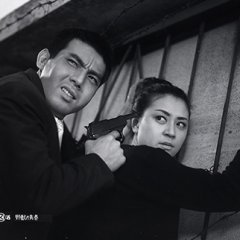
Mizuno is, in every sense, an outsider private eye: a former policeman expelled for unorthodox methods, who inserts himself between two rival gangs in a structure reminiscent of a “servant of two masters,” only to reveal a far more personal objective—uncovering the truth behind his mentor’s death, too hastily dismissed as suicide. It is here that the picture fully descends into the territory of the bleakest noir.
The truth, far from restoring order, ends up eroding everything: it exposes, contaminates, destroys. And when the full picture finally comes into focus, what emerges is not justice, but a form of awareness that is irreparably compromised.
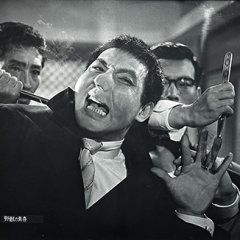
Suzuki builds this trajectory through a mise-en-scène that is violent, stripped down, almost brutal, yet constantly interrupted by visual insertions that resist any single interpretation: elements that seem to drift out of context, such as the yellow dust that invades the assault scene (and then the wind, an indispensable feature in the director's cinematic language), the sudden fall of the addicted woman, or abrupt eruptions of violence and sadism that oscillate between realism and abstraction.
These are images that do not explain—they suggest, unsettle, remain open. In this sense, the work does not simply tell a story; rather, it fractures it, distorts it, placing it under constant tension between narrative surface and something more elusive beneath it.
What emerges is a deeply corrupted world, permeated by a violence that spares no one. Within this universe, the portrayal of female characters takes on extreme contours, often tied to dynamics of manipulation, exploitation, and betrayal.
Seen through a contemporary lens, this aspect may appear problematic—but it can also be repositioned within the grammar of hard-boiled noir, where female figures often function less as causes of degeneration than as reflections of a world already compromised.
In this context, the protagonist’s so-called 'misogyny' appears less as a moral stance and more as the byproduct of an environment in which every relationship is contaminated.
Mizuno himself is neither a traditional hero nor a straightforward anti-hero. He operates according to a personal code—seemingly more stable than that of the other characters, yet far from irreproachable. In a world where everything is tainted, his position inevitably begins to crack: he is not detached from the violence that surrounds him, nor from its most ruthless logic.
The ending, in this sense, is revealing. Mizuno does not simply expose the truth—he actively shapes its outcome, deliberately closing a cycle of violence that leaves no room for redemption.
It is precisely in this gesture—lucid, fully conscious—that the character’s ambiguity comes into focus: not a judge, not a savior, but someone who, while holding onto a personal moral line, ultimately shares in the same dark substance of the world he moves through.
What remains is a sense of emptiness, almost exhaustion—as if, once the mechanism has been revealed, there were nothing left to preserve.
In this regard, "Youth of the Beast" is not only a remarkably effective noir, but one of the most accomplished expressions of the internal tension that defines Suzuki’s cinema: an unstable balance between form and sabotage, between adherence to genre and its gradual dissolution.
An image that offers no foothold, seeks no redemption—and because of this, retains an extraordinary power even today.
9/10
Esta resenha foi útil para você?
Recomendações
There have been no recommendations submitted. Be the first and add one.