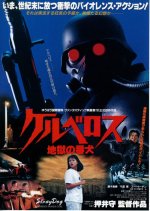
This film is the second episode of the Kerberos feature trilogy. It is preceded by The Red Spectacles, released in 1987, and followed by Jin-Roh premiered in 1999. However the trilogy's timeline is set backward; this film is the prequel to The Red Spectacles and the sequel of Jin-Roh. The film begins with the last stand of the Kerberos unit. After disobeying an order to disarm and disband, they have held out for an unspecified time: talk between the fatigued Kerberos cops suggests that they might have been stuck there for three days, three months, to three years. A power amplifier system issues orders for a final stand and for Koichi Todome, Midori Washio, and Soichiro Toribe to come to the central building. A Kerberos named Inui wanders through the halls of the Kerberos headquarters and then witnesses officer Koichi Todome boarding a helicopter. Angry, Inui feels betrayed by his master and asks why he's running away and not fighting until the end like he has ordered to his men. As the helicopter takes off, the army breach the headquarters. Edit Translation
- English
- magyar / magyar nyelv
- dansk
- Norsk
- Native Title: ケルベロス 地獄の番犬
- Also Known As: Jigoku no Banken
- Screenwriter & Director: Oshii Mamoru
- Genres: Action, Drama


Photos

Reviews

Check your expectations at the door
I feel like I need to check my expectations at the door with the Kerberos films, because Stray Dog has now made it two for two in terms of what the saga promises being vastly different to what it delivers. A voyage of self-discovery and an almost complete inverse of the claustrophobic and highly contained surrealist tone of The Red Spectacles, this film is instead slow, meticulous, delicate and at times insanely beautiful, almost as if Mamoru Oshii is attempting to channel the works of Takeshi Kitano. Scenes breathe, conversations feel incidental, and the camera observes rather than dramatises. It offers brief glimpses and hints to the wider armour-clad world of this tantalising dystopian universe, never fully delivering like its earlier companion piece. Instead, we get a slice of life holiday road trip, cosy and melancholic, usually encompassing a silent exploration of local scenery and Kenji Kawai's wonderfully relaxing musical score, in an attempt to find meaning in downtime. Oshii's direction is remarkably relaxed, the cinematography filled with bustling moments in dense urban environments, a dedicated segment in the portrait of a life. However, the tone frequently shifts between slapstick comedy and over-the-top gags, which ultimately makes the serious moments harder to realise, especially the incredible final act shootout, which felt so rewarding to see, bookending a long stretch of near-idleness. I need more of that in the next films because I don't think I could take being blue balled like this for a third time. While there are definitely elements to Stray Dog I liked, being so quiet, strange and disarmingly casual, it all feels in service of a saga that squanders its awesome setting. Here's hoping Jin-Roh delivers...