

### Drama-Watching Diary – Episode 7
**09-09 23:07**
**Views: 86**
https://imgur.com/a/epOFfKz
**Moonlight Song**
Ye Haitang’s mother singing *“Moonlight”* was added on the spot. I wanted the song to have an origin for Atang, since her mom used to sing it to her when she was little.
I talked to the music teacher, and she learned and performed it live during filming. A shout-out to the child actress Xiao Shunli who played young Ye Haitang — nearly half of her role was crying scenes. She was genuinely terrified of Ye Yibo, the kind of fear where just seeing him made her scared.
The actress Lu Zi, who played Wu Fengying, is incredibly talented. All the home scenes were finished within one day — and it was all emotional material, very tough and exhausting for an actor. The mom’s styling was exactly like how I remembered factory-area aunties looked when I was a kid.
The first time I heard *“Moonlight”* was in middle school, watching a Beyond band concert on VCD when Wong Ka Kui played and sang it. It left a deep impression.
I told the screenwriter I wanted a song Atang could sing to Axun — ideally a children’s song — and they thought of this one. In the show, the character sings it about four times. It’s also used in the OST many times, and it works well.
https://imgur.com/a/6bTHWpD
**I’m not very good at creating suspense/crime vibes**
The scene of discovering Ye Haitang’s body in 2026 was filmed right after a heavy rainstorm. The atmosphere worked well.
There was originally another scene showing a young couple fishing and finding the body, but in editing it felt too drawn-out and was cut.
https://imgur.com/a/4aqB81T
**Real hospital basement**
The three scenes with Yunan and Cheng in this episode were shot in a real hospital. The acting and blocking flowed seamlessly.
For the quarrel scene between Cheng and Yunan in the parking garage, I had already decided during the location scout to film it as silhouettes, to add a suffocating atmosphere.
Special praise for Huizi’s scene where she runs out and sits on the steps. We chatted beforehand, and I asked her to deliver the voice message to her dad with the same aggrieved tone a child would have. We used three cameras. After one take I was already in tears, and I knew we didn’t need another.
Technically, this was a very difficult scene: fear ➡ denial ➡ panic ➡ grievance ➡ composure ➡ toughness, with even subtler emotional shifts. I hadn’t expected her to confront the police head-on, but later we agreed it was a stress reaction. Overall, this almost solo scene was nailed by Huizi — precise, controlled, not falling into just “a breakdown.”
I’m also sharing a screenshot of our chat after the scene (with her permission), so you can see her own thoughts at the time.
**Some production notes**
* A building in the background was originally new and pink — we aged it with CG.
* In Ep. 7, Sun Miaomiao officially joins the “Mailbox Protection Squad.” The actress Cao Yixin is also from Northeast China. In fact, almost all 2026 Beixing storyline roles — from police to demolition office — were cast with Northeastern actors for authenticity.
* During script read-throughs, Zhang Baiqiao and Cao Yixin even debated which specific Northeastern accent to use, which taught me new dialect tidbits.
* Their mailbox scenes were shot very quickly, often improvised without rehearsal.
Fun fact: screenwriter Cheng Xiaomao originally wrote Sun Miaomiao for herself, and was a little bitter I didn’t let her play it. But she admitted Teacher Cao’s acting was better.
Before filming I asked Cao to gain weight, but it didn’t really work.
**Note:** Wielding a kitchen knife is dangerous behavior — don’t imitate it.
https://imgur.com/a/KqiK3Oy
**Key moments**
* Atang’s line in this scene is a gem — very refined writing by the screenwriter.
* The scene where Atang gives her dad the house was reshot. In the first version she was tough and cool, but I felt by then she had hope and inner support, so nothing Yibo said could shake her. After talking with the writer, we reshot it the next day.
* Shen Xiaojun’s breakdown from sneaky to fully cracking — watching it live was cathartic, but very hard on the actor, requiring many takes until his hands were swollen. We debated whether to use school uniforms, and decided not to; research showed by then many schools already had uniforms.
https://imgur.com/a/KkdfKHQ
**Costumes and props**
* Axun bought three dresses and a pair of shoes under Haozi’s persuasion, spending over 100 yuan. Haozi was written as trendy, a Chow Yun-fat fan, believing that even if you’re poor, you must dress well for pride. There was even a deleted scene in Ep. 1 of Haozi preparing clothes for Axun.
* Atang never wore skirts originally, since she didn’t want anyone to see her scars.
https://imgur.com/a/tQHY7X0
This rain-soaked playful scene had a rough fate — we issued four shooting notices but for various reasons it never got filmed until later. Originally, I wanted to shoot it under that big bridge arch, but then Songkou Ancient Town was hit by flooding, so we had to move to Meizhou.
For this scene, I wanted to recreate the vibe of the La La Land mountaintop sequence between the leads — so I had them hold hands, spin around, and we just captured spontaneous moments. One shot had the water pouring down too heavily, which actually looked a bit distracting, but their energy was so good that we kept it in the edit.
For the music, I was worried that using “Spring Blossoms” would feel too sad, but with any other track it just didn’t have the same flavor.
Xiao Zhou actually contributed quite a lot of ideas for this scene, haha.
**Firecrackers**
Took many tries — the Meizhou humidity made it hard to light both strings at once. Finally got lucky before props ran out. Some extras were locals watching the fun — I liked the realism. Locals were very kind and even helped actors with Hakka pronunciation.
https://imgur.com/a/yhGSiQH
**Other highlights**
* Billiard hall reopening was a rare happy shoot — lots of bonus footage and photos. Everyone dressed in their best outfits. Atang wore the polka-dot dress Axun bought her. Haozi really loved it, though Axun thought it didn’t suit her and bought it for Pearl instead, spending all his money. Brother Cha’s green suit was his only decent piece, worn only for big occasions.
* Behind-the-scenes shots: crew working hard, shy Brother Cha, cinematographer doubling as supporting actor.
https://imgur.com/a/gjc4QFX
**Fat Dog**
Played by Cai Jiaxin, a local theater troupe director. Originally the screenwriter Cheng Xiaogou wrote it for himself, but tore his cruciate ligament playing basketball and had to drop out. In hindsight, Cai fit better: he had to eat constantly and never blink in scenes.
Fat Dog and A’Bao are orphans, brothers four years apart. The younger is mentally challenged, always scavenging and eating trash, while A’Bao as a child starved himself to feed him, stunting his growth. A’Bao is cunning and cruel, never doing the dirty work himself, while his brother always carries a bayonet.
Growing up in the mid-90s, I saw many such delinquent kids around schools. Most didn’t end well. Grateful for the government’s crackdown on organized crime, which gave us today’s safer environment.
---
**From Episode 7 onward, the plot density increases a lot — it may take me a long time to write each diary entry.**
---
Drama Watching Diary EP08
I’ve been busy wrapping up the filming of *Liaozhai*, and finally have time to write about Episode 8. This episode has the heaviest emotional intensity.
We used a non-linear narrative structure here. Honestly, I knew while filming that it was a risky choice—since the story already had dual timelines running in parallel. Sure enough, after the broadcast, some viewers felt a little confused. But I still believe this was the right decision. We don’t have many episodes, so we can’t break everything down into tiny pieces.
When talking with our screenwriter Kitty about this episode, we realized that if we followed a conventional linear approach, the drama would feel flat and lack punch. So we made the bold decision: just jump straight to the “post-murder in the original timeline” segment. Drop it like a hammer—direct, fierce, and impactful.
This episode took the longest to edit. The rough cut was an hour and a half long, which obviously wouldn’t work. We kept trying to simplify the narrative. My memories of editing this episode are: arguing, messing around, being moved by new cuts, and eating steamed dumplings.
Editing is really about finding the one right path through a vast forest of footage.
https://imgur.com/a/lM1XhUW
Shot in Meizhou on my phone—you’re not mistaken, that was the 13th draft. The earliest title the screenwriter gave it was this.
https://imgur.com/a/k6ghCpK
The scene in front of the shop is also a time-jump—it’s from when Tang was working at the dock (Episodes 11–12).
That crystal ball gave us so much trouble while filming—it would spin or not spin, light up or not light up. Whether the shot worked all depended on its mood.
The window-climbing scene comes from my childhood memory. Shopping malls used to have ground-floor display windows full of TVs, often playing gunfight movies I’d never seen.
https://imgur.com/a/KTJBJC4
Here, Atang even acted spoiled so Axun wouldn’t spend money… I actually laughed out loud while filming.
https://imgur.com/a/REHg0tr
I remember using a diffusion filter here, so the candlelight would bloom on camera.
The birthday scene is one of the warmest and most romantic moments of the drama. All three of Axun’s wishes were about Atang—so simple and sincere.
The emotional performances from the two actors were incredibly moving and real. Almost all done in one take, shot very quickly. Pay attention to Zhou’s subtle expressions as Wang’s performance moves him—just one scene ago he’d said, “What’s the point of men celebrating birthdays,” but here he’s deeply touched. It’s not that he doesn’t yearn for beauty, it’s that his past made him believe such things had nothing to do with him. But when someone actually lights candles for him—even with a fake cake—it warms him completely. After all, he’s still just a kid.
I love these “small cut” emotional moments. Accumulating countless tiny beats leads to a transformation, ultimately changing Axun’s desire—to settle down and live peacefully with Atang.
https://imgur.com/a/bBTZtaq
For the seaside scene, I didn’t want to show the killing process or the corpse. I felt those would only distract and weaken the emotions.
Both actors originally wanted to act with more physical movement, thinking it would express emotion better. But I told Axun: right now is a moment of panic—you must force yourself to stay calm, suppress your emotions, and persuade Atang that this has nothing to do with her. Of course Atang would never accept that, so the conflict arises naturally.
https://imgur.com/a/1PYPJDa
*(Camera angle 1)*
https://imgur.com/a/0j6uTpE
*(Camera angle 2)*
Their performances were so powerful I couldn’t shoot many setups. Instead, I filmed using a two-camera cross-shoot (each camera capturing close-ups of one actor). Because their performances varied a lot in each take, reacting emotionally to each other, it was impossible to replicate exactly. Normally I avoid this approach to maintain perfect lighting, but here performance outweighed lighting. Let the acting shine, even if the lighting isn’t flawless.
I saw behind-the-scenes footage—after finishing this scene, the two actors couldn’t get out of character for a long time.
https://imgur.com/a/geVJPxA
The police station confession scene was another day. It was a heavy scene. That night, rain suddenly poured down again. We waited, but it wouldn’t stop. Finally, I said, “Let’s shoot in the rain—it fits the mood.” When filming Axun walking forward, I suddenly thought he should look up at the rain—one last moment of freedom. I grabbed the walkie and told him mid-scene to lift his head. He understood instantly and slowly looked up—perfect.
https://imgur.com/a/1jntTtE
The extra police character was played by Liu Zhehun, who just wrapped another project and dropped by our set. He’d played singer Wang Ke in my previous drama *Miss You*. That day, I asked him to throw on a uniform and cameo as a bumbling trainee cop.
I honestly didn’t know what 1990s police would do when faced with a suspect turning themselves in, and I didn’t want to get it wrong. Our assistant director even called up an old police contact, who explained the standard procedure: squat down, hands behind head, search.
https://imgur.com/a/osz4I0q
1st photo - sense of brokeness
3rd photo - wall scratched up
After Atang shows up, Zhou insisted the police must restrain and hold her down—since her emotions would be intense. But during filming, the policeman next to Ye Haitang just couldn’t control her at all. Lulu’s strength is incredible—she clung to the wall, wouldn’t move, and they couldn’t pull her away. In the end, we had to give in for the scene to work.
Lulu is an actress who never holds back emotionally. If she had to really fight me, I probably couldn’t beat her.
Here, the a cappella version of *Moonlight Light* truly elevated the moment.
https://imgur.com/a/2fLwCyH
the two actors waiting for cameras, still unable to leave character
https://imgur.com/a/MIfL2F2
About the prison scenes—we had a big headache in prep. Normally, filming in an actual prison is almost impossible. Alternatives are to find a suitable location to convert or build sets. But since we only had a few prison scenes, building sets was out of budget. Plus, I needed *two* prisons: one in use and another being demolished—almost an impossible task.
And yet… our incredible location producer found a real abandoned prison in Meizhou!!!! That was one of those miraculous things about this drama—we always managed to conjure a location to film.
Inside the real cells, the atmosphere was heavy and suffocating. The ceilings were extremely high, at least six meters.
This was also where Atang and Axun wrapped their final scenes of the entire series.
https://imgur.com/a/zr319En
cast photo with cellmates, minus Yu Zhiyong
https://imgur.com/a/2i7P1tM
“budget burning”
For Atang’s college entrance exam scene, we used a huge number of student extras. Bad kid Zhou Peng even helped by giving acting directions to the extras.
near Axun’s home
silhouette
Originally, this scene was written at the police station entrance. But right before shooting, I wanted to move it somewhere quieter. So Lulu, the crew, and I wandered along the riverside, looking for a location—walked really far until we found this spot.
That day felt like being back in my early 20s, when I had just started filming—scouring the city with a group of people for usable locations. Lulu joked, “I bet you’re trying to find somewhere that makes me look lonely for this scene.” She’s an interesting person—dry humor, but very serious too.
I remember once she suddenly asked me outside a bookstore, “What do you think the world will be like in 20 years?” I honestly couldn’t answer.
https://imgur.com/a/T5YHEvd
The orphanage scene was actually filmed inside an abandoned factory. Its front gate doubled as the mental hospital entrance. The place looked great visually, but unfortunately, the script didn’t leave much space to use it more.
https://imgur.com/a/Luy3tTl
The scene with Haozi coming to find Atang took two days. On the first day, we lost daylight too quickly and couldn’t finish, so we had to return the next day.
https://imgur.com/a/S8mvMdx
For the seaside scene where Atang breaks down, the waves were huge. I worried a wave might sweep Lulu away, so we tied a safety rope around her waist. Unfortunately, one of our cameras got hit by a wave—water damaged it. The gimbal stabilizer died on the spot. The department head was furious.
Later, Axun’s rapid information-overload flashback was crafted really well by our editor.
One thing I still complain about: that day’s shooting schedule was insane. We only visited that seaside location once—but had to shoot *everything*: the montage of them running and playing happily, the despair-suicide scene, Axun burning the letter, the confrontation with Ye Yibo, the murder scene… basically all the seaside sequences in the entire drama—shot in one single day!!
The actors had to bounce repeatedly between extreme joy and extreme breakdown. The filming pressure on me was massive. I understood we had driven hundreds of kilometers from Meizhou, so it wasn’t practical to come back again. But in hindsight, if we’d had just one more day there, the results would’ve been even better. At least it didn’t rain that day—thankfully.
https://imgur.com/a/XONGs1f
abandoned prison’s real gate
https://imgur.com/a/sUgF5V5
The “burning the letter after release” scene was the very first scene we shot that morning. The sea wind was so strong the lighter couldn’t ignite the paper. Actually, there’s a continuity error—what you see is us cutting around it: we poured some alcohol to finally get the paper lit.
Originally it was supposed to be a crying scene, but I changed it—I thought it should be laughter instead. Reading that Atang was doing well, why cry? It should feel like relief and comfort.
https://imgur.com/a/2KrRy6u
From Axun getting his new ID card to returning to Meiwan, some time had actually passed. We prepared two wigs of different hair lengths to show this.
The wig was very realistic—but it cost extra time every day to prepare.
https://imgur.com/a/2lDS9vd
Grandma passed away, but Pearl carried on running the sweet soup shop.
After Haozi’s release, he really did live a steady life. Originally, there was a scene where some new generation punks came to eat without paying and stir up trouble, with Haozi smoothing things over with a smile. But it slowed the pace, so I cut it.
Looking back, I regret not giving him more physical traces of working-class life—like burn marks from frying skewers, or some oil stains. He looked a bit too clean. A pity. These two kids, who once loved fashion and appearances so much, had been worn down by life into plainness.
By the way, the sweet soup shop grandma and their relationship with her never got much screen time. She was Pearl’s real grandmother. Pearl’s parents left long ago and never returned, so Grandma raised her—despite Pearl having polio.
Grandma also watched Cha-ge’s gang grow up—she was annoyed by them all the time. Cha-ge, feeling bad for Pearl, let her sell tickets at the video hall so her work wouldn’t be too hard. The sweet soup shop was also the group’s favorite hangout. Back then, there weren’t many snacks—drinking a bowl of osmanthus syrup felt like happiness. Shops like that later evolved into modern milk tea stores.
When Axun and Haozi were kids, they often stole money from Grandma’s stall. She never confronted them. Cha-ge always noticed and secretly returned the money.
https://imgur.com/a/A2PwFoo
This river became a powerful visual symbol for Meiwan.
Originally, the scene of Axun meeting Haozi after release was set at the sweet soup shop. But I thought it was too public—too many people around. And I didn’t think Axun would want to bring it up in front of Pearl, since she was deeply traumatized by “that incident.” He wouldn’t want to trigger her.
Seeing Haozi living a stable, happy life, Axun wouldn’t disturb him. He wouldn’t bring trouble to his brother. That’s why Pearl never even knew Axun had come back once.
So I relocated the scene to this more secluded spot. Thanks to Songkou Ancient Town—walk a little further, and you’ll always find a new location.
https://imgur.com/a/Lyk06PX
This scene actually covers a lot: about Cha-ge, about their lives over the years.
It’s a long scene. After shooting, one of our normally quiet producers told me it made him cry, and begged me not to cut a single line.
On set, we did add lines—like Axun telling Haozi to make sure his kid goes to university. That was every parent’s biggest hope back then. They had all suffered for not having studied properly.
The theme of “study hard” shows up countless times in the drama. That’s definitely me inserting my own values—I want the audience to hear it.
When I was young, I never met any good teachers, and I wasn’t obedient. I kept transferring schools, never went to a proper university. Instead, I went to an art school for music—which was its own interesting experience.
But growing up with knowledge, and being among better classmates—that’s very important.
Seven years ago, I filmed *Gank Your Heart* starring Wang Yibo, about e-sports. After it aired, I got a private message from a student who said she was inspired by the show, and wanted to work hard like the protagonist Ji Xiangkong. She promised to study hard for high school entrance exams. Later she messaged again to say she got into a key high school.
I was shocked—an idol drama could have that effect? It gave me a sense of responsibility.
Back to the acting: this sequence was a huge turning point for Axun. Ten-plus years had passed, everything had changed. The characters underwent massive time leaps. We had no space to show what really happened during those lost years. But from their performances, you could see the toll of life—not just different appearances. Their acting style, pacing, reactions—everything felt like they had become new people.
https://imgur.com/a/Dua646M
The final hug here was very touching.
In the end, Axun never sought out Haozi again. He didn’t want to disturb anyone.
https://imgur.com/a/RdzDZ2h
This sequence was shot over two days: one for the childhood version, one for the present. The color tones are slightly different too.
https://imgur.com/a/vEOy9cy
‘Tang Yixun watched the three of them walk away, and the days of youth and recklessness he shared with Haozi and Li Chadong flashed back to his mind. Those once reckless and arrogant hooligans were now completely different.’
When I first read the script, I was deeply moved. But I didn’t know how to best adapt it into film language. Flashbacks would work, but felt too ordinary.
Then I remembered an old movie, *Cyborg She (My Girlfriend Is a Cyborg)*, where the protagonist time-travels and sees his younger self with his grandmother.
So I thought: why not let the characters reappear in that scene—having the 30-year-old Axun cross paths with his younger self? It better expresses the “things have changed, people are gone” theme the screenwriter wrote. Surreal, but effective.
On filming day, I even pulled up the reference scene for Zhou to watch. That’s how we got Axun’s iconic “two-stage laugh.”
What he actually saw was the moment from Episode 1 when they first appeared, going to Ye Yibo’s house to collect debt. Carefree, cocky laughter. Lines like “Buy Axun a robot” and “Marry Sister Xin” were all improvised by the actors in the moment.
https://imgur.com/a/J8BRTw7
The boat symbolizes the boys’ dreams.
https://imgur.com/a/vplPQF8
Cha-ge really did buy a boat—though he never took it out to sea. But Haozi was right: don’t worry about Cha-ge, he’s Cha-ge, he’ll always be cool.
Filming this was tough—we were on another boat, far away, hard to control Cha-ge’s boat direction.
https://imgur.com/a/EembEff
This cemetery was stunning. I rejected many other sites before finally finding this one in Fuzhou, more than 200 km away.
Once inside, everyone naturally spoke more quietly. It was peaceful. We filmed in an area that hadn’t been sold yet.
I’ve already written on Weibo about the cemetery performance, so I’ll just add here for those who missed it.
translations can be seen in my earlier post
cemetery atmospheric shots
We captured some really beautiful establishing shots here.
https://imgur.com/a/FdeiWYE
For this phone call scene, Xiao Zhou insisted that I first perform for him exactly how to dial the number sequence — it was too heavy for him. Once he entered the role, he was genuinely afraid of doing the scene.
The convenience store was actually a real shop across from Grandma’s sweet soup shop, which we remodeled into the set.
https://imgur.com/a/qObJhjV
The phone call scene was actually Lulu’s very first scene after joining the crew (her second was the domestic violence scene). Beside her was Xiao Shen Cheng. The location was Shen Cheng’s actual home. Lulu came very early that day and sat at the monitor, watching Shen Cheng and Yu Nian rehearse their family argument.
https://imgur.com/a/5yjzUTS
For the scene outside Yu Zhiyong’s house, I deliberately waited for a train to pass through the background, which gave it a really nice atmosphere.
This location was in the outskirts of Harbin, a very neat little village.
https://imgur.com/a/rWlvu2t
In this scene, Axun has almost no lines — just some subtle eye contact with Yu Zhiyong’s mother. He helps her sustain a “kindhearted lie.” It’s a very heart-wrenching scene; you can really see Axun’s inner conflict. He stuffs down several big bites of food before finally forcing out that line: *“From now on, I’ll cook for you every day.”*
The little girl (Lin Yimo) acted beautifully as well — when Grandma coughed, she went to fetch medicine all on her own. That wasn’t rehearsed — she slipped into character and did it naturally. We were all stunned.
https://imgur.com/a/F79FZad
This was Zhou Yiran’s very first scene after joining the cast. After just one rehearsal, I felt he already nailed what a man in his thirties should carry. This role was his.
To be honest, I think “big emotional” scenes are easier to achieve. The hardest ones are these — the kind without a standard answer.
A few years ago, my mother was hospitalized in the ICU. I sat outside the ward every day, just like Axun. Waiting until the director finished rounds so I could get a few words in about her condition.
One day, two brothers surrounded the doctor to ask about their father’s illness. The doctor replied, “The situation isn’t good. You’d better prepare funeral clothes.” The brothers just stood there quietly for a while, then walked away.
I took that exact line from the doctor and put it into the script, and also told Zhou about my memory of that day.
When people face something like this, they’re usually in shock — blank.
The original script even had a burial scene for Yu Zhiyong’s mother, but I didn’t film it. Too unbearably sad.
https://imgur.com/a/8aPutu0
On set.
There was actually another version of this scene — Xiao Zhou waiting for the bus with little Yu Nian and taking him on board. After filming it, Zhou felt like he was “kidnapping a child,” but I thought it was fine.
In the final cut, we used an empty shot of a car passing by to transition, and kept the focus on the dialogue inside the car.
That day was chaotic at the location — traffic constantly going back and forth. I wanted a bleak, desolate mood, but we could only shoot in gaps between cars. Luckily, a tree in the distance gave us a solid visual anchor.
https://imgur.com/a/8umbbLJ
For this setup, only one side could be used for shooting. The reverse side was right against residential buildings and didn’t look good. So we cheated the shot a bit — had the actors turn around, pretending it was the reverse side.
https://imgur.com/a/eKbY9Ke
This was filmed just outside the Harbin shipyard. I loved this spot the moment I scouted it.
https://imgur.com/a/6V5j2gr
The montage of looking for odd jobs — I think the acting details were handled really well.
https://imgur.com/a/lwP5TxB
This scene was an extra pickup shot. Looking at it now, the hat seems too new — it should’ve been aged and dirtied.
https://imgur.com/a/Vc42mrd
That transition shot was definitely intentional. It wasn’t for showiness — it was to express the meaning in the context. Carrying bricks is to support and lift your future.
https://imgur.com/a/Wrqxjx1
This was a really beautiful moment.
The shot was done all in one take: the two run left out of frame, Zhou quickly changes clothes off-camera, then the 7-year-old Yu Nian runs in. In post, we added special effects of plants sprouting and growing to mark the time transition.
We filmed two versions of this transition. The other one was indoors: blowing out candles, then cutting to 7-year-old Yu Nian. In editing, I decided this outdoor version was more beautiful.
https://imgur.com/a/ox3MR8c
This was also near the shipyard — only from this angle does it look best. That day a flock of birds came flying by, and we caught some shots. They were used in the very first trailer.
location-scouting photo
https://imgur.com/a/nuckZ0T
Xiao Mei (played by Teacher Gao Fei) is a character I really like — warm, open, genuine, not pretentious. She’s straightforward, and Axun understands what she means. But his heart simply has no room for anyone else anymore.
Every actor in this series, no matter how small their part, treated it with seriousness.
https://imgur.com/a/YiPdXKS
The transition into old Tang was a point of debate. I struggled — I wanted a transition, but not something so flashy it would weaken the audience’s emotions.
In the end, we went with the simplest method: an in-frame/out-of-frame shot. The cinematographer shot the same camera move twice, then we did a simple dissolve in editing. No VFX at all.
No tricks here — the emotions carried it. The two actors delivered perfectly in sync. Looking back now, we probably should’ve held the old Atang shot one second longer in the edit.
At the time, I even thought of digitally enlarging the trees to show decades passing. But then I dropped it. Any flashy effect would only distract from the emotion.
https://imgur.com/a/MKNOW4T
Old Atang’s voice was dubbed by Teacher Qiuqiu, who was also our dubbing director. She voiced “Fourth Sister” in *Black Myth: Wukong*, which made her very popular.
During the dubbing, Ren Youlun was in awe. He’s a gamer and loved that character.
https://imgur.com/a/R7mFEUV
Here’s a missed shot from the elderly group. At the monitor, people were already crying. Parting in life is even sadder than parting by death.
The song *“When Spring Blossoms I Meet You”* truly fit the series — it was suggested by producer Cao Siqi.
Our producers really loved this drama. None of them treated it as just a job.
Even after the series finished airing, Teacher Mianmian kept urging me to keep updating these diaries.
By the time I wrote Episode 8’s diary, I realized it was basically turning into the old “director’s commentary tracks” you’d find on DVDs — the director sitting there, watching the whole film, talking through it.
---
This was a sad episode. It was long, and I spent many days writing about it.
I will finish all 12 episodes.
Almost six o’clock now. I wonder what the weather is like in Meiwan.


I'm almost finished with Ep 8. I'd asked a prior question of whether to watch then read your thread or to read before watching. I found watching then reading ep by ep to be more helpful, if you can call wanting the drama to last longer helpful. It has a hold on me for some reason. Thank you for being such a sweetheart in taking your valuable time to write this thread.

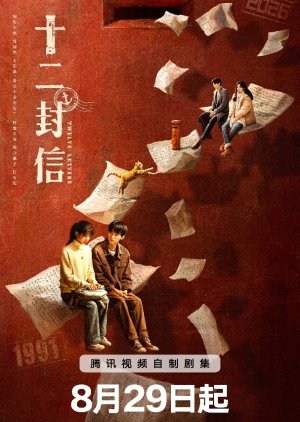
Details
- Title: Twelve Letters
- Type: Drama
- Format: Standard Series
- Country: China
- Episodes: 12
- Aired: Aug 29, 2025 - Sep 1, 2025
- Aired On: Monday, Friday, Saturday, Sunday
- Original Network: Tencent Video
- Duration: 45 min.
- Genres: Thriller, Mystery, Romance, Fantasy
- Tags: Web Release, Emotionally Strong Female Lead, Town Setting, Debt Collector Male Lead, Dark Fiction, Two Timelines, Hardworking Male Lead, Hardworking Female Lead, Unconditional Love, Smart Female Lead
- Content Rating: Not Yet Rated
Statistics
- Score: 8.8 (scored by 6,266 users)
- Ranked: #145
- Popularity: #1358
- Watchers: 18,714
- Favorites: 0
Top Contributors


Popular Lists
Related lists from users







Recently Watched By


