
 K-Drama




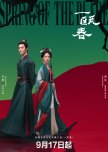
a beautiful blade, poorly forged
Spring of the Blade had been on my watchlist mainly for Zhou Ye and Xu Kai, so naturally, I had high hopes. Thankfully, their pairing delivered. Their chemistry is one of the drama’s greatest strengths—there is something wonderfully playful in the way Xie Qingyuan and Shen Run constantly test, tease, and outmanoeuvre one another. Zhou Ye also gave Xie Qingyuan a lovely sense of intelligence and strength; her character gradually unfolds into someone capable and decisive, and her past and motivations are given enough room to make her journey feel complete.
The revenge arc, which serves as the heart of the story, was also handled rather well. The secrets were revealed gradually, piece by piece, and I enjoyed watching the truth emerge beneath everything that had happened. My difficulty lies more in everything surrounding that central story. I have not read the novel, so I can only speak from the drama itself, but I often found myself wondering whether the story simply needed more time—or perhaps less of it. There are episodes filled with conversations and detours, yet some of the most important parts of the characters’ lives feel strangely absent. Shen Run is the clearest example. His family was massacred overnight after being accused of corruption and treason, leaving only him and his brother alive. From such a painful beginning, how did he eventually become a highly respected official, trusted and favoured by the new emperor? I wanted to understand that journey: how he survived, what shaped him, and what brought him to the person we meet in the story. Unfortunately, much of it remains only a shadow. I heard that some of Shen Run’s storyline may have been affected by production difficulties, and if so, I can only feel sorry that Xu Kai’s character was unable to receive the depth he deserved. The revenge may have reached its destination, but it could not entirely make up for the parts of Shen Run’s story we never had the chance to see.
The pacing becomes especially difficult in the latter half, when the story spends so much time around the Xie family that Shen Run sometimes feels almost like a supporting character in his own story. The final episodes were particularly frustrating, because our two leads received surprisingly little meaningful screen time. Even the political side of the story often feels distant: there is an emperor, there are ministers, accusations and impeachments, yet we rarely see the court itself or the confrontations that should give these events their weight. The Marquis’ death and sacrifice, for instance, are largely explained rather than experienced. I also had mixed feelings about Second Lady Xie’s ending. After everything she had done, I expected a more meaningful consequence. And Li Chongxin himself was such a quietly tragic character—betrayed by the people he trusted most, yet still gentle enough to want to help others. Perhaps that gentleness is also why he could never truly be the person Xie Qingyuan needed beside her.
Despite my reservations about the writing, I cannot deny that Spring of the Blade is a beautiful production. There are many lovely compositions, thoughtful camera angles, and moments where the directing captures the atmosphere beautifully, even if the focus occasionally felt somewhat misplaced. The soundtrack also complements the story well. I have heard that the production may have faced financial difficulties, and if that is true, perhaps it explains some of the limitations that become noticeable along the way. It is a little bittersweet to see such a promising production feel as though it had to make compromises.
In the end, I am grateful that I watched it for Zhou Ye and Xu Kai, because their chemistry was every bit as enjoyable as I had hoped. If you come for their quiet provocations, playful exchanges, and the pleasure of watching two clever people circle around one another, there is much to enjoy. The revenge story itself also keeps its promise and eventually brings its secrets to light. But for me, the drama leaves behind a lingering feeling of what could have been. The pieces were beautiful—the actors, the chemistry, the premise, the atmosphere—yet some of the most important pieces never quite found their place.
Was this review helpful to you?


