

Completely Horrible
The live-action adaptation of Omniscient Reader’s Viewpoint, released as Omniscient Reader: The Prophet, is an unfortunate example of how a complex, beloved narrative can be reduced to something shallow and commercial. Despite the high production budget and a cast filled with recognizable names, the film lacks the emotional weight, narrative structure, and character depth that made the original work resonate with its global audience.
The most glaring issue lies in the storyline. Instead of faithfully adapting the layered plot of the web novel—which explores trauma, survival, and moral ambiguity—the film simplifies the narrative into a generic survival fantasy. Critical concepts such as the "Omniscient Reader’s viewpoint," the bookmark ability, and the intricate progression of the scenarios are either completely removed or barely acknowledged. As a result, the film feels rushed, disjointed, and emotionally disconnected. Major arcs are skipped, key character relationships are underdeveloped, and the plot concludes at an arbitrary point that offers neither closure nor intrigue.
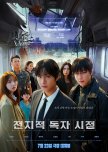
Characterization suffers heavily as well. Kim Dokja, who in the original is deeply introspective, morally gray, and defined by his loneliness, is portrayed here as a one-dimensional protagonist with little to no internal conflict. Ahn Hyo‑seop gives a competent performance but lacks the intensity and subtle complexity the role demands. Lee Min‑ho, cast as Yoo Joonghyuk, brings star power but fails to embody the cold, emotionally damaged regressor. His portrayal feels too refined, lacking the hardened edge and unpredictability of Joonghyuk’s character. Jisoo’s casting as Lee Jihye is also misaligned; she does not convincingly portray the reckless, wounded energy of a traumatized teenager. Though some actors like Chae Soo‑bin and Nana appear more fitting, their limited screen time prevents them from making any real impact.
Visually, the film tries to impress with CGI-heavy scenes and high-stakes scenarios, but the direction lacks cohesion. The pacing is uneven, with key moments feeling rushed or emotionally flat. The worldbuilding—an essential part of ORV is almost nonexistent. The scenarios don’t feel dangerous or immersive; instead, they come off as disconnected action set-pieces. The system UI, the dokkaebi, and the overall atmosphere feel more like visual props than parts of a lived-in world.
What makes this adaptation particularly disappointing is how it strips away everything that made the original work meaningful. The philosophical reflections, the deconstruction of narrative roles, the complicated emotional bonds, and the slow, painful evolution of Kim Dokja—all of it is discarded in favor of a mainstream-friendly fantasy plot with famous faces and fast pacing. It feels less like an adaptation and more like a shallow reimagining designed to be consumed quickly and forgotten just as fast.
For fans of the original story, this adaptation is difficult to recommend. It misses the core message, the emotional highs, and the quiet devastation that defined Omniscient Reader’s Viewpoint. For newcomers, it offers little more than surface-level storytelling and forgettable character arcs. It is, at best, a missed opportunity and at worst, a hollow shell of a story that deserved much more care.
The most glaring issue lies in the storyline. Instead of faithfully adapting the layered plot of the web novel—which explores trauma, survival, and moral ambiguity—the film simplifies the narrative into a generic survival fantasy. Critical concepts such as the "Omniscient Reader’s viewpoint," the bookmark ability, and the intricate progression of the scenarios are either completely removed or barely acknowledged. As a result, the film feels rushed, disjointed, and emotionally disconnected. Major arcs are skipped, key character relationships are underdeveloped, and the plot concludes at an arbitrary point that offers neither closure nor intrigue.
Characterization suffers heavily as well. Kim Dokja, who in the original is deeply introspective, morally gray, and defined by his loneliness, is portrayed here as a one-dimensional protagonist with little to no internal conflict. Ahn Hyo‑seop gives a competent performance but lacks the intensity and subtle complexity the role demands. Lee Min‑ho, cast as Yoo Joonghyuk, brings star power but fails to embody the cold, emotionally damaged regressor. His portrayal feels too refined, lacking the hardened edge and unpredictability of Joonghyuk’s character. Jisoo’s casting as Lee Jihye is also misaligned; she does not convincingly portray the reckless, wounded energy of a traumatized teenager. Though some actors like Chae Soo‑bin and Nana appear more fitting, their limited screen time prevents them from making any real impact.
Visually, the film tries to impress with CGI-heavy scenes and high-stakes scenarios, but the direction lacks cohesion. The pacing is uneven, with key moments feeling rushed or emotionally flat. The worldbuilding—an essential part of ORV is almost nonexistent. The scenarios don’t feel dangerous or immersive; instead, they come off as disconnected action set-pieces. The system UI, the dokkaebi, and the overall atmosphere feel more like visual props than parts of a lived-in world.
What makes this adaptation particularly disappointing is how it strips away everything that made the original work meaningful. The philosophical reflections, the deconstruction of narrative roles, the complicated emotional bonds, and the slow, painful evolution of Kim Dokja—all of it is discarded in favor of a mainstream-friendly fantasy plot with famous faces and fast pacing. It feels less like an adaptation and more like a shallow reimagining designed to be consumed quickly and forgotten just as fast.
For fans of the original story, this adaptation is difficult to recommend. It misses the core message, the emotional highs, and the quiet devastation that defined Omniscient Reader’s Viewpoint. For newcomers, it offers little more than surface-level storytelling and forgettable character arcs. It is, at best, a missed opportunity and at worst, a hollow shell of a story that deserved much more care.
Was this review helpful to you?


