
 Celebrity


This review may contain spoilers
An outstanding Ji Chang-wook and a psychologically fascinating female lead
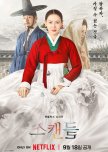
When I started watching "The Scandal", I had no idea that it was an adaptation of *Les Liaisons dangereuses*. Nevertheless, the story immediately reminded me of the French novel. At first, I also wondered whether the producers were trying to capitalize on the success of "Bridgerton*" with its combination of period costumes, aristocratic intrigue and sexual tension. But the series turned out to be considerably darker and more psychologically interesting than I had anticipated.
1. Ji Chang-wook: An outstanding performance
I have admired Ji Chang-wook for years. Even in 'Empress Ki' his ability to portray a tragic hero was evident. But in 'The Scandal', I believe he has surpassed himself. His portrayal of Cho Won is exceptional, particularly in his depiction of emotional vulnerability. What begins as the performance of a confident, almost arrogant seducer gradually reveals a deeply wounded man, trapped between his attachment to Lady Cho and his discovery of genuine love. His facial expressions, especially his eyes, communicate emotions that words could never adequately express. His transformation from a seemingly carefree womanizer into a tragic hero was, for me, the most compelling aspect of the entire series.
I was initially surprised by the explicit intimate scenes, but I appreciated his decision not to artificially enhance his physique for the role. His natural physical appearance made the character more believable. The emphasis remained on the emotional significance of intimacy rather than on displaying a perfectly sculpted body. This was a mature, courageous performance that demonstrated just how versatile an actor he has become.
2. Lady Cho: An intelligent woman trapped by her circumstances
I must admit that Son Ye-jin has never been one of my favourite actresses. Even in 'Crash Landing on You', I found her screen presence rather cold and emotionally distant. However, I appreciated her performance here, particularly toward the end, when Lady Cho's carefully constructed emotional defenses finally begin to collapse.
What fascinated me most was her character's psychology.
Lady Cho is an exceptionally intelligent woman whose abilities are recognized by her father. Yet she cannot put her intelligence to use by serving the king simply because she is a woman. The wedding flashback is particularly revealing. Her father weeps not only because his daughter's remarkable potential will remain unfulfilled, but also because he will miss her terribly after her marriage. At precisely this moment, she is preparing to escape with the young Cho Won.
Could her father's grief have influenced her decision to abandon their escape? Did she sacrifice her love out of filial loyalty? Or did she recognize that running away with Cho Won would not resolve her fundamental problem: being an ambitious, intelligent woman in a society that offered her so few opportunities? The series leaves these questions unanswered, that might be a weakness and I think that also steers some critiscm. However, they invite us to reflect on her motivations.
Interestingly, her father subsequently disappears from the narrative. Instead, we see Lady Cho establishing considerable authority within her husband's household. Perhaps this becomes her substitute for the political influence and intellectual recognition she was denied.
3. The disturbing question of the concubine
One aspect of Lady Cho's behavior made me particularly uncomfortable: her attempt to manipulate the young concubine's pregnancy and involve Cho Won in the arrangement. The marriage has produced no children, and the husband needs an heir. But why does Lady Cho devise such an elaborate and morally questionable scheme? Is she primarily trying to secure her position within the household? Is she demonstrating that she can control everyone around her, including her husband and Cho Won? Or is there also jealousy involved?
Perhaps she resents the fact that the young man who once loved her has become such a successful womanizer. Yet she simultaneously uses his sexuality as an instrument of her own ambitions. This contradiction makes her character both fascinating and deeply disturbing.
4. Nana: The Unexpected Winner
For me, Nana's character is the unexpected winner of the series. While the other two destroy each other, she discovers life. Starting as a young virgin widow who is expected to commit suicide, she experiences sexuality, rediscovers her will to live and ultimately breaks free from the constraints imposed upon her. Whether joining a Christian community represents genuine liberation or simply exchanging one restrictive belief system for another remains an interesting question.
Nana's performance was wonderfully subtle. With her perpetually wounded, almost deer-like expression, she conveyed vulnerability without ever appearing weak. Her character's transformation was remarkable, and her understated acting provided a beautiful contrast to the emotional intensity of the two leads.
5. Two very different tragic characters
Ultimately, I see the two principal characters as tragic figures, but their tragedies unfold differently. Cho Won gradually discovers genuine emotional intimacy, only to find himself unable to escape the destructive relationship that has shaped his life. Lady Cho, meanwhile, is a woman of exceptional intelligence and frustrated ambition who has learned to exercise power through manipulation. Perhaps she genuinely loves Cho Won, but she seems unable to separate love from control.
I particularly appreciated how their psychological complexity emerges through their actions rather than through lengthy explanations. For me, this is a series that becomes more interesting the longer you reflect on it. Not every motivation is fully explained, and certain narrative decisions remain questionable. But the characters offer considerably more depth than a conventional historical romance.
Above all, Ji Chang-wook's performance is unforgettable. I have always considered him an excellent actor, but his portrayal of Cho Won has given me an entirely new appreciation of his abilities.
PS: the music was sometimes too 'French' for my taste, and yes, it was a bit lenghty. However, I congratulate the director ti undertake such different K-Drama.
Was this review helpful to you?


