
 Editorials

 1
1


This review may contain spoilers
If you fall asleep while watching the drama, and no eyes are opened to see it, is the drama good?
We get it, Na Hong Jin's The Wailing (2016) is great! But that does not mean replicating its structure will yield the same results. Similar to that of the infamous double ritual in The Wailing, The Frog showcases two events in separate timelines simultaneously, and uses editing to trick viewers from noticing. It is not until later where the disjointed timeline unravels and attentive viewers begin to get an idea of what had happened. However, unlike The Wailing whose tricky editing served a thematic purpose, The Frog presents no reasoning for its editing choice except to test the viewer's patience. Also "coincidentally," both productions tackle the problem of random evil. But the stark contrast of how the subject matter was handled between the two is clear once again. While The Wailing ventures on an ambitious aim of understanding the why, utilizing the director's personal wrestling of his faith as a keystone for shaping the plot, The Frog gives a muted showcase of the damages done by evil without much reflection, but to present the hackneyed observation that bystanders and strangers lack empathy. The execution between the two is akin to a gymnast gracefully landing a complex somersault and a frog leaping and falling flat on its belly. The Frog's performance is not the prettiest nor very thoughtful, but at least there was an attempt.
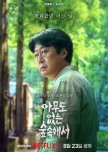
The series traces the timelines of two lodging owners, Sang Jun, a motel owner, and Young Ha, a guest house owner. Both are victims of collateral damage by problematic renters, Hyang Cheol, a serial killer, and Seong Ah, a murderous squatter. Their narratives unfold nonlinearly, twenty years apart. In Sang Jun's case, a serial killer randomly dismembers a body in one of the rooms, driving away business once the incident garners media attention. After a year, the motel owner goes bankrupt and is left with a broken family. Twenty years later in another remote corner of the same town, Young Ha deduces a woman has killed her stepson in the guest house. But to preserve the sanctity of his wife's final resting place and to avoid trouble involving a stranger, the pension house owner buries the truth. A year later, the same woman returns and tries to purchase the house.
Swarms of flashing lights and camera lens fill the air as media teams bombard a motel. We are at Lake Side View motel where Sang Jun frantically arrives to the scene of conflict oblivious to what has happened. A detective at the scene briefs him that one of his tenants is serial killer Ji Hyang Cheol, and the killer had dismembered a woman in one of the rooms. The devastated and terrified owner makes his way to the second floor room and uncovers the grisly truth. As if the traumatic event wasn't enough, Sang Jun soon realizes the greatest threat of Lake Side View motel wasn't the serial killer who was swiftly captured by police, but the hounding news anchors and reporters that covered the story without consideration for his circumstances.
For casual viewers, the scene of a media storm is not unordinary, but those who kept up with Korean entertainment news can link the event with the suicide of Lee Sun Kyun, a popular actor known for his unique voice. The nonstop coverage of his scandal was widespread. Naturally, the climate was ripe for rumors to proliferate among laypeople and professionals alike. It was only after his death when onlookers began to find the police, who leaked information, and the media, which relied less on the veracity but the quantity and quickness of their coverage, culpable. So, it should not color anyone surprised that a Netflix series attempts to capitalize on an infamous tragedy to function as a social commentary in the most careless and caricature-like manner in the next release cycle after his death.
There is another frantic owner: Young Ha has a good idea of what transpired inside the guest house and has the opportunity to correct an evil; he chooses not to. Instead, the bloodied crime scene is washed by his sweat, as the pension house owner ensures if Seong Ah, who cleaned the room in a hurry, left any lingering evidence, then he'll be the one to erase it. Yet, like the reporters who had ignored Sang Jun's circumstances when covering his story, the writer also forgets about Young Ha's situation when rushing to the next part of the story. Here's why:
The Frog lazily frames both business owners, Young Ha and Sang Jun, adjacently and parallel their misfortunes as the same. However, with a moment of reflection, it should be clear the pension owner's justification for not reporting the crime becomes less plausible when we consider:
I. Young Ha, whose daughter and son-in-law are willing to set up the house as a personal vacation house instead, is wealthy; Sang Jun invested his last cent into buying the motel and was penniless. In other words, Sang Jun is desperate for success, but Young Ha is.
II. Seong Ah takes the corpse with her and cleans the crime scene; Hyang Cheol did not and left the dismembered body parts on the motel bedroom. In other words, for the motel, the media directly captured the gruesome murder of the crime scene plastering the images on the front page. However, the worst that can occur for the pension house is a standard infanticide coverage without any images. In the absolute worst case scenario, if Young Ha loses customers, he can simply turn his pension house into a second vacation house. Preserving the sanctity of the home for his deceased wife is not convincing when he has already come across the truth. Is it really reasonable to avoid an investigate of a dead child in case public reception tarnishes the reputation of your deceased wife's property? Then, maybe the justification for Young Ha's inaction boils down to a selfish businessman who did not want to involve his hands in the "meager death" of a stranger's child after all.
In a distant morning, Young Ha prepares the guest house and the dinner ingredients for a scheduled gathering. Out of the blue, Seong Ah returns in cliché fashion that calling it "cliché" wouldn't do it justice. A murderess has returned to her witness but how do we guarantee she remains with him in the most contrived way? Instead of creating a reasonable character who either keeps incriminating evidence for safe measure or discards them entirely to avoid the trouble of possessing something he shouldn't, the brilliant writer opts for Young Ha to keep half-incriminating evidence. That is, he keeps the dashcam footage history, which entails he'll be jeopardizing his life while in his possession, but the evidence is weak and circumstantial at best. Additionally, he cleans the bloodied record, the other half of the evidence necessary to bring about reasonable suspicion. Despite that, the nonsensical decision-making was perfectly orchestrated. This is because if Young Ha possessed both pieces of evidence, a quick sucker punch to Seong Ah's face upon her unwelcomed appearance, would be the impetus to stun, restrain, and call the cops on her. In his current state, the pension house owner cannot do that. Instead, he and Seong Ah must now apparently live together. But, the whole purpose for a half-incriminating evidence, rather than no evidence at all, is to prepare ANOTHER cliché that occurs when our soft-hearted, child-murder witness has change of heart.
Young Ha cannot fathom living beside his rambunctious, new neighbor. But Young Ha only has circumstantial evidence. So how can he compile enough evidence that goes beyond a reasonable doubt? A voice recorder will do! Now after he records Seong Ah's confession, he can simply drive off into the sunset and present the police his undeniable evidence. Nope. In predictable fashion, not only does the psycho woman conveniently spot the recorder packaging, she finds Young Ha right as he pulls up to the police station, floors the gas pedal and T-bone collides the his car in broad daylight for every eyewitness to see. Is this disappointing or actually impressive stuff? Talk about making the most of something!
That question is quickly put to rest in the following scene. We see a bloodied Young Ha in a wrecked car and Seong Ha with a mean glare casually approaching him. His car is bellowing with smoke as he is losing consciousness. Cops are running over to rescue the owner. Everyone saw what had happened. So, all the cops need to do is place Seong Ah under arrest for attempted murder, or at least, reckless endangerment, right? Just as viewers eagerly await for Justice to be served on an ice-cold platter, the writer jumps out of the screen and whispers into our ears, "Did anyone ACTUALLY see what happened?" And just like that, the attempted murder becomes nothing but a wistful, evaporating memory. When viewers awake from their hypnotic slumber, we are convinced the accident never happened. Young Ha and Seong Ah also go back to being neighborly housemates. Then, some time later, a douchebag cop loverboy appears. He dies. Once again, no one gives a hoot about his going missing.
Finally, the two timelines converge as one, but the timelines are not the only thing that changes. There is an abrupt and drastic tonal shift where the series morphs into some box-office action flick, losing all the tension that the first half laboriously spent attempting to build up. Instead, that tension is quickly replaced with more clichés, logical gaps, and half-assed writing:
A man carries a rifle into a hospital filled with people, shoots another man, leaps out of the window of the several story building suffering from minor injury, and limps away. Authority figures practically do not exist and wend along the sidelines unless we conveniently need them to clean up the messy story at the end (or to summarize the drama). Safety concerns are nonexistent in this show as the characters line up like sheeps to a slaughterhouse to confront a madwoman. But actually, it turns out Seong Ah lacks strength and is easily overpowered! Oh wait, but it turns out the other characters lack brain cells! A car comes crashing through the side of art gallery leading to destruction of property and endangerment of people's lives. The writer's response to clean this mess? Money. Because we all know rich people are above the law and escape their openly criminal behavior, duh!
After going through various cumbersome shenanigans, the closing curtain draws near. We face both killers individually: Hyang Cheol in his visiting cell; Seong Ah at gun point by her ex-husband. And when both killers are supposed to explain the BIG why: Why did we have to sit through those mindless and droning action sequences? Why did either killers carelessly go to a lodge, where anyone can spot them, to exact their deeds, instead of what killers typically do to avoid eyewitnesses? Essentially, both of their responses were, "Meh, because I felt like it in the heat of the moment; because I am CRAAAAZY."
What the fu--
Ribbit... Ribbit... Ribbit...
Then, the brilliance of the writer hits us like the rays of Heaven:
A FROG DIES FROM A STONE THROWN INADVERTENTLY
The mumbo jumbo yapanese is to connect it to the frog idiom: the killers are the stone tossers randomly chucking their rocks; the business owners are the poor frogs! Of course, it all makes sense; duh, it was all because of the frogs, as the title suggests; this writer is a genius!
The Frog is the prototypical example of consumerist culture gone haywire. The art of screenplay and directing has become formulaic cookie-cutters, a pastiche of previous hits but devoid of authenticity or identity, relying on subterfuge and dynamic action sequences to compensate for its lack of depth and creativity. Any semblance of a "voice" is to pitch a tame, yet spineless position that matches the zeitgeist:
The ultra-rich are evil! Everyone in Korea was unilaterally outraged by media encroachment, so let's write about that in a comically obvious way! But let's add some conventional wisdom, such as a frog idiom, to give the series some narrative depth!
In the mean time, the characters can forcefully draw out the connection with their unnatural dialogue.
The Frog is symbolic. It is a frog inflating its throat, a generic, empty piece of entertainment with captivating images, that tries to croak deeper than its previous, but is caught unawares when people eventually find it annoying. If anything, The Frog represents enough time has passed for commodified art forms to have become the norm and the accepted. With its positive reception marks another sad victory for the factory-churning, AI-generated future that algorithmically deconstruct and reconstruct human creativity for fast consumption. Here's to a superficial and soulless tomorrow.
The series traces the timelines of two lodging owners, Sang Jun, a motel owner, and Young Ha, a guest house owner. Both are victims of collateral damage by problematic renters, Hyang Cheol, a serial killer, and Seong Ah, a murderous squatter. Their narratives unfold nonlinearly, twenty years apart. In Sang Jun's case, a serial killer randomly dismembers a body in one of the rooms, driving away business once the incident garners media attention. After a year, the motel owner goes bankrupt and is left with a broken family. Twenty years later in another remote corner of the same town, Young Ha deduces a woman has killed her stepson in the guest house. But to preserve the sanctity of his wife's final resting place and to avoid trouble involving a stranger, the pension house owner buries the truth. A year later, the same woman returns and tries to purchase the house.
Swarms of flashing lights and camera lens fill the air as media teams bombard a motel. We are at Lake Side View motel where Sang Jun frantically arrives to the scene of conflict oblivious to what has happened. A detective at the scene briefs him that one of his tenants is serial killer Ji Hyang Cheol, and the killer had dismembered a woman in one of the rooms. The devastated and terrified owner makes his way to the second floor room and uncovers the grisly truth. As if the traumatic event wasn't enough, Sang Jun soon realizes the greatest threat of Lake Side View motel wasn't the serial killer who was swiftly captured by police, but the hounding news anchors and reporters that covered the story without consideration for his circumstances.
For casual viewers, the scene of a media storm is not unordinary, but those who kept up with Korean entertainment news can link the event with the suicide of Lee Sun Kyun, a popular actor known for his unique voice. The nonstop coverage of his scandal was widespread. Naturally, the climate was ripe for rumors to proliferate among laypeople and professionals alike. It was only after his death when onlookers began to find the police, who leaked information, and the media, which relied less on the veracity but the quantity and quickness of their coverage, culpable. So, it should not color anyone surprised that a Netflix series attempts to capitalize on an infamous tragedy to function as a social commentary in the most careless and caricature-like manner in the next release cycle after his death.
There is another frantic owner: Young Ha has a good idea of what transpired inside the guest house and has the opportunity to correct an evil; he chooses not to. Instead, the bloodied crime scene is washed by his sweat, as the pension house owner ensures if Seong Ah, who cleaned the room in a hurry, left any lingering evidence, then he'll be the one to erase it. Yet, like the reporters who had ignored Sang Jun's circumstances when covering his story, the writer also forgets about Young Ha's situation when rushing to the next part of the story. Here's why:
The Frog lazily frames both business owners, Young Ha and Sang Jun, adjacently and parallel their misfortunes as the same. However, with a moment of reflection, it should be clear the pension owner's justification for not reporting the crime becomes less plausible when we consider:
I. Young Ha, whose daughter and son-in-law are willing to set up the house as a personal vacation house instead, is wealthy; Sang Jun invested his last cent into buying the motel and was penniless. In other words, Sang Jun is desperate for success, but Young Ha is.
II. Seong Ah takes the corpse with her and cleans the crime scene; Hyang Cheol did not and left the dismembered body parts on the motel bedroom. In other words, for the motel, the media directly captured the gruesome murder of the crime scene plastering the images on the front page. However, the worst that can occur for the pension house is a standard infanticide coverage without any images. In the absolute worst case scenario, if Young Ha loses customers, he can simply turn his pension house into a second vacation house. Preserving the sanctity of the home for his deceased wife is not convincing when he has already come across the truth. Is it really reasonable to avoid an investigate of a dead child in case public reception tarnishes the reputation of your deceased wife's property? Then, maybe the justification for Young Ha's inaction boils down to a selfish businessman who did not want to involve his hands in the "meager death" of a stranger's child after all.
In a distant morning, Young Ha prepares the guest house and the dinner ingredients for a scheduled gathering. Out of the blue, Seong Ah returns in cliché fashion that calling it "cliché" wouldn't do it justice. A murderess has returned to her witness but how do we guarantee she remains with him in the most contrived way? Instead of creating a reasonable character who either keeps incriminating evidence for safe measure or discards them entirely to avoid the trouble of possessing something he shouldn't, the brilliant writer opts for Young Ha to keep half-incriminating evidence. That is, he keeps the dashcam footage history, which entails he'll be jeopardizing his life while in his possession, but the evidence is weak and circumstantial at best. Additionally, he cleans the bloodied record, the other half of the evidence necessary to bring about reasonable suspicion. Despite that, the nonsensical decision-making was perfectly orchestrated. This is because if Young Ha possessed both pieces of evidence, a quick sucker punch to Seong Ah's face upon her unwelcomed appearance, would be the impetus to stun, restrain, and call the cops on her. In his current state, the pension house owner cannot do that. Instead, he and Seong Ah must now apparently live together. But, the whole purpose for a half-incriminating evidence, rather than no evidence at all, is to prepare ANOTHER cliché that occurs when our soft-hearted, child-murder witness has change of heart.
Young Ha cannot fathom living beside his rambunctious, new neighbor. But Young Ha only has circumstantial evidence. So how can he compile enough evidence that goes beyond a reasonable doubt? A voice recorder will do! Now after he records Seong Ah's confession, he can simply drive off into the sunset and present the police his undeniable evidence. Nope. In predictable fashion, not only does the psycho woman conveniently spot the recorder packaging, she finds Young Ha right as he pulls up to the police station, floors the gas pedal and T-bone collides the his car in broad daylight for every eyewitness to see. Is this disappointing or actually impressive stuff? Talk about making the most of something!
That question is quickly put to rest in the following scene. We see a bloodied Young Ha in a wrecked car and Seong Ha with a mean glare casually approaching him. His car is bellowing with smoke as he is losing consciousness. Cops are running over to rescue the owner. Everyone saw what had happened. So, all the cops need to do is place Seong Ah under arrest for attempted murder, or at least, reckless endangerment, right? Just as viewers eagerly await for Justice to be served on an ice-cold platter, the writer jumps out of the screen and whispers into our ears, "Did anyone ACTUALLY see what happened?" And just like that, the attempted murder becomes nothing but a wistful, evaporating memory. When viewers awake from their hypnotic slumber, we are convinced the accident never happened. Young Ha and Seong Ah also go back to being neighborly housemates. Then, some time later, a douchebag cop loverboy appears. He dies. Once again, no one gives a hoot about his going missing.
Finally, the two timelines converge as one, but the timelines are not the only thing that changes. There is an abrupt and drastic tonal shift where the series morphs into some box-office action flick, losing all the tension that the first half laboriously spent attempting to build up. Instead, that tension is quickly replaced with more clichés, logical gaps, and half-assed writing:
A man carries a rifle into a hospital filled with people, shoots another man, leaps out of the window of the several story building suffering from minor injury, and limps away. Authority figures practically do not exist and wend along the sidelines unless we conveniently need them to clean up the messy story at the end (or to summarize the drama). Safety concerns are nonexistent in this show as the characters line up like sheeps to a slaughterhouse to confront a madwoman. But actually, it turns out Seong Ah lacks strength and is easily overpowered! Oh wait, but it turns out the other characters lack brain cells! A car comes crashing through the side of art gallery leading to destruction of property and endangerment of people's lives. The writer's response to clean this mess? Money. Because we all know rich people are above the law and escape their openly criminal behavior, duh!
After going through various cumbersome shenanigans, the closing curtain draws near. We face both killers individually: Hyang Cheol in his visiting cell; Seong Ah at gun point by her ex-husband. And when both killers are supposed to explain the BIG why: Why did we have to sit through those mindless and droning action sequences? Why did either killers carelessly go to a lodge, where anyone can spot them, to exact their deeds, instead of what killers typically do to avoid eyewitnesses? Essentially, both of their responses were, "Meh, because I felt like it in the heat of the moment; because I am CRAAAAZY."
What the fu--
Ribbit... Ribbit... Ribbit...
Then, the brilliance of the writer hits us like the rays of Heaven:
A FROG DIES FROM A STONE THROWN INADVERTENTLY
The mumbo jumbo yapanese is to connect it to the frog idiom: the killers are the stone tossers randomly chucking their rocks; the business owners are the poor frogs! Of course, it all makes sense; duh, it was all because of the frogs, as the title suggests; this writer is a genius!
The Frog is the prototypical example of consumerist culture gone haywire. The art of screenplay and directing has become formulaic cookie-cutters, a pastiche of previous hits but devoid of authenticity or identity, relying on subterfuge and dynamic action sequences to compensate for its lack of depth and creativity. Any semblance of a "voice" is to pitch a tame, yet spineless position that matches the zeitgeist:
The ultra-rich are evil! Everyone in Korea was unilaterally outraged by media encroachment, so let's write about that in a comically obvious way! But let's add some conventional wisdom, such as a frog idiom, to give the series some narrative depth!
In the mean time, the characters can forcefully draw out the connection with their unnatural dialogue.
The Frog is symbolic. It is a frog inflating its throat, a generic, empty piece of entertainment with captivating images, that tries to croak deeper than its previous, but is caught unawares when people eventually find it annoying. If anything, The Frog represents enough time has passed for commodified art forms to have become the norm and the accepted. With its positive reception marks another sad victory for the factory-churning, AI-generated future that algorithmically deconstruct and reconstruct human creativity for fast consumption. Here's to a superficial and soulless tomorrow.
Was this review helpful to you?


