
 Editorials

 3
3 3
3 3
3


A Fragile Woman and A Toxic Relationship
Why are we still cheering for this trope in 2026?
It is a question I found myself asking repeatedly across twelve episodes of In Your Radiant Season, MBC's latest romantic drama that arrived in February dressed in stunning cinematography, a genuinely moving OST, and a premise that had every reason to work. Two broken people healing themselves so they could meet each other in the middle. A narrative goldmine, in theory. What followed was a drama so bizarrely split between its own best and worst instincts that by the finale I had developed a full taxonomy of my emotional responses to it, ranging from genuine tears to genuine laughter, and not always in the directions the show intended.
Let me start with the cast, because this drama's greatest achievement and its most damning failure both live there. Chae Jong-hyeop as Sunwoo Chan starts as one of the most promising male leads in recent memory. His golden retriever energy is genuinely disarming, his carecore foundation in the early episodes feels rare and earned, and Chae Jong-hyeop carries the character's warmth with complete conviction. The tragedy of Chan is not in the performance. It is in what the writing does to him once the romantic machinery kicks in. Manipulation does not require malicious intent to be manipulation. It only requires consistently choosing your own comfort over someone else's right to informed consent, and Chan does exactly that, on a loop, across ten episodes.
The original sin was the website lie in episode two, the moment Chan consciously decided to control what Ha-ran knew about their connection. Not to protect her. To protect himself from a conversation he was not ready to have. The replacement pen sourced internationally from Boston. The "I don't want to reopen old wounds" justification that was never about her wounds. Every single one traces back to that one decision, and he had maximum opportunity to come clean before anything romantic developed, before the three month trial, before the camera, before the kiss, before his own internal monologue admitted "I know I'm being greedy." Strip away the soft lighting and the slow piano keys and what remains is a man who consistently prioritized his own emotional comfort over a grieving woman's right to know her own story. Textbook manipulation, dressed in carecore aesthetics. Which the drama itself admitted in episode 12.
Lee Sung-kyung as Song Ha-ran is my first exposure to her work, and I will say this honestly: her early episodes genuinely moved me. The specific brand of grief she carries in episodes one through three is precise and layered, less a woman who lost someone and more a woman who appointed herself responsible for that loss and built her entire architecture around paying a debt nobody assigned her. That reading held, briefly, and beautifully. Then the full picture assembled itself and the math stopped adding up. Ha-ran lost her parents at sixteen and functioned. She lost a boyfriend she had just started dating, long distance, at twenty-five, and spent seven years in complete paralysis requiring her grandmother, a coffee shop owner, and eventually a stranger with a camera to engineer her back into the world. And eventually, the performance flattened entirely under the weight of a character the writing had stopped protecting. By the later episodes, every new crying scene over increasingly minor provocations stopped reading as grief and started reading as habit, and my response shifted accordingly from empathy to apathy, and then from apathy to something closer to active irritation. That is the quietest possible indictment of what the writing did to both the character and the actress carrying her. Her own grandmother noted that she did not take her parents' loss this hard.
The drama offers this line sympathetically. It lands as an indictment. By episode six, Ha-ran was doing slow motion Seoul bucket list tours and heart to hearts with her grandmother because a man she insisted she was not that close to had failed to deliver a text message before switching to airplane mode mid-flight. She is thirty-two. She runs a design team at Korea's premier fashion house. And she is sprawling across her emotional floor over an undelivered iMessage. Song Ha-ran will be filed permanently as a prime example of a fragile Female Lead with zero emotional regulation, zero agency, and zero identity outside of her romance. A block of tofu would have been more compelling to watch. The show wanted her to be the lone woman walking into a snow field, poetic and wounded and profound. The timeline and the surrounding cast revealed she was just standing at the edge of a very warm room, choosing not to turn around. That is not a fortress. That is a preference.
Here is where this drama becomes genuinely extraordinary, and genuinely maddening, in the same breath. Because Han Ji-hyun as Song Ha-yeong, the middle sister, is one of the finest performances I have encountered in recent dramaland, and I am not being generous. Ha-yeong checks every single box of a strong female lead while occupying a supporting role, which should embarrass the writers responsible for Ha-ran enormously. Han Ji-hyun plays Ha-yeong on two simultaneous frequencies, the surface brightness that the other characters receive and the undertow of grief underneath that only the audience catches if they are paying close enough attention. Ha-yeong made her defining decision at approximately fourteen, standing in a funeral hanbok against a wall, eyes closed, saying "I have to be okay. I have to keep this family together." She has been executing that decision every single day since, converting pain into laughter in real time, for everyone else's benefit but also for her own, because someone had to hold and she volunteered without being asked. She cried exactly twice across eleven episodes. Both times voluntarily, both times with directional purpose, because Song Ha-yeong does not break accidentally. Even her grief has agency. Han Ji-hyun threads the needle of this character with extraordinary precision, never tipping into melodrama, never losing the comedy, never letting you forget that the loudest person in every room is also the one carrying the most invisible weight. Her confession scene, her "then start thinking of me that way" delivered at a dinner table, and her beaming nod in a blizzard after twelve episodes of patience, are the three best scenes this drama produced. I want a spin-off. I want it immediately. I will watch it in one sitting.
Oh Ye-ju as Song Ha-dam, the youngest sister, quietly surprised me throughout. Ha-dam is the most emotionally mature person in this drama despite being a high school senior, and Oh Ye-ju carries that specific brand of grounded teenage wisdom without making it feel precocious. Her trajectory as a young actress is worth watching. Lee Mi-sook as Nana Kim is the drama's steadying heartbeat, a woman managing her own quietly terrifying secret while remaining the warmest presence in every room she occupies. Kwon Hyuk as Yeon Tae-sok is perfectly cast against Han Ji-hyun in a way that feels almost unfair to the main couple. His contained stillness against Ha-yeong's unbridled energy creates a dynamic that generates more genuine romantic tension in a single sour candy detail than the main couple managed across twelve episodes of soft lighting. Kim Tae-young as Cha Yu-gyeom rounds out a remarkably strong ensemble, accessing emotional range well beyond what his age and experience would suggest.
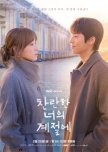
The drama's greatest structural achievement, and its most accidental one, is what happens when you look at all four couples simultaneously. By episode nine, every supporting character had become a satellite lighthouse for someone in their orbit, taking care of others in the specific language only they knew how. Ha-yeong holding a family together for fifteen years while quietly watching Nana Kim for signs nobody else caught. Tae-sok stocking Ha-yeong's favorite sour candy and sweeping cemetery paths and begging supplier favors in secret so a designer could be fully creative without the weight of practicality. Yu-gyeom engraving "guardian" on a necklace with his phone number for a grandmother he met crossing a street because it was simply the right thing to do. Mr. Park keeping a coffee shop light on for seven years and proposing before surgery in one quiet sentence: "take a rest, by my side, with me." Ha-dam telling her injured, frightened boyfriend "then you can just be my Yu-gyeom who tried." Every single one of them demonstrating love as a verb, love as a daily practice, love as something you do without requiring an audience or a piano cue. And then the main couple, still locked in their manufactured tensions and their soft lit lies, completely absent from this constellation of genuine human warmth. The heart and soul of In Your Radiant Season is everyone except the people on the poster.
The OST deserves its own mention, because it is genuinely one of the stronger soundtrack collections this year has produced. I Feel You by Yegny and Beautiful Days With You by Youngjun carry the quieter melancholy of the drama's better moments with exactly the right restraint, while You Are My Color by JUNGSOOMIN and About Time by BANG YEDAM bring a slightly warmer, brighter texture that serves the ensemble stories beautifully. All I Wish by Seo Ja-yeong caps the collection with grace. My only complaint is that the same songs were routinely deployed in service of the main couple's manufactured emotional moments, which is less a criticism of the music and more a casualty of association. The OST itself is blameless. I recommend seeking it out on your streaming platform of choice, ideally divorced from the scenes it was occasionally asked to carry beyond its job description.
This is what makes the editorial gaslighting so specifically damaging. Three consecutive episodes dressed minor inconveniences in the cinematographic language of genuine tragedy. A cancelled work project became a world-ending emergency. A failed text message from airplane mode became the emotional equivalent of losing a person. A bucket list Seoul tour became the dramatic processing of profound grief. When everything is painted as dramatic with every trick available, nothing is. The result was predictable and devastating. By the time the actual dramatic revelation arrived in episode eleven, the genuine climax the show had been building toward, I was laughing. Pure schadenfreude. The moment a drama's climactic emotional revelation produces genuine schadenfreude in a viewer who wept over a laundry detergent scene and a man standing in the rain with an umbrella, you have your most complete and honest verdict on what went wrong. They did not just fail to make me feel what they intended. They inverted it entirely. That is not a stumble. That is a structural collapse.
To be precise about something before closing: I am not opposed to fragile or grieving female leads. Dramaland has given us devastated women written with full agency and complete internal logic, women whose grief scale matches their loss, whose healing arc belongs to them rather than to whoever showed up with a camera and a carecore foundation. Song Ha-ran's depression was not one of those. It was unearned, disproportionate, and structurally inconsistent with every other character in her own drama who survived the same foundational loss and chose to keep moving. Her resolution, chasing a man who lied to her face across ten episodes because she saw his drawing on Instagram, is among the most unearned happy endings I have encountered. The woman who survived losing her parents at sixteen, who built a career, who runs a design team, has her entire arc hinge on needing a boy to complete her healing. In 2026. With Ha-yeong standing right next to her as proof that the writers knew exactly how to do this differently.
With all of that said, I do recommend In Your Radiant Season, with one very specific condition. Watch it the way I eventually learned to, with a working FFWD button and zero guilt about using it. Because the moment you grant yourself permission to sidestep Song Ha-ran and Sunwoo Chan's manufactured orbit entirely, something genuinely beautiful opens up. A grandmother who was proposed before surgery in one quiet sentence. A profound and supporting sisterly love between the three sisters. A middle sister who cried twice in twelve episodes and meant it both times. Two high school sweethearts charting an uncertain future with complete honesty. A younger sister trying to recreate her late mother's scents. A man in a blizzard finally asking the question he has been circling for fifteen years. Every one of these stories is told with full hearts, sharp writing, and endings that land exactly as earned as the journey that built them. The ensemble of this drama is worth your time and your tears. They just happen to share a show with a main couple that is worth neither.
Which brings me back to where I started, why are we still cheering for this in 2026?
It is a question I found myself asking repeatedly across twelve episodes of In Your Radiant Season, MBC's latest romantic drama that arrived in February dressed in stunning cinematography, a genuinely moving OST, and a premise that had every reason to work. Two broken people healing themselves so they could meet each other in the middle. A narrative goldmine, in theory. What followed was a drama so bizarrely split between its own best and worst instincts that by the finale I had developed a full taxonomy of my emotional responses to it, ranging from genuine tears to genuine laughter, and not always in the directions the show intended.
Let me start with the cast, because this drama's greatest achievement and its most damning failure both live there. Chae Jong-hyeop as Sunwoo Chan starts as one of the most promising male leads in recent memory. His golden retriever energy is genuinely disarming, his carecore foundation in the early episodes feels rare and earned, and Chae Jong-hyeop carries the character's warmth with complete conviction. The tragedy of Chan is not in the performance. It is in what the writing does to him once the romantic machinery kicks in. Manipulation does not require malicious intent to be manipulation. It only requires consistently choosing your own comfort over someone else's right to informed consent, and Chan does exactly that, on a loop, across ten episodes.
The original sin was the website lie in episode two, the moment Chan consciously decided to control what Ha-ran knew about their connection. Not to protect her. To protect himself from a conversation he was not ready to have. The replacement pen sourced internationally from Boston. The "I don't want to reopen old wounds" justification that was never about her wounds. Every single one traces back to that one decision, and he had maximum opportunity to come clean before anything romantic developed, before the three month trial, before the camera, before the kiss, before his own internal monologue admitted "I know I'm being greedy." Strip away the soft lighting and the slow piano keys and what remains is a man who consistently prioritized his own emotional comfort over a grieving woman's right to know her own story. Textbook manipulation, dressed in carecore aesthetics. Which the drama itself admitted in episode 12.
Lee Sung-kyung as Song Ha-ran is my first exposure to her work, and I will say this honestly: her early episodes genuinely moved me. The specific brand of grief she carries in episodes one through three is precise and layered, less a woman who lost someone and more a woman who appointed herself responsible for that loss and built her entire architecture around paying a debt nobody assigned her. That reading held, briefly, and beautifully. Then the full picture assembled itself and the math stopped adding up. Ha-ran lost her parents at sixteen and functioned. She lost a boyfriend she had just started dating, long distance, at twenty-five, and spent seven years in complete paralysis requiring her grandmother, a coffee shop owner, and eventually a stranger with a camera to engineer her back into the world. And eventually, the performance flattened entirely under the weight of a character the writing had stopped protecting. By the later episodes, every new crying scene over increasingly minor provocations stopped reading as grief and started reading as habit, and my response shifted accordingly from empathy to apathy, and then from apathy to something closer to active irritation. That is the quietest possible indictment of what the writing did to both the character and the actress carrying her. Her own grandmother noted that she did not take her parents' loss this hard.
The drama offers this line sympathetically. It lands as an indictment. By episode six, Ha-ran was doing slow motion Seoul bucket list tours and heart to hearts with her grandmother because a man she insisted she was not that close to had failed to deliver a text message before switching to airplane mode mid-flight. She is thirty-two. She runs a design team at Korea's premier fashion house. And she is sprawling across her emotional floor over an undelivered iMessage. Song Ha-ran will be filed permanently as a prime example of a fragile Female Lead with zero emotional regulation, zero agency, and zero identity outside of her romance. A block of tofu would have been more compelling to watch. The show wanted her to be the lone woman walking into a snow field, poetic and wounded and profound. The timeline and the surrounding cast revealed she was just standing at the edge of a very warm room, choosing not to turn around. That is not a fortress. That is a preference.
Here is where this drama becomes genuinely extraordinary, and genuinely maddening, in the same breath. Because Han Ji-hyun as Song Ha-yeong, the middle sister, is one of the finest performances I have encountered in recent dramaland, and I am not being generous. Ha-yeong checks every single box of a strong female lead while occupying a supporting role, which should embarrass the writers responsible for Ha-ran enormously. Han Ji-hyun plays Ha-yeong on two simultaneous frequencies, the surface brightness that the other characters receive and the undertow of grief underneath that only the audience catches if they are paying close enough attention. Ha-yeong made her defining decision at approximately fourteen, standing in a funeral hanbok against a wall, eyes closed, saying "I have to be okay. I have to keep this family together." She has been executing that decision every single day since, converting pain into laughter in real time, for everyone else's benefit but also for her own, because someone had to hold and she volunteered without being asked. She cried exactly twice across eleven episodes. Both times voluntarily, both times with directional purpose, because Song Ha-yeong does not break accidentally. Even her grief has agency. Han Ji-hyun threads the needle of this character with extraordinary precision, never tipping into melodrama, never losing the comedy, never letting you forget that the loudest person in every room is also the one carrying the most invisible weight. Her confession scene, her "then start thinking of me that way" delivered at a dinner table, and her beaming nod in a blizzard after twelve episodes of patience, are the three best scenes this drama produced. I want a spin-off. I want it immediately. I will watch it in one sitting.
Oh Ye-ju as Song Ha-dam, the youngest sister, quietly surprised me throughout. Ha-dam is the most emotionally mature person in this drama despite being a high school senior, and Oh Ye-ju carries that specific brand of grounded teenage wisdom without making it feel precocious. Her trajectory as a young actress is worth watching. Lee Mi-sook as Nana Kim is the drama's steadying heartbeat, a woman managing her own quietly terrifying secret while remaining the warmest presence in every room she occupies. Kwon Hyuk as Yeon Tae-sok is perfectly cast against Han Ji-hyun in a way that feels almost unfair to the main couple. His contained stillness against Ha-yeong's unbridled energy creates a dynamic that generates more genuine romantic tension in a single sour candy detail than the main couple managed across twelve episodes of soft lighting. Kim Tae-young as Cha Yu-gyeom rounds out a remarkably strong ensemble, accessing emotional range well beyond what his age and experience would suggest.
The drama's greatest structural achievement, and its most accidental one, is what happens when you look at all four couples simultaneously. By episode nine, every supporting character had become a satellite lighthouse for someone in their orbit, taking care of others in the specific language only they knew how. Ha-yeong holding a family together for fifteen years while quietly watching Nana Kim for signs nobody else caught. Tae-sok stocking Ha-yeong's favorite sour candy and sweeping cemetery paths and begging supplier favors in secret so a designer could be fully creative without the weight of practicality. Yu-gyeom engraving "guardian" on a necklace with his phone number for a grandmother he met crossing a street because it was simply the right thing to do. Mr. Park keeping a coffee shop light on for seven years and proposing before surgery in one quiet sentence: "take a rest, by my side, with me." Ha-dam telling her injured, frightened boyfriend "then you can just be my Yu-gyeom who tried." Every single one of them demonstrating love as a verb, love as a daily practice, love as something you do without requiring an audience or a piano cue. And then the main couple, still locked in their manufactured tensions and their soft lit lies, completely absent from this constellation of genuine human warmth. The heart and soul of In Your Radiant Season is everyone except the people on the poster.
The OST deserves its own mention, because it is genuinely one of the stronger soundtrack collections this year has produced. I Feel You by Yegny and Beautiful Days With You by Youngjun carry the quieter melancholy of the drama's better moments with exactly the right restraint, while You Are My Color by JUNGSOOMIN and About Time by BANG YEDAM bring a slightly warmer, brighter texture that serves the ensemble stories beautifully. All I Wish by Seo Ja-yeong caps the collection with grace. My only complaint is that the same songs were routinely deployed in service of the main couple's manufactured emotional moments, which is less a criticism of the music and more a casualty of association. The OST itself is blameless. I recommend seeking it out on your streaming platform of choice, ideally divorced from the scenes it was occasionally asked to carry beyond its job description.
This is what makes the editorial gaslighting so specifically damaging. Three consecutive episodes dressed minor inconveniences in the cinematographic language of genuine tragedy. A cancelled work project became a world-ending emergency. A failed text message from airplane mode became the emotional equivalent of losing a person. A bucket list Seoul tour became the dramatic processing of profound grief. When everything is painted as dramatic with every trick available, nothing is. The result was predictable and devastating. By the time the actual dramatic revelation arrived in episode eleven, the genuine climax the show had been building toward, I was laughing. Pure schadenfreude. The moment a drama's climactic emotional revelation produces genuine schadenfreude in a viewer who wept over a laundry detergent scene and a man standing in the rain with an umbrella, you have your most complete and honest verdict on what went wrong. They did not just fail to make me feel what they intended. They inverted it entirely. That is not a stumble. That is a structural collapse.
To be precise about something before closing: I am not opposed to fragile or grieving female leads. Dramaland has given us devastated women written with full agency and complete internal logic, women whose grief scale matches their loss, whose healing arc belongs to them rather than to whoever showed up with a camera and a carecore foundation. Song Ha-ran's depression was not one of those. It was unearned, disproportionate, and structurally inconsistent with every other character in her own drama who survived the same foundational loss and chose to keep moving. Her resolution, chasing a man who lied to her face across ten episodes because she saw his drawing on Instagram, is among the most unearned happy endings I have encountered. The woman who survived losing her parents at sixteen, who built a career, who runs a design team, has her entire arc hinge on needing a boy to complete her healing. In 2026. With Ha-yeong standing right next to her as proof that the writers knew exactly how to do this differently.
With all of that said, I do recommend In Your Radiant Season, with one very specific condition. Watch it the way I eventually learned to, with a working FFWD button and zero guilt about using it. Because the moment you grant yourself permission to sidestep Song Ha-ran and Sunwoo Chan's manufactured orbit entirely, something genuinely beautiful opens up. A grandmother who was proposed before surgery in one quiet sentence. A profound and supporting sisterly love between the three sisters. A middle sister who cried twice in twelve episodes and meant it both times. Two high school sweethearts charting an uncertain future with complete honesty. A younger sister trying to recreate her late mother's scents. A man in a blizzard finally asking the question he has been circling for fifteen years. Every one of these stories is told with full hearts, sharp writing, and endings that land exactly as earned as the journey that built them. The ensemble of this drama is worth your time and your tears. They just happen to share a show with a main couple that is worth neither.
Which brings me back to where I started, why are we still cheering for this in 2026?
Was this review helpful to you?


