
 K-Drama


This review may contain spoilers
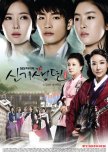
There's romance here, but it's mostly a slice of life family drama with some makjang (melodrama) thrown in- secret identities, poor woman/rich man, evil stepmother, not knowing your friend is actually your brother, or that you are related to so and so, etc. It might be a little slow for others (it takes a few episodes, maybe until episode 15 and over to get into its groove) but I really enjoyed watching the family dynamics the most. It gave me the same sense of comfort as watching something like Reply 1998, which also had an ensemble cast.
The story is split into 3 arcs. The first arc focuses on the Geum family, then the house of the Gisaeng (Buyyeongak) and then the Ah family. I like how most of the characters here are essentially good, but flawed. At first, I thought Ra Ra would be nothing more than the spoiled female antagonist who got in between the male and female lead, but it turned out that while she was spoiled, she was essentially good and became an ally of theirs. Her birth mother Shin Hyo Ri started out as shallow and absorbed, only thinking about inheriting a building when the grandfather died, but she turned out to be caring and even accepted Son Ja, who was her husband's son with another woman.
Dan Sa Ran is basically a Yamato Nadeshiko, a very ladylike and gentle character. I didn't always agree with her way of thinking, but found her likeable overall in her interactions with others and how she found ways to mend fences. I didn't understand the weight the drama was putting on her background and thought she was making too much a big deal out of it (literally losing her self worth when she found out she was adopted) but then I realized that her behavior was actually shaped by the people around her, especially key characters like the male lead's mother- who was actually a good person, but would not accept her at first only because she was poor... and it got even worse when they found out that she was adopted. The drama isn't necessarily justifying this way of thinking, it only shows that even people who are essentially good have prejudices and can behave badly, which leads to negative things for others. The male lead's father, Ah Sura, was technically the main antagonist in the last third of the drama and the actor playing him did a great* job. His obsession with his dog Andre, was also hilarious.
The male lead Ah Da Mo wasn't always good to Sa Ran, but like the rest, was still essentially good. This has one of those tropes where it takes awhile for the male lead to realize he loves the female lead and it causes her to suffer for a bit...but when he finally realizes it, he makes it up to her and also suffers a lot trying to win her back. The way he broke up with her was pretty callous, but it turns out that it was because he knew his father would never accept her (he is technically right about this, because chairman Ah Sura made life a living hell for both* of them later on); this probably has the best grovel scene from a male lead for a female lead that I've seen; I mean literal groveling. The scene (along with the events that lead to it) was very dramatic.
Things I feel neutral about: Some anti-Japanese themes...Japanese guys harassing Korean women in the subway...the male lead goes to Japan and after reflecting in an onsen, decides to break up with the female lead...
There's a supernatural event here that feels out of place. As punishment for the way he treated Sa Ran, chairman Ah Sura gets possessed by different ghosts...this feels out of place in a drama with no supernatural themes, but I think the actor did a great* job acting like an old ahjumma, a warrior from the past and even a little kid.
Things I didn't like: I feel bad about disliking Sa Ran's birth mother, because she was poor and disabled, but it really annoyed me how she didn't do anything throughout the story but cry about the child she gave away and stare off into space and be miserable. I honestly hate how she left a defenseless baby on the doorstep, vulnerable and exposed to all kinds of harm and didn't even bother to leave a letter to explain who this baby was (she was actually the cause of all the female lead's problems)...but even this I excused because other shows also have this scene where they sacrifice a character's common sense for dramatic purposes...even Doctor Who had a scene where a baby was left on a doorstep.
The female lead's birth parents were the flattest characters in the entire story...they had no personality and they didn't do anything but talk about their missing child. At least the birth father (Dr. Geum) developed some personality later when he had a rivalry with chairman Ah Sura.
I feel confused about the representation of the Gisaeng in this drama and whether it was trying to present them in a positive or negative light. Madame Oh was very gracious and majestic as the head of Buyeongak...she also made a good point that if Japan could keep its geisha culture, then Korea should also be able to preserve the Gisaeng. I just don't understand why all the other characters looked down on the Gisaeng so much. They weren't doing anything wrong and the scenes in the Gisaeng house were pretty wholesome...then the show introduced this archaic practice (raising one's hair) which struck me as very demeaning and outdated...I can see this practice being done in a historical drama, but in 2011?? The problem is that the show wasn't trying to depict the prejudices that people had towards the Gisaeng...it was showing how most of the characters (even the morally upright ones) viewed being a gisaeng as something very negative and something to be ashamed of.
When Madame Oh finds out that Sa Ran's step parents are literally thrown off a cliff in the last episode, she thinks it's karma for how they forced her (Sa Ran) to become a gisaeng to answer for their money problems. If being a gisaeng is such a bad thing, then why did Madame Oh decide to become one and want to preserve the tradition in the first place? It felt anti-thematic.
Was this review helpful to you?


