

 1
1 1
1 2
2



A story closer to real life than the usual BL and an ode to indie cinema
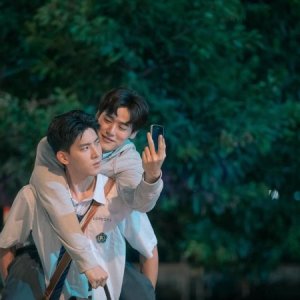
Hope (Night Yodsakon Khamnang) is a fried dumpling seller. Nine (Kong Chindanai Boonruang) is an actor from the Chiang Mai BL production company, who reluctantly accepts a leading role in a new boy love series. The young man is reluctant to the proposal of York (Sak Kidtisag Makongrach), the director of the company, to be part of a new couple to replace the one formed by the main cast, whose members were forced to abandon the film project after the expiration of their contracts.The worlds of Hope and Nine intersect when the former parks his sales cart in front of the production company and in one of those turns of life the young people meet. The two begin a journey when they realize that they are united by unexpected and uncontrollable feelings.
I highly value series like 'My Star', from Wayufilm Production, for the same reason that others will surely deny it: good execution, level of acting, filming and production, despite its low budget; characters far from the clichés of attractive boys that populate BL series, many of them with nothing to contribute other than their beautiful faces and contoured bodies; simple stories that are much closer to real life, truly passionate actors and a production team in each installment, and a firm determination not to kneel before the giants of the entertainment world with their very common mediocre stories interested only in making money, and whose proposals frequently fail, among other reasons, for not taking their fans seriously.
We are faced with a Thai BL that is not cheesy and unpleasant. The couple has very good chemistry. They are actors who have starred in other projects, such as 'LGBTQ+ Dramas Season 2', 'Our First Time' or 'Midnight Love', among others, and they know each other well.
Furthermore, the editing team chose exceptional music to accompany the miniseries.
I also appreciate the tenacity of the creators to not succumb to the dictates and whims of commercial companies, eager to contribute funds to the production of many BL audiovisuals in exchange for advertising their products, something that we frequently criticize in other series of the genre, thus respecting Wayufilm Production its ethics and principle of being a production company that is committed to indie cinema.
'My Star' can be considered within the name of independent cinema because it has a low budget, is made in more precarious conditions than the so-called official cinema, deals with everyday themes and is closer to the public, lacks mass distribution and, therefore, having fewer possibilities of obtaining large income and being made by a director outside the world of large production companies.
Being able to film without falling into the rigid schemes of the studio system is one of the highest aspirations of every director.
Written and directed by Thai filmmaker Nitchapoom Chaianun, CEO of WayuFilm and founder of MongKlong Studio and GoodJob VDO, 'My Star' joins other dramatized films of his authorship that address issues related to sexuality and gender identity, such as since he debuted with his first short film 'Fresh' (เฟรชเฉิ่ม), in 2006, which was followed by 'Fresh Cool Story 2' (เรื่องเฟรชเฉิ่ม 2).
Determined to delicately portray the diversity of human relationships, dismantling the prevailing stereotypes regarding what is "normal", and contributing to the struggle of Thai LGBT people, Nicchi, as he likes to call himself, has obtained popular recognition with his films and series BL-themed feature films such as the feature film 'My Bromance' (พี่ชาย, RTGS: Phi Chai), 'My Bromance 2: 5 Year Later: The Series', 'My Bromance: Reunion', 'Key Love', 'NightTime', ' The Rain Stories', 'Yantra' (อาถรรพ์ยันต์มหาเสน่ห์), among others.

Slow-burning love and a tangible chemistry that goes beyond the screen
Legend has it that thousands of years ago humans were made up of two people. That being had two heads as well as two pairs of arms and legs. His wisdom was delirious, his reasoning was precise, and in his body two hearts beat with harmony and fullness. The person was happy because he lived in love with his counterpart, but one day he defied the gods and received the most severe punishment: being separated from his other half. He was condemned to search for the one who was taken from him in order to feel whole again.From that moment on we wander the world looking for the ideal person, the perfect partner who will complement us.
What if love is not in that stranger but in someone very close? What if your childhood friend, the one who accompanied you since you were a child in childhood games and pranks, or who was a little older in high school or university, could be the perfect match? Couldn't the love of your life be that friend who has been there all the time, by your side, the one who listens to you, the one who knows you well, the one who gives you advice, a hug in the moment of triumph or a shoulder in the moment of pain and sadness? It may seem strange, but if he has been there for so many years to support us, maybe he is also there to love.
If there is a recurring trope in film and television, it is the movies and series of best friends who fall in love, something that is also very common in real life.
With this premise, Ayaka Kato, the director of the Japanese BL series 'My Personal Weatherman' and 'Zenra Meshi', called on the screenwriter Takeshi Miyamoto ('Perfect Propose') to work together, as they did in 'Old Fashion Cupcake' , to adapt and give life, in real action, to the characters and events of 'Kare no Iru Seikatsu' ('Living With Him'), the popular original manga by Toworu Miyata. Koji Nomura also joined in writing the scripts. Together they created a drama that exposes the complexities of love, painting a vivid picture of a relationship that evolves over just over a decade.
NBC Universal Entertainment Japan's romantic comedy-drama tells the story of two childhood friends who reunite after a few years apart and realize they have feelings for each other. As they navigate the challenges of early youth and the expectations of their respective social circles, they must decide if they are brave enough to risk everything for a chance at love.
The narrative, as the title suggests, offers snapshots of a life together, weaving together the shared experiences of Kazuhito and Ryo. Over the course of 10 half-hour episodes, the series encapsulates the bittersweet exploration of young adulthood, highlighting fleeting but impactful moments that shape their relationship.
In a total departure from his role in the 'Kamen Rider' franchise, Sato Ryuga, in his first leading role, plays Kazuhito Tanaka, a young man with a sparkling aura, good personality and physical appearance. This young man has had feelings for his friend Ryota for many years. There was a past between the two when he was a member of the baseball club, which could be the key to their union and attraction.
For his part, Sakai Sho, a Japanese social media influencer who turned to acting by participating in the film 'Tokyo, I Love You' and the series 'Jeanne no Sabaki' and 'Takara-kun to Amagi-kun' , the latter also from the BL genre, plays Ryota Natsukawa, a housewife-type boy who is good at household chores, such as cooking and washing clothes, with an honest and expressive personality.
They are both best friends since childhood and total opposites. Ryo, who in high school was part of the "normal" group, today longs to be independent from his parents and living in his own house while studying at university will give him the desired freedom. Meanwhile, Kazuhito, the one from the "popular" group "As he goes through high school, he is in need of a place to sleep. The turning point of this story begins when the two friends meet again.
Upon reconnecting, Ryota recognizes that, despite his perfect appearance and pleasant personality, Kazuhito does not have a girlfriend. Curious to know why he hasn't found his better half, he tries to point out his flaws from a girlfriend's point of view. But you can't see any imperfections.
This is how he proposes to have a date, with the pretext of finding him an ideal girl. However, Ryota finds his heart fluttering at Kazuhito's kind words and actions. As the two deepen their relationship and Ryota gets to know more about the young man with whom he shares a roof, he wonders if he is in love or if it is just a deep feeling of friendship.
As they share time together and the old friendship seems to have been rekindled, the spark will fan their hearts. Little by little they are getting closer. Kazuhito is the one who takes the first step, declaring his old and undying love to Ryo. He suddenly finds himself in the middle of a crossroads: not knowing whether or not to love his friend, or whether he is right or wrong. How can you find the answer to this great enigma?
As they deepen their friendship, love simmers. They will need time for everything to develop. The series shows us how little by little two souls recognize each other and a beautiful feeling is created in their hearts. Will they be ready to take the next step?
The interplay of love and memories of the past drive their individual and shared narratives. The uncomfortable initial encounter matures into meaningful dialogues, fostering the expected physical interactions on the part of the audience. Lovers of the BL genre will gladly receive this story about best friends who fall in love, for the innocence and development of their characters and for the dramatic and even fun situations that are generated when they discover that they are in love.
Kazuhito and Ryo are the clear example that shows that opposites attract, and that they can be very happy together. The reunion and living together under the same roof shakes the lives of the two young people. These events trigger a story marked by the complexity of human bonds, an aspect that, although typical of the romantic genre, in this work delves into love, friendship, discovery, acceptance, family relationships and reflection on complexities of being an LGBT person today.
The audience will obtain a lot of information about the hidden feelings and thoughts of the two, mainly those of Ryo, which will be revealed through the conversations of the protagonists and the evocation of the moments lived long ago since they met until their lives He set them on different paths. The viewer will find it nice to see the two of them together. The way their lives are told is actually very enjoyable and seems authentic. The flashbacks will help you travel to the past to learn that there was always something special between them.
The stories of the secondary characters offer the viewer even more information about their love story. The plot arc develops throughout the drama: the friends will meet again to become lovers and will have a very romantic ending.
There's something undeniably touching about watching two best friends fall in love. However, everything can be unpredictable when this happens. Will things work out because they know each other and have a deep enough connection to embark on the journey of love? Or, on the contrary, will one of them, or both, not take the step for fear of breaking the friendship? This is precisely a dilemma in which we can all be at some point.
Sato Ryuga is the star of the show. As Kamen Rider Geats, his transition into a romantic role as the young college student who falls in love with his best friend is believable. He has a strong screen presence and those romantic scenes can delight the audience.
The dramatization presents a peculiarity in its conception: it is a look at homosexual youth in a conservative society with strong patriarchal and heteronormative traditions in which discrimination against LGTB+ people persists and gay marriage or equal marriage is not recognized.
In order to bring together current generations and members of the LGBT community who are increasingly interested, some in understanding relationships between people of the same sex in a changing society and others in seeing themselves reflected in various audiovisual content and formats, the director He guided the production under certain influences from cinema and serial products of the moment. The creative photographic work, the use of lights and the unique transition curtains show a relationship with the plot.
'Kare no Iru Seikatsu' also surprises with one of the most original presentation designs of the latest JBL dramas, where even a minimal detail denotes intention, insight, while revealing identity elements of the work. Music, an essential complement in fiction, also fits like a perfect piece in the scenes, especially the romantic ones.
However, the true essence of the series lies in the tangible chemistry between the two characters. His portrayal of Ryo and Kazuhito's quiet, fun, and tender relationship transcends the screen, filled with raw emotions, chaos, and affection.

The beginning of the beautiful love story of Takumi and Gii
'Takumi-kun Series: Nagai Nagai Monogatari no Hajimari no Asa' portrays the sparkling love story of Takumi and Gii, in a real-time adaptation of 'Takumi-kun Series', the well-known manga series of light novels of the shōnen genre. ai, written by Shinobu Gotoh, and published by the Kadokawa Shōten publishing house.Kenji Yokoi and Hiroko Kanasugi, the same duo from the previous film, are back together to, the first as director and the second as screenwriter, add to their filmography this romantic, school, youth and Japanese BL drama, released in 2023, which tells the original story of the first installment of the 'Takumi-kun Series' and the beginning of the romance between these two boys, and to do so it combines three titles from the Kanzen-ban 1 (omnibus edition) of the original novels: 'Akatsuki wo Matsumade' (Until I Wait for Dawn), 'Soshite Harukaze ni Sasayaite' (And Then, I Whisper in the Spring Breeze) and 'Nagai Nagai Monogatari no Hajimari no Asa' (The Morning of the Beginning of a Long, Long Story).
Without a doubt, it will surprise the public that, 17 years after the first film adaptation in 2007, the popular series is producing a film that travels back to its beginnings to recreate this famous romance with a new cast and story.
The film has taken the viewer by surprise, who never thought one of the classic Japanese live-action adaptations that were made at a time when today's popular BLs were hardly produced would ever be revisited. However, nostalgia, curiosity and intrigue have summoned his followers of yesteryear, while making those who have never seen the previous titles rear their heads: 'Takumi-kun Series: Soshite, Harukaze ni Sasayaite' (2007), 'Takumi -kun Series: Nijiiro no Garasu' (2009), Takumi-kun Series: Bibo no Detail (2010), 'Takumi-kun Series: Pure' (2010) and 'Takumi-kun Series: Ano, Hareta Aozora' (2011) .
With this, six live-action films have been made based on the series. Actors Tomo Yanagishita and Keisuke Katō played Takumi and Gii, respectively, in the first film. In subsequent adaptations of the franchise, both actors were replaced by Kyōsuke Hamao and Daisuke Watanabe in their respective roles of Takumi and Gii. Yukihiro Takiguchi, who played Akaike, was the only actor to appear in every film. Here Takahashi Rio is responsible for assuming the role.
Plot
Far away from the city and deep in the mountains, lies Shidō Academy, an all-male high school. In years past the school housed only the children of the country's elite families, but recently it has opened its doors to everyone in its historic classrooms. Takumi Hayama, a boy of humble origins, prepares to enter the prestigious institution.
The story begins precisely on the day of the entrance exercise. Giichi Saki, or just Gii, played by Kato Daigo in his acting debut, a popular boy who has returned from the United States, passes Takumi Hayama (Morishita Shion) in the hallway.
Fascinated by his striking presence, strong magnetism, and Gii's exotic, non-Japanese beauty, Takumi follows him with his eyes. Gii stops walking and they look at each other, with a mischievous smile on the latter's lips.
Now a high school student, Takumi is treated like a weirdo by his classmates due to his haphephobia, that is, phobia of human contact, the product of a psychological trauma from the past. It is for this same reason that he avoids socializing with others and everyone at school sees him as unemotional and unsociable. However, his aversion to touching and being touched by others begins to disappear thanks to Gii and his relationship with him.
Furthermore, Takumi is discriminated against for having a humble origin. The only person interested in forming a sincere friendship with Takumi is Toshihisa Katakura (Yusuke Noguchi), his dormmate.
Spring arrives and, at the beginning of the second year, the students are relocated and Takumi begins to occupy a dormitory with Gii, unaware that his own withdrawn and distant personality has caught the attention of his new partner. Gii is the only person who doesn't see Takumi as a stranger and the two become friends. The distance between them shortens while the bond strengthens. As Takumi learns more about Gii, he must also learn to overcome his past and the rivals who threaten to break up their budding relationship. The days of peace for Takumi will soon be altered.
Romance takes time to develop. Faithful to the original, the bond between the two young people is cemented from silence and distance. When the characters finally realize that they are meant to be, all the waiting is worth it. Having seen the previous films allows the viewer to understand that the relationship is simmering, and that at the least expected moment the love interests will finally come together.
The public must understand that their characters are completely opposite and have led a very different life because they come from two worlds facing each other: that of capital, on the one hand, and that of work, on the other. That is, that of luxury and waste, and that of poverty and deprivation.
The relationship is unintentionally helped by third-year student Kei Aso (Nagashima Ryunosuke) by asking Takumi to participate with him in the campus "shrine quest" event. Gii's jealousy does not take long to appear, realizing that other boys are also interested in Takumi.
On the other hand, Gii is more determined every day to get closer to the boy to protect him from harassment and accompany him in his loneliness. Paying attention to what Takumi's other students say drives him to relate insistently. The united glances and close encounters eventually lead to a closer bond.
Against everything desired, Izumi Takabayashi (Nakayama Satsuki) is the essential key for Gii to finally confess his love. Takabayashi is the first to realize that his beloved Gii not only does not pay him the required attention, but is also interested in Takumi. And while jealousy consumes him, he plans an attack against him, and summons the students who idolize him.
However, Gii realizes Takabayashi's plot and tries to save Takumi. While they are kidnapped, Gii takes the opportunity to confess his love. This truth disturbs Takumi, however, he realizes the true sensitivity of Gii's personality.
And so begins the long, long, brilliant story of Takumi and Gii. I doubt I will end the saga with this film. He himself left the door open to continue the romance.
Through the eyes of Takumi, the narrator, the viewer will be able to enjoy the birth of romance between two people who are a priori incompatible and who, however, enter into a loving relationship, marked by trauma and jealousy.
With a modern approach to differentiate itself from the previous films, Kato Daigo, the actor who plays Gii, has a strong presence on the screen and those scenes of walks around the school or simply being in his bedroom, near Takumi or talking to Other characters can make the audience delirious.
Morishita Shion shows the fragility and vulnerability of her character, and also how she comes to understand that Gii was the piece she needed for her life to turn around and begin to be happy.
There are no kissing scenes, but the interaction, physical and emotional, and the chemistry between the protagonists are manifested in so many other moments of intimacy, such as a friendly conversation.
I value in the film that it joins other dramatized films to address issues related to sexuality and gender identity. In conservative societies with strong patriarchal and heteronormative traditions, such as Japan, where discrimination against LGBT+ people persists and relationships between people of the same sex are not recognized, and where stigma and repression of sexual diversity prevail, conscious or unconsciously, the population has a deep-rooted prejudice that separating, even a little, from "normality" causes unhappiness.
Although some change is beginning to be seen, even young people instinctively discriminate when they pity homosexuals and think that they deserve support because they are not normal people. Perhaps, through works like this, people, especially new and future generations, will realize that homosexuals also enjoy "normal happiness" and a daily life that is not far from their own, thus allowing society changes.
By showing relationships between people of the same sex, without a doubt the image of the homosexual man in society changes. In this film, the character of Gii, an educated, high-society, athletic and attractive young man, who falls in love with a humble and broken boy, with a trauma that consumes him, and together they share a romance, which also has a transformative capacity, It can be the remedy to free young people from the image they harbor of masculinity.
I celebrate in boys' love their efforts to portray the diversity of human relationships with delicacy, dismantling the prevailing stereotypes regarding what is "normal." I applaud that efforts like this contribute to gradually changing society, bridging the gap between fiction and reality. Step by step, Japanese boys' love infiltrates the collective consciousness, and could usher in a new era in which homosexuals are not discriminated against.

I must confess that the second part of the story completely changed the perception I initially had of the film. It has a terrible script and the performances leave a lot to be desired, but it has in its favor that it addresses prostitution, both male and female, an interesting topic that is little addressed in the context of BL series. The narrative is also unpredictable, since the viewer is not able to predict what will happen next. It is also worth noting the surprising twists with which they catch us from time to time.
Negative:
1- The retrospective flashback technique is used as an easy and “recurrent” resource. Its abuse means that at times the viewer does not know what the main plot is, whether what is told in so many flashbacks or the backstory. As a result, we have the main plot lose intensity and prominence in favor of the recurring memories of the two main characters.
2- Repetition of scenes in their entirety.
Movie summary (Contains spoiler):
Third is a young man who learns that his girlfriend, Ann, is dedicated, through a digital application, to being hired by women to work as a companion or scort. One day he follows her and discovers that her job also includes prostitution. Finally, Third finds out that Ann has set her eyes on a young woman, is in love and intends to start a lesbian relationship with her. Third and Ann ask to have a week apart to reevaluate their relationship.
For his part, Pai is a young man also dedicated to prostitution. In fact, his girlfriend has just broken up with him because she refused to accept him doing this job. He is reluctant to submit to his girlfriend's whims, claiming that if he depended on her he would become useless again. There is no doubt that prostitution is Pai's profession. At one point, he asks Third: “And if we want to say no when (clients) want to have sex, how do we compensate them in a way that makes them feel less bad and avoids bad reviews?”
Pai's proposal to his girlfriend is laughable, as he refuses to break up with her: “I will find a middle ground. I will stop holding hands with my clients. Just dinners, movies and walks. And I will also add a rule: do not touch any customers, especially women.”
Third hires Pai for three days to go into the woods to “watch birds,” but he really has ulterior motives. Third knows in advance that Pai works as an escort or “hand-holding” other men, that is, he is a man you pay to have sex with. And he also knows that the girl his girlfriend is having an affair with is none other than Prang, Pai's girlfriend. Third's goal is to trick Pai into following the two girls and exposing their infidelities.
When the time comes, Third confesses to Pai what his purposes are. Pai initially feels hurt because, on the one hand, he understands that he has been deceived by his girlfriend: while he demanded that she quit her job as an escort or she would break up with him if she did not comply with his requirements, she was having an affair with a woman. And on the other hand, Pai feels that he has been used by Third and is a pawn in his plan. Finally, they both surprise the girls by being unfaithful, they turn to each other for support between drinks of alcoholic beverages and they console each other.
Third is clear: He has no future with his girlfriend, with whom he is forced to break up. This is evidenced when Pai asks Third to make peace with his girlfriend, who he hasn't broken up with yet. And Third responds: “Do you want me to chase my girlfriend and make peace with a person who is in love with someone else?”
On the other hand, Ann confesses that she will stop prostituting herself for love of Prang. The love that the two girls feel for each other is palpable, so it is incomprehensible that, when they discover that they have been trapped by their boyfriends, they claim, between tears, that they have devised a plan to deceive them, offer apologies and hope to be forgiven. for them.
Could the two initial couples forget what happened and start over again when Prang and Ann love each other?
I also find it incomprehensible:
- Ann, who is a prostitute and therefore cheats on her boyfriend, when arguing with Prang about whether they should get back together with their respective boyfriends, tells him that she doesn't want to cheat on anyone or make anyone feel bad because of her. .
- Why, if the two girls love each other, do they ask to forget their relationship and return to their respective boyfriends?
- Was Ann's goal to make Third jealous, as Prang suggested?
- Third is okay with his girlfriend earning money from the dating app, but not being a prostitute?
-How could Prang know that Third would follow Ann into the forest and bring with him Pai, a person he didn't even know?
-How is it possible that the two girls devised a plan to deceive them based on information that it is impossible for them to have had when they planned to go camping?
Third accompanies Pai to the bus that will take him back to Bangkok. They say goodbye, they plan to follow each other on social networks, but at the last moment Pai gets out of the vehicle, returns to where Third is and confesses to having fallen in love with him in those days of tribulations. Third smiles as a sign that he too has fallen in love. At that moment a phone call comes in from Prang. They try to say something to them, but the call is cut off.
The ending allows us to see the emotions and feelings that overwhelm the two couples in their respective cars traveling to the capital. While the two boys talk animatedly, laughing and joking, Pai lovingly fixes the hair of Third, who is driving the car. I have no doubt that there is a future between the two. Love has won. For her part, an obviously upset Ann drives the car and Prang, also angry, tries unsuccessfully to establish telephone communication. They have lost in the game.
The director of the film, Jedi Suriyan Dangintawat, has also directed “I Wish You Love”, “Fake Love” and “Friends Forever”, stories that make up, along with others, the series “My Universe”. I have been able to see the last two. Refund Love is the only redeemable one, in my opinion, even though it lacks ambition (or taste, or subtlety, or class). Not even the sometimes pretended humor comes to compensate for its flaws.

Stigma, discrimination, and the necessary social changes in a homophobic society
'The Teacher', the second feature film by director and screenwriter Chen Ming Lang, following her debut with 'Tomorrow Comes Today' (2013), develops a modern and sober melodrama that intertwines two plots: a tragic love story hampered by HIV and the resistance of a society that still distrusts differences.There is no greater truth than that which expresses that we are witnessing one of those films that doesn't shout, but pierces you. The sensitivity with which it portrays love, identity, and the pain of the unspoken is devastating in the best sense. Each shot seems to stare the viewer straight in the face, as if asking them not to blink at the discomfort... and at the tenderness. It is cinema that is felt, thought, and stored.
Of special note is the technical and artistic execution, which is raised from a close local customs, leaving the artistic aspect in the background.
Starring Oscar Chiu, known for playing Tony in the cult film 'Story in Taipei' (2017), for his outstanding performance as the lead in the drama film 'Final Examen' and his recurring role in the Netflix romance series 'More than Blue: The Series' (2021), 'The Teacher', which premiered at the Queer East Festival 2019, features honest and passionate performances.
Set in a context of progressive openness due to the legalization of same-sex marriage, the film focuses on the more personal politics of a young man who finds his voice as he experiences his first serious romantic and sexual relationship.
Its effective introduction introduces us to Kevin (Chiu, who earned a Best New Actor nomination for this role at the Golden Horse Festival in Taiwan), a young Civics teacher who seems to have a happy and enjoyable life. Outside of class, he alternates his activism for gay rights, equal marriage, and Gender Equality Education with his romantic relationship with his boyfriend Jin Wu Gao (Chin-Hao Chang, known for his role in 'Hong Se Qi Qiu' (2017), a former factory owner a few years older than him.
With a mother (played by actress Tzu-hua Ho - 'Red Horse in the Summer Sky'm, 2022) who accepts her son's homosexuality, Kevin soon leaves the family home to live with his boyfriend.
In seconds, this pleasant existence is turned upside down. Upon openly admitting in class that he supports same-sex marriage, the teacher begins to suffer homophobic taunts from his students, frequent warnings from the school principal, and calls for his expulsion from parents concerned about the growing rumor that Kevin, in addition to being homosexual, also has AIDS. Suddenly, the teacher finds himself embroiled in a controversy that pits his profession against his sexuality.
At the same time, Kevin discovers that Gao is HIV-positive and has a wife (Winnie Shih-Ying Chang, winner of the Best Supporting Actress award at the Taiwanese Golden Horse Festival for this role), two issues that Gao has deliberately hidden from him.
Thus, Kevin must deal with the social stigma of HIV/AIDS and a conservative society's rejection of his homosexuality, which threaten both his romantic relationship and his job. With all these ingredients, the director female portrays the lack of democratic openness and the need for profound changes that go far beyond the political and legislative, in a conservative and homophobic society that today, even six years after same-sex marriage was approved, is reluctant to accept diversity.
But despite these dramatic events, 'The Teacher' maintains a certain serenity and dignity, and the camera only allows us glimpses into Kevin's life, often without exposition, such as the strange scene in which he attends Gao's father's birthday banquet or the brief episode in which his wife enters the apartment with a hammer.
Produced by Swallow Wings Films and Portico Productions, the openness of several characters, as well as the demonstrations in favor of same-sex marriage and the need for Gender Equality Education, reflect the situation faced by LGBT+ people in Taiwan.
On the other hand, the main heart of 'The Teacher' lies in the relationship between Kevin and Gao, from their meeting in a public restroom in Taipei to the couple crisis stemming from the secrets one of them has kept from the other. Despite having the option of building a romantic relationship with a happy ending, Chen Ming Lang opts for an unsweetened reality. Beyond depicting an unlikely and unrealistic queer utopia, the film aims to reflect a version of real life.
Thus, the film introduces the characters into a series of events that break with the idyllic setting to expose the stigma that members of the LGBTQ+ community have regarding HIV. The film also shows the lack of understanding, fear, pain, as well as selfishness and lack of empathy. A more faithful portrayal of the truth.
Of characters and actors
The dramatic plot of 'The Teacher' is supported by an impeccable lead cast and superbly acted supporting characters. Oscar Chiu leads the cast with great naturalness, expressing his character's metamorphosis with great interpretive power.
With a performance that is absolutely true to the script, Oscar Chiu portrays his character's evolution throughout the story, from his carefree demeanor, his passion for teaching, to the most tense dramatic sequences. Ductile, with a variety of registers and great empathy with the audience, Chiu manages to reveal himself as an actor of great naturalness and freshness. His character, who appears in several nude scenes, has a magnificent arc, and his passion and anger develop harmoniously until the crude confrontation in a hospital where he goes to find Gao, towards the end. The depictions of gay sex are also quite rebellious.
His character's fate is a revolutionary political statement, especially for Taiwan. Kevin has a well-defined relationship with his mother, who loves her son and doesn't shy away from discussing his concerns with him, while Kevin doesn't dare reveal too much to anyone. "The Teacher", calm and at times not condescending, reflects this reluctance.
Although Kevin remains an enigmatic character, the actor who plays him manages to convey his frustrations and joys with subtle facial expressions. And because of this, both the character and the film feel real.
Nearly defeated by a homophobic system that requires him to disclose his health status and hide his sexuality if he wishes to continue his professional work as a teacher, Kevin is able to learn from his own lessons, ensuring that there are glimmers of hope for the LGBT+ community in Taiwan.
Tzu-hua Ho delivers a performance full of truth and organicity, with a familiar, traditional magic that rounds out his work in front of the camera. For this reason, some of the scenes between mother and son captivate the viewer with their sincerity. The veteran actress gives a good performance, without letting Kevin know how much she truly cares if her son decides to never return to the house where he was born.
The scene in which the two are walking through the market and Kevin talks to her about Gao for the first time, even showing her a photo of her boyfriend, is brilliant. Ho's face reflects such a mixture of indignation and concern that it's not entirely clear whether he cares about his son.
For his part, Chin-Hao Chang draws a character from a more measured and steady stance. Consequently, almost all of his screen time offers a sense of remaining too stable, while the audience expects more visceral action from him. The exercise of restraint is understandable, but there are moments when he could shine brighter, but he doesn't. Despite not loving his wife, despite not sharing the same bed, for some reason they remain married.
Of all the characters, he is the most distant. And the actor plays him with a charm that denotes hypocrisy. His dark side is wonderfully demonstrated in the brief scene in which he leans over a canister of nitrous oxide, inhaling its fumes as if drinking from a fountain. I would have liked the relationship between Kevin and Gao to have had more nuances than what we're given.
Winnie Shih-Ying Chang also has a complex role: she has been abandoned by her husband due to a sexuality she fully understands, but still, perhaps to comply with social norms, she wants them to conceive a child together. Her character is sincere, but even her emotional state is measured and restrained.
A sequence in which he buys and then uses a hammer discreetly shows the dexterity and strength of his performance. The protagonist of one of the film's most hilarious moments, his character remains the most interesting, as she is less of a villain and more of a pragmatic and strong presence.
The dynamic between Kevin and the school principal, Mr. Lin (Chin-Yu Lin), also deserves attention. At first, he scolds Kevin for wearing his hair too neatly and demands that he be notified about his extracurricular activities, specifically those related to his political activism for LGBT+ rights.
Later, when the teacher is questioned by the students' parents, Kevin's sexuality seems less problematic than we thought, and he is even defended by his fellow coworkers. This, along with the presence of his best friend Jo (Shih-ling Hsueh), a more radical and visually open character, offered the possibility that Taiwanese cinema could open up even more after 'The Teacher,' gifting viewers with titles such as 'The Name Engraved in Your Heart' (Kuang-Hui Liu, 2020), 'Rizi' (Tsai Ming-liang, 2020), 'Moneyboys' (C.B. Yi, 2021), 'Marry My Dead Body' (Cheng Wei-hao, 2022), and 'Dear Tenant' (Cheng Yu-chieh, 2020), to name just a few.
The cast embodies that closeness, that social reflection that seeks to connect directly with viewers.
Chen Ming-Lang also never judges the characters' actions, as we see them make their own, often very human, mistakes. Because of this distance, the film's ending is always in doubt, and when it arrives, it ends mid-sentence.
Conclusions
The film reflects the relationship between Taiwanese society and sexual liberation, as well as the stigma still faced by people living with HIV/AIDS. While exploring the personal consequences from a realistic perspective, one that does not seek to sugarcoat the fears, prejudices, and experiences of members of the LGBT+ community, 'The Teacher' promotes the necessary social changes within a conservative society that still views those who are different with contempt.

Love, Tragedy, and Queer Representations: The Path to LGBT+ Visibility in Filipino Series
Written and directed by Filipino educator and filmmaker Trent Joshua Asuncion, who has considerable experience directing LGBT+-themed films and series, including the short films 'Bakla', 'Third and Josh', and 'Distansya', and the dramas 'In This Kaleidoscope World', 'Saan, Sana Tayo sa Himig ng Musika', and 'Cut', all from 2021, he delivers a love story etched in pain in the drama series 'DanDanSoy'.This is one of those series that you won't forget, one that remains forever etched in your mind and retina.
This isn't the typical romance that BL fans dream of, especially those who follow dramas produced by GMMTV and other Thai producers, where everything is illusory and the darker, more antisocial elements of queer theory are never addressed, those that don't challenge the status quo or explore queer desire as something alien to social expectations.
Filled with rawness, realism, sadness, and tragedy, this is a difficult series to watch, especially because it tells a story in which love is fleeting, grows on the edge of a precipice, and it seems as if everything is against its ability to flourish and exist in peace.
Set in the harshness of a rural area of a Philippine province, and set against the backdrop of the nation's enforced community quarantines to combat the pandemic caused by the novel coronavirus, the series produced by Star Image Artist Management and Aqueous Entertainment is both passionate and deeply tragic.
The story follows Cardo and Nathaniel, two young people from different backgrounds, one poor and the other rich, one raised in a rural setting and the other in the city, one accepted by his family as gay and the other rejected for it. Despite the poverty surrounding them, they have been happily dating for six years. But the arrival of the pandemic disrupts their lives, and they will have to expose themselves to the dangers of the streets in order to obtain food and other necessities.
The miniseries is skillful at depicting a sad and cruel reality: the high poverty rate in the Philippines contributed to the worsening living conditions and even the rising death rate of many poor Filipinos due to the impossibility of obtaining the necessary confinement amid the pandemic if they wanted to survive on their subsistence income. It also explains how poverty is an impediment to accessing medical services and how family rejection of their homosexual children prevents the latter from obtaining not only understanding of their homosexuality, but also the necessary financial assistance in times of need.
On the other hand, "DanDanSoy" explores the relationship between religiosity and poverty in the Philippines, seen from its psychological perspective. In a poor country like the Philippines, people tend to cling to something mystical as a way to escape harsh realities, such as death and poverty, and to find hope through these beliefs. For this reason, we shouldn't be surprised at how they can praise their God and then reject him when reality is either kind or unfavorable.
On the other hand, "DanDanSoy" explores religiosity and poverty in the Philippines, seen from a psychological perspective. In a poor country like the Philippines, people tend to cling to something mystical as a way to escape harsh realities, such as death and poverty, and to find hope through these beliefs. For this reason, we should not be surprised at how people can deny their God when reality is adverse.
The striking images, captured through the beautiful photography of Jasper Ezekiel Aquino, that transcend the plot or narrative, contribute to highlighting the realism and harshness of life for the Filipino population, where an estimated 25% of its inhabitants are poor and the incidence of poverty is much higher in rural areas (36%) than in urban areas (13%).
The script, written by Trent Joshua Asuncion himself, thankfully eschews the laudatory and pitiful vision that predominates in Asian gay dramas, and allows us the miracle of visualizing, in its five 15-minute episodes, the reality of two young gay men facing the pandemic and the rigors of life in a country traditionally governed by a semi-feudal oligarchy that protects the interests of the landed elite and where fragile governance structures have contributed to the persistence of poverty.
Extra points for the soundtrack and the performances of new actors John Gil Co and Gino John Gomez, who play Cardo and Nathaniel, respectively.
The casting team must also be recognized for selecting two actors who achieve good on-screen chemistry, in addition to breaking the stereotypes initially associated in the film and television industry with gay characters as comic relief or tormentors.
I like how the actor connects directly with the audience, looking directly into the camera. The creators of 'DanDanSoy' are very skillful at humanizing the characters and imbuing their actions with feelings, emotions, and meaning, not only when they talk to each other about their current concerns or their past lives before and after meeting, or through their interactions in the beautiful sex scenes by the light of a campfire that helps break the darkness reigning in the rustic cabin where they live.
The humanization of the characters is also present when the actors subtly break the fourth wall to convey their life experiences to the viewer, sharing health advice and the use of medicinal plants useful for dealing with ailments associated with the pandemic, or talking about the preparation of typical dishes from rural Filipino cuisine, which depends on subsistence farming and fishing. I'm also struck by how the two protagonists call each other "My love," instead of by their first names.
While they do not escape the portrayal of the homosexual character as a victim of a tragic and dramatic role in Philippine drama, Cardo and Nathaniel are very masculine, seemingly heterosexual men capable of accepting their sexual orientation and seeking the path to freedom, helping to change the public's mindset with their homosexual portrayals, unafraid to hide their sexuality for fear of retribution and discrimination.
Fortunately, Trent Joshua Asuncion doesn't seek to create a queer drama in 'DanDanSoy' that reeks of a commercialized spectacle, focused on fulfilling requirements rather than genuinely pushing boundaries. Moreover, he also eschews the formula that masculinity remains the key to widespread "gay" appeal in the Philippines.
The LGBT characters in the series are young people who earn a living by working in agriculture, manual labor, and construction, contributing to the true representation of the LGBT+ community while facing rejection from a heteronormative and patriarchal society, like the Philippine one, which doesn't accept homosexual protagonists because they "don't identify with them".
And this is also a reason for praise for everyone involved in the production.
In short: This story about a gay couple facing the pandemic, poverty in rural Philippines, and an exclusionary society is a gut-punch: you'll be reaching for the tissues.

Tired of their complicated relationship and heartbroken, Selya runs away from home and ends up in a small town plagued by homophobes, bigots, and gossipy busybodies. There she meets Piling (Eva Darren, 'Bikini Open' 2005), who is also a teacher, and Ramon (Ricky Davao, 'American Adobo' 2001), a closeted gay man.
In an attempt to save his reputation and keep his homosexual relationship with Carding (Alan Paule, 'Son of the Macho Dancer' 2021), a married man with two young children, hidden, Ramon proposes to Selya. After hearing gossip from the townspeople regarding Ramon's sexuality, and his refusal to have a sexual relationship with her, Selya realizes that things will not end well, and returns to Bobby, only to regret her affair with this unscrupulous man when he leaves her pregnant and continues to refuse to marry her.
At this crossroads, Selya decides to return to Ramon and raise their child with him. Despite their platonic relationship, Selya is glad of her decision, realizing her worth as a woman.
Surprisingly, shortly afterward, Bobby reappears in the protagonist's life, intent on winning her back and starting a family with her and their child. Selya is forced to confront her own irony as she bravely defies the needs of her flesh and chooses the most rewarding and stable bond.
Curiosities
'Ang Lalaki sa Buhay ni Selya' was originally scheduled for release in 1997, but it became a resounding success with the censors, which is why it was released a year later. This controversial drama is based on the script written by Bibeth Orteza and directed by her husband, Carlos Siguion-Reyna, who has considerable experience as an actor, screenwriter, and director in a wide variety of genres (including the comedy-drama 'Hari ng Tondo', 2014).
The film is Rosanna Roces's second and final project with Reyna Films and one of the filmmaker's projects that addresses taboo subjects in Filipino cinema.
Winner of the Teddy Jury Prize at the Berlin International Film Festival, Germany, the Best Asian Feature Film Award at the Newport Beach International Film Festival, USA, and the Special Jury Prize in the Feature Film Competition at the Turin International Gay & Lesbian Film Festival, Italy, all in 1998, the courage of its creators with its premise must be highlighted, for its progressive nature, for its portrayal of homosexuals, for confronting the social climate of homophobia and censorship of the time in which it was filmed, which was little or nothing different from today's.
Watching it now, almost three decades later, the viewer will understand that its premise is neither novel nor does it represent a cinematic innovation, but its brevity and commitment to the story it tells undoubtedly paved the way for contemporary Filipino LGBT+ cinema.
The Best
The portrayal of a woman who faces her own prejudices in a community of gossipmongers, bigots, and homophobes, and who must choose between two men: a high school principal who is closeted gay, and a man who seeks a greater commitment to her.
Its messages of value, such as the unfair need to hide one's sexuality, the damage this can cause to oneself and others, and how minorities (including sexual minorities) have been forced to hide and even lie in many cases throughout history due to homophobia and intolerance.
The sudden change in tone.
The excellent camerawork.
The direction: Although some scenes needed polishing, it deserves applause for its recurring visual elements (such as the lattices) and, in general, for the beautiful scenes, the beautifully woven lines, the handling of the themes covered, and the long and well-thought-out sequences from the script to the staging.
The performances of the cast, especially the award-winning Ricky Davao as the troubled hero, are also very believable. Likewise, the character played by Rosanna Roces is very believable. With a more solid and nuanced role, Eva Darren achieves the best supporting role in Reyna's films.
Ryan Cayabyab's soundtrack is moving.
The juxtaposition of the two families in the finale adds drama and elevates the film.
The struggles of both Selya, a heterosexual woman looking for more than sex, and Ramon, a closeted gay man, are written in a way that shows them as true to themselves, regardless of the ultimate end. The character played by Rosanna Roces wants sex and continues to want it. The character played by Ricky Davao is gay and will remain so. And this is how homosexuality is portrayed throughout the film.
The Worst
The script, despite featuring witty lines and a rather unpleasant display of humanity, lacks continuity. The story struggles to identify Selya's true personality in her relationships with Bobby and Ramon. The dialogue is unrealistic. Above all, the subject matter is handled in a melodramatic manner that will put off most moviegoers looking for a more frank take on homosexuality.
Love, wedding, tragedy and curse
At just 8 minutes, 'From Now On To The Past' constitutes one of the great milestones in audience and critical reception on the screen of the People's Republic of China in the last decade.In this exponent of cinema that shows pure love with a gay theme, a magician predicts that there will be blood at the wedding. But it will still be celebrated, because fear and imprecation will not prevent Sang (Hu Ling Meng) from speeding up the marriage plans with Tian (Pei Zi Tian), although carrying out the betrothal is something that should not have even been thought of. Apparently, a kind of ancestral curse haunts true lovers.
In addition to the young couple, Da (Wang Keda), their good mutual friend who will serve as best man, will join the terrifying wedding. Full of complex and real emotional entanglements, which eventually lead to tragedy, the three prepare to wait for the dark day. Everything ready now for the unimaginable…
Directed by Chinese filmmaker Yang Yongchun, and released on November 11, 2015, the film shows an impressive and deep scene of intimacy between two men. Filmed in Thailand, 'From Now On To The Past' explores that love means giving unconditionally for the person you love, even the most precious thing one can have: one's own life.
Produced by Beijing Pansy Pictures Co., Ltd., the viewer can see how the relationship between Tian and Da has undergone subtle changes over time. Da suffers in silence, as his feelings for Tian have turned into same-sex love, and the two can only hide this love in silence. They both break the friendship of the brothers who grew up together, and even break the shackles of love on the rainy night before the wedding.
The film works, mostly, by appreciating the way in which the technical resources contribute to the scenario of growing sexual tension between the two men, the restlessness and fear generated by the curse; as well as the articulation of climates that range from celebration to the dark, very well conceived and managed.
With natural and attractive performances, the audience comes to understand that the three characters are full of entanglement and pain.
Note that while the magician's prophecy was coming true, Sang comes to remember the second half of the prediction, hidden from the public until that moment: "the person he loves the most will die".
The craft of the Chinese school is manifested here, in this sense, through photography and the work of the team of artistic directors. The music also contributes to the above, and in this section the weight falls on the interpretation of the actress and singer Hu Ling Meng to the closing song, which is titled "From Now On To The Past." The conjunction of the three fronts determines the impressive visual and sound display of the film.
Two other indicators of value of 'From Now On To The Past' are linked to the management of its cast, populated by famous local figures from cinema and series, and to the way of interweaving the story – wrapped in the cloaks of drama, fantasy, romance and melodrama – with the indigenous weight of superstitions and wedding celebrations.
As the film confirms, such procedures are still decisive in the culture of a country whose technological, scientific and industrial rise does not prevent the permanence of atavistic practices based on the convergence of beliefs from diverse origins.
If you ask me why this film has such a tragic ending, I would answer that the writer and director want to tell us that homosexual relationships can end in tragedy; that is to say, it is easy to get together and break up, without the support of family, friends...
The sad ending also better sublimates the theme of the entire film, such as telling people that members of the LGBT+ community should receive more support in our societies.

A story about the transience of love
The lack of family support, the consequences of discrimination in conservative, heteronormative and patriarchal societies, the lack of friends, the nonexistence of a romantic partner, etc., can influence reinforcing a certain feeling of emptiness or loneliness that is often attempted wrongly satisfy with the fleeting and sporadic physical contact of casual sex, which sometimes has a price tag.The LGBT+ themed short film reminds us that sex is not the solution to fill that void or that feeling of loneliness.
Distributed by Matchbox, the South Korean film released in 2021 explores the complexities of love, the human need to be free and human relationships, through an intimate approach and a visually poetic narrative.
Through the story of Soo Hyuk, a young man who silently cries out for help and works for a dating service run by a manager whose only interest is money, we will experience how the protagonist will experience the emotional ups and downs of an ephemeral love, when a The client hires him to spend the afternoon with him, but it may not end as they both expect, because while one hopes to find the dreaded violent sex, the other is looking for something more than a simple carnal relationship.
The meeting between prostitute and client, two heartbroken men seeking human warmth, will become a turning point in the lives of both young people, probably generating a radical change in their lives.
The director of the film (I would like to have references from the cast and crew) portrays two disturbed characters in an alienating environment, who will begin a brief emotional relationship, sharing their feelings and emotions, seeking the warmth of human company.
The story can convey a great feeling of melancholy. It may be the successful musicalization, or it may even be the story, with which it is difficult not to feel identified in a certain way:
- How not to feel identified with the client, a writer who needs much more than sex, and is looking for company to eat and talk while writing a novel... an anonymous client who uses the gay dating service for the first time and from the first moment feels worried seeing the newcomer sad, hurt, bewildered, stressed?
- How not to feel identified with a prostitute with a heart of gold who perceives himself as a sexual object for those who call the gay dating service looking for casual sex to hide the loneliness and pain in their lives. What does the cover photo want to tell us, if not the image of two men not behind a large window from where you can see the outside, but rather the bars of a prison from outside where you can see the sadness, the melancholy of their lives?
• How not to feel identified with the story of these two young people, which reminds us that there are people who are not here to stay with us, but who have a purpose in our lives. How can you not feel identified with the story of these two young people who forged a brief connection that helped them get to know themselves?
• How can you not feel identified with the end of the short, which sends us a message of hope, that everything will be fine if we take a sudden turn in our lives when they lead us to a dark and sad dead end?
In short, a tender erotic short film about the most prolific topic in gay cinema. What is old is new again. Transactional sex pales in comparison to a meaningful kiss.

The most beautiful declaration of love in world cinematography
Chinese cinema, supported by European critics in the 80s and 90s and by the public in recent years, has been in good health for more than a hundred years.Chinese cinematography makes about 400 films annually, covering all genres and themes. In its exhibition halls, this production occupies 60 to 70 percent of the projection time.
They also make just over a hundred television series and about 20 cartoons for younger audiences.
The awards from European festivals are repeated, and although the Hollywood Oscar resists, the European and Asian awards are almost never missing.
The development of childhood and adolescence, the daily life of the peasantry and the development of contemporary Chinese society are among the priority themes of the Asian giant's cinematography.
Stories about young people who love, study, work, live and make their way in life are present in the Chinese films of the so-called Sixth Generation.
From the hand of contemporary filmmakers, films such as 'As black as coal' (Báirì Yànhuǒ, Diao Yinan, 2014), 'I am not Madame Bovary' (Wǒ Búshì Pān Jīnlián, Feng Xiaogang, 2016), 'Mrs. Fang' (Fang Xiu Ying, Wang Bing, 2017), 'An Elephant Sitting Still' (Dà Xiàng Xí Dì Ér zuò, Hu Bo, 2018), 'That woman/Ash is the purest white' (Jiang hu er nü, Jia Zhang Ke, 2018), 'Long journey into the night' (Dìqiú zuìhòu de yèwǎn, Bi Gan, 2018), 'Farewell, my son' (dìjiǔtiāncháng, Wang Xiaoshuai, 2019), 'The Wandering Earth' (Liu Lang Di Qiu, Frant Gwo, 2019), among others.
Queer cinema is not far behind, and if in 1996 Zhang Yuan released 'East Palace West Palace', Cu Zi En filmed 'Jiu yue' (2001), Wang Chao released 'Xun Zhao Luo Mai' (Looking for Rohmer), Lu Po-wen presented 'River Knows Fish Heart' (2018), Luo Ye filmed 'Chun feng chen zui de ye wan' ('Spring Fever' / 'Nuit d'ivresse printanière') and Xu Fang Yi exhibited 'Kinematic Theory' and 'The Ambiguous Focus', filmmaker Tang Shi premiered 'Sentimental and Peaceful Today' ('The Raccoon', or 'The Reccoon'), with a script of his own.
Originally conceived as a degree project by professors of Chinese Literature at Peking University, the interest of an increasingly large group of admirers and benefactors made it possible to turn the short film into a feature film.
'The Raccoon' is a faithful reflection of the predominant Chinese personality as a people and culture: interactions that are not warm, although love and affection are still shown. It is part of the formal nature of relationships in Chinese culture.
Gu Xiao An (actor Weng Hai Bin) is a student studying Chinese Literature at a university in Beijing. One night he receives an invitation from his dorm roommates to sleep on the roof of the building to escape the heat. Xiao An lies down, and a friend lies next to him. In the early morning he feels cold, and when he wakes up he notices that his blanket (printed with bears) does not cover him, and next to him a person sleeps with his blanket. He pulls it to get hold of it and, accidentally, touches the erect member of the sleeper, who wakes up and shouts: "It hurts, it hurts". Xiao runs away with the blanket. When he gets to his room he discovers that his friend is sleeping covered with his blanket, so he took the wrong one. He hopes that because it is dark at night, the owner of the blanket has not seen him, but the next morning he is woken up by the owner of the blanket, Mao Cai (actor Wu Di), ready to get his blanket back. The entire misunderstanding is cleared up and when Mao Cai is about to leave, Xiao tells him that he offended, upset, tried to hit someone, and not an apology. Mao Cai invites him to dinner, as an apology. Thus begins a love triangle, as Lao Si (Deng Tian Xiong), another roommate, is in love with Xiao.
Xiao and Mao Cai quickly become close friends. Mao Cai is the first to approach Xiao. He calls her "my wife" to his friends. The friends tell Mao Cai why he dresses so elegantly if his wife lives in the front room and he sees her every day. Students govern relationships in the dorms. There is no presence of any professor or administrative official of the university interfering in the lives of the students.
Xiao sick with jealousy. Moments before he argued with the handsome and slender seme Mao Cai. He is confused by his feelings for him and doesn't want him around. He remembers that Mao Cai, to his question, answered that two years ago, in high school, he was in love with a girl, but they broke up when they graduated. Xiao is sad. Mao Cai is not among the visitors to the hospital, but later, upon returning to his bedroom, he finds out that Mao Cai was the one who picked him up, took him to the hospital, and bought his medicine. This makes him go look for him and they reconnect.
At another point, the cute and sweet Mao Cai tells Xiao that he reminds him of "his brother", who died years ago. He liked bear-printed blankets, he liked the same foods that Xiao likes, and he always walked behind Mao Cai's back, as if he were his shadow, like Xiao walks behind him. "I'm going to sing for you. I'm going to call you my brother". Hugs him. Mao Cai skips his class, and enters Xiao's. He tells him not to write, to play with him. The game consists of reaching under the table and touching the other's penis. A surprised Xiao scolds him. "Are you sick?". The teacher notices. She, the only teacher in the film, is cheerful and positive when she discovers the two boys holding hands in her Chinese Literature class.
Xiao asks him, always on the rooftop where they met and where they meet, why he wants her to call him "brother". And Mao Cai tells him about his parents' divorce when he was a child. He went with his mother to another city, and his younger brother stayed with his father. Xiao now doubts if Mao Cai is in love with him or if he just reminds her of her brother. And, hurt, he distances himself again. This moment is taken advantage of by the thin and passive Lao Si to approach Xiao.
The action is slow, but the film captures the viewer, keeping them interested in the events, often with the need to put a handkerchief close to their eyes. The film takes its time to reach intimacy quickly. It is in the manner of that great Asian and universal filmography that is Chinese: the protagonists meet to talk for hours over a long period. Then a shy, light hug, to give way, after long hours of conversation and after a long period, to a much warmer hug, and finally a kiss, as a prelude to the tender love relationship. That is the classic courtship employed by the Chinese methodological way: step by step and often tumultuous, as we continue to see among Chinese university students, in the last premiere of that country, in the one before it and in the one to come.
They reconnect again. They go back up to the roof to talk. They share the bowl of noodles again.
Mao Cai is jealous, because in the dining room he saw Xiao looking into the distance at Lao Si while he was looking for lunch for the two of them. Mao Cai will be acting in a play in which his girlfriend betrays him with another man. Mao Cai is the first to provoke Xiao: "Aren’t you worried about the female character kidnapping me? ". But Xiao replies: "It's good to have a sister-in-law. It's not bad to have someone taking care of me. To check if my future sister-in-law is suitable, I would have to go see the play…".
It doesn't end. A tormented and jealous Mao Cai, little by little, while listening to him, stopped eating, and as in his character in the play, he threw the bowl of food and left. He is already in love with Xiao. He no longer wants him as a brother. He desires it, longs for it as a lover.
It's the dress rehearsal. Mao Cai goes to Xiao's room to look for him so they can both go to the theater, but he has left early with Lao Si. At the theater, the two arrive holding hands. Mao Cai throws the bowl on the floor when he sees them and leaves the theater. Xiao thinks it's part of the performance, and applauds. He goes to Mao Cai's room. He finds out that he is in a bad mood and has not gone to rest: “Haven't you realized why Mao Cai is in a bad mood? "Shouldn't you have gone to the theater with him? ". Mao Cai's companions understand the reason for Mao Cai's mood, but Xiao is unable to understand.
They see each other on the roof. "Xiao, why didn't you wait for me to go to rehearsal? I don't know why, when I saw you holding Lao Si's hand, my heart hurt terribly. I feel like you belong to me". And after a hug: "Xiao An, do you still love this brother?". Mao Cai pulls Xiao over and they kiss.
Lan Xin, the young student and female character in the play, pursues Maocai. After the success of the play and a night of drinking, Xiao An and Mao Cai wake up naked in a hotel bed the next morning. Xiao says he doesn't remember anything from the night before, and Mao Cai throws himself at him and tells him that if he wants they can repeat what they did. That's when Lan Xin arrives to give Mao Cai the "jacket you left in my room last night." And he sits on the bed in which Xiao lies still, without getting up, naked, and tells him, before a disturbed Mao Cai, that the night before he got drunk and Mao Cai brought him to the hotel room, that he should be grateful to him. , and invites him to go eat together, the three of them. But Xiao doesn't go. And when he is alone he calls Lao Si. Xiao hugs him when Lao Si tells him how could Mao Cai leave him in that condition in the hotel. Mao Cai sees them hugging, from the doorway, with food in their hands, and leaves without them noticing. He didn't have time to go to eat with Lan Xin. He immediately returned to look for Xia. Throw the food in the trash can. Were Xiao and Mao Cai together? Were Mao Cai and Lan Xin together? At this point, Mao Cai admits to being in love with Xiao.
Apparently, Xiao believes that Mao Cai played with his feelings. That's why he is close to Lao Si now.
Lan Xin shoots a photo at Mao Cai and hands him her cell phone, but her goal is for Mao Cai to see a photo she took the day before of Xia and Lao Si in the hills "looking cute together."
Lao Sin and Xiao return from a walk. Xiao is sad. Mao Cai and Lan Xi wait for the bus to go to dinner. The four of them are seen. Mao Cai tries to talk to Xiao, but Lao Sin interferes: "if you already have the girl, why your interest in going after Xiao?" And Mao Cai hits him.
The next morning, Lan Xin calls Mao Cai from the ground floor of the building to go to breakfast, but he kindly and politely shows his disinterest.
Mao Cai calls Xiao. He awaits him in the stands of the university stadium. Arrives. It's cold. "As your friend, I'm tired. So let's stop being friends," Xiao suggests. And, when he turns his back to leave, Mao Cai gets up, hugs him from behind, surrounds Xiao's entire body with his arms, and the most beautiful declaration of love ever written in the history of cinema occurs: "Don't go." Let me tell you everything I feel. These days I haven't even seen you. I can't sleep at night. It's all you. Our chemistry, your way of lying, the way you get angry. …My mind is "Sometimes I want to go find you, but I think you want to see Lao Si. Looking at you and seeing you laugh makes my heart sad.
Here I am, annoyed with the translation. Parts of the monologue are lost or poorly translated.
Mao Cai turns Xiao on his heel, and the two look into each other's eyes. Shy, Xiao, lower your gaze. Mao Cai continues: "Do you hear me?" "Yeah". "Can you understand it?" Xiao looks up. Their gazes meet again. "NO". Mao Can, defeated, collapses his arms. And Xiao's voice is heard again, while, happily, he runs away from Mao Cai and he chases him, laughing, with happy music that plays for the first time: "I would like to hear your declaration of love again." "Xiao, idiot".
And as the credits roll, Xiao hugs Mao Cai, tells him he missed him, and will sing a song adapted for him.
Note: The structure of the review is very atypical in my production, but I am reluctant to review the film in any other way.

From Chinese BL fiction to the colors of Southeast Asia
The plot begins when An's world is shaken after Jin, his adoptive brother and platonic love, returns to Thailand from the United States, after several years geographically and sentimentally distanced.In this way, those who, between laughter and games, and without having any blood relationship, had grown up within the same family, meet again. But they are not children anymore. They are two university students. The reunion gives rise to the fact that, while both discover that some powerful and intense feelings unite them beyond being "brothers", An immerses himself in a journey in which he realizes a shocking truth from his past.
We are talking about 'Secret Love', a BL genre miniseries, directed by Content, the Chinese-Thai adaptation of the Asian giant's novel danmei, by J.W. "Secret Planet Series".
Produced by Bebravehud and distributed internationally by executive producers Wang Yuren and Wu Ben, 'Secret Love' leaves the viewer with a carnival of events, secrets, crimes, manipulations, intrigues, betrayals, revelations, adoptions, childhood traumas, reconciliations and love affairs
It is a short miniseries of the BL genre presented by QuStory, with 81 episodes of 2 minutes each.
Among the points to highlight, it is necessary to keep in mind the schedule for which it was conceived. 'Secret Love' was not created for primetime requirements, but to be shown on Saturday and Sunday evenings in China, Hong Kong and Thailand by HONGKONG QUKAN Network Technology CO., Limited.
It is a short miniseries of the BL genre presented by QuStory, with 81 episodes of 2 minutes each.
Among the points to highlight, it is necessary to keep in mind the schedule for which it was conceived. 'Secret Love' was not created for primetime requirements, but to be shown on Saturday and Sunday evenings in China, Hong Kong and Thailand by HONGKONG QUKAN Network Technology CO., Limited.
The fact explains several characteristics that today are understood from a more systematic perspective: the colors, the lightness of the plot, the construction of charismatic and attractive characters, the secret and forbidden romance for various reasons and the titanic strategies of the father of one of the two boys. for obstructing it.
It should be taken into account that, for years, we have consumed the products of the countries involved in the project that release BL series frequently, with different target audiences and, therefore, records of particular audiences. ELIMINATE
That a poor boy is adopted by a rich family after surviving an accident, at age eleven, in which his parents died; that in the future the same person who welcomed him into their home may be unfairly accused of causing his orphanhood; That someone he trusts is the real culprit of the murder, and ends up in love with his adoptive brother, may seem implausible; but in the vision of its creators it is nothing more than a functional resource that is inserted into an imaginative and traditionally light dramaturgical conception.
While Gu Hao Wei (Thitipol Nimsakul), the company's CEO and friend of An's deceased parents, and his wife (a role assumed by actress Ganitharin Pacharapakdeechode), have upset more than one viewer with their actions, the first for his homophobia and practice of domestic violence against Jin, and the second for carrying several blames, a point in favor is the overthrow of his negative attitudes due to the growing love between the young orphan and his own son, as well as the loss of control of the company when it passed into the hands of the adopted boy.
For his part, Uncle Q (Chakkritt Wangpattanasirikul) is a dark and negative character, who tries to manipulate An for his own benefit.
The fact that it is a short drama does not represent a serious problem for me: I watch the 20 weekly episodes, in a subtitled edition, one following the previous one.
On the other hand, the sum of all the episodes broadcast between Saturday and Sunday add up, in their entirety, to the approximately 40 minutes that the BL series that we frequently enjoy have. In total, the 81 episodes would represent four episodes in a series of this format.
We also have Turbo Chanokchon Boonmanawong among the cast, an actor known for playing Camp in the story 'Friends Forever', from the BL series 'My Universe', and Anda in 'Love Stage!!', who plays in this one. occasion to Lan; and Tee Vitsarut Suwinijjit, popular among genre lovers after starring in 'Restart(ed)', now adding the role of Tong to his resume.
The flashbacks that lead the viewer to understand An's past, the gloomy settings and, at times, the soundtrack of 'Secret Love', underline the dark elements of the story.
Despite some timorous performances (to be developed in the immediate future by the two protagonists), and the lack of depth in the story, the latter being a typical feature of short plots and low-budget productions, both in music and in dialogues, the viewer will also find a beautiful story of love and reconciliation, especially with oneself for hiding an atrocious family secret for years. All of these elements immerse us in engaging entertainment, and debuting stars Tle Matimun Sreeboonrueang, as Jin, and FirstOne Wannakorn Reungrat, as An, are especially charming.
Casting directors take note: Tle and FirstOne, in their respective first roles in their young careers, are two actors to be reckoned with, capable of conveying subtle shades of inner turmoil, of discomfort at finding themselves in love with someone of the same gender, then of his time on the 'TV Show DMD Friendship the Reality', Domundi's artist training program.
They both need a little more acting skills, confidence in front of the cameras. I have no doubt they will win in this regard.
The protagonists of 'Secret Love' had already participated in the 'TV Show SosatSeoulsay', precisely in episode 237, a television program that follows the protagonists and actors of Thai dramas.
In the script, which adapts the Chinese BL novel of the same name, the ingenuity of Wang Tinglian and Ding Wuen must be highlighted, by taking the original work and transferring its setting to Thailand, where the centers move between lavish mansions, companies and the university, with its pertinent allusions to studies, to obtaining the family company as an inheritance and to the search for success at any price, no matter if through crime.
And, if we talk about society, the series explores in a sensible way (and with high doses of sensitivity) certain topics such as male homosexuality, the emancipation of children from their parents, the breaking of taboos, self-acceptance and friendship.
The miniseries, with Chinese narrative inspiration and a warm mix of Thai essences, manages to satisfy the public thanks to the combination of melodramatic elements in an agile, light and attractive story.
Can love change people into better versions of themselves?
Boy meets girl, or girl meets girl, or boy meets boy. Boy and girl, or girl and girl, or boy and boy fall in love, overcome some bumps in the road and in the end they are happily ever after. This is, with variations, the structure of most of the portraits of love that films and television series have left us.Although it is evident that the vision of the relationships that world cinematography has, starting with Hollywood, is, to say the least, quite limited, cinema and television have contributed decisively – just like music, novels or advertising – to shaping our expectations about life as a couple. It also leads to frustration when, as often happens, the actual experience does not correspond to those expectations.
Much has been written about the role of television series in consolidating the myths of romantic love. Experts on the subject have identified up to ten myths: that of the better half (which assumes that we all have a predestined soul mate and we will only be happy with that person), that of exclusivity (the belief that we cannot love more than one person at a time), that of free will (which ignores that there are social, biological and cultural factors that influence our choice of partner), that of fidelity (which maintains that all our romantic and erotic desires must be satisfied by a only person), that of eternal passion (which leads us to think that the enthusiasm and ardor of the beginnings of a relationship can be maintained after months or years of living together), that of marriage (according to which, true love necessarily leads to a stable and lasting), that of love that conquers everything (the idea that love always prevails and there is no problem, inside or outside the couple, that it cannot solve), that of jealousy as a sign of true love (very deep-rooted, helps to normalize possessiveness), and the power of love to change people.
And I'm not referring to when we ask for changes that affect the personality of one of the members of the couple by asking them to stop being him or her, which can generate conflicts, when we demand permutations using the pretext that they have to do it "for love".
No. I point out that the way we build our personality, our hobbies and our way of thinking is also influenced by socialization, and depending on our life history there are some people who influence us more or less. In many cases, the person we choose to walk the path of life as a couple makes us evolve to become better individuals.
This is the force behind the Japanese series 'Doku Koi Doku mo Sugireba Koi to Naru', from directors Maiko Ouchi, Masataka Hayashi, Tatsuya Aoki.
Based on the manga of the same name by Keisuke Makino, the series, in the romantic comedy, thriller and legal genre, follows two young people: one of them is Shiba Ryoma (Shogo Hama), a 27-year-old elite lawyer with social anxiety turned into a the youngest partner of an important law firm. Regarded as the cold and ruthless "Ice King of Law", he is valued as legal advisor to numerous important clients, and Haruto (Katsumi Hyodo), a mysterious genius con artist, talented at disguising himself as another person.
Wearing a high-end suit, Ryoma is a perfect man who never makes mistakes and holds a position as a key member of the corporate legal affairs team of a large law firm, dealing with legal disputes such as mergers, acquisitions, and inter-company resolution. His hard heart has never shown interest in anything other than his job, but one day, at a bar where the president of his advisory board takes him, he meets Haruto, a con mastermind with captivating eyes, and a connection develops snapshot.
From that moment on, both begin to live together under the same roof, since Ryoma needs the work of an assistant to help him investigate the legal processes to present in court. Both join forces to solve complex cases, using unethical methods, while developing feelings for each other.
From that moment on, both begin to live together under the same roof, since Ryoma needs the work of an assistant to help him investigate the legal processes to present in court. The two join forces to solve complex cases, using unethical methods, while developing feelings for each other.
However, as the saying goes, "If you take the poison, it will reach the plate", and Haruto's "poison" gradually seeps into Ryoma's cold and firm heart...!
Produced by TBS Drama Stream and Netflix Japan, and scripted by Kawasaki Izumi, the series describes how two completely opposite people become secret boyfriends and solve legal problems in an exciting way.
If I admire something in Japanese BL series, it is their ability to delve into the psychological complexity of people. In this case, above other considerations, 'Doku Koi Doku mo Sugireba Koi to Naru' presents us with two very different young people with no initial ties to each other, and the sentimental and emotional repercussions that they will have to assume when one enters life of the other. None of them will be the same again.
Both will be marked not only by their involvement in the resolution of important disputes in a court of law. And in this look inside a shared existence is how the series delves into the depth of love between two human beings so different from each other, and how their lives will change from that moment on. The interpretations live up to the demanding level of this need to show how far love can go, and to what extent it has the power to transform people, for the better.
In his first leading role in a romantic drama, Katsumi Hyodo wins audiences over as her motherless character begins to love Ryoma's sensitivity and clumsiness. His love for Ryoma, his dedication to helping him solve important and complicated legal cases, will open the doors not only to the lawyer's house. When she meets Ryoma and realizes that he is in love with him, he stops being that man who gets into trouble by being part of a gang of scammers, and fully lives that love, opens his heart and tells her story, which is also linked to that of young people and adolescents who, like him, do not have a home and have been despised by society and even excluded from their family.
Despite this being the first time he plays a lawyer in a love story where he falls in love with someone of the same sex, Shogo Hama shows talent by building a strongly tsundere character, inexperienced in love, frustrated by his inability to express the feelings he gradually develops for Haruto. Win with high marks in this new challenge as an actor.
Ryoma, his character, is a fascinating young man who takes the viewer from coldness to warmth. The lawyer is strong, determined, determined and with a strong personality that projects an image of absolute control in his life, especially before his clients and his opponents in court. However, he carries the frustration of having been betrayed by his senior and having lost, for this reason, a trial that he had won.
The construction of this character allowed Shogo Hama to display a performance full of subtleties, in which Ryoma's external coldness contrasts with the moments of introspection and the decisions he makes since Haruto enters his life.
Over time, one comes to modify the other's behavior for the better, as they fight to resolve legal cases.
What will Ryoma do when his bosses find out that his assistant is a known scammer? Will love be stronger than his dreams of being a defender of the law? What will happen when Ryoma finds out that Haruto is the son of his worst enemy? Will Haruto's love warm Ryoma's cold heart? Will Haruto leave his past behind for love?
The toxic and romantic chemistry between Shogo Hama and Katsumi Hyodo, which almost transpires across the screen from the moment they meet, is one of the keys to the success of this unconventional series between an elite lawyer and a con artist, a few years younger.
These types of stories are preferred by the Japanese viewer, so having one of those plots set in the BL universe feels like a dream.
Many times love is there, in front of you. All you have to do is open your eyes and see it
At times told with subtlety, other times with symbolism, 'Phupha | Nanfah' tells us a story of an interrupted love and reconciliation of two best friends in love, who due to misunderstandings and lack of communication will not dare to confess their feelings.Directed by Choi Sittichai ('21 Days Theory') in 2022, the story tells a story based on real events, collected in a novel of the same name written by Thanyathorn Siwanukroh, and adapted by screenwriter Eakarong Coompromboon.
The beautiful soundtrack, composed by Sompob Pokepoom (Boy), is performed by the actors who play the main characters. These manage to convey to the viewer that tension between friendship and the love of a couple that is not always easy to manage.
With good production values, beautiful photography, vibrant cinematography, precise artistic direction in creating a heartbreaking and nostalgic atmosphere, a successful placement of flashbacks to mark the two timelines in which the story is told: past and present, and the electrifying chemistry of the two main actors, ''Phupha | Nanfah' tells the difficulties that occur when one of the lovers believes that love is not possible and chooses to put distance between them.
The story focuses on Nanfah/"Nan" and Phupha/"Phu", two young university students who, in addition to being single, physically attractive, enigmatic personality, dreams, professional goals and adventures, share a dormitory and have built a solid friendship.
The two promised each other that they would never leave each other's side, but Phu has developed feelings that go beyond those of one friend for another, and assuming that Nan does not reciprocate his love because he is in love with a fellow student, decides to break the promise, lie to his friend about his whereabouts and walk away from him.
Divided into two episodes, each focused on one of the protagonists, the miniseries tells the love story from their respective perspectives. The first, titled 'Phupha', introduces us to a heartbreaking but romantic story.
Through a fascinating emotional arc told in just over thirty minutes, we discover that in the present, Phu runs a coffee plantation with his uncle. Through a photograph in its frame that breaks the glass when it falls to the floor, as a symbol of their broken relationship, this character remembers his university years and his friendly relationship with Nan.
In this way, we travel to the past to observe an emotionally charged story, with heartbreaking confrontations, and powerful performances by Wattikorn Permsubhirun (Kiak) as Nan, and Kittikun Tansuhas (Kun) as Phu.
The viewer can appreciate how, despite their times not coinciding due to studying different careers, although they do study at the same faculty, both young people seek to enjoy moments in each other's company.
Their close relationship causes others to speculate about the nature of it, but both will deny having romantic feelings. Gigi (Heidi Amanda Jensen) interested in winning Nan's love, is one of those interested in discovering the essence of the bond that unites the two boys. On the other hand, Deena (Marima Suphatra Kliangprom) has set her eyes on Phu and hopes to get closer to him to win him over.
The relationship between the two protagonists becomes much more strained when Nan asks a reluctant Phu to help him learn the rudiments of the dance so he can participate in a competition. Seeing in this a possibility to strengthen the relationship with his platonic love, Phu finally agrees to be his rehearsal partner and attend professional classes together.
Through misunderstandings, and lack of communication, Phu perceives that Nan's interest in participating in the contest with her friend Deena is because she is in love with her, and this suspicion will generate jealousy, anger, arguments and new tensions.
Through his actions and a gripping inner monologue, the viewer easily comes to understand that Phu doesn't just see Nan as a friend. The episode satisfactorily shows a boy in love and tormented by realizing that his infatuation is not reciprocated, while Nan, unintentionally, breaks his heart, when in truth she also wants to share time with the boy with whom she has built a great friendship.
The audience will live, along with Phu, his intense journey of ups and downs, anguish and heartbreak, as well as incomprehension on the part of Nan as she cannot understand Phu's reactions to her actions.
Both actors are magnificent, one conveying his secret infatuation, jealousy, desperation, and rage resulting from unrequited love. It seems as if Phu's love for Nan flows like the grain of wood. Meanwhile, the other convincingly conveys the nostalgia, melancholy and pain of not being able to hug and laugh with his friend, the impossibility of putting his nose close to his friend's neck to smell the aroma of the freshly sprayed perfume, of capturing it with his hands to preventing him from getting out of bed and forcing him to lie down next to him again, the anguish of not knowing..., the suffering of waiting for the longed-for reunion and the long-awaited reconciliation.
The distressing tension between the two grows even more when Nan introduces Phu to Deena so they can meet, so the troubled lover assumes that Nan is looking to match him with someone else since she has no romantic interest in him. Later, Phu watches from a distance as Nan and Gigi talk and hug. Although Nan has no feelings for Gigi, Phu misinterprets Nan's action, so he decides to break his promise and walk away from him, but not before lying to her about where he is heading and the reason why, according to him, he unexpectedly must leave for Australia.
The second episode, 'Nanfah', which presents us with two young people who are no longer friends, because contrary to their promise, each one has taken different paths, masterfully portrays the suffocating anguish of a friend in search of the other, a friend in need of reconciliation and reunion.
Between them there is an abyss of silence and incomprehension. In the present, Nan still does not know the real reasons why Phu broke the promise and is no longer part of her life, so she tries to bridge the distance that separates them through constant messages through a computer screen or mobile. But his words and tears are met with only silence in response.
In his memory, he travels to the past, to the exact moment he discovers Phu's absence, just on the day of both of their college graduations. He remembers that Phu had promised to confess something important to him after finishing the formal act, a confession never expressed due to his departure.
In this way, the dramatized story tells how, through conversations held with the janitor of the building where the two young people sleep, Nan will suddenly understand the reason why Phu has abandoned him. This truth takes shape in his mind, and will prompt him to travel every year, for a decade, to the Australian city of Melbourne where he believes he will be able to find Phu.
That is, during his pilgrimage, Nan has discovered that Phu has secretly loved him for years, and that misunderstandings and lack of communication between the two are the cause of the separation. Therefore, at this time, Nan is not just looking for a friend. He is aware that he also loves Phu and wants him to return to his life.
On this journey of desperate search, Nan will find an ally in Khunkhao (Seagames Teerapat Angkanit), a young man of Thai origin born in Australia, who will develop unrequited feelings for Nan.
With an open ending, 'Phupha | Nanfah' leaves tensions and undefined relationships to be taken up in a series filmed in 2023 by Kongkiat Khomsiri, known, in addition to his work in horror and action films, as one of the directors of 'KinnPorsche' , and written by Thanyathorn Siwanukroh, who is also the screenwriter of the adaptation.
Kuk and Kiat once again shine as Phu and Nan, respectively, while the character of Khunkhao, with an unexpected turn that will pleasantly surprised everyone, and Deena and Gigi, return to provide diversity and color to the remake.
Like 'Phupha | Nanfah', its prequel is an ode to love and true and sincere friendship.
Rewrite history and historical truth
The trick of rewriting history and leaving what is not appropriate in the landfill is old: the United States lost the war in Vietnam, but years later it had its 'Rambo', capable of single-handedly winning another vengeful invasion and thus giving comfort to the nostalgic.Another example of rewriting history was pouring rivers of ink in the American newspapers of the time to blame Cuba and Spain for the blowing up of the North American battleship Maine, on February 15, 1898, with the aim of suing and pressuring the North American government to that he decided to intervene militarily in Cuba and rob the Cubans of their independence and sovereignty.
In fact, the Maine had arrived at the Havana port on January 25 of that year, with the excuse of making a "friendly visit", although, given the tension that existed between the United States and Spain, it was evident that the presence of the ship It was nothing more than one more in the chain of pressures that the North American government had been exerting on the Spanish government in what clearly constituted preparation for intervention, with annexationist and expansionist objectives, in the war that the Cubans were waging against the regime Hispanic colonial.
Let us also not forget how Western historians, especially German, British and American, began to rewrite history to detract from the Red Army and the Soviet Union in the defeat of fascism, and overvalue the intervention of the Western allies, which, although important, was not transcendental for the final victory against Hitler's Germany.
In truth, this war was won from fascism thanks, mostly, to the military and human effort of the U.S.S.R. and its people, who put twenty-eight million victims in the balance of death. However, this objective data is based, among many other reasons, on the fact that more than 70% of Nazi losses occurred on the Eastern Front and that it was the Soviet army that brought the German machine to its knees.
When the Allies landed in Normandy, back in June 1944, the Soviets were already advancing unstoppably towards the heart of the German Reich after defeating the Germans in the Battles of Moscow, Stalingrad and the Kursk Arch, decisive in ensuring a radical turn in the evolution of World War II. Even without Western intervention, Berlin would have fallen anyway and the Soviets would have even liberated Paris or Rome.
In the effort to manipulate history, Western historians forget that Winston Churchill himself, who at that time was the Prime Minister of Great Britain, wrote that "it was precisely the Russian Red Army that took the guts out of the war machine." Hitlerian", or the statement of Dwight Eisenhower, Commander in Chief of North American troops in Europe and future President of the United States, who was forced to publicly declare that "the great deeds of the Soviet Army during the war against Germany They aroused the admiration of the whole world.
I think about the above while watching 'Special: Drama Special Season 15: The Officer Discusses', written by Sudocrean Im Eui Jung ('Love According to Law', 2022).
Based on real events, this excellent work of the historical, dramatic and family genre, tells us, in terms of a relationship of friendship, murders and palace intrigues, how the Crown Prince Yi San (Nam Da Reum), summons the historians of Joseon to eliminate from the annals collected in the "Diary of the Royal Secretariat" the events related to the death of his father, Crown Prince Sado, who was murdered by his own father, King Yeongjo (played by actor Jo Han Chul), who was the twenty-first king of the Korean Joseon Dynasty (reigned October 16, 1724 – April 22, 1776), and by Lady Hyegyeong.
Aware that history can be manipulated if one has the means and capabilities to do so and, above all, if one who writes it in a real and objective manner is silenced, in order to ascend to the throne and consolidate his reign, Yi San, who reigned with the name of Jeongjo of Joseon (October 28, 1752 - August 18, 1800), and was the twenty-second ruler of the Joseon dynasty of Korea (1776-1800), he did not hesitate to assassinate anyone who opposed him in his efforts to try to clear the name of his father, who was considered incapable and weak.
History remembers that on the day Jeongjo finally assumed the throne, after the death of his grandfather, he looked at everyone present in the royal hall and said: "I am the son of the late Crown Prince Sado...". These words were considered a warning to those complicit in his father's death.
During the stage prior to his coronation, characterized by the chaos generated by the murder of his father on the orders of his own grandfather, King Yeongjo, who made the decision influenced by politicians opposed to the crown prince, Yi San demanded that the kingdom's historians Comply with your order.
However, Nam Yeo Gang (Tang Jun Sang), a young historian who in his childhood was sent to the Palace to keep the future king company, and with whom he develops a strong friendship since childhood, refuses to obey him and will seek to prevent the crown prince carry out his unhistorical plans.
When Yi San assures that by eliminating what happened from the annals he intends to refound the nation so that a new State can emerge, the historian Nam responds: "By erasing History, in what way will your Joseon be new?" This is the work of historians: in short, to study, describe, analyze, capture the past in writing, and protect the historical truth.
I would like to finally highlight the performances of the children Lee Chun Moo as Crown Prince Yi San [Young] and Choi Ye Chan as Nam Yeo Gang [Young].

The time travel makes the film unique among other recent Taiwanese LGBT productions
Who has not ever dreamed of taking a walk through the gladiator era in the Roman Colosseum or playing chess with Napoleon Bonaparte? As long as mobile phones do not incorporate the function of taking leaps through History – something impossible and unusual, at least for the moment –, there is always the option of dreaming thanks to cinema.For as long as we have been aware of it, the passage of time and its nature have fascinated humanity. Particularly in cinema, time travel and temporal paradoxes have proven to be a resource that, well used, has given rise to truly fascinating films, from well-established classics like 'Back to the Future' to recent gems like 'The Time of Huan Nan', a romantic Taiwanese LGBT+ adventure directed by Leading Lee ('Anywhere, Somewhere, Nowhere', 2014).
Starring Hsia Teng Hung, Wang Yu Ping, Edison Song and Chu Meng Hsuan, the film evokes other notable Taiwanese films, while exploring LGBT+ relationships, family relationships, parents' refusal to accept their children's homosexuality and the market traditional Huan Nan, with a history of 55 years, located in the Monga delta, bathed by the Tamsui River and the Xindian River, in the Mongka district of Taipei.
Inspired by true events, field research and production took more than three years and the film is a strong collaborative project with various departments of the Taipei City government. It was filmed on location in the district and cast many local market vendors.
Although the supreme objective of the film is to represent this historic place where thousands of inhabitants of the island capital converge daily, 'The Time of Huan Nan' is more than the sum of its parts and is a moving work.
Epic, intimate, and with intense colors, 'The Time of Huan Nan' reminded me of 'Les 7 Vies de Léa', a French series released by Netflix in 2022, and which also takes us back 30 years to 1991, but in This case involves teenagers. Something like this happens in the Taiwanese film, although not as complicated.
The film revolves around Chen Yao Hua (Hsia Teng Hung), a daring high school student who in the year 2022, in the midst of the Covid-19 pandemic, works in the historic market at the family butcher stall. While filming with his cell phone his father, Chen Bao Ding, who in the middle of a depression dances on the roof of the market with a sword, Chen is suddenly transported 31 years ago, to 1991, when his father was young.
The film shows that from this roof you can see the best panoramic night views of all of Taipei.
Mistaken for Liu Yong Hui, a missing high school student (which is why he will be called by that name from then on), Chen Yao Hua unexpectedly enters the circle of three inseparable friends: the young version of his own father (Edison Song), An Jiang Chang (Chu Meng Hsuan), her father's lover, and Yu Kang Ming (Wang Yu Ping), the only female member of the close-knit group of friends and who plays an important role in bonding the four gang members
From the first moments, Chen Yao Hua, who has traveled back in time to trace his father's history and discover why he suffers from depression, falls in love with Yu Kang Ming, but neither of them know how to deal with the other's attraction, and, in turn, discovers that his father is homosexual and has a secret relationship with Chang An Jian.
In this way, in this vibrant and vigorous scene converted into another character, these three homoeroticly filmed handsome men, and the charming girl, take the oath as the "Four Young Brothers of Huan Nan" They hang out at the market and flirt with each other while exploring life's possibilities.
Well filmed and with an outstanding rhythm, the film tells us how the four characters jump between 1991 and 2022, while they experience the changes in their lives and how their passions, desires and regrets develop over just over three decades; and how they can make changes to redeem the losses and pain they endured all that time.
All this against the backdrop of a time that is not tolerant for LGBT+ people in Taiwan, and in which the lives of the four friends will eventually be destroyed.
Full of warmth, sensuality and love, in this sense, 'The Time of Huan Nan' joins the list of Taiwanese films that explore homosexual relationships from martial law to today, as is the case with 'Your Name Engraved Herein', by Kuang-Hui Liu (2020), or 'Girlfriend Boyfriend', by Yang Ye Che (2012).
Likewise, like this last film, or 'Eternal Summer', by director Leste Chen (2006), 'The Time of Huan Nan' presents the dynamics of a love triangle between a heterosexual woman and two homosexual men.
Likewise, 'The Time of Huan Nan' evokes other Taiwanese films, while in its final stages it makes visual references to 'The River', by Tsai Ming-liang, while the dynamic between the four protagonists is reminiscent of 'Mongka', the film by 2010 year by filmmaker Doze Niu, including queer subtext. In this way, these two productions share the environment, taking as their setting that historic district of the Taiwanese capital, considered the oldest neighborhood in the city.
Likewise, the intimate bath that Chen Yao Hua gives to Chen Bao Ding reminds me of the bath, in which perhaps strangely because they are father and son the homoerotic aspect is more than hinted at, the one given by Ah Jie (Roy Chiu) to Zheng Yuan (Spark Chen), in 'Dear Ex', the film directed by Taiwanese Mag Hsu.
However, the time travel narrative makes 'The Time of Huan Nan' unique among other recent Taiwanese LGBT films, and its stylistic flair makes it superior to recent hits like 'Marry My Dead Body'.
This won't be the only bathing scene. This will not be the only intimate and homoerotic moment: the three men will enjoy themselves in a public bathroom, and in it the two young lovers will clean their bodies with soap and water under the curious gaze of Chen Ya Hua. Because yes, in 'The Time of Huan Nan' there will be no sex scenes, not even a shy kiss, but there are many dazzling close-ups of beautiful male faces, torsos and buttocks, and intimate close-ups and sexy players behind a ball in a rugby match
Beyond the good editing, the beautiful photography and an exciting and stimulating story full of convincing performances in which the four protagonists carry the weight of the film, with a powerful mix of charisma and excellent chemistry between them, 'The Time of Huan Nan' also seems like a movie that couldn't have been filmed anywhere in Asia except Taiwan.
The most obvious sign of this is its direct representation of LGBT+ characters and themes. While other Asian countries make films of this genre and theme, they are generally not for general consumption.
In just three months since its premiere on July 13, 2024 at the New York Asian Film Festival (NYAFF), 'The Time of Huan Nan' has become a very popular film. This perhaps reflects Taiwan's continuing reputation as the most tolerant place towards LGBT people in East Asia. Although the advances or setbacks in terms of the rights of LGBT+ people may be conditioned by who are the politicians who govern at the level of the entire Island as well as in each district, and impediments that threaten the lives of homosexuals, such as that a gay couple can adopt a child and the impossibility of having property rights and hereditary rights, the widespread success of this film validates and further increases Taiwanese tolerance towards people from that community.
Even the performances of the secondary characters, such as Chen Yao-hua and Chang An-jian's parents, are good, despite their small roles.
The flaws of 'The Time of Huan Nan' are mainly narrative. Chen Yao Hua is perhaps too indifferent to the many new discoveries about his father. Likewise, the film may not stick to its premise, with the time travel plot losing steam towards the end once Chen Yao Hua returns to the present, and is now seen to have been missing for thirty years.
It is dark and complicated to say the least. Especially when he has to worry about an unfolding tragedy: Chang An Jian's disappearance thirty years ago, so he must return to the past once again. But this is not a world in which the future traveler can alter events while traveling through time.
On the other hand, already in the endings, an overly didactic and explanatory section is introduced about the Huan Nan market and the Mongka district, which breaks with the tone and dynamics of the film.


