

This review may contain spoilers
A cathartic and healing watch.
TLDR; watch it to vicariously live the experience of living in an idyllic seaside village, swimming in the ocean, catching seafood, and cooking meals with your friends every day
In Azure Spring, the sensory experience is the primary thing. Watching the scenes play out, I could feel the water they swam in. The feeling of walking over the stones on the beach. The hot sun. The way it feels to walk over the hot concrete in the alleyways, leaving a trail of ocean water dripping from your clothes. The warm, comfortable exhaustion in your body after a day of swimming. Catching your food by day, cooking and eating it by night, then waking up to another day to do it all again - your body in motion, senses immersed in nature, rooted in reality. Living day by day. For me, watching this drama affirmed an important message: part of the joy of the human experience is simply being alive to the sensations of existing in the world.
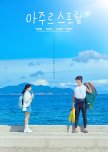
Having not known much about the series prior to watching, I wasn’t sure what to expect. I had previously watched and enjoyed Welcome to Samdal-ri (2023), a series with similar plot elements - girl hits a snag in her career in the big city, moves back to her small seaside hometown to heal. However, the similarities end there. Azure Spring is a gem of a drama - it is not neatly polished nor conventionally packaged; rather, its cinematography, pacing, tone, and OST are more like those of an independent film or Ghibli film. In fact, I sense a strong Miyazaki/Ghibli influence in its slow and healing pace, piano-driven OST, the significance ascribed to food and the simple pleasures of being alive, and a tone that’s simple, innocent, and joyful, yet anchored by realism and a hint of darkness. These unique elements make it a cathartic and joyful watch. The series is light on romance, showing a realistic relationship progression between the two leads, and at just 6 episodes, each clocking in at around half an hour, it feels more like a long movie.
While the core strength of the series lies in the sensory experience it evokes, the actual plot serves mainly as a complement to the scenery and cinematography. The story is solid: Seo An Na, facing a slump in her swimming career caused by a shoulder injury and a shady coach-slash-boyfriend, escapes from Seoul to the refuge of her small island coastal hometown. There, she meets Yun Deok Hyun for the first time, the quiet and stoic tenant who’s been living in her and her late mother’s home for 3 years, who also bears scars of his own. The two learn to co-habit, moving from a prickly tenant-landlord-roommate relationship to a deep, trusting friendship (and romance) as Deok Hyun teaches An Na how to free-dive. Complemented by a few colorful supporting characters (Baek Su Jeong, An Na’s childhood friend, and Jung Ki Tae, a mysterious figure from Deok Hyun’s past), the story serves as a frame for the series to explore the natural scenery along with its themes of healing, grief, beauty in the mundane, and the simple joy of living.
Central to this was Kang Sang Jun’s strong performance as Yun Deok Hyeon. While all of the cast gave solid performances, Kang Sang Jun’s muted yet detailed portrayal of Deok Hyeon anchored the tone of the series. His physicality and mannerisms brought Deok Hyeon’s character to life with a compelling nuance, all within 6 short episodes. I’d previously seen Kang Sang Jun in a supporting role in Dear Hyeri (2024), wherein I was impressed by the screen presence and charisma he commanded within a small amount of screentime. I’m excited to see more of his works in the future.
Nonetheless, some things in this drama were indeed left to be desired. An Na’s swimming coach boyfriend, Cha Jae Yun, was somewhat caricatured, as was Baek Su Jeong (but for her, this over-the-top quality is woven into her character’s personality, so it felt a little more acceptable). I also wish that the series had been expanded a bit more to show Deok Hyun’s role in the village and his relationship with the village elders, given his residence there for 3 years. It was mentioned in passing, but never really fully shown onscreen. Thus, the scene in the final episode where the village elders embrace Deok Hyun with open arms despite his dark past felt a bit rushed and unrealistic. I also wish I’d seen a bit more of the dynamic between Seo An Na, her coach/boyfriend Cha Jae Yun, and her rival swimming teammate. The coach/boyfriend double-title is already loaded, and the implication that he was blocking An Na’s career opportunities to benefit her rival, while at the same time dating An Na, seems rife with complexity. Showing more of this dynamic could’ve given just a bit more depth to An Na’s character. Lastly, the CGI cat that they chose to include was… regrettable 😅
Despite these shortcomings, the drama is still strong as a healing and cathartic watch. The catharsis comes not only from the visceral beauty of the natural scenery, but also, interestingly, from the focus on food and cooking. From the first episode, food takes on a certain significance. An Na, having arrived from the city with just a suitcase, has few options for food, and repeatedly finds herself confronted with the dilemma of finding her next meal. She sneakily turns to her roommate Deok Hyun’s frozen leftovers in the fridge, harvested from the sea, to quiet her rumbling belly. To guide her cooking, An Na draws on memories of her late mom, a free-diver herself, and the meals they shared, made from her fresh catches growing up. She begins to cook, steadily, step-by-step, first for herself and gradually for those around her as well. In this way, food serves as a healing force for An Na’s grief and a way to honor her mother’s memory. It also blends naturally into the way her and Deok Hyun’s lives are immersed and interconnected with nature, as she uses fresh ingredients that they catch themselves, straight from the ocean. As we watch An Na cook, we can feel the simple joy of working with your hands to put together a meal for your friends. The series presents long, enjoyable scene sequences dedicated just to the preparation of the food. These scenes contribute little to the plot - the purpose is simply to evoke the senses. The feeling of chopping ingredients on a cutting board, the heat and sweat of tending a fire, the aroma of a cooked meal. This, combined with the natural setting, allows the viewer to feel the sensations with An Na and the rest of the characters - the sensation of being alive.
All in all, this is a gem of a drama and a healing watch, owing to the strength of its cinematography, scenery, tone, pacing, and OST. As I lived the experiences alongside the characters in the series, I felt grief for the parts of my life where my days, too, looked like this - a part of the human experience that I want to get back. I resonated with the characters - especially Deok Hyeon's struggles with guilt vs. forgiveness, avoidance vs. belonging, and rooted for their healing alongside my own. What pulled me into the story, above all, were the sensory experiences evoked by the drama. The series allowed me to feel the sensations of being alive alongside the characters as they swam, dove, cooked, and existed in the physical world. TV and film have the power to immerse you intimately into a story through the senses, namely sight and sound, in a way that's unique from other media. It makes me think of the novel Writers & Lovers (2020) by Lily King, where it's argued (and I may be recalling this incorrectly) that literature is uniquely intimate because it simulates consciousness itself, unlike sensory art forms like dance or music or, presumably, TV and film. But I'd argue the opposite - that sensory forms of art like TV and film are just as, if not more, intimate. In literature, there is room for interpretation in a scene. In literature, a line may read: "He looked away uncomfortably." But when we imagine the action in our minds, it is fuzzy - we can imagine it in an infinite number of ways. By contrast, in a TV show or drama, the act of looking away uncomfortably is performed a specific way by the actor, a concrete action that we see with our eyes, grounding us in physical reality. It's the specificity and concreteness of it that allows us to be immersed in the reality that the characters inhabit. It allows us to feel those sensations with the characters and interpret the world around them with them. It's the closest simulation you can get to another person's experience of existence and personhood. That is why I watch K-dramas: to remind me of what it's like to be alive and what it means to be human.
In Azure Spring, the sensory experience is the primary thing. Watching the scenes play out, I could feel the water they swam in. The feeling of walking over the stones on the beach. The hot sun. The way it feels to walk over the hot concrete in the alleyways, leaving a trail of ocean water dripping from your clothes. The warm, comfortable exhaustion in your body after a day of swimming. Catching your food by day, cooking and eating it by night, then waking up to another day to do it all again - your body in motion, senses immersed in nature, rooted in reality. Living day by day. For me, watching this drama affirmed an important message: part of the joy of the human experience is simply being alive to the sensations of existing in the world.
Having not known much about the series prior to watching, I wasn’t sure what to expect. I had previously watched and enjoyed Welcome to Samdal-ri (2023), a series with similar plot elements - girl hits a snag in her career in the big city, moves back to her small seaside hometown to heal. However, the similarities end there. Azure Spring is a gem of a drama - it is not neatly polished nor conventionally packaged; rather, its cinematography, pacing, tone, and OST are more like those of an independent film or Ghibli film. In fact, I sense a strong Miyazaki/Ghibli influence in its slow and healing pace, piano-driven OST, the significance ascribed to food and the simple pleasures of being alive, and a tone that’s simple, innocent, and joyful, yet anchored by realism and a hint of darkness. These unique elements make it a cathartic and joyful watch. The series is light on romance, showing a realistic relationship progression between the two leads, and at just 6 episodes, each clocking in at around half an hour, it feels more like a long movie.
While the core strength of the series lies in the sensory experience it evokes, the actual plot serves mainly as a complement to the scenery and cinematography. The story is solid: Seo An Na, facing a slump in her swimming career caused by a shoulder injury and a shady coach-slash-boyfriend, escapes from Seoul to the refuge of her small island coastal hometown. There, she meets Yun Deok Hyun for the first time, the quiet and stoic tenant who’s been living in her and her late mother’s home for 3 years, who also bears scars of his own. The two learn to co-habit, moving from a prickly tenant-landlord-roommate relationship to a deep, trusting friendship (and romance) as Deok Hyun teaches An Na how to free-dive. Complemented by a few colorful supporting characters (Baek Su Jeong, An Na’s childhood friend, and Jung Ki Tae, a mysterious figure from Deok Hyun’s past), the story serves as a frame for the series to explore the natural scenery along with its themes of healing, grief, beauty in the mundane, and the simple joy of living.
Central to this was Kang Sang Jun’s strong performance as Yun Deok Hyeon. While all of the cast gave solid performances, Kang Sang Jun’s muted yet detailed portrayal of Deok Hyeon anchored the tone of the series. His physicality and mannerisms brought Deok Hyeon’s character to life with a compelling nuance, all within 6 short episodes. I’d previously seen Kang Sang Jun in a supporting role in Dear Hyeri (2024), wherein I was impressed by the screen presence and charisma he commanded within a small amount of screentime. I’m excited to see more of his works in the future.
Nonetheless, some things in this drama were indeed left to be desired. An Na’s swimming coach boyfriend, Cha Jae Yun, was somewhat caricatured, as was Baek Su Jeong (but for her, this over-the-top quality is woven into her character’s personality, so it felt a little more acceptable). I also wish that the series had been expanded a bit more to show Deok Hyun’s role in the village and his relationship with the village elders, given his residence there for 3 years. It was mentioned in passing, but never really fully shown onscreen. Thus, the scene in the final episode where the village elders embrace Deok Hyun with open arms despite his dark past felt a bit rushed and unrealistic. I also wish I’d seen a bit more of the dynamic between Seo An Na, her coach/boyfriend Cha Jae Yun, and her rival swimming teammate. The coach/boyfriend double-title is already loaded, and the implication that he was blocking An Na’s career opportunities to benefit her rival, while at the same time dating An Na, seems rife with complexity. Showing more of this dynamic could’ve given just a bit more depth to An Na’s character. Lastly, the CGI cat that they chose to include was… regrettable 😅
Despite these shortcomings, the drama is still strong as a healing and cathartic watch. The catharsis comes not only from the visceral beauty of the natural scenery, but also, interestingly, from the focus on food and cooking. From the first episode, food takes on a certain significance. An Na, having arrived from the city with just a suitcase, has few options for food, and repeatedly finds herself confronted with the dilemma of finding her next meal. She sneakily turns to her roommate Deok Hyun’s frozen leftovers in the fridge, harvested from the sea, to quiet her rumbling belly. To guide her cooking, An Na draws on memories of her late mom, a free-diver herself, and the meals they shared, made from her fresh catches growing up. She begins to cook, steadily, step-by-step, first for herself and gradually for those around her as well. In this way, food serves as a healing force for An Na’s grief and a way to honor her mother’s memory. It also blends naturally into the way her and Deok Hyun’s lives are immersed and interconnected with nature, as she uses fresh ingredients that they catch themselves, straight from the ocean. As we watch An Na cook, we can feel the simple joy of working with your hands to put together a meal for your friends. The series presents long, enjoyable scene sequences dedicated just to the preparation of the food. These scenes contribute little to the plot - the purpose is simply to evoke the senses. The feeling of chopping ingredients on a cutting board, the heat and sweat of tending a fire, the aroma of a cooked meal. This, combined with the natural setting, allows the viewer to feel the sensations with An Na and the rest of the characters - the sensation of being alive.
All in all, this is a gem of a drama and a healing watch, owing to the strength of its cinematography, scenery, tone, pacing, and OST. As I lived the experiences alongside the characters in the series, I felt grief for the parts of my life where my days, too, looked like this - a part of the human experience that I want to get back. I resonated with the characters - especially Deok Hyeon's struggles with guilt vs. forgiveness, avoidance vs. belonging, and rooted for their healing alongside my own. What pulled me into the story, above all, were the sensory experiences evoked by the drama. The series allowed me to feel the sensations of being alive alongside the characters as they swam, dove, cooked, and existed in the physical world. TV and film have the power to immerse you intimately into a story through the senses, namely sight and sound, in a way that's unique from other media. It makes me think of the novel Writers & Lovers (2020) by Lily King, where it's argued (and I may be recalling this incorrectly) that literature is uniquely intimate because it simulates consciousness itself, unlike sensory art forms like dance or music or, presumably, TV and film. But I'd argue the opposite - that sensory forms of art like TV and film are just as, if not more, intimate. In literature, there is room for interpretation in a scene. In literature, a line may read: "He looked away uncomfortably." But when we imagine the action in our minds, it is fuzzy - we can imagine it in an infinite number of ways. By contrast, in a TV show or drama, the act of looking away uncomfortably is performed a specific way by the actor, a concrete action that we see with our eyes, grounding us in physical reality. It's the specificity and concreteness of it that allows us to be immersed in the reality that the characters inhabit. It allows us to feel those sensations with the characters and interpret the world around them with them. It's the closest simulation you can get to another person's experience of existence and personhood. That is why I watch K-dramas: to remind me of what it's like to be alive and what it means to be human.
Was this review helpful to you?


