


This review may contain spoilers
Slow Burn, Heavy Heart, Full Reward
“Beside the Sky” is A Tender, Unflinching Evolution of the Fourever You Universe
When *Fourever You* aired last year, it quickly became one of the more emotionally resonant BL entries in the Thai television landscape — particularly the North Star arc, which struck a rare balance between romantic idealism and grounded vulnerability. So heading into **Fourever You Part 2: Beside the Sky**, anticipation wasn’t casual — it was earned.
What Part 2 does intelligently, and arguably decisively, is restructure the narrative format. Rather than interweaving multiple couples simultaneously, *Beside the Sky* isolates one pairing and gives it narrative sovereignty. That creative choice allows for depth instead of diffusion. It invites emotional immersion rather than fragmentation. In an umbrella series built on interconnected romances, this structural refinement feels like maturation.
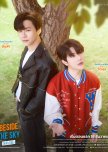
This first arc centres on Typhoon (Tonliew Methaphat Chimkul), a first-year university student burdened by unresolved trauma — parental neglect, projected hatred, internalised guilt, and sustained verbal abuse. His psychological landscape is not treated as aesthetic angst but as lived consequence. The writing does not sensationalise his pain; it observes it.
Opposite him is Tonfah (Bever Patsapon Jansuppakitkun), an older neighbour from Typhoon’s childhood who once served as quiet protector. Years later, their reunion carries both nostalgia and tension. Tonfah represents emotional steadiness — not saviourism, but safe presence. Their dynamic unfolds with deliberate restraint. There are no contrived misunderstandings, no inflated melodrama. Instead, the series leans into something rarer: emotional patience.
Unlike Part 1 — which balanced sweetness with light conflict — *Beside the Sky* is tonally heavier. It interrogates generational toxicity, cycles of blame, and the corrosive effects of shame. Yet it never collapses into misery for spectacle. The pain feels narratively justified, not engineered. Conflict emerges from character psychology rather than plot convenience.
Tonliew’s performance, in particular, is a revelation. His portrayal of Typhoon’s fragility avoids caricature. The emotional beats — especially the now much-discussed door scene — land with unguarded authenticity. There is restraint in his breakdowns, a lived-in exhaustion that makes the tears feel earned rather than performed. Bever matches him with composure and quiet intensity. His Tonfah is not flamboyant or exaggerated; he communicates through stillness, through eye contact that lingers just a beat longer than expected. Their chemistry operates in subtext. It simmers rather than explodes.
Technically, the production reflects noticeable growth. Under the direction of **Natthanon Kheeddee**, the visual language is more assured. The colour grading leans into cooler palettes during heavier sequences and softens during moments of intimacy, reinforcing emotional transitions without announcing them. Set design feels intentional rather than decorative. The pacing, though slow, is disciplined — it trusts the audience to sit in silence without rushing toward payoff.
Adapted from Howlsairy’s novel and produced by **Studio Wabi Sabi**, the eight-episode arc (premiering 20 December 2025 on GMM25, streaming via WeTV) demonstrates a clearer narrative cohesion than its predecessor. It balances tonal shifts — from devastating confrontation to giddy tenderness — with fluidity. The transitions feel organic rather than abrupt.
The ensemble presence also strengthens continuity. Returning characters — including Pond Ponlawit, Maxky Ratchata, and Ngern Anupart — ground the universe, while Typhoon’s friend group injects warmth that offsets the emotional gravity. North, in particular, remains a compelling secondary anchor — loyal, reactive, human.
What distinguishes *Beside the Sky* most, however, is its refusal to chase broad appeal. It is not engineered for viral cliffhangers. It is not paced for binge-driven immediacy. It requires patience. It asks viewers to engage with discomfort. That very refusal to dilute its emotional density is likely the source of early criticism — and paradoxically, its greatest strength.
As someone who has covered and analysed BL storytelling across several cycles of trend shifts, I can confidently say this arc signals evolution. It demonstrates that romance-driven series can sustain psychological realism without sacrificing intimacy. It proves that slow-burn does not have to mean stagnation; it can mean accumulation.
By the end of its eight episodes, *Beside the Sky* does something increasingly rare in contemporary television: it lingers. Not through shock value, but through emotional residue. It is the kind of story that revisits you unprompted — in a line of dialogue, in a look exchanged, in a silence that felt too familiar.
For me, it surpasses Part 1 — which was already strong — in narrative confidence, technical refinement, and emotional maturity. It has secured an early place in my Top 3 of 2026, not because it is easy viewing, but because it is brave enough to remain honest.
Quietly devastating. Formally improved. Emotionally intelligent.
A series that understands that sometimes, the most powerful romances are not the loudest — but the ones that dare to sit beside the sky and wait.
When *Fourever You* aired last year, it quickly became one of the more emotionally resonant BL entries in the Thai television landscape — particularly the North Star arc, which struck a rare balance between romantic idealism and grounded vulnerability. So heading into **Fourever You Part 2: Beside the Sky**, anticipation wasn’t casual — it was earned.
What Part 2 does intelligently, and arguably decisively, is restructure the narrative format. Rather than interweaving multiple couples simultaneously, *Beside the Sky* isolates one pairing and gives it narrative sovereignty. That creative choice allows for depth instead of diffusion. It invites emotional immersion rather than fragmentation. In an umbrella series built on interconnected romances, this structural refinement feels like maturation.
This first arc centres on Typhoon (Tonliew Methaphat Chimkul), a first-year university student burdened by unresolved trauma — parental neglect, projected hatred, internalised guilt, and sustained verbal abuse. His psychological landscape is not treated as aesthetic angst but as lived consequence. The writing does not sensationalise his pain; it observes it.
Opposite him is Tonfah (Bever Patsapon Jansuppakitkun), an older neighbour from Typhoon’s childhood who once served as quiet protector. Years later, their reunion carries both nostalgia and tension. Tonfah represents emotional steadiness — not saviourism, but safe presence. Their dynamic unfolds with deliberate restraint. There are no contrived misunderstandings, no inflated melodrama. Instead, the series leans into something rarer: emotional patience.
Unlike Part 1 — which balanced sweetness with light conflict — *Beside the Sky* is tonally heavier. It interrogates generational toxicity, cycles of blame, and the corrosive effects of shame. Yet it never collapses into misery for spectacle. The pain feels narratively justified, not engineered. Conflict emerges from character psychology rather than plot convenience.
Tonliew’s performance, in particular, is a revelation. His portrayal of Typhoon’s fragility avoids caricature. The emotional beats — especially the now much-discussed door scene — land with unguarded authenticity. There is restraint in his breakdowns, a lived-in exhaustion that makes the tears feel earned rather than performed. Bever matches him with composure and quiet intensity. His Tonfah is not flamboyant or exaggerated; he communicates through stillness, through eye contact that lingers just a beat longer than expected. Their chemistry operates in subtext. It simmers rather than explodes.
Technically, the production reflects noticeable growth. Under the direction of **Natthanon Kheeddee**, the visual language is more assured. The colour grading leans into cooler palettes during heavier sequences and softens during moments of intimacy, reinforcing emotional transitions without announcing them. Set design feels intentional rather than decorative. The pacing, though slow, is disciplined — it trusts the audience to sit in silence without rushing toward payoff.
Adapted from Howlsairy’s novel and produced by **Studio Wabi Sabi**, the eight-episode arc (premiering 20 December 2025 on GMM25, streaming via WeTV) demonstrates a clearer narrative cohesion than its predecessor. It balances tonal shifts — from devastating confrontation to giddy tenderness — with fluidity. The transitions feel organic rather than abrupt.
The ensemble presence also strengthens continuity. Returning characters — including Pond Ponlawit, Maxky Ratchata, and Ngern Anupart — ground the universe, while Typhoon’s friend group injects warmth that offsets the emotional gravity. North, in particular, remains a compelling secondary anchor — loyal, reactive, human.
What distinguishes *Beside the Sky* most, however, is its refusal to chase broad appeal. It is not engineered for viral cliffhangers. It is not paced for binge-driven immediacy. It requires patience. It asks viewers to engage with discomfort. That very refusal to dilute its emotional density is likely the source of early criticism — and paradoxically, its greatest strength.
As someone who has covered and analysed BL storytelling across several cycles of trend shifts, I can confidently say this arc signals evolution. It demonstrates that romance-driven series can sustain psychological realism without sacrificing intimacy. It proves that slow-burn does not have to mean stagnation; it can mean accumulation.
By the end of its eight episodes, *Beside the Sky* does something increasingly rare in contemporary television: it lingers. Not through shock value, but through emotional residue. It is the kind of story that revisits you unprompted — in a line of dialogue, in a look exchanged, in a silence that felt too familiar.
For me, it surpasses Part 1 — which was already strong — in narrative confidence, technical refinement, and emotional maturity. It has secured an early place in my Top 3 of 2026, not because it is easy viewing, but because it is brave enough to remain honest.
Quietly devastating. Formally improved. Emotionally intelligent.
A series that understands that sometimes, the most powerful romances are not the loudest — but the ones that dare to sit beside the sky and wait.
Was this review helpful to you?


