

 1
1


This review may contain spoilers
A flawed albeit watchable 'Hua Mulan' drama
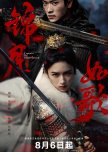
The drama depicts the story of He Yan, He family’s daughter, who disguises herself as her brother, "He Ru Fei," by wearing a mask to protect their noble title. She meets Xiao Jue at Xianchang Academy, but leaves to change her fate by going to the battlefield. After returning home as the hero General Feihong, she is betrayed by her family when her brother reappears to ‘take over’ from her. He Yan then takes on the identity of a city gate officer's daughter and joins the military in Yezhou under Xiao Jue’s command, who initially suspects her of being a spy. There she befriends Chu Zhao, a protégé of Prime Minister Xu Jing Fu with an agenda, and proves her military prowess through several challenges thrown at her at the garrison and tribulations, i.e., the missions at Jiang and Rundu cities with Xua Jue, on the road to reclaiming her real identity. As He Yan and Xiao Jue face life-threatening encounters on the battlefield, their relationship grows stronger, and they gradually realize their true feelings for one another.
‘The Legend of the Female General’ was penned by Qian Shan Cha Ke, the author of ‘The Glory’ and ‘The Double,’ previously adapted to screen, successfully.
On paper the synopsis is a copy-paste Mulan reproduction with all the elements of a grand story. The multi-dimensional main characters: He Yan and Xiao Jue, contrast and balance each other out; they are the true yin and yang, the invisible ouroboros representation of true love. The solid supporting characters i.e. Chu Zhao and He Ru Fei advance the story, with their own Machiavellian actions adding layers of angst to the plot, rather than pointlessly existing; and the story’s silver-lining, a woman’s goal to be recognized as the great general that she is by the emperor, ‘society’ and the patriarchal universe where she lived in. Backed by her strong feelings of justice, her beliefs, motivations and honour, that has honed her body and her mind, both physically and emotionally, He Yan rises above fights and battles to fully embody her true self, a legendary female general with an imperfectly crafted journey; an inspiring story of female empowerment … on paper.
Fans have endured the endless wait for the drama’s release, the uncertainty, the longing, and the shattered illusions, so to watch He Yan’s story finally come to life on screen seems like ‘The Legend of the Female General for Dummies’. In short, an infantile script with a travesty of the production team, who had a higher budget to work with than The Glory’ and ‘The Double’ did, yet disastrously managed to release an inferior-quality drama with poor acting, amateurish dialogue and editing and inconsistent episode duration. It is wondered whether or not the producers of ‘Legend of the Female General’ genuinely believed that they held ‘the snitch’ in their hands or they just needed several pairs of glasses to see that they held fictional ‘blugers’ instead.
It's tragically surreal how He Yan was reduced to a one-dimensional woman on screen, obsessed with revenge and ‘dudu’, while Xiao Jue’s was ‘magically transformed’ into Prince Charming in a panoply, continuously rushing to save her from harm. He Yan didn’t need saving. The audience did, from this poorly executed series, from the standardized facial expressions that showed nothing, possibly in an attempt to cultivate wisdom and compassion, and from the absence of the invisible web tapestry that faultlessly connected all the story’s arcs to the overall plot. Adding insult to injury, the supporting cast’s narrative was substandard, with their uncreative, recycled plots, whose portrayal didn’t add value to the story, i.e., He Ru Fei ‘childish’ actions, tantrums and manipulations; Chu Zhao’s active passiveness for the majority of the drama; Xu Ping Ting’s frivolity, jealousy, and revenge attempt; and Commander Li’s misogyny, making the characters presence appear dull and lacklustre in the grand scheme of things, which was dismaying. They seemed to clutter the plot and distract audience. Cheng Li Su and Song Tao Tao’s subplot was pointless 90% of the time and didn’t support the drama’s narrative, feeling slightly out of place and unnecessary. The guest roles on the other hand, i.e., Peter Sheng’s Yan He, Ma Tian Yu’s Xiao Jing or Karina Zhao’s Song Wan, added a little bit of flair to the drama which was nice but didn’t remove its mantle of invisibility.
Zhou Ye and Cheng Lei’s stoic performances as leads didn’t stand out at all, perhaps a result of a lack of screen presence to command the audience’s attention to their roles. If they had more emotional depth and range and looked more authentic it might have been different. This is something that can be improved i.e., through non-verbal communication and acting technique workshops and/or courses… Despite that, both actors seemed to have connected with their characters and their technical skills were good. The battle sequences and the fighting were top notch but the overuse of the word ‘dudu’ was not.
Zhang Kang Le’s Chu Zhao meek period performance was prosaic, however when the character goes full on psychotic mode with his delusions, disorganized thinking and hallucinations about He Yan, particularly after seeing her and Xiao Jue kissing, the actor delivered. Chu Zhao should just be happy for them and be happy himself instead of going all the way cliché undiagnosed schizophrenia, Heathcliff mode when he knew that He Yan only had eyes for Xiao Jue. His emotions and actions were all over the place which was pointless but it did add a layer of angst to the story.
Bai Shu’s rendition of He Ru Fei was irritating to the point of wanting to advise the character to see a psychologist. In this way, Bai Shu’s performance was memorable, in spite of his forgettable acting. He Ru Fei needed help him heal his brattish behavioural issues, his inner child that has clearly suffered from abandonment, and his misplaced hatred for He Yan, who was forced to take over his identity. After his recovery, He Ru Fei might actually become a better human being and live a happy life with a partner, alone or as a monk. It would be interesting to see how Bai Shu would fare in his interpretation of these happier, lighter imaginary versions of the character.
All of this made the drama a disappointment, however, once all its shortcomings were ignored and all the preconceived thoughts of what it should have been were shed, including the ‘beautiful kiss scene’ that added a level of stupidity to the romance with an alternated focus on He Yan’s shoes, the series was extremely compelling to watch. It resembled a live-action of the 1998 animated film Mulan, bringing to consciousness the love for the Disney story and that was all that mattered, not the logic or the reason or the facts that mentally weakened the drama.
He Yan’s journey at Yezhou garrison with her motley crew, the challenges and the struggles, the determination to become stronger, to prove her worth in a masculine army world were poignant and truly a delight to watch. Her loyalty and love for Xiao Jue were unwavering and heartwarming and sweet as was her longing for the Qinglang sword, which Xiao Jue returned to her before her sparring match with He Ru Fei, in front of the emperor and his ministers at the palace. That scene was so captivating that had to be rewatched, particularly the part where He Yan pins He Ru Fei’s sword down with the tip of Qinglang. It was beautiful.
Xiao Jue, well Cheng Lei is handsome and visually serviceable in the drama. He’s not exactly Li Shang but the world is imperfect anyway, beauty is in the eyes of the beholder, and Xiao Jue and He Yan are great together, and the ending, despite being cliché, that is, showing their wedding, was satisfying.
Overall, the drama was extremely flawed but enjoyed for the most part.
To truly and fully appreciate the story… a suggestion: read the novel.
‘The Legend of the Female General’ was penned by Qian Shan Cha Ke, the author of ‘The Glory’ and ‘The Double,’ previously adapted to screen, successfully.
On paper the synopsis is a copy-paste Mulan reproduction with all the elements of a grand story. The multi-dimensional main characters: He Yan and Xiao Jue, contrast and balance each other out; they are the true yin and yang, the invisible ouroboros representation of true love. The solid supporting characters i.e. Chu Zhao and He Ru Fei advance the story, with their own Machiavellian actions adding layers of angst to the plot, rather than pointlessly existing; and the story’s silver-lining, a woman’s goal to be recognized as the great general that she is by the emperor, ‘society’ and the patriarchal universe where she lived in. Backed by her strong feelings of justice, her beliefs, motivations and honour, that has honed her body and her mind, both physically and emotionally, He Yan rises above fights and battles to fully embody her true self, a legendary female general with an imperfectly crafted journey; an inspiring story of female empowerment … on paper.
Fans have endured the endless wait for the drama’s release, the uncertainty, the longing, and the shattered illusions, so to watch He Yan’s story finally come to life on screen seems like ‘The Legend of the Female General for Dummies’. In short, an infantile script with a travesty of the production team, who had a higher budget to work with than The Glory’ and ‘The Double’ did, yet disastrously managed to release an inferior-quality drama with poor acting, amateurish dialogue and editing and inconsistent episode duration. It is wondered whether or not the producers of ‘Legend of the Female General’ genuinely believed that they held ‘the snitch’ in their hands or they just needed several pairs of glasses to see that they held fictional ‘blugers’ instead.
It's tragically surreal how He Yan was reduced to a one-dimensional woman on screen, obsessed with revenge and ‘dudu’, while Xiao Jue’s was ‘magically transformed’ into Prince Charming in a panoply, continuously rushing to save her from harm. He Yan didn’t need saving. The audience did, from this poorly executed series, from the standardized facial expressions that showed nothing, possibly in an attempt to cultivate wisdom and compassion, and from the absence of the invisible web tapestry that faultlessly connected all the story’s arcs to the overall plot. Adding insult to injury, the supporting cast’s narrative was substandard, with their uncreative, recycled plots, whose portrayal didn’t add value to the story, i.e., He Ru Fei ‘childish’ actions, tantrums and manipulations; Chu Zhao’s active passiveness for the majority of the drama; Xu Ping Ting’s frivolity, jealousy, and revenge attempt; and Commander Li’s misogyny, making the characters presence appear dull and lacklustre in the grand scheme of things, which was dismaying. They seemed to clutter the plot and distract audience. Cheng Li Su and Song Tao Tao’s subplot was pointless 90% of the time and didn’t support the drama’s narrative, feeling slightly out of place and unnecessary. The guest roles on the other hand, i.e., Peter Sheng’s Yan He, Ma Tian Yu’s Xiao Jing or Karina Zhao’s Song Wan, added a little bit of flair to the drama which was nice but didn’t remove its mantle of invisibility.
Zhou Ye and Cheng Lei’s stoic performances as leads didn’t stand out at all, perhaps a result of a lack of screen presence to command the audience’s attention to their roles. If they had more emotional depth and range and looked more authentic it might have been different. This is something that can be improved i.e., through non-verbal communication and acting technique workshops and/or courses… Despite that, both actors seemed to have connected with their characters and their technical skills were good. The battle sequences and the fighting were top notch but the overuse of the word ‘dudu’ was not.
Zhang Kang Le’s Chu Zhao meek period performance was prosaic, however when the character goes full on psychotic mode with his delusions, disorganized thinking and hallucinations about He Yan, particularly after seeing her and Xiao Jue kissing, the actor delivered. Chu Zhao should just be happy for them and be happy himself instead of going all the way cliché undiagnosed schizophrenia, Heathcliff mode when he knew that He Yan only had eyes for Xiao Jue. His emotions and actions were all over the place which was pointless but it did add a layer of angst to the story.
Bai Shu’s rendition of He Ru Fei was irritating to the point of wanting to advise the character to see a psychologist. In this way, Bai Shu’s performance was memorable, in spite of his forgettable acting. He Ru Fei needed help him heal his brattish behavioural issues, his inner child that has clearly suffered from abandonment, and his misplaced hatred for He Yan, who was forced to take over his identity. After his recovery, He Ru Fei might actually become a better human being and live a happy life with a partner, alone or as a monk. It would be interesting to see how Bai Shu would fare in his interpretation of these happier, lighter imaginary versions of the character.
All of this made the drama a disappointment, however, once all its shortcomings were ignored and all the preconceived thoughts of what it should have been were shed, including the ‘beautiful kiss scene’ that added a level of stupidity to the romance with an alternated focus on He Yan’s shoes, the series was extremely compelling to watch. It resembled a live-action of the 1998 animated film Mulan, bringing to consciousness the love for the Disney story and that was all that mattered, not the logic or the reason or the facts that mentally weakened the drama.
He Yan’s journey at Yezhou garrison with her motley crew, the challenges and the struggles, the determination to become stronger, to prove her worth in a masculine army world were poignant and truly a delight to watch. Her loyalty and love for Xiao Jue were unwavering and heartwarming and sweet as was her longing for the Qinglang sword, which Xiao Jue returned to her before her sparring match with He Ru Fei, in front of the emperor and his ministers at the palace. That scene was so captivating that had to be rewatched, particularly the part where He Yan pins He Ru Fei’s sword down with the tip of Qinglang. It was beautiful.
Xiao Jue, well Cheng Lei is handsome and visually serviceable in the drama. He’s not exactly Li Shang but the world is imperfect anyway, beauty is in the eyes of the beholder, and Xiao Jue and He Yan are great together, and the ending, despite being cliché, that is, showing their wedding, was satisfying.
Overall, the drama was extremely flawed but enjoyed for the most part.
To truly and fully appreciate the story… a suggestion: read the novel.
Was this review helpful to you?


