
 Editorials

 148
148 300
300 27
27 3
3 5
5 6
6 12
12 5
5 7
7 8
8 4
4 12
12 5
5 2
2 8
8 48
48 4
4 5
5 4
4 3
3 1
1 4
4 5
5 5
5 2
2 8
8 31
31 46
46 13
13 28
28


A KINGDOM BUILT ON BURIED SINS
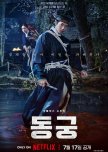
You know a fantasy K-drama is serious when the crown princes start dropping dead one after another before you've even learned anybody's name. The East Palace opens with the royal family being terrorized by what everyone believes is the vengeful spirit of a pond, and honestly, if I were the king, I'd stop pretending this was a coincidence after prince number two. But no. Like every politician in fiction, he spends way too long convincing himself everything is fine until the very last heir falls ill. Suddenly ghosts become everybody's problem, and that's when Gu-cheon, a man capable of crossing into the spirit world, is summoned to uncover what's really happening. Working alongside him is court lady Saeng-gang, whose ability to communicate with spirits makes her just as essential to the investigation.
I'll admit my expectations were ridiculously high going into this. Nam Joo-hyuk was finally back after military service, Netflix was throwing money at a historical fantasy, and the trailers promised ghosts running around a Joseon palace. I was fully prepared for elegant people getting possessed every twenty minutes. Instead, the series did something much better. Yes, there are terrifying spirits and creepy folklore creatures, but they're really just the gateway drug. The real addiction is the mystery.
Every time Gu-cheon and Saeng-gang think they've figured something out, the show basically laughs in their faces and says, "Cute theory. Here's another century-old secret." The investigation keeps peeling back layers of palace history until you realize the ghosts aren't even the biggest problem anymore. The supernatural gets your attention, but it's the people who keep you awake afterward. The series understands one of horror's oldest truths: monsters are scary, but humans with power and something to hide are absolutely terrifying.
For much of its runtime, the mystery unfolds with remarkable confidence, but as the series progresses, it becomes increasingly determined to explain every supernatural rule governing its world. New layers of mythology, spiritual mechanics, and centuries-old lore are introduced so frequently that the investigation occasionally loses the elegant simplicity that made its opening episodes so compelling. Rather than deepening the mystery, some of these explanations feel like unnecessary detours that slow the pacing and briefly interrupt the tension.
Gu-cheon ended up being one of my favorite fantasy protagonists in years because the show never tries to make him effortlessly cool. He's sarcastic, emotionally unavailable, and gives off the energy of someone who desperately wants everybody to leave him alone. At first he almost seems indifferent to the supernatural despite having the ability to enter the spirit realm, but every trip comes with a physical and emotional cost, and the more you learn about his past, the more his detached personality starts to feel less like a character quirk and more like survival. Nam Joo-hyuk plays him with remarkable restraint, communicating exhaustion, guilt, and grief without needing lengthy speeches every five minutes.
Then there's Saeng-gang, who thankfully avoids becoming the obligatory female sidekick whose only purpose is looking impressed while the hero saves the day. If anything, she's the one holding the investigation together. While Gu-cheon wrestles with ghosts and vengeful spirits, Saeng-gang untangles palace politics, hidden motives, and decades of buried secrets. I loved that the series never treats intelligence as less valuable than supernatural abilities.
They solve different pieces of the same puzzle, and because of that, they actually feel like partners instead of two characters taking turns carrying the plot. Their chemistry isn't built on endless misunderstandings or forced romantic tension either. It grows through trust, mutual respect, and the realization that they're probably the only two people who truly understand what the other is carrying.
The palace itself deserves credit because it never feels like a pretty historical backdrop. It feels alive, and not in the comforting Disney-castle way. Every hallway, courtyard, and abandoned chamber seems to be hiding another crime someone desperately wants forgotten. The series relies far more on atmosphere than cheap jump scares, creating a constant sense that someone, or something, is watching from just outside the frame. Whenever Gu-cheon crosses into the spirit world, the visual shift immediately reminds you why he dreads using his abilities. Those sequences are eerie without becoming overindulgent, making the supernatural feel genuinely dangerous instead of simply cool to look at.
Cho Seung-woo and Jang Young-nam elevate the political side of the story far beyond the usual palace scheming. Neither the King nor the Queen Dowager sees themselves as villains, and that's exactly what makes them compelling. They're consumed by protecting the royal bloodline and preserving secrets that should probably never have existed in the first place, and somewhere along the way they sacrifice every shred of humanity they had left. Watching them eliminate anyone who gets too close to the truth becomes just as suspenseful as Gu-cheon's encounters with the spirits. Eventually, the show makes it painfully clear that the greatest evil haunting the palace was never the ghosts lurking in the pond. It was the people sitting on the throne.
One of the series' biggest strengths is how confidently it keeps reinventing its own mystery. Nearly every episode ends with what feels like a major breakthrough, only for the next revelation to completely reshape everything you thought you understood. Those twists rarely feel like cheap cliffhangers because each one uncovers another piece of the palace's forgotten history, making the investigation feel richer instead of more convoluted.
That said, the writers occasionally become so eager to outdo the previous reveal that later twists rely on increasingly elaborate mythology rather than emotional payoff. The surprises remain entertaining, but not every revelation carries the same weight as the earlier ones.
Visually, The East Palace is gorgeous. The palace sets are stunning, the costumes are rich without feeling theatrical, the creature designs draw heavily from Korean folklore, and the sword fights are choreographed with impressive precision. The CGI occasionally gets a little too ambitious, particularly during some of the larger supernatural set pieces, where spectacle sometimes takes priority over clarity. There were moments when I understood that something impressive was happening without being entirely sure what had actually happened.
What impressed me most is that The East Palace never forgets what kind of story it wants to tell. Beneath the ghosts, folklore, political conspiracies, and elaborate mythology lies a mystery about grief, ambition, guilt, and the terrible things people justify in the name of family and legacy. I just wish the series had trusted that emotional core as much as it trusted its ever-expanding lore. Whenever it focuses on its characters and the palace conspiracy, it's genuinely gripping. Whenever it disappears into lengthy supernatural explanations, some of that momentum slips away.
Even so, The East Palace remains an atmospheric, beautifully produced supernatural thriller elevated by strong performances, memorable horror imagery, and an engaging central mystery. It doesn't always balance its mythology with the same confidence it brings to its characters, but when everything clicks, it's exactly the kind of haunting historical fantasy I was hoping for.
I'll admit my expectations were ridiculously high going into this. Nam Joo-hyuk was finally back after military service, Netflix was throwing money at a historical fantasy, and the trailers promised ghosts running around a Joseon palace. I was fully prepared for elegant people getting possessed every twenty minutes. Instead, the series did something much better. Yes, there are terrifying spirits and creepy folklore creatures, but they're really just the gateway drug. The real addiction is the mystery.
Every time Gu-cheon and Saeng-gang think they've figured something out, the show basically laughs in their faces and says, "Cute theory. Here's another century-old secret." The investigation keeps peeling back layers of palace history until you realize the ghosts aren't even the biggest problem anymore. The supernatural gets your attention, but it's the people who keep you awake afterward. The series understands one of horror's oldest truths: monsters are scary, but humans with power and something to hide are absolutely terrifying.
For much of its runtime, the mystery unfolds with remarkable confidence, but as the series progresses, it becomes increasingly determined to explain every supernatural rule governing its world. New layers of mythology, spiritual mechanics, and centuries-old lore are introduced so frequently that the investigation occasionally loses the elegant simplicity that made its opening episodes so compelling. Rather than deepening the mystery, some of these explanations feel like unnecessary detours that slow the pacing and briefly interrupt the tension.
Gu-cheon ended up being one of my favorite fantasy protagonists in years because the show never tries to make him effortlessly cool. He's sarcastic, emotionally unavailable, and gives off the energy of someone who desperately wants everybody to leave him alone. At first he almost seems indifferent to the supernatural despite having the ability to enter the spirit realm, but every trip comes with a physical and emotional cost, and the more you learn about his past, the more his detached personality starts to feel less like a character quirk and more like survival. Nam Joo-hyuk plays him with remarkable restraint, communicating exhaustion, guilt, and grief without needing lengthy speeches every five minutes.
Then there's Saeng-gang, who thankfully avoids becoming the obligatory female sidekick whose only purpose is looking impressed while the hero saves the day. If anything, she's the one holding the investigation together. While Gu-cheon wrestles with ghosts and vengeful spirits, Saeng-gang untangles palace politics, hidden motives, and decades of buried secrets. I loved that the series never treats intelligence as less valuable than supernatural abilities.
They solve different pieces of the same puzzle, and because of that, they actually feel like partners instead of two characters taking turns carrying the plot. Their chemistry isn't built on endless misunderstandings or forced romantic tension either. It grows through trust, mutual respect, and the realization that they're probably the only two people who truly understand what the other is carrying.
The palace itself deserves credit because it never feels like a pretty historical backdrop. It feels alive, and not in the comforting Disney-castle way. Every hallway, courtyard, and abandoned chamber seems to be hiding another crime someone desperately wants forgotten. The series relies far more on atmosphere than cheap jump scares, creating a constant sense that someone, or something, is watching from just outside the frame. Whenever Gu-cheon crosses into the spirit world, the visual shift immediately reminds you why he dreads using his abilities. Those sequences are eerie without becoming overindulgent, making the supernatural feel genuinely dangerous instead of simply cool to look at.
Cho Seung-woo and Jang Young-nam elevate the political side of the story far beyond the usual palace scheming. Neither the King nor the Queen Dowager sees themselves as villains, and that's exactly what makes them compelling. They're consumed by protecting the royal bloodline and preserving secrets that should probably never have existed in the first place, and somewhere along the way they sacrifice every shred of humanity they had left. Watching them eliminate anyone who gets too close to the truth becomes just as suspenseful as Gu-cheon's encounters with the spirits. Eventually, the show makes it painfully clear that the greatest evil haunting the palace was never the ghosts lurking in the pond. It was the people sitting on the throne.
One of the series' biggest strengths is how confidently it keeps reinventing its own mystery. Nearly every episode ends with what feels like a major breakthrough, only for the next revelation to completely reshape everything you thought you understood. Those twists rarely feel like cheap cliffhangers because each one uncovers another piece of the palace's forgotten history, making the investigation feel richer instead of more convoluted.
That said, the writers occasionally become so eager to outdo the previous reveal that later twists rely on increasingly elaborate mythology rather than emotional payoff. The surprises remain entertaining, but not every revelation carries the same weight as the earlier ones.
Visually, The East Palace is gorgeous. The palace sets are stunning, the costumes are rich without feeling theatrical, the creature designs draw heavily from Korean folklore, and the sword fights are choreographed with impressive precision. The CGI occasionally gets a little too ambitious, particularly during some of the larger supernatural set pieces, where spectacle sometimes takes priority over clarity. There were moments when I understood that something impressive was happening without being entirely sure what had actually happened.
What impressed me most is that The East Palace never forgets what kind of story it wants to tell. Beneath the ghosts, folklore, political conspiracies, and elaborate mythology lies a mystery about grief, ambition, guilt, and the terrible things people justify in the name of family and legacy. I just wish the series had trusted that emotional core as much as it trusted its ever-expanding lore. Whenever it focuses on its characters and the palace conspiracy, it's genuinely gripping. Whenever it disappears into lengthy supernatural explanations, some of that momentum slips away.
Even so, The East Palace remains an atmospheric, beautifully produced supernatural thriller elevated by strong performances, memorable horror imagery, and an engaging central mystery. It doesn't always balance its mythology with the same confidence it brings to its characters, but when everything clicks, it's exactly the kind of haunting historical fantasy I was hoping for.
Was this review helpful to you?


