




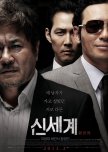
Bloody when South Korean gangsters settle scores.
New World is a sometimes bloody thriller that, despite its length, manages to keep the tension up almost the entire way.
When the leader of a large criminal organization dies in a car accident, a power struggle begins over who will take over his place. In the highly hierarchical organization, there are two candidates for the leadership position, each of whom leads two factions of criminals, and the loser risks both being murdered himself and having all his followers murdered.
With one of them, the arrogant and materialistic Chung, the police have managed to place one of their men, Ja-sung, who over several years of work has managed to rise to the top and is now Chung’s right-hand man. Since his wife is pregnant, he hopes to soon be released from his assignment for the police, but the death of the leader and the ensuing power struggle put the situation in a different position, and he is forced to continue with his assignment. Fearing what will happen to his wife and future children, he is torn between loyalty to his profession as a police officer and loyalty to Chung and the group of underlings who completely trust him.
The film sets the tone right away, with a bloody opening scene in which a suspected infiltrator is tortured to death. The film then follows a traditional but effective dramatic curve, where dialogue dominates while the premises of the film and its characters are explained, before the action scenes take over towards the end.
The film's greatest asset lies in the acting. Having a bunch of costumed gangsters running around and fighting with each other could easily be silly, but thanks to a simultaneously restrained and fateful, personal and conscious acting style, the characters appear as cool as they themselves seem to want to be perceived. The many extreme close-ups of the characters' faces, showing both sweat and the slightest twitch of their eyelids, bring us even closer to their inner thoughts. A constant awareness of the characters’ personal stakes, especially the risk to Ja-sung, creates a tension that is maintained throughout the film. It is heightened by the many twists and turns in the story, which make the film both unexpected and unpredictable.
The police chief who gives Ja Sung his assignment is played by Choi Min Sik, known from Oldboy, otherwise the actors are relatively unknown in the West.
The photography contributes a lot to the coolness of the film and the characters. The camera really enjoys the color-saturated images of the exclusive surroundings in which the wealthy gangsters move. The sterile and stylish surroundings reflect the perfect surface that the characters seem to want to convey, but stand in stark contrast to the chaos that prevails beneath the surface, where loyalties are questioned and lives are at stake. The editing is smooth and flawless and the image composition balanced and well thought out. The editing keeps the pace up and the tension intact even through the less fast-paced scenes, which retain their intensity through a combination of close-ups and tense dialogue.
It is actually unclear what illegalities they are actually up to, apart from murdering scoundrels. But that does not matter much, what is clear is that the organization has unlimited money that primarily benefits those high in the hierarchy, and that it takes cold-bloodedness and violence to get there. The tension that has been at a fairly even level through large parts of the film rises towards the end in a crescendo of violence and blood that makes the rest of the film fade, while the final scenes are etched on the retina.
When the leader of a large criminal organization dies in a car accident, a power struggle begins over who will take over his place. In the highly hierarchical organization, there are two candidates for the leadership position, each of whom leads two factions of criminals, and the loser risks both being murdered himself and having all his followers murdered.
With one of them, the arrogant and materialistic Chung, the police have managed to place one of their men, Ja-sung, who over several years of work has managed to rise to the top and is now Chung’s right-hand man. Since his wife is pregnant, he hopes to soon be released from his assignment for the police, but the death of the leader and the ensuing power struggle put the situation in a different position, and he is forced to continue with his assignment. Fearing what will happen to his wife and future children, he is torn between loyalty to his profession as a police officer and loyalty to Chung and the group of underlings who completely trust him.
The film sets the tone right away, with a bloody opening scene in which a suspected infiltrator is tortured to death. The film then follows a traditional but effective dramatic curve, where dialogue dominates while the premises of the film and its characters are explained, before the action scenes take over towards the end.
The film's greatest asset lies in the acting. Having a bunch of costumed gangsters running around and fighting with each other could easily be silly, but thanks to a simultaneously restrained and fateful, personal and conscious acting style, the characters appear as cool as they themselves seem to want to be perceived. The many extreme close-ups of the characters' faces, showing both sweat and the slightest twitch of their eyelids, bring us even closer to their inner thoughts. A constant awareness of the characters’ personal stakes, especially the risk to Ja-sung, creates a tension that is maintained throughout the film. It is heightened by the many twists and turns in the story, which make the film both unexpected and unpredictable.
The police chief who gives Ja Sung his assignment is played by Choi Min Sik, known from Oldboy, otherwise the actors are relatively unknown in the West.
The photography contributes a lot to the coolness of the film and the characters. The camera really enjoys the color-saturated images of the exclusive surroundings in which the wealthy gangsters move. The sterile and stylish surroundings reflect the perfect surface that the characters seem to want to convey, but stand in stark contrast to the chaos that prevails beneath the surface, where loyalties are questioned and lives are at stake. The editing is smooth and flawless and the image composition balanced and well thought out. The editing keeps the pace up and the tension intact even through the less fast-paced scenes, which retain their intensity through a combination of close-ups and tense dialogue.
It is actually unclear what illegalities they are actually up to, apart from murdering scoundrels. But that does not matter much, what is clear is that the organization has unlimited money that primarily benefits those high in the hierarchy, and that it takes cold-bloodedness and violence to get there. The tension that has been at a fairly even level through large parts of the film rises towards the end in a crescendo of violence and blood that makes the rest of the film fade, while the final scenes are etched on the retina.
Was this review helpful to you?


