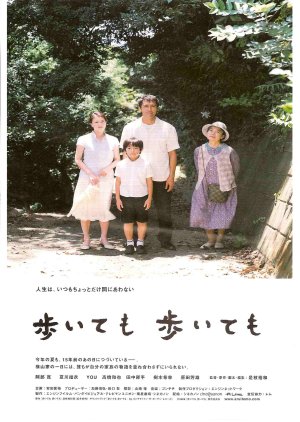
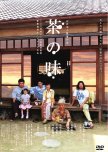
Still Walking centers on a particular day in the life of an ordinary Japanese family. While they try to maintain a semblance of normalcy on this day, the occasion cannot allow it to be wholly so. It is the memorial of a tragic death, and so even the most errant of relatives have come to call.
The story is told through beautifully written, but realistic conversations and domestic interactions between characters. While they cook, play, eat, or chat together, the dynamics between them slowly but surely unfold. We see fondness, pain, nostalgia, resentments, and all manner of feeling bubble to the surface. But none of this is done in the usual bombastic way, lending the entire piece more relatability than one might first imagine. It’s all very Japanese, but very human as well; how often have you swallowed a hurtful comment or urged yourself to forget it… just because of the ties that bind? I saw parts of my own family in Still Walking, little bites of conversation I've spoken myself. It leaves one with much to think about.
My chief issue would be that, while slow films rarely bother me, this takes a little *too* long to launch. Still Walking requires the viewer to see every minute to feel its effects to the highest measure. The ending also feels a little incomplete, but that can be overlooked; Still Walking is meant to portray life continuing under the cloud of death. We don’t always get perfect conclusions in real life, do we?
Calling out a particular actor or actress for an exemplary performance would be difficult. The entire ensemble works together so well they give the solid impression of an actual family, bitterness, warmth, and all. If forced to choose, Abe Hiroshi might win as the most easily recognizable among them; much of Still Walking focuses on his Ryota, and he’s arguably representative of Kore-eda himself. Kiki Kirin is also remarkable as Toshiko, the talkative and smiling mother who hides her many battle-scars behind polite words. She sometimes reminded me of my own mother, which was a little jarring.
A particular piece of music that sticks with me after completion is Blue Light Yokohama (Ishida Ayumi). If one has never "heard" nostalgia, this song will change that. Despite being quite the “oldie,” its inclusion is just exquisite. Common sounds are used effectively also; such as overlapping talk, popping and sizzling in the kitchen, etc.
Please note the interesting shots used in Still Walking. Detail in them is astounding, from hallways to individual rooms. The cinematography here lends an air of tranquility, of reality, of home…. My weak powers of description are not enough to describe the effect. One must truly see it for themselves.
Was this review helpful to you?

Yui and Abe’s acting skills are impeccable and the way they play off each other is captivating! Actually, everyone was really great, such natural and organic scenes which were composed mostly of dialog, GREAT dialog which grew and simmered like real conversations… so realistic, at times if seemed like I was watching a hidden camera video recording of some family’s life!
Watching this has really reinforced my Yui Natsukawa love, man…she was so doggone pretty and delicate in this one, not at all like the tough realist Natsumi Hayakawa (her character in Kekkon Dekinai Otoko), but both really great characters. And of course, no matter who she plays, her characters always have those signature dimples, and in fact, there's a scene where Mother (played excellently by the awesome Kiki Kirin) even comments, "Oh, you have cute dimples!" LOLOL
PS. Was really cool to realize the line “Aruitemo, Aruitemo” used as the title of this movie came from none other than the immensely gorgeous Japan chanteuse Ayumi Ishida’s song “Blue Light Yokohama”, how cool is THAT!!!
Was this review helpful to you?

"I'm always a little too late."
'Still Walking' was conceived by Kore-eda after the deaths of his parents, and embodies his regret in being unable to fulfil his own filial piety. To keep things brief, this film is a masterpiece. Kore-eda's ability to balance heavy themes with warmth and humanity proves he is at the height of his craft. The acting from every performer couldn't be better, and the minimalistic soundtrack was always used at the right moments. It definitely warrants a second watch."The characters are utterly ordinary people: the film takes place over the course of a single summer day.... nothing of consequence happens during their rare, overnight family reunion. Yet over the course of this day, as deceptively tranquil as a calm sea, the tide flows in then out, and wavelets constantly ripple the surface." Hirokazu Kore-eda, 2008.
Was this review helpful to you?

This review may contain spoilers
Atmospheric Japanese drama.
If for some reason you were to make a dish out of Still Walking, it would undoubtedly be sushi. It is served in a very stylish way. The strong contrast of easily digestible salmon pieces and strong wasabi-dipped shrimp pieces makes for an excellent overall experience and a plate model in its most beautiful form.Now Still Walking, despite the similarities, is not a dish but a feature film by Japanese filmmaker Hirokazu Koreeda.
Ryota Yokoyama (Hiroshi Abe) is on his way home to his childhood home where both of his parents still live. All family members are there to enjoy dinner together. This is something unusual as the occasions when they actually sit down and eat dinner together are becoming increasingly rare. This is mainly because all the children are adults and have their own families, but perhaps it is also because they are now a smaller family member at the table. Ryota's older brother lost his life saving another boy. The same boy who has now done nothing sensible with his life.
It is noticeable that frustration is the common thread as it is there all the time, both from the parents and from the children. The mother is worried that Ryota will not give her any "real" grandchildren, as he married a woman who had a child from a previous relationship. The father of the family carries so much frustration that his favorite son sacrificed his life for someone who did not deserve it and that his last living son does not want to become a doctor and take over his practice.
All family members carry their worries and secrets towards each other. One by one, the audience gets to look into them without them really being investigated between the characters. It is a cat-and-mouse game in body language and a balancing act between love and disappointment which is fascinating and exciting to watch.
I am struck by how similar families can be. Regardless of origin or background, the same common concerns still exist. The parallels between my own family and the Yokoyama family become increasingly apparent when you look through the cultural differences. Because Still Walking actually gives an excellent insight into what it can really be like to come home to your parents and once again end up in the old roles that you have had since you were little. Ending up in this old “role” and then having in mind that one day your parents will no longer be there to answer for the things you have wondered about scares me.
With a beautiful soundtrack and nice photography, it adds spice to the nice, easy-to-digest story that Hirokazu Koreeda tells. So whether you like sushi or not, I think the film will offer some new emotions. Because the recognition factor made me decide to show my parents a little more love more often.
Was this review helpful to you?