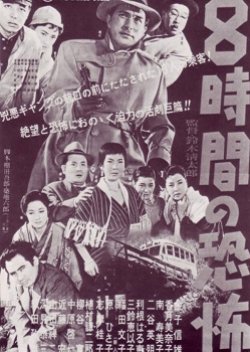
A bus making its precarious way across a winding mountain road picks up some unwelcome passengers. (Source: TMDB) Edit Translation
- English
- magyar / magyar nyelv
- dansk
- Norsk
- Native Title: 8時間の恐怖
- Also Known As: Hachijikan no Kyoufu
- Director: Suzuki Seijun
- Genres: Thriller, Drama
Cast & Credits
-
 Kaneko NobuoKosaku MoriSupport Role
 -
 Misuzu EikoYasu NakayamaSupport Role
 -
 Hara HisakoYanagawa ShizuSupport Role
 -
 Kondo HiroshiKimitsuka Saburo [gangster]Support Role
 -
 Chae RangDetectiveSupport Role
 -
 Kazuki Minako[Female student]Support Role






Reviews

This review may contain spoilers
“I’m not John Ford. And whatever this is… it’s not a western.”
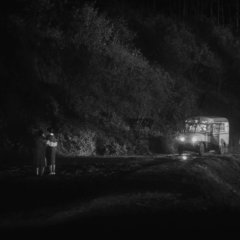
A landslide blocks the railway line, forcing an assorted group of passengers to continue their journey toward an alternative station aboard an aging bus, along a treacherous and unforgiving mountain road. A situation already precarious in itself, which takes on far more ominous overtones when word spreads that two dangerous criminals may be traveling the very same route.It takes little more than this premise to recognize how, in the hands of Seijun Suzuki, what unfolds is a reinterpretation — only seemingly faithful — of the archetypal model established by “Stagecoach” (John Ford, 1939): a moving microcosm of humanity, compelled to confront an external threat that inevitably brings to the surface latent tensions, contradictions, and hierarchies.
It is no coincidence that one of the characters — the woman working at an American base — explicitly evokes that very imagery, enthusiastically likening the situation to a “western movie.” A fleeting moment, perhaps, but one that functions almost as a statement of intent, subtly offering the viewer a key through which to interpret what follows.
Because while the starting point appears to adhere to a well-established narrative framework, it is precisely in the development — in the details, tonal shifts, and the characters’ reactions — that Suzuki’s gaze begins to gently destabilize the structure, allowing a sense of underlying instability to emerge, one that would soon become a defining trait of his cinema.
From this seemingly codified foundation, it is in the definition of its characters that the work most clearly reveals its true nature.
The passengers are not merely individuals, but rather recognizable social archetypes, arranged with almost schematic precision: figures that initially seem to comply perfectly with genre conventions, only to be gradually tested — and often subverted — over the course of the journey.
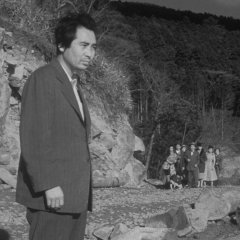
We encounter the “fallen” woman tied to the American base, yet endowed with a moral integrity far stronger than her role would suggest; the convicted murderer — a former military doctor — who will unexpectedly reveal a capacity for sacrifice; the irreproachable policeman; and the aging driver, a figure not unlike those found in westerns, suspended between irony and quiet responsibility.
Alongside them unfolds a gallery of equally emblematic presences: the opportunistic salesman, dysfunctional couples, restless bourgeois figures, young people chasing uncertain futures — culminating in perhaps the most fragile and emotionally resonant character, the abandoned mother traveling with her child, who becomes one of the narrative’s emotional centers.
At first, these figures seem to move within predictable and almost reassuring boundaries. But with the violent intrusion of the two criminals, that fragile balance begins to fracture.
At this precise moment that the masks fall.
What initially appeared as simple typification gradually transforms into a far more exposed and unforgiving terrain, where each individual’s true nature emerges: the cowardice of those concerned only with survival, the opportunism of those seeking advantage, but also the unexpected courage of those who, having nothing left to lose, choose to act.
In this regard, the trajectory of the condemned man is particularly telling — a figure initially relegated to the margins, yet ultimately embodying a form of redemption through action, in stark contrast to others who, despite their social respectability, prove incapable of withstanding the pressure.
What emerges, then, is not so much a distinction between good and evil, but between those who can endure the strain… and those who are crushed by it.
And it is from this tension — more human than moral — that a fragile sense of solidarity begins to take shape: intermittent, unstable, yet ultimately the only viable means of survival for a group that, until then, shared nothing but a common destination.
From this reluctant convergence arises a collective response — not heroic in the traditional sense, but instinctive, almost inevitable — as individuals, pushed to their limits, are forced to recognize themselves as part of a shared fate.
The resolution of the conflict, sudden and violent, brings the tension to an end, but offers no true sense of liberation.
Because while the group ultimately reaches the long-awaited station, what awaits each of them is a return to reality that feels, in many cases, far more disillusioned than the expectations that accompanied their departure. Dreams fade, illusions dissolve, and what remains is the quiet weight of an experience that cannot simply be left behind.
It is worth noting that, despite its apparent structural rigor, “Eight Hours of Terror” was subject to studio interference during the editing phase — a clear indication of the uneasy relationship between Suzuki and the production system within which he operated.
And yet, even within such constraints, his authorial presence unmistakably surfaces.
One can already sense a subtle inclination toward disruption: moments of irony, sudden tonal shifts, small acts of irreverence that both relieve and destabilize the tension. Certain characters, deliberately accentuated, verge on caricature, contributing to an unstable balance between realism and stylization.
Likewise, the management of space — largely confined to the interior of the bus — becomes a genuine exercise in form, where rhythm and suspense rely heavily on precise editing and carefully controlled shifts in perspective, avoiding any sense of stagnation despite the limited setting.
It is within these details, rather than in the broader narrative structure, that the first signs of Suzuki’s emerging voice can be clearly detected — a tension that would later expand more radically as the constraints imposed by the studio system grew increasingly restrictive.
Even taking into account the inevitable reworking and external interference, “Eight Hours of Terror” stands as a remarkably accomplished piece, where narrative solidity coexists with a subtle but persistent undercurrent of formal deviation.
It is within this silent friction — between structure and subversion — that the work finds its identity, revealing itself not only as an effective genre piece, but also as an early indication of the incompatibility that would come to define Seijun Suzuki’s relationship with the industry that sought, unsuccessfully, to contain him.
8 ½
Was this review helpful to you?
Recommendations
There have been no recommendations submitted. Be the first and add one.