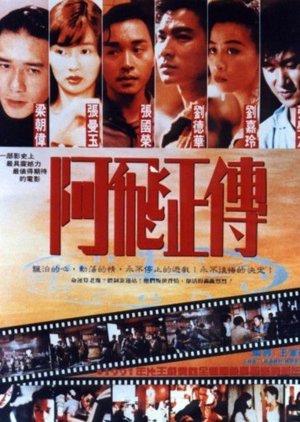
If I've said that In The Mood for Love will make you feel exactly just that and 2046 would make you in the mood for heartbreaks then Days of Being Wild will give you the mood to be just that—wild.
Days of Being Wild is only Kar-wai's second film and it both shows his infancy but also how he shaped his identity as a director as well as his characters, some of which have regularly appeared throughout the Informal Trilogy.
Leslie Cheung plays the young and charismatic but emotionally unstable, York who is a womanizer. Cheung, whom I have seen in Happy Together with Tony Leung is really a charismatic character. He embodies a sexiness that's untamed and draws you in as a viewer. It's no wonder that two of his flames are so madly in love with him. Much like in his character in said film, Cheung here is also on the verge of self-destruction further heightened by his familial identity.
But Kar-wai doesn't just focus on Cheung. He also gives us Maggie Cheung's Su Li Shen, Carina Lau's Mimi and to an extent, Andy Lau's Tide perspectives—all of whom are grappled with their own frustrations that ultimately involves York. It's York's own biological identity that shapes his relationship with women and eventually, how he lives. He is damaged but it is not romanticized. Kar-wai isn't a pessimist, he is just showing rawness.
Kar-wai traits also plague the screen: cramped spaces that seem to emit suffocation, unusual angles highlighting the characters and their interactions, dark and damp and nostalgic setting—all embody Kar-wai's consistency as a director and how his filmmaking drives his story as much as character even if it's lack of a strong plot.
There is so much tension in this film, so much dramatic build-up and so much longing. How much does Li Shen long for York? How much does Mimi long for York? How much does York long for his mother? How much does Tide long for Li Shen? Each minute is made with beauty, each glimpse, each touch feels like it's consuming you. Just like Li Shen and York's memorable 1 minute, Days of Being Wild has been another memorable beauty of a film.
This film, itself, is about identity. Who is York to his biological parents? Who is Li Shen without York? Who is Mimi when she is not Mimi? Who is Tide as a sailor? Every fleeting seconds matter in discovering who we are and how each person in our life shape us.
Was this review helpful to you?

"You'll see me in your dreams tonight"
Days of Being Wild showed what lengths broken people would go to in order to find the object of their desire. Time, whether it hastened by too quickly or dragged like a cement block, tethered the characters to their obsessions. Everyone had a myopic gaze of life and much of it revolved around a self-obsessed rebel.Yuddy had a habit of seducing women and then breaking their hearts. Raised by a sex worker, he desperately wanted to know who his biological mother was. Rebecca had told him his mother was a Filipino noblewoman who had paid her to raise him. Mom really put a lot of thought into that one, didn’t she? Yuddy seduced Su Li Zhen who ran a snack stand and box office by having her look at his watch for a minute. One minute before 3:00 was to be burned in their minds on that date. Their relationship flared and flamed out when Li Zhen realized he would never marry her. Before he could change the sheets on his bed, he’d seduced exotic dancer Mimi.
Women were obsessed with Yuddy---Li Zhen, Mimi, and even his adoptive mother Rebecca. And I never could figure out why. He thought only about himself and constantly told them what they could and couldn’t say. He must have been one hell of a lover to make them lose their dignity and hearts over him. Young love is often messy and impulsive with heavy doses of heartache and drama but it was hard to understand why these women found him so irresistible. How desperate for love, sex, and/or companionship they must have been. Loneliness can be a harsh mistress.
Yuddy often compared himself to a bird with no legs who had to keep flying when in reality the bird had been dead all along. The story lost steam when he left Hong Kong to find his mother in the Philippines. Without the women he seemed even more like a loser with no job, no family, and on a headlong journey to disaster.
Much of the background noise was the chiming and ticking of clocks. “I used to think a minute could pass so quickly, but actually, it can take forever,” Li Zhen told the young policeman named Tide. Later Yuddy would tell Tide, “Life really isn’t that long.” For the heartbroken, the nights took forever to pass. For a young man who made a reckless decision, it passed all too quickly and that minute would be seared in his memory.
The cast was stellar. Leslie Cheung gave Yuddy a primal movement that even the corny pickup line of, “You’ll see me in your dreams tonight” made women thirsty for him. Maggie was gorgeous but other than standing or walking around looking anguished with her hair in her eyes had little to do. Carina Lau as Mimi chewed up the scenery as the brash cabaret dancer in love with Yuddy. Andy Lau, like Maggie, was underused until the final chapter. The dark, subdued lighting and greens and golds were reminiscent of In the Mood for Love, as well as the final character revealed.
Perhaps because the actors seemed too old to be so foolhardy, I found the characters difficult to connect with and care about. The despondent mood was as dreary as the rain soaked streets the characters wandered through. Days of Being Wild was beautifully shot, lit, and composed and while mesmerizing to look at, it left me feeling empty afterward.
28 February 2024
Was this review helpful to you?

This review may contain spoilers
Days of Being Wild Contains Multitudes
Does life matter? If so, how should life matter? Should life be treated seriously, or as a carefree joke? If yes to the latter, how will you treat it as a joke? Will you treat your own life as a joke, or others' as well? If life is a joke, do your actions and repercussions of said actions matter? If not, then does anything matter? Do the people around you matter? Is life simply a train that goes from station to station?This movie hit me hard from multiple perspectives. Firstly, Wong Kar Wai never ceases to astound me with his ability to pick actors that fit their roles so well. Leslie Chung, Andy Lau, Maggie Chung, and Carina Lau all make up a star-studded cast, all of which have vastly improved their acting skills since their last outings. Secondly, WKW is a master storyteller, as each of his films either center around one major lesson or several interconnected lessons, with Days of Being Wild belonging in the latter category. Lastly, the cinematography of WKW's films is always mesmerizing. Christopher Doyle's first outing with WKW leaves a lasting impression. The dark emerald-green hue adds a dreamy filter to the film's dark color palette. The music, as ever in WKW movies, is a mix between east/west, casting an extra layer of sophistication to the film's setting.
Yuddy (Leslie Chung) is a carefree toyboy who is a troubled narcissist. Yuddy has a bit of a troubled past, as he was an 'unwanted' child, his real mother leaving him to his stepmom, Poon Tik Wa (Rebecca Pan). Yuddy uses this unfortunate fact about his mother to extrapolate his dislike for other women. If his mom didn't want him, then other women should not have the "privilege" of having him either. This leads to Yuddy manipulating both Li Zhen (Maggie Chung) and Mimi (Carina Lau) into believing that he has feelings for them, when really the only thing he wants from them is sex. When he finally "captures" his prey, he discards them like a bucket of meat. The contrast is quite jarring, as Yuddy is full of suavity and wittiness when seducing women, but as soon as he gets what he wants, he pretends like he doesn't even know them. Yuddy does not care how his actions affect others; Yuddy believes that he is the main protagonist of his own story, and all other people around him are simply side-characters—a means to an end.
Tide (Andy Lau), on the other hand, is in a way a foil to Yuddy's character. We don't know much about Tide other than that he grew up poor and had aspirations to be a sailor but had to put those plans to the side due to his ailing mother. Tide becomes a cop to pay the bills in the meantime. Tide gets assigned as 'night-time' patrol at the apartment Yuddy lives in. Tide develops a friendly relationship with Li Zhen as he becomes her confidant, as she is still reeling from Yuddy's emotional manipulation. With their interactions, we also learn about Tide's ability to empathize (another contract from Yuddy.) While Yuddy pretends to have these qualities by reciting vapid poetry and metaphors, Tide demonstrates an excellent capacity for listening and observation. As an example of this, Tide provides riveting commentary to Li Zhen when she compares the life of her cousin, who married a rich man, to herself, who is simply a ticket concession stand worker at a stadium who got stood up by Yuddy. Tide has an incredible response to this, and is one of my favorite lines from any movie:
"Not everyone can be that lucky; don't compare yourself with other people. I didn't feel poor until I started school. All the other guys got new uniforms every year, but I had to wear the same one every year. That's when I realized I was poor."
This is the turning point for Li Zhen, as she realizes she needs to move on. Tide promises that if she ever needs someone to talk to, she can talk to him by calling the phone right by where he patrols every evening. She appreciates this gesture, but realizes the lesson Tide taught her, and never calls back.
All in all, things end tragically for Yuddy, as he eventually finds his real mother, but she doesn't want him. He also ends up getting killed at the end due to him shafting a criminal gang who specializes in forged passports. He almost gets Tide killed because he lumps him in along with the action, once again, showing he has no regard for how actions affect other people.
Ultimately, the movie ends up with everyone moving on with their lives. Li Zhen never calls back Tide (except at the very end, but he has already moved on), Tide goes on to become a sailor, Mimi gets over her breakup with Yuddy, Poon Tik Wa marries her American suitor and lives a happy life. Yuddy, on the other hand, becomes a forgotten character—just an empty space in history.
A powerful movie that teaches us all that (1) if you treat life like a joke, life will treat you back like a joke; (2) your actions affect others whether you like it or not, and how you treat others ultimately will cement your legacy in others' mind, if they even remember you at all; and (3) you are not the protagonist of an 'overarching' story in life. Everybody has their own life to live; nobody is a protagonist, and nobody is a side-character. The world will simply move on with or without you. The world has no protagonists; it is simply a medium in which we live our lives. The world doesn't owe you anything and you don't owe it anything back. What you decide to do with the incredible opportunity called "life" is up to you; but, whatever you do, you will face the consequences of your actions one way or another.
Was this review helpful to you?