K-Drama

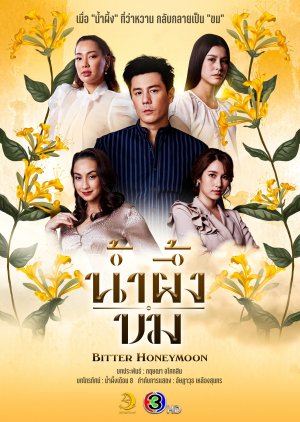
Purim was brutally hurt in love when his lover, Rose, dumped him for a wealthy man and never saw him again. Purim, on the other hand, never forgot the pain that was inflicted on him by Rose and always felt the desire to get revenge. As years passed, Purim became a wealthy businessman while Rose became an alcoholic and gambler. One day the fate of the two collided again and seeing an opportunity for revenge Purim made Rose sell her daughter Kungsadarn to him as a wife in return of paying her gambling debt. After their marriage,Purim slowly starts to see the goodness in Kungsadarn and warm feelings begin to develop in his heart. However... there are other obstacles that are ahead in their path. (Source: Thaidramatic_update Instagram; edited by Soju at kisskh) Edit Translation
- English
- magyar / magyar nyelv
- dansk
- Norsk
- Native Title: น้ำผึ้งขม
- Also Known As: Bitter Honey , Nam Pueng Kom , Nampueng Kom , Namphueng Khom
- Screenwriter & Director: Asadawut Luangsuntorn
- Genres: Historical, Romance, Drama
Cast & Credits
-
") Dome Pakorn Lum"Pu" Purim PhitsanukanMain Role
Dome Pakorn Lum"Pu" Purim PhitsanukanMain Role -
") Yiiiwha Preeyakarn Jaikanta"Nui" Kangsadan Sattayawat / "Grace"Main Role
Yiiiwha Preeyakarn Jaikanta"Nui" Kangsadan Sattayawat / "Grace"Main Role -
") Joy Rinlanee SripenJuangjan PhitsanukanMain Role
Joy Rinlanee SripenJuangjan PhitsanukanMain Role -
") Kat Katreeya EnglishRoseMain Role
Kat Katreeya EnglishRoseMain Role -
") First Ekkaphong JongkesakornSanthad WisetchaiyoSupport Role
First Ekkaphong JongkesakornSanthad WisetchaiyoSupport Role -
") Pango Jintanutda LummakanonSaengdaoSupport Role
Pango Jintanutda LummakanonSaengdaoSupport Role









Reviews

When Obsession Is Mistaken for Love
I was waiting for this lakorn for a long time. I had already watched its older 2009 version, so I was glad to see a new adaptation finally released. I discovered it today and started watching immediately.
Purim, however, is honestly a disgusting character. A complete womanizer. He keeps hanging around with different women and then takes out his frustration on Nui simply because she ignores him. What makes it worse is the age gap—Nui is young enough to be his daughter. His behavior feels more like harassment than romance, giving off a disturbing, almost predatory personality.
Nui, on the other hand, is portrayed as a constant crybaby—naive, emotionally weak, and painfully unaware. Thank God this is just a drama, because in real life I find such portrayals frustrating. Female characters deserve at least basic intelligence, the ability to recognize right from wrong, and the courage to stand up for themselves instead of silently suffering.
That said, this kind of storyline is sadly very popular in Thai lakorns—the obsessive, dominating male lead and the fragile, submissive female lead. The familiar “slap-and-kiss” trope continues, where no matter how cruel or abusive the man is, everything is magically forgiven in the end. Forced love is normalized, and even sexual violence is romanticized, which is deeply toxic and potentially traumatic for real women watching.
As a drama, it fits the genre perfectly. But as a story about love, it raises uncomfortable questions about what we choose to normalize and glorify on screen.
Was this review helpful to you?
All the water works! - just not mine
I honestly cannot recommend this lakorn at all. It is pretty cliche and nothing we haven’t seen before. Mean ML who never really redeems himself and super weak FL. I usually don’t mind kind of cliche, mind numbing lakorns - they’re nice to watch in the background while doing something else. But this one… I skipped way more than I usually do. The ML was just kind of stupid and didn’t really give off mean, dangerous guy vibes but seemed to be good but also confused but also wanted revenge but also not really… HOWEVER, my biggest gripe was with the FL. I have never seen this much crying by a FL before. She didn’t go more than 3 minutes of screen time without tearing up again. I felt bad for the actress cause she must have been dehydrated as hell by the end of the shoot of this lakorn. It was super super aggravating. I like slap/kiss but there weren’t even any real kisses where you could see lips touching. It was just the ML being rapey and the FL crying. I guess the slap in slap/kiss was correct cause I wanted to slap just about everyone on screen at some point.Don’t recommend!
Was this review helpful to you?