News


 1
 1
Who will spy on the spies?
The Wind Blows from Longxi is an intricate ancient spy thriller that is not for instant gratification audiences. Its biggest hurdle are the first three or four episodes that are weighed down by the introduction of too many bearded and murky characters on both sides of the Shu-Wei conflict. Clearly even Lu Yang couldn't resist romance of the Three Kingdoms lore and goes down the rabbit hole of lingering on defining events and larger than life figures of the day that are peripheral to the otherwise tight plot. Past that, the storytelling simply immerses you in the lonely, tangled, nail biting, heartbreaking, cruel and utterly thankless world of ordinary spies, ants who put themselves in harms way to pave the way for great men to be glorified by history.Recent adaptations of Mo Boyang's works have been orgies of high speed chases and thrilling action scenes that fall short on suspense and in delivering satisfying and convincing motives and twists. This is very much the opposite. The production values are movie like in quality but due to the shadowy palette, this is best enjoyed on a big screen. The camera is often very still and at times comes at avant-garde angles in low light that accentuates the clandestine nature of the interactions, of opaque motives and conveys a omnipresent sense of alone-ness, tension, ambiguity and danger. The action scenes are signature Lu Yang - impressively choreographed, blood thirsty, vicious and up close and personal in the critical moments.
This drama is set during Zhuge Liang's Northern Expeditions, a period of stalemate between Shu and Wei where neither side had a clear advantage or scored decisive victories. It is an apt setting for this kind of story because when the margins are narrow, intelligence and counter intelligence can tip the scales in either direction. The drama opens with Zhuge Liang's first (of five) Northern Expeditions, which was unsuccessful. This led to General Ma Su's decapitation for his failure to hold Jieting and Zhuge Liang's demotion. It allowed his political rival General Li Yan who advocated a Southern campaign against Wu instead of Zhuge Liang's Northern Expeditions against Wei, to gain power and influence. The Northern Expeditions took place in rather complex geographic terrain, where the timely delivery of military food provisions was challenging and made the difference between victory and defeat. That is broadly most of the historical background that is needed to understand this story. Of course Three Kingdoms buffs will be thrilled by the "drive-by" of many legendary figures on both sides of the conflict but the important characters in Ma Boyong's stories are always the little people or the ants.
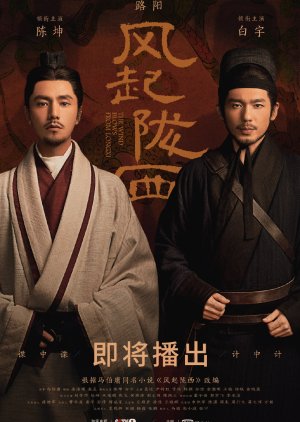
The lines between fact and fiction blur as Siwencao, Shu's intelligence agency, suspects that compromised military intelligence had led to their defeat at Jieting. Siwencao hastily concludes that Chen Gong (Chen Kun), a Shu spy code name Baidi (White Emperor) under deep cover at Tianshui (a Wei stronghold) must have defected and sends Xun Xu (Bai Yu), Deputy Chief of Internal Affairs to deal with him. But Xun Xu is not convinced of Chen Gong's culpability; they are intimate friends, related by marriage. Together, they discover that the highest echelons of Siwencao has been infiltrated by Zhulong (Wax Dragon), a Wei spy. They can trust no one and go rogue with a bold ploy to lure Zhulong out into the open with Shu's crossbow design, long coveted by Wei. They are forced down separate paths that are fraught with danger, under resourced and alone with nothing but their absolute trust in and knowledge of each other. But nothing ever goes completely to plan and everyone has secrets. When the rubber meets the road, will they still have each others' back? How well can one really know someone? This also applies to Chen Gong's relationships with both Mi Chong and Guo Gang, which are as riveting and illuminating has his relationship with Xun Xu. After all, this is about two states at war with each other, there is really no good or bad or right or wrong side. All of the characters on both sides are patriots to their own cause; fascinating, layered, suspicious and disingenuous characters practiced in the art of deception. Were it not for an accident of birth, Guo Gang could well have been a Xun Xu to Chen Gong.
The role of such a cunning, duplicitous and morally ambivalent character such as Chen Gong must have been written with Chen Kun in mind. He dominates the screen in every scene and had my heart in my throat at his ability to turn around dire situations and the glimpses of his ferocious, raw pain and rage that is quickly disguised by indifference or conviviality. The wildness and the violence of his emotions when he takes revenge, where his veins literally popped out of his forehead is frighteningly intense and breathtaking. Bai Yu's Xun Xu is Chen Gong's conscience, a sincere and persistent truth seeker whose bottom line is not flexible. Xun Xu's most consequential mis-calculations are with those he loves best and his regret and unspeakable guilt and sorrow are among the most moving performances I have seen from Bai Yu. While Chen Gong and Xun Xu don't actually get that much screen time together, their screen chemistry is tangible and conveys a bond that transcends dialogue with undercurrents from their body language and their unguarded manner with one another. When Chen Gong starts to play a lone hand, Xun Xu senses it and their dynamics shift and become subtly more stilted, again showcasing the sheer virtuosity of their performances.
The most outstanding aspect of Longxi's storytelling is how masterfully the narrative builds up to the plot twists and the reveals. It is so insidious that by the time the reveals happen it is already sitting on the edges of my mind and thus seems to be organic. This is very compelling because I feel that I am part of the process, and underneath all the surrounding complexity the solutions are rather straightforward and should have been obvious. The characters are so fully actualised that their decisions are characteristic and the outcomes are inexorable. Unlike many other conspiracy heavy plots, this does not succumb to too many twists with overly convoluted or illogical outcomes.
The ending is gut wrenching and yet oddly triumphant and fitting. What is clear from the get go is that Chen Gong and Xun Xu are just expendable pawns caught in a high stakes game where they are besieged by both the enemy within and the enemy outside. As a result of serendipity and his own deviousness, Chen Gong is able for a moment, to seize control of the chess board. He plays the White Emperor's gambit, trading one life for three, empowers a righteous man and writes his own ticket home. His decisions are completely in character and in doing so, he finally articulates his own bottom line. But I won't lie, my first reaction to the ending was ".And that is why those dumb f*cks lost the war!" Because I am not sure the greater good was served. While one traitor is felled, the other villain with equally dishonourable tactics gets off largely unscathed and Siwencao remains a weapon that can be both used and abused. The age old question - "Who will spy on the spies?" remains.
While the start is dense and lacks finesse and the dialogue is on the heavy side, this is a drama that rewards the patient viewer. It is not a masterpiece, indeed many of the criticisms about accessibility and the dialogue that is heavily littered with modern phrases are more than fair. Yet I find the immersive storytelling, the suspenseful plot, the stellar acting and the unconventional camerawork immensely enjoyable. This is not something likely to enjoy mass appeal but for me, I would be surprised if I watch a better drama in 2022. I can happily give this a 9.5/10.
Was this review helpful to you?

Very niche, but my favourite show EVER!
"Two men talking in a room" is what you'll get in 60% of this show. 25% of the show has more than two but no more than ten men, or a man and a woman, talking in a room. And another 10% is two or more men talking outdoors... yup, you get the idea. Superficially, that's most of what you'll see in The Wind Blows From Longxi. And it’s also part of the show's very niche appeal.Longxi checks all my personal boxes for a favourite drama— great acting, real historical events, tight plot, treacherous politics, and zero distracting romance. It’s one of my favourite shows of all time, if not my favourite show ever. In a nutshell, Longxi is about spies during the Three Kingdoms period. Chen Gong is a veteran Shu field agent embedded in Wei. A critical military campaign against Wei goes horribly awry due to wrong intel provided by Chen Gong. How did that happen? Where do Chen Gong's loyalties truly lie? These are the questions that Chen Gong’s sworn brother and in-law, Xun Xu (also an intel veteran), is brought in to investigate. If you’ve read The Tao of Spycraft or any of Ralph Sawyer’s other books on ancient Chinese warfare, many of the spy methods and tactics in this show will be familiar. Since defection and double agents are normal in spycraft, one question is whether the defection is genuine or just a ruse to gain the enemy’s trust. That’s the central issue in this show, which the poster caption 谋中谋 计中计 (“the scheme within the scheme; the plan within the plan”) encapsulates.
Plot: A very twisty plot that doesn’t strain credibility. The least headache-inducing way to follow the plot of this show is to ask whose interests are currently aligned with whose. Without saying too much about what happens (because that would really ruin everything), the whole plot turns on the constantly shifting allegiances of various players, at the highest and lowest levels of society, in the conflict between Shu and Wei. The plot is complicated but doesn’t tie your brain in a knot until the episodes hit the late teens. Thankfully, ep. 21 onwards provide the clarification you need. If you get lost, there is a 5 minute “Cliff’s Notes” recap at the end of every episode that summarises the key developments. However, you’re very much on your own when it comes to the finer plot points, which the recap doesn’t cover. The final resolution is elegant and gut-wrenching, and I am glad the team did not go for a happier ending. That would have been far less satisfying.
Script: The script doesn't waste any time getting the show off the ground, even if it seems that little goes on in the first episode (it's important background context and sets the scene for everything else). Overall, it's just the right length at 24 episodes. Since this is a hardcore spy-plus-politics drama, most of the real action takes place behind closed doors, with bearded, middle-aged men plotting and scheming over cups of tea. The dialogue is exquisitely political and worth following closely. We are treated to scene after scene of various players abandoning old allegiances and cementing new ones, and having those allegiances tested by their new masters. One such scene is the one where Feng Ying (Shu spymaster) seeks out Li Yan (Shu general), formerly from an internal “enemy” faction, to declare his allegiance to Li Yan. Feng Ying tries to get on Li Yan’s good side to protect himself from Li Miao (Shu interim mid-level "civil servant"), who also works for Li Yan, but wants to turn Feng Ying into a scapegoat for his own political purposes. Li Yan appears to believe this is a ruse by Feng Ying and tests him, but goes along with it as it benefits him in the short term. I also liked how there were relatively few flashbacks. The ones in Longxi are short and moving without being too sentimental; I especially loved the one where a ball lying by the door causes a very miserable Guo Gang to reminisce about playing cuju (蹴鞠?) with Chen Gong in the rain. Another striking thing is the judicious use of action scenes. Since Longxi is about politics and intel, there are only a handful of brief action scenes (mostly military skirmishes). Then in ep 23, the viewer is treated to the show's only extended sword-fighting sequence with Chen Gong. The burst of pure violence and pent-up rage in this sequence arguably makes this scene the emotional climax of Longxi. Chen Gong, like any good field agent, has iron self-control. At worst, he has quiet breakdowns in private, then quickly gets his act together again. But in the swordfight scene, he lets it all out. It's moment of pure catharsis for the character that sets the stage for the final episode. Definitely one of the finest moments in an already amazing show.
Themes: The 2 main themes of Longxi are (1) the moral neutrality of politics, and (2) that human relationships are a double-edged sword. The life-and-death political struggle between Zhuge Liang and Li Yan is not a matter of good versus evil (even if Li Yan does some truly terrible things), but down to a difference in opinion as to how Shu should ensure its medium-term survival. And at the end, it’s Chen Gong’s feelings for Di Yue (his wife) and Xun Xu that threaten his allies’ best-laid plans, even as his allies exhort him to continue making enormous personal sacrifices for Shu. For both Xun Xu and Chen Gong, what ultimately gives them moral closure and defines their biggest decisions is not self-interest or patriotism, but staying true to their loved ones. Powerful stuff.
Acting: Everyone put in an A+ performance here, except Angelababy. I have nothing against that lady, but she was pretty wooden in this show and looked so airbrushed. She also didn't quite click with Bai Yu on screen. (I don’t watch enough shows to comment on whether this is better or worse than AB’s usual...) Chen Kun was of course brilliant as Chen Gong, but I was equally (if not more) impressed by Bai Yu’s low-key but completely spot-on performance as the dangerously sentimental Xun Xu. Xun Xu has the smarts and EQ to be a great intel guy, but he's too emotional and high-minded for his line of work. He's terrible at lying and makes a few wrong calls that have serious consequences. One gets the sense that he has only survived this long due his kicked puppy expression that tugs at everyone's heartstrings, a good brain, and sheer luck. Bai Yu perfectly captured this precarious balance of vulnerability, world-weariness and cunning at the core of Xun Xu. His final exchange with Chen Gong, especially the delivery of「我看透了你的心」(“I’ve seen through your heart”) in ep. 24 was also a total tear-jerker. With a lesser script and actor, Xun Xu would have been a character whose naivete makes the viewer question how his head has managed to remain on his shoulders. But through the combination of great script characterisation and Bai Yu's acting, Xun Xu becomes a convincing example of the idealistic survivor who manages to keep going even after all the dust has settled. I also really enjoyed Edward Zhang’s performance as the Wuxian cult leader Huang Yu. He fully conveyed his character’s megalomania and cruelty with what little screen-time he was given. The actors playing Feng Ying, Guo Gang and Mi Chong were also absolutely brilliant. I loved them all!
Music: This was okay. It was composed by Kawai Kenji, but I was hoping for thematic music that was less Western in flavour. It was also disappointingly run-of-the-mill "epic"-sounding stuff. But it's not a deal-breaker for me.
All in all, 10/10, A++++ from this very satisfied viewer! For me, I’m not sure if any other mainstream period drama can compare with this show.
Was this review helpful to you?

Great Acting, Pacing with Unexpected Twists
Completed - 5/19/2022 - 8.75When it's announced that Chen Kun and Bai Yu were going to be in a drama together, one could assume you don't have to worry about the quality of acting in "The Wind Blows From Longxi". This is a very heavy, political drama involving spies and schemes. If you had a bad experience with boring and dragged out political dramas in the past, and are still interested in this genre, DO NOT miss out on this drama.
Plot - I would not classify myself as a huge fan of this genre, as I often get bored in the middle of such politics heavy drama, e.g. "The Longest Day in Chang'an". However, with only 24 episodes, we have a very tight plot with amazing twists and turns. The pacing is the best I've seen in a historical political drama. There are schemes over schemes, lies after lies, spies everywhere trying to outsmart each other. The whole drama is very dark and serious, as it should be during war times. However, I did think to myself wishing there were a few more lighter moments (not comedy). I wanted to see more flashbacks of Chen Gong, Xun Xu and Di Yue, before they became spies. Those were the times when we saw smiles on their faces. On the other hand, yes, there are legitimate criticisms about the introduction of so many characters in the first few episodes. And yes, the summary at the end of each episode does help viewers in understanding what exactly happened. However, my biggest criticism of the drama is that, if the writing of the drama is better, do we really need to have the episode-end summary in the first place? Can't the story be written in a way that's less confusing for the audience, who has no prior knowledge of those historic times, and not be confused by the barrage of characters?
Acting - As I mentioned earlier, you really don't need to question the quality of acting in this drama. Not just because of Chen Kun and Bai Yu, but also all of the supporting cast. No matter how small or big the part is, everyone was excellent. And yes, Angelbaby wasn't bad either, though her part is small. In the last episode when Cheng Gong (Chen Kun) and Xun Xu (Bai Yu) had the confrontation heart-to-heart talk, I couldn't help but cry with Xun Xu.
Friendships/Relationships - The friendship between Cheng Gong and Xun Xu is on a different level. They understand and trust each other. There are many times in this drama where each could have questioned the motive and sincerity of actions. They could not be honest due to the nature of the business, but deep down they trust each other and use their brains to arrive at the correct conclusion. I wish we have more scenes with the two of them together. On the other hand, even though General Li and Prime Minister Zhuge seem like enemies, they are both loyal servants to the emperor. They just have different ideologies, motivations and strategies on what's best for the kingdom.
Production Quality - This is not a palace drama so we don't have beautiful set designs and costumes. These are turbulent times and everything felt so realistic. The lighting, sets, props, houses - everything looks so real. Others commented that this drama is very dark (not enough lighting), but I personally enjoy the use of natural light from candles and lanterns. They could probably use an extra candle or two here and there. This drama may not have the beautiful cinematography as in "Luoyang" or "The Longest Day in Chang'an", but it just feels right. I also greatly enjoy the gritty fight scene towards the end between Chen Gong and Huang Yu. That was very physical but with a lot of emotions. I would have loved to see more.
Was this review helpful to you?

Huh, so that’s what consistency in a period drama feels like...
Occasionally you’ll come across a series that’s so unique in terms of quality, yet for reasons it shouldn’t be the case. The Wind Blows From Longxi is a comparatively short drama that succeeds in everything it goes for, that most period dramas these days fail to.Now before i get into a overview for those that are interested in trying the series without spoilers , a forewarning. TWBFL isn’t for those that aren’t a fan of dramas not trying to grip their audience immediately with bright and vibrant colors, doll like characters, straightforward beginnings, or the trendy dynamic pacing that you regularly see in other series. You’re thrown into a gritty, detailed period setting that takes its time to draw in the viewers at a steady pace with its bold narration and realistic characters that are brung to life by both the great cast selection and airtight writing surrounding their background and motivations.
Wind Blows From Longxi doesn’t hold your hand with simplified explanations nor one layered characters. Which may leave some confused given the seemingly large cast you have to get accustomed to within a 24 episode span. Everyone has a purpose, many having 2-3 faces to achieve their true goals that are revealed over time. But fret not! One of the underrated strengths this series has is the very helpful, humorous, yet repetitive recaps at the end of each episode to assist viewers with staying aware of everything that’s going on that are both told and sometimes not easily shown to viewers that aren’t used to the hidden details and agendas. And ofc it’s optional, if you don’t need any clarification or refreshers you’re more than welcome to skip over them with no effects on your viewing experience.
You’re given a spy story that naturally becomes the focus in a relatively short span after being shown the cause of later occurrences in this drama. Keeping you on the edge of your seat with great fight choreographies, thrilling backed into a corner moments where your intelligence and quick thinking is your only friend, hidden agendas, betrayal, along with its fair share of sudden heart wrenching moments.
The gorgeous,dark, very still cinematography is one of the strongest aspects of this drama, buuut can also be one of it’s weak aspects depending on the viewer. Backgrounds rarely bares the light needed for some to see exactly what’s going on at times, which can become quite bothersome depending on the devices used to watch. An aspect i can for sure say is the weakest that this drama bears is the BGM. Not once, but several times over the course of these 24 episodes the BGM is blasting when it isn’t needed, as if they’re trying to distract you from what’s actually going on in front of you, which is weird...because that isn’t the case, yet it’s there, just to be there? Some times not even matching with the tone of the current scenes that are happening. When some scenes are way better off dead silent or subtle, the bgm rumbles. You become used to it over a few episodes, making you unaware of how often they’re constantly slinging tracks behind the scenes that can break your immersion. Luckily, this is the weakest aspect of this drama. Oh, and there’s Angelababy.. uh yeah.
The Wind Blows From Longxi is likely to be a hidden gem as time past from it not catering to what period drama audiences are now used to and favor , causing many to rather be uninterested in trying out or dropping. What i can say is that for those(like me) that still prefer a well written story with a much more serious tone at a realistic steady pace, The Wind Blows from Longxi is a beautifully handled drama that is most certainly a must try at the very least.
Was this review helpful to you?

Perfect!
I started watching this series after a long day of work. My cloggy mind didn't allow me to digest the story properly. Heck! I couldn't even distinguish the bearded characters one from another; they all looked alike to me. This was such a heavy drama for me wanting something light and funny to end my day, so I put it aside. Then I read my good friend's, PeachBlossomGoddess's, amazing review. Her articulation and insightful analysis piqued my curiosity and encouraged me to pick this drama up again. I'm glad I did. Since then, there's no one moment that was not filled with heart pounding excitement, suspense and intrigues.The Wind Blows From Longxi is not your normal Chinese historical drama with beautiful faces and costumes, light hearted dialogues or "wirefu" fighting scenes. There are no wuxia elements nor romance here. This drama is heavy, authentic, and fast moving, with vicious killings and amazingly believable combat scenes. The acting is immaculate. The plot is tight with plots within plots, and twists and turns. Every episode is nail-bitingly tensed and enjoyable.
Set in the Three Kingdoms period (220 to 280), some very famous historical figures such as Zhuge Liang, are featured (not main role), with the capital city of Chengdu, and the chants of restoration of the Han Dynasty are repeatedly echoed. The settings, costumes, decorum and some events follow closely the historical records though the main characters are fictional.
I have thoroughly enjoyed this drama. This is a must-watch for history buffs and anyone who loves spy stories and espionage, and values authentic acting and believable settings with great plot.
TWO THUMBS UP!
Was this review helpful to you?
Fascinating acting, extremely underrated drama.
The wind blows from Longxi is a real gem with delightful acting and adorable hidden details.However it is not like NIF or Joy of Life, or any other action costume drama with many fighting scenes and "flying" warriors.
Also it is definitely not a traffic drama for young audience.
Mature storyline.
The middle-aged actors radiate depth of emotions and expressions. The casting is perfect, main and supporting actors match each other and create charming vibes and very good chemistry on the screen.
Suitable costumes, realistic settings and scenery.
Such pleasure to watch.
Was this review helpful to you?

 1
The Price of Loyalty
The Wind Blows from Longxi is an espionage drama in the truest sense of the word. Rather than using espionage as a backdrop for romance or political drama, it puts spies and intelligence work firmly at the center of the story. Schemes are layered on top of schemes, loyalties are constantly tested, identities are questioned, and undercover spies seem to be everywhere. Friendship and romance are present, but they are more like seasoning than the main dish, adding depth to the characters without taking away from the espionage at its core.This is definitely a drama that requires your full attention. A good portion of the show is essentially bearded men sitting around having extremely serious conversations, and there is a lot of dialogue to process. Yet somehow, I was completely immersed. The script has a certain weight to it, and I often felt like I was investigating alongside the characters rather than simply watching them investigate. The first few episodes were easily the hardest to get through because there were so many names, characters, factions, and pieces of information being introduced at once. Once everything started falling into place, however, the experience became much smoother. I also appreciated the recaps at the end of each episode. Considering how dense the story and language can be, those recaps were a lifesaver.
What kept me hooked was the detective work. There are twists upon twists, and I found myself making assumptions constantly, only to question those assumptions a few minutes later. Even when I guessed something correctly, I still wasn't entirely convinced that I was right. That uncertainty became part of the fun. The drama constantly made me feel like I was one step away from figuring everything out, only to move the chess pieces around again. It really rewards paying attention to the smallest details.
The action was another pleasant surprise. Instead of relying heavily on flashy editing to make the scenes look impressive, the drama lets the actors, choreography, and sequences do the work. The result feels grounded and realistic, which makes the action more satisfying to watch. I also enjoyed the little mechanical details woven into the story, especially the bird-shaped wooden and bamboo glider said to be inspired by Lu Ban, the famous Chinese carpenter and architect. I ended up researching Lu Ban because of this drama, which is always a good sign that something has successfully piqued my curiosity. I particularly appreciated that the drama didn't just mention the mechanism but actually showed it being used to fly.
Chen Gong and Xun Xu, played by Chen Kun and Bai Yu respectively, left an especially strong impression on me. This was my first drama with both actors, and they made these two characters incredibly memorable. Chen Gong and Xun Xu are good friends, in-laws, and colleagues within Shu's intelligence agency, yet they could hardly be more different.
Chen Gong is cunning, morally ambiguous, unpredictable, and incredibly difficult to read. I was constantly trying to figure out what he was thinking, what he was planning, and what move he would make next. His ability to navigate through one impossible situation after another was fascinating. Somehow, no matter what decision he made, I found myself rooting for him.
Chen Kun absolutely owned this role. His performance is subtle but incredibly expressive. His eyes, facial expressions, and even the smallest movements convey so much without feeling exaggerated. I especially appreciated how his portrayal of rage and anger did not rely on the usual red, teary-eyed look. There was something much more restrained and realistic in his expression, which somehow made it more powerful. He completely embodied Chen Gong's gravitas as an undercover spy, while still showing his anxiety, charisma, restlessness, quick thinking, and vulnerability. There was so much happening beneath the surface. Breathtaking.
Xun Xu is almost Chen Gong's complete opposite. He is righteous, rigid, and deeply committed to following the rules. Bending them, even for someone he cares about, is almost impossible for him. I enjoyed watching him piece together clues just as much as I enjoyed watching Chen Gong maneuver around them. There were times when I desperately wanted Xun Xu to uncover the truth, and other times when I was practically begging him not to.
Bai Yu also impressed me tremendously, particularly in scenes where Xun Xu was overwhelmed by regret, guilt, and sorrow. His emotions felt raw enough that my heart genuinely sank watching him. And then, amusingly, we get to see this persistent, serious investigator turn into a complete puppy around the woman he likes. It was adorable. Still, I was relieved that the drama did not turn him into someone who would abandon everything in the name of love. Just when I thought he might become weak because of his feelings, Xun Xu reminded me who he was. Shu always comes first, and he remains steadfast in that conviction.
Naturally, the relationship between Chen Gong and Xun Xu became one of my favorite parts of the drama. Their bond is incredibly strong, to the point where distance cannot easily break it. But because they are so fundamentally different, there is always this lingering feeling that sooner or later, their friendship will be put to the ultimate test. The buildup to that test, and the test itself, became some of the most emotional material in the drama. Their relationship gives the espionage story a human heart without turning it into a friendship drama.
Visually, The Wind Blows from Longxi is just as deliberate as its storytelling. The muted color palette gives everything a rustic, vintage, mysterious, and serious atmosphere. It is also surprisingly easy on the eyes. The lack of overly bright colors and attention-grabbing elements means the visuals rarely compete with the story. Instead, they quietly support the mood and allow the audience to focus on the dialogue, expressions, and movements of the characters. The cinematography, sets, costumes, and overall production design come together beautifully. Combined with the OST and score, the drama creates an atmosphere that feels immersive from beginning to end.
The ending sucked me right in and left me feeling thoroughly harrowed. At the same time, I can't say I was completely surprised by it. In a story about spies and intelligence agencies, people are ultimately pieces on a chessboard, and the ending drives that point home rather brutally. Chen Gong and Xun Xu may be important to us as viewers, but to the larger machinery of the espionage game, they are expendable. Still, I couldn't help thinking that there might have been other alternatives, other solutions, perhaps even another possible outcome. Maybe that lingering frustration is exactly what the ending wanted to leave behind. What I do know is that the final moments between Chen Gong and Xun Xu were gut-wrenching. After everything going on, the ending was one of the strongest and most emotional moments of the entire story.
Ultimately, The Wind Blows from Longxi is a drama that rewards attention. It has a heavy start, dense dialogue, a complicated plot, and enough names and schemes to make you question whether you should be taking notes. But once you settle into its rhythm, it becomes an incredibly immersive experience. It may not be a drama everyone will enjoy, even among fans of espionage stories. It asks for patience, concentration, and a willingness to let the story unfold at its own pace. For me, though, the payoff was worth it. I came for the spies, stayed for the detective work, and ended up emotionally invested in the characters.
Was this review helpful to you?

Dont Miss it!
This is a serious and intense spy period drama. First few episodes were confusing as not familiar with the characters (looked alike) except for Chen Kun and Bai Yu, plus the pace was fast but once you get the hang of it, you would be able to follow each characters and the story accordingly. The ending recap is a plus as well, makes you understand the plot better in case you are still confused or missed out certain details. The brighter and slight comedic effect also manages to relieve some emotional feel with every episode.Chen Kun is good in his laid back Chen Gong while Bai Yu, in his all seriousness, is great to watch as well. I also enjoyed Chancellor Mi's acting, Wei's Guo, Clerk Feng, Di Yue, Sun, AB, almost all.
Liked the cinematic screening of the drama, candles' dimness, the simple props, no fancy clothes, no act-cute actresses (AB counted ? ) no pretty boys, no extravagant backdrops.
If you like no-nonsense and dont mind bearded men in plots planning, then I would recommend you to watch this as this is one of the better production in the light of other period dramas during this time.
Was this review helpful to you?

Strong Bromance/Friendship hidden in troubled and complicated times
I decided to watch this drama when I knew Bai Yu is one of the male leads ,, because I love his acting ,, he's one of the best chinese melodramatic actors ever ,, watched most of his dramas and was blown a way by his performance in themBut
After first few episodes I felt lost and a bit bored ,, thank god for that cheerful person who comes at the end of every episode explaining what has happened in each episode using simple talk to simple minded people like me LOL
I was thinking of dropping it .. didn't feel there is an actual interesting connection I connect with but I kept skimming through the episodes as they came out and realized that this drama is hidden gem but not for every one ,, it's heavy and complicated sometimes ,, confusing a lot with all similar styling of a lot of characters but the two leads were obvious and distinctive at least to me ,, there were Bromance blooming between them and felt strong brotherly connection despite the troubles they were both facing
the plotting and was interwind and very complicated to follow but I was focused on the two leads that made it easier to understand
It started to get interesting after episode seven ,, things started happening quickly and there were challenges facing the two leads separately ,, the romance was very little but it was there and even that wasn't light ,,it was romance mixed with spy fare , secrecy and sadness
the two leads came together again as best friends and as brothers but in somewhat at odds ,, their friendship was tested in a huge way at the last ten episodes and it was amazing ride to be honest ,, watching how their bond couldn't be broken
if it weren't for their Bromance and the twists here and there this drama would have been a boring historical drama
I loved it and I loved how they were challenged and how the plot is so intriguing especially from the middle to the end
I emphasize on Bromance because it touched my heart ,, their bond and their brotherly love for each other was the best thing that kept me on the edge of my seat to the end
it's definitely a Bromance drama as it's true history tale
I recommend this drama to people who likes heavy political plots with no fighting or wuxia magic ,, just heavy historical plot mixed with good strong Brotherhood
Was this review helpful to you?
Complex, compelling, heartbreaking spy thriller
The Wind Blows From Longxi is an intelligent drama, full of intelligent characters, and it assumes that its viewers will be equally intelligent and able to follow its complex plot.It is not a show for casual viewers. It starts off with no exposition. For a non-Chinese audience or in fact, for anyone without prior knowledge of the Three Kingdoms and figures like Zhuge Liang, it might be off putting. But your patience will be rewarded if you hang in there, especially in the second half of the show.
The show is worth it for the plot only. As PeachBlossomGoddess pointed out, the scenario is so well-written that by the time shocking twists occur, eveything falls into place and clicks into your mind. How many spies could there really be? How could this guy make such mistakes? How could this fall into this person’s hands? What’s the ultimate goal here? Million questions popped up as we watched, and the show always delivered brilliantly.
Beyond the plot, the meticulous production and top-notch acting elevated a show that could end up being too dry and cerebral. Chen Kun’s Chen Gong and Bai Yu’s Xun Xu are stellar. The brotherhood between them is the emotional anchor of the show. You can tell you’re watching great actors when you you see them playing spies pretending to be someone they’re not, and their ambiguous performance makes you guess who they are truly — like the multilayered plot, these are mutilayered performances by actors who play roles within roles within roles. I bawled a lot in the last episode, which meant for me that not only did the show manage to keep me engaged intellectually through and through, it also emotionally gut-punched me!
Unlike many Chinese shows, it’s relatively short at 24 episodes, and once it reaches the end, it didn’t need to rush through anything, all characters’ arcs make sense, and the plot threads are wrapped up neatly.
It’s my second Ma Boyong’s show after Under the Miscrocope, which with The Wind Blows From Longxi shares themes such as politics, morality, loyalty, sacrifice… I loved that in the end, this was not a clear-cut good vs evil battle, and yet, it also let the integrity and dignity of its main characters shine.
A nearly perfect show, particularly once the story lifts off after the first few episodes, and one of the few I’m tempted to rewatch with the emotional rollercoaster of hindsight.
Was this review helpful to you?

A character study in espionage, honor, and brotherhood
This is the kind of drama I search high and low to find. This was perfect, in my opinion. Beautiful story, complex and rich. Intricate to the point that If you miss one line of dialogue you might be confused for the rest of the drama. I love the dramas that are almost exclusively people whispering anxiously in dimly lit rooms. I love the agony of impossible decisions, the cruelty of duty and the enduring and thankless masochism of blood-deep bonds of friendship in times of war. I love endings that make you feel hollow but satisfied.The atmosphere of this was beyond perfect. The warm shadows of the sparsely-lit interiors were offset by the stark gray daylight of midwinter shining through open doorways and windows in the background; often the characters were mere silhouettes huddled tightly in their heavy clothes, hands tucked in sleeves, clouds of white steam as they talked. The pristine official and palace settings were harshened by frozen mud and a palate of earth tones. Everywhere you look you'll find layer upon layer of rich textures... It will make you feel the cold, feel the difficult and uncertain calm that settled tensely between wars and battles and political upheavals. And because the palate is so muted and the settings so restrained, the characters' movements and faces become a matter of fixation.
The story here is impeccable. Impossibly high stakes handled almost blindly in the dark, muddy alleyways behind the palace walls by people without names and without monuments. Espionage stories must necessarily be intricate. But they must also matter in a way that cannot ignore nation or individual. To do this well is difficult, to say the least. This story does such an amazing job with this that I fear future espionage stories I watch/read will pale in comparison.
As impressive as everyone's acting was (everyone), Chen Kun as Chen Gong was a standout. This was a difficult, tricky role that succeeded or failed on the actor's interpretation and delivery and Chen Kun walked that highwire like a true artist. From the prolonged monologue at the end of the first episode until his final moment on screen he maintained a relentless level of intensity and complexity that withstood any amount of scrutiny or analysis. A flicker of his eyebrow could be found to hold depth of unspoken information. Which is to say that literally every muscle movement on screen was deliberate. I haven't seen acting like his in a very, very long time. Too, this character could have been played as pitiful or even as some kind of victim (in the sense that spies tend always to get treated like pieces on a board), but you never get that from Chen Kun. It's hard to describe the type of strength he portrays. You see it especially in that first episode when it's so clear how terrified he is, blinding, all-consuming fear, yet we do not pity him.
Bai Yu met and answered the exemplary performance of Chen Kun quite well. A less complicated character, his was nonetheless fully realized, flawed, likable, and essential to the story. He experienced a kind of development through the story that I don't often see writers allow, a kind of accumulation of damage that created an almost blissful numbness by which he was able to maintain his integrity and still do his job. A really unique take on such a character.
I'm unfamiliar with Angelababy as an actress, but she delivered a really nuanced take on what could have been a very same 'ol same 'ol character. She's largely inscrutable, which contributes volumes to how interesting her character is to watch. And I can't commend the writers enough for steering away from a) that predictable romance storyline or worse b) a love triangle. Either would have cheapened her character.
This story will stay with me for a long time. I look forward to rewatching it. I'm working on learning Mandarin, so I'm also looking forward to reading the novel one of these days.
(I took off half a star for those early episodes with the horrendous cutesy explains at the end and also because occasionally the sweeping score seemed poorly timed with what was on the screen. But these are matters that are of very little importance to me, honestly.)
Was this review helpful to you?
Cinematography is quite excellent, there might be some disturbances with the dark tone, but it actually fits with the heavy theme.
Storyline is quite hard to enjoy if you are not familiar with the three kingdoms background, but for those who gets it, it is indeed an enjoyable watch to be immersed in the "spy wars" of the era.
The casting and acting are overall well done, this is one of the most star-studded drama in recent years, even Angelababy did not disappoint.
In short, it is one of Cdramas with decent quality in recent years. Well done to director Lu Yang and team.
Was this review helpful to you?