Bad acting, bad script, bad characters, bad pace, bad action choreographer, bad stunt manager, bad execution of original premise, bad camera-work, bad costume design ... yeah, just really really bad in general.
This is like the worst gothic-vampire movie you've ever seen multiplied about thirty-fold and combined with action choreography that would make "Deathstalker and the Warriors from Hell" look like Woo-ping Yuen's latest action set-piece.
Even approached from a plot-progression and character-oriented standpoint, this is bad. Ok, that's a bit harsh. The concept itself is somewhat intriguing, with the idea of unavoidable fate and a Romeo/Juliet-esque romance going on. Too bad the acting is painfully bad. Given the poor performances in that arena, one expects other parts to hold up better -- thus my emphasis on the action and scenic bits; both of which only add to the net failure of this drama.
Was this review helpful to you?

Honestly, I found this drama very disappointing. The first episode was pretty good and I was expecting a lot, but after that, it lost many of its interest. The best thing about it was its OST, which contains some nice tracks.
I have read better reviews about other Gumiho dramas so, even though I haven't watched them, I would recommend them instead of this one.
Was this review helpful to you?

I don't understand all this bas review.
Ok, it isn't one of the best drama created but it's good!
I liked the actor and the storyline.
And I loved JunJin
Was this review helpful to you?

Was this review helpful to you?

This review may contain spoilers
Moonlight Finds What Daylight Misses
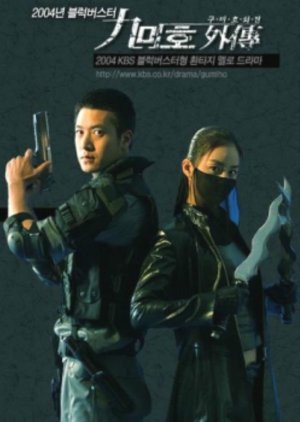
'Forbidden Love' (2004) remains, years later, an anomalous but surprisingly coherent work: a drama that uses melodrama as its backbone to graft on horror folklore, urban action and a far from trivial reflection on power and visibility. A work that does not seek balance, but builds its identity precisely on the friction between registers.One of the most interesting aspects of the series is the choice not to “hide” the supernatural, but rather to have it coexist openly with the urban landscape. The gumiho clan does not live on the margins: they are fully embedded in contemporary society, often occupying positions of authority. If during the day these creatures appear perfectly integrated into civil life, at night they sink into the underground, where an archaic realm of braziers, altars and ancestral symbols (and an abundance of leather outfits!) opens up, fuelling a world of rituals, feuds and millennial secrets. An imagery that, in terms of artificiality and evocativeness, is more reminiscent of Italian peplum movies and certain deliberately fictitious sets by Mario Bava than television realism.
In this dual space — bourgeois surface above, primordial rituality below — suspended between melodrama and gothic horror, paganism and the occult, the series finds its most authentic identity. 'Forbidden Love' is not a “spectacular” fantasy in the classical sense, but a lateral fantasy that infiltrates the interstices of the modern city: the fantastic does not destroy reality or replace it, but slowly infects it, almost vampirically, creeping into the creases of everyday life.
The melodramatic storyline is based on predestined yet impossible loves, in which every feeling is doomed from the outset. The gumiho Shi Yeon (Kim Tae Hee, beautiful and committed to a well-developed role, albeit still too expressive in her facial gestures) is at the centre of an emotional four-way relationship with no way out: She rejects the human and predestined love of policeman Kang Min Woo (Jo Hyun Jae, convincing), because she belongs to the lineage that he, initially unaware, fights against; but she also rejects that of her fellow Mu Young (Jun Jin, overly restrained), unable to arouse true involvement in her.
Shi Yeon is inextricably linked to the fate of the thousand-year-old fox; a natural and spiritual law that governs the existence of gumiho, laden with symbolic and metaphorical references: the impossibility of emotional bonds, not having to give in to human love, not mixing desire with the primordial instinct of the fox. The ‘curse’ represents the price to be paid for becoming fully human. Hence the divided identity, the repression of feelings, the eternal conflict between imposed destiny and individual choice, the personal sacrifice that precludes both paths, because every emotional bond strengthens one part of her at the expense of the other...
The gumiho warrior is an almost ascetic figure, forced into solitude not by moral choice, but by ontological necessity, which is immutable. The drama still holds up today precisely because of this mature and painful conflict: love truly becomes “forbidden love”.
Around them moves Chae Yi (Han Ye Seul, super sexy and perfectly suited to the role), a tragic character crushed by a double inferiority — hierarchical and sentimental — that transforms jealousy into betrayal. In this context, the melodrama offers no promise of redemption: love, though predestined, cannot be fulfilled without destroying those who feel it. No one, human or gumiho, is destined for a happy ending, because the predestination of love is not a promise, but a condemnation.
It is within this relentless logic that a “sideways” loss occurs, seemingly unrelated to the love four-way, but destined to contaminate it from within: a human bereavement, innocent and unaware of the deep axis of the story, which, touching on one of the symbolic cores of the gumiho’s existence, transforms love itself into guilt.
The introduction of the special police division marks a decisive change of scale. The military, not surprisingly, ‘don't mince words’: they embody a cold and repressive rationality that conflicts with both the gumiho and Kang Min Woo. The policeman thus becomes a tragic figure in his own right: torn between love and duty, empathy and repression, caught in the middle of two worlds that demand absolute loyalty. His conflict is insoluble, because every choice involves a loss. It is here that the melodrama acquires an unexpected depth: love is not salvation, but yet another battlefield.
The action scenes do not seek realism or pure spectacle, but instead function as geometric rituals inscribed in urban space. Squares, rooftops, stadiums, gyms, shopping centers, and even churches become chessboards where Korean folklore, television melodrama, and post- ‘Matrix’ and ‘Underworld’ action imagery coexist in a kitschy balance that is as delirious as it is coherent.
The characters seem to move according to invisible rules: the conflict is less psychological and more topological. The gumiho factions occupy areas, the police establish a counter-map, and the clashes take the form of choreographed rituals rather than traditional narrative events. Many sequences seem to openly declare: “Let's take a hyper-kinetic Western grammar and perform it with absolute seriousness, even when it's excessive.” Accelerated editing without realistic justification, iconic poses, sudden slow motion. This is where kitsch becomes conscious language: not irony, not parody, but total adherence to the subject's delirium.
In this radicalism, Korean drama touches upon — perhaps unintentionally — an unexpected arthouse cinema: a Jacques Rivette catapulted into contemporary Seoul, between ‘Duelle’, ‘Noroît’ and ‘Out 1’, but filmed as if Spike Jonze and the Beastie Boys had stumbled upon the set by chance. “Comment vous dire... c'est du sabotage!”. A happy and vital sabotage that cracks the surface romanticism and lets it breathe in the unexpected, in physical gestures, in the pure energy of movement.
Despite its obvious flaws in terms of pacing and writing, ‘Forbidden Love’ remains an ambitious drama with a strong sense of identity. Re-evaluating it means accepting its irregularities without mistaking them for superficiality. It does not excel in every single aspect, but it builds a coherent universe, a layered urban mythology and a surprising dialogue between folklore, action and melodrama. Its value lies in the sum of its parts, not in the perfection of each one: an uneven but coherent story, which finds its strength in its eclecticism. Not a perfect series, but an object with an off-kilter charm that, years later, deserves a closer look and a more generous judgement — and, above all, recognition of its courage in remaining true to itself, right up to the very last frame.
7 ½
Was this review helpful to you?

Mistério e Ação em uma Fábula Fantástica
Nine Tailed Fox (2004), da KBS2, é um dorama que mistura elementos de mitologia coreana com ação e romance, criando uma narrativa envolvente e sobrenatural. A história gira em torno de uma mulher descendente de uma linhagem de raposas de nove caudas, seres míticos com habilidades sobrenaturais. Ela se encontra em um conflito entre proteger sua identidade e suas emoções humanas, ao mesmo tempo em que lida com forças do mal e um romance proibido com um ser humano.O ponto forte de Nine Tailed Fox está na sua mistura de fantasia e ação, com cenas visualmente impressionantes e uma trama que mantém o público em suspense. A mitologia coreana, representada pela raposa de nove caudas (Gumiho), é explorada de forma fascinante, trazendo uma profundidade única à narrativa. Os efeitos visuais e o design de produção destacam o aspecto sobrenatural da trama, enquanto o romance central acrescenta uma camada de emoção e drama.
Para os fãs de histórias fantásticas com um toque de romance e ação, Nine Tailed Fox oferece uma experiência envolvente que explora os dilemas entre humanidade e imortalidade, e os sacrifícios que o amor verdadeiro pode exigir.
Was this review helpful to you?