News


 1
I have concluded that literal wizards made this show.
The question here isn't "Is it good."The REAL question is "HOW is this so good."
I have thought a lot about this. And I think I've figured it out. Now hear me out, I know it sounds crazy. But it is the only answer that makes logical sense:
There was a group of wizards that got into watching c-dramas, and they were like "Dude, we should make a c-drama." So they gathered around a magic cauldron and were like
"We found this hair stylist we could use, what do you think."
"Good enough. Throw em in the pot."
(other wizard throws stylist in the cauldron, POOF! big burst of light)
"What about this director?"
"He's pretty good. Throw him in the pot too. And that ML, close enough, he's fine, throw him in."
(Other wizard looks at ML skeptically) "You sure?"
"Yeah, throw him in. "
(POOF!)
"We picked up these costumes whaddya think"
(Barely looks at them) "Sure. I trust you. They seem fine."
(POOF!)
(They throw all the other stuff in the cauldron, cameraman, lighting, music, makeup, script, actors, etc etc...... point their magical staffs and start chanting 'mekka lekka hi mekka neinie ho.... mekka lekka hi mekka heinie ho....' and then BOOM the cauldron explodes in a blinding light)
(wizard raises his hands to the sky)
"BEHOLD! FOR WE HAVE CREATED PURE GOLD!"
Because I mean how else do you explain it!? How did all B+ ingredients turn into an A+ drama?!?? Magic! It has to be!!
* How am I this addicted to a show that doesn't even have a spice factor, with an ML I don't think is that hot? Magic
* How am I not put off and distracted by the dubbing? Magic
* I don't care that much about the salt trade, the politics, the romance, the intrigue... so why tf is this story just GRIPPING me and not letting go? Magic
* If the production quality isn't anywhere near as good as Rise of the Phoenixes, why am I so enchanted by it? Magic
CONCLUSION: This is a TOP-TIER BINGE WATCH, created through actual sorcery by literal wizards.
CAVEAT: There's a very slight ramp-up till it truly gets going, you need to give it like maybe 2 or 3 episodes before the addiction begins to set in. But after that it's like pushing a snowball down a hill, it packs it's own momentum before too long and then boom you're up at 2AM with dark circles under your eyes like "Just one more episode!"
Was this review helpful to you?

This review may contain spoilers
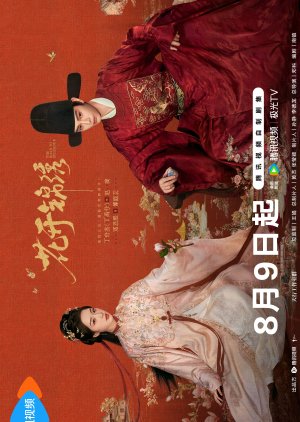
At its core, the story follows Fu Tingyun, a noblewoman whose life is suddenly destroyed after she is falsely accused of an affair, and Zhao Ling, a sharp and ambitious salt smuggler who comes from a completely different world. When circumstances force them to make a deal and flee together, two people who initially have very little reason to trust each other slowly become partners, allies and, eventually, something much more. And I really enjoyed this setup. What makes the drama particularly interesting is that it doesn't simply throw the leads together and immediately turn everything into romance. Their relationship develops through necessity first. They have to rely on each other, learn each other's strengths and weaknesses, and figure out how to survive everything that keeps being thrown at them.
Fu Tingyun was one of my favorite parts of the drama.
She starts from an incredibly difficult position. She's a noblewoman, but her status offers her very little protection once her family decides that her reputation matters more than she does. After being framed, she is essentially pushed into a corner and forced to find a way out of a situation she didn't create. What I liked is that she doesn't simply spend the entire drama waiting for someone to save her.
She's clever.
She's observant.
She's capable of adapting.
And, most importantly, she learns. She may come from a privileged background, but once she's forced outside that world, she has to understand very quickly that the rules she grew up with don't necessarily apply anymore.
Watching her gradually become more independent was one of the most satisfying aspects of the story. I especially appreciated that the drama doesn't reduce her to simply being "the clever female lead."
She has vulnerabilities.
She makes mistakes.
She can be emotional.
But she keeps moving forward.
That made her character arc feel earned.
And then we have Zhao Ling.
Thank you.
Seriously.
It was refreshing to have a male lead who isn't a prince, duke, general or some ridiculously powerful nobleman who can solve every problem by waving his hand. He comes from a humble background, operates in an illegal trade and knows exactly how to survive in a world where people with money and power can crush people like him without thinking twice.
He's rough around the edges, street-smart and ambitious. But he also has principles. He knows where his limits are, and despite the questionable nature of his profession, he isn't simply a selfish criminal. His ambitions are tied to his desire to improve his life and protect the people around him.
Another thing I really appreciated is that The Road to Splendor doesn't allow the romance to completely swallow the plot.
The story begins with a personal crisis, but it gradually expands into something much larger.
We get family conflict, power struggles, the salt trade, corruption, political intrigue and questions of social class. The escape storyline gives the drama a feeling of constant movement, and instead of keeping the characters trapped inside one household for dozens of episodes, the story actually takes them on a journey.
The drama doesn't feel like a world populated exclusively by the leads and a bunch of disposable villains. Several of the secondary characters have their own motivations, loyalties and agendas, and even the antagonistic characters can be genuinely infuriating in the best possible way.
The family dynamics in particular add a lot to the story because they show how differently people react when survival, reputation and power are involved.
There aren't many characters here who are simply evil for no reason.
People want things.
They make choices.
They protect themselves.
Sometimes they hurt others in the process.
That makes the conflict much more interesting.
It's not a perfect drama.
There are moments where certain plot developments could have been handled more smoothly, and some of the political and family storylines can become a little dense.
But none of that changed the fact that I genuinely enjoyed watching it.
The story kept me interested, the leads had fantastic chemistry, the characters had room to grow, and the production looked beautiful.
Most importantly, it didn't feel like I was watching the same historical romance I've already watched twenty times.
Beautiful, entertaining and surprisingly addictive.
Was this review helpful to you?

THIS ROAD HAD NO SPLENDOR, and yet I ENJOYED THIS JOURNEY
I finished watching this drama two days ago, and yet I could not decide on how to rate it. It felt like a heartbreak happening in front of my eyes, and yet I could neither hate it nor look away from it.One thing I do want people to know before picking this up is that THIS IS NOT A ROMANCE GENRE DRAMA, yes romance plays a pivotal role in the way the characters develop, and the decisions they make. However, there is barely any romance on screen. The story focuses more on the court politics, life as a commoner with no power, and how both of these shape and change the two pivotal leads individually *and* differently.
Without giving spoilers, I would say there were many times in the show where I hated the decisions (or the circumstances that resulted in those decisions) the main characters took, however I wasn't annoyed by them. Usually, I am the kind of person who drops shows instantly once a character makes a stupid decision that goes against their character's core traits. But here, all decisions taken were true to their core, and I think that's why I happened to fall for the show despite such heartbreaks.
This drama dares to tell a new story without falling for the celebrated perfect green flag ML and always understanding and devoted FL drama tropes. It treats its characters as real human beings instead of a self-insert mould in an escapist fantasy. And for that I fully respect it.
It also had me GLUED from episode one; this director's cinematographer should never stop working with him AND the screenwriter as always is GREAT at writing layered characters and diverse representation of what it means to be a strong female character.
I would recommend watching it but I would warn you, there was NO SPLENDOR ON THIS ROAD!
Was this review helpful to you?

A Journey I Was Invested in From Start to Finish
Honestly, I really enjoyed this drama. Not a single episode felt boring to me. I was invested from the beginning all the way to the ending, and I always wanted to know what was going to happen next. It’s been a while since I watched a drama where I didn't feel like skipping through certain parts.What I loved the most was the rags-to-riches storyline. Watching Zhao Ling slowly build his way up from nothing was so satisfying. I really liked seeing his journey, especially because it didn't feel like he suddenly became successful overnight. You actually get to see him struggle, make choices, and slowly get to where he wants to be.
And I have to talk about the leads. I've already watched some of the Ding Yu Xi's previous works, so I already knew he was good, but I really enjoyed him in this one too. Zhao Ling was such an interesting character to watch, and I loved seeing his growth throughout the story.
Also, Ancy Deng was such a pleasant surprise for me. I've never watched any of her dramas before, so this was my first one, and I genuinely think she's really good. I loved watching her character grow throughout the story, and she made the emotional scenes feel very natural.
Obviously, Zhao Ling and Xie Tingyun are some of my favorites. I really liked their relationship and the way they supported each other. Their chemistry worked for me, and I enjoyed watching them become closer while dealing with everything happening around them.
And I have to mention the Emperor because honestly, I really liked him. It's actually rare for me to like an emperor character this much. Usually they're either frustrating, completely unreasonable, or just there to create problems, but I genuinely enjoyed his character here.
There are also quite a few supporting characters I ended up loving. Fan Yake is probably the funniest one for me because I really disliked her at first. I was fully prepared to hate her, but by the end I didn't actually hate her that much. Her character grew on me more than I expected.
I also really liked the different relationships between the characters. It wasn't only about the main couple, and that made the whole story more enjoyable for me.
Overall, I genuinely had a great time watching this. The story kept me interested, the characters grew on me, and I really loved the whole journey from nothing to something. And after watching Ancy Deng for the first time here, I definitely want to check out more of her dramas.
And honestly, I wasn't ready to say goodbye to this drama when it ended. I genuinely wanted a few more episodes. I was having such a good time with these characters and their story that the ending came way too quickly for me. I would've happily watched a few more episodes just to spend more time with everyone.
Was this review helpful to you?

Behind Every Great Man, There’s an Ambitious Woman
*The Road to Splendor* is a character-driven historical drama about two people whose ambitions change as dramatically as their circumstances. What begins as the story of a man who wants little more than an ordinary life gradually becomes a story of power, responsibility, marriage, friendship, and the price of wanting more. At the centre of it are Zhao Ling and Fu Tingyun, whose paths continually intersect as they move from survival and uncertainty toward wealth, influence, and increasingly complicated choices.Zhao Ling and Tingyun's relationship is one of the things I enjoyed most. Their connection doesn't begin with romance. At first, Zhao Ling is simply someone who chooses to stand beside Tingyun and help her, even when neither of them has any real romantic feelings for the other. Their relationship grows through circumstances, trust, betrayal, and eventually genuine affection. I also liked watching Zhao Ling mature. He starts as a man who wants very little from life, but responsibility gradually changes him. He doesn't suddenly become ambitious; he adapts, learns, and eventually becomes someone capable of carrying the weight that comes with his position. Tingyun changes too, and that is where their relationship becomes even more interesting. The woman who once wanted more begins to value the simpler life, while the man who once wanted simplicity becomes increasingly ambitious. Their roles don't reverse overnight, but the change is noticeable by the end.
Fan Yake was the character I felt for the most. Her story is painful because so much of what she does comes from insecurity, pride, and her desperate desire to prove that she belongs. But even when I understood where she was coming from, I still couldn't justify the way she treated Tingyun. Her betrayal made their friendship particularly difficult to watch, because this wasn't simply a rivalry between two strangers. They had history. And Yu Jingxiu's treatment of her only made it worse. I never felt that Fan Yake deserved the way he treated her, especially after she had already sacrificed so much for him.
Madam Yu, meanwhile, was a completely different kind of character. She was intelligent, calculating and formidable, and for much of the story she felt like a far greater threat than her husband. And then there was Fourth Master Fu, who I initially took for nothing more than a proud and difficult man. The more I watched, though, the more I realised there was something seriously wrong with this man. His past actions, especially his involvement in Tingyun's mother's death, made him much harder to sympathise with. What made it even more complicated was that, despite his constant opposition, Tingyun never simply stopped seeing him as her father. Zhao Ling eventually became the one who killed him, but even though I understood why it happened, I still didn't particularly like the way it was handled. He was still her father, and that made the whole thing feel heavier than a simple case of an antagonist getting what he deserved.
The plot itself kept enough moving parts around the characters to make the journey worthwhile. Betrayals, family conflicts, business interests and court politics continually pushed the characters into situations where they had to choose between what they wanted and what they were expected to do. Some of the political developments were more interesting than others, but they worked best when they directly affected the characters rather than existing simply as background intrigue.
Visually, the drama is also a pleasure to watch. The historical setting, costumes, locations and overall atmosphere give it a polished feel, and the performances help carry the more character-driven moments.
For me, *The Road to Splendor* was not the most intriguing drama I've watched, but it was a good journey with characters that actually changed along the way. Some of the consequences, especially toward the antagonists, could have carried more weight, but I still enjoyed the overall experience.
**8/10.**
Was this review helpful to you?
This review may contain spoilers
Masterpiece
This drama is will written speaks on the struggles that women has to deal with a male dominated time.ancy deng and ding yu xi chemistry together is still strong like was in their first drama melody of golden age loved the fact in this drama they had a kid this time i hope they come back together for third drama . Ancy deng is strong actress i can tell she grown matured as actor. Loved how they showed the relationships are prefect and that marriage is hard especially when comes to money and power. Concubine wu and fan shi ran it was nice to see them grow on their own realized man is worth it. Glad yu jing xiu got his karma. I def highly recommend this drama its def rewatchWas this review helpful to you?

This review may contain spoilers
It Could Have Been More Epic
It’s my first review on MDL i think, I’m not well versed in words but I wanted to leave a few for this drama.This review contains spoilers, please do not read if you don’t want to be spoiled.
The Road to Splendor was a difficult drama to rate. 8 seems too low for my rating standards because I am not a picky viewer, I place heart above many things when I watch a drama, as long as it has a lot of heart, plot holes, mediocre acting and so on are usually overlooked. 9 would seem too high because unfortunately I think I really had trouble connecting and relating after that 5 years jump when the drama hits the mid 20 ep mark. But I have rated objectively much worse drama 8.5… I wish I could give this drama a happy 9, because the beginning until that 5 years time jump was so good. I loved it so much I bought WeTV express package the second day the drama came out after struggling with ep 1 however. But from ep 2 onwards to ep 20, the drama had my heart.
Alas, the whole arc in the capital and court politics really lost me quite a bit. I actually really enjoyed the grown up version of Fu Tingyun and Zhao Ling, Zhao Ling definitely changed the most between the 2. But I only actually “enjoyed” his change truly after the death of General Mo Yi. Before that incident, his change was quite empty, I think he was supposed to be empty after that 5 years of war, but it didn’t translate well acting wise and on screen wise. I wanted to see pain, desperation, anger, a man eaten by this desire for revenge or something. I guess I wanted intensity from Zhao Ling, but he just wasn’t. He kinda just was… and I don’t know the right word nor adjective to describe the man that he was.
We are told he struggled, but I didn’t feel like he struggled, I just felt like he was very incompetent in many aspects.
Also, the reunion after that 5 years mark was so underwhelming in every way, I felt the longing and that deadly desire to reunite from our female lead Fu Tingyun, but I felt nothing from Zhao Ling. You can argue that the war took his soul away which would be justified I suppose, but again my problem was that I felt again, nothing from him. I think that his character from the very beginning held onto this unconditional love for FTY and his unconditional desire to protect her and keep her safe. Even if the war has taken every single thing from his whole being and his soul, I think his character would have benefited greatly from this undying inner fire for FTY. It should have been one painfully epic reunion for them, both knowing what awaits them in the dangerous capital. But I had there, after that 5 years time jump, an almost indifferent man feeling wise. Undying fire not because romance is central, but because it would be more interesting to see his characters face all the dilemmas that were coming at him with so much more potence, this inner battle of keeping integrity, morals, while having to sacrifice unimaginable things. Again, and I’m sorry for repeating the same thing, I just wanted to see Zhao Ling struggle and completely defeated and eaten by the inner demons, but he was just so lifeless. Things were happening to him because the script said that it would.
Thankfully the last arc picked up, and things started to dance again. The last 4, 5 episodes really saved the luckluster capital arc.
My favorite scene in the last few episode was actually of Zhao Ling and the Emperor, when Zhao Ling requested to retire from court, it was a beautiful scene, when a man has tasted the bitterest part of life and has the courage to forego it all for the one thing that truly matters to men: freedom and love.
Many dramas end on protagonists making it big in court, I’ve always wanted to see our protagonist walk away from it all.
All I did was talk about Zhao Ling, and not so much about our female lead, but I think it’s because her acting has been more consistent and her character too (consistent doesn’t mean she didn’t grow, just that her actions were understandable or at the least relatable in some way), and I really felt for her and her pain even during those very bad post-halfway episodes. When her and Zhao Ling grew distant, I felt FTY’s pain, not much Zhao Ling’s.
It’s always bittersweet when a drama comes to an end, and especially so when you feel that the drama had so much more potential. Potential to be those 10/10 dramas, it has all the right elements to be one, but sadly wasn’t one.
I might have been a bit harsh, because I really almost dropped around those 23-28 episodes mark, more than once, but I still think the drama had a really great first half, and a solid ending! The chemistry was really there the first half, and then at the end.
It was my first Ding Yu Xi and Deng Enxi’ drama, and I like both of them! Will keep an eye on them in the future.
My favorite character in this drama is Madame Yu, and she was sooo wonderful until the writing decided to kill Concubine Wu’s aunt and FL’s mother… and all the greatness collapsed. She had the potential to be one of the greatest villain in a drama but alas.
I wish everything could have been more bittersweet because I felt like that was what The Road to Splendor set out to be.
Was this review helpful to you?

The Plot Has Returned From Exile
Recent costume dramas have become remarkably good at serving gold-rimmed plates with nothing on them.Beautiful faces.
Expensive clothes.
Enough slow motion to delay the plot indefinitely.
The Road to Splendor finally remembered the food.
This is an ambitious story about two outsiders forcing their way through a society determined to keep them in their assigned places. Fu Tingyun has education, status and strategic intelligence but little control over her own future. Zhao Ling has courage, ability and ambition but no respectable name capable of converting those qualities into power.
Together, they discover that social mobility in imperial China requires intelligence, sacrifice and a concerning willingness to survive attempted murder before breakfast.
The salt-reform storyline and the imperial-tomb scheme are the drama at its sharpest: intelligent people manipulating systems rather than waiting for the script to remove their opponents.
Schemes require preparation.
Actions have consequences.
Characters remember information after learning it.
Luxurious.
What impressed me most was not simply that the plot was complicated, but that its complications grew naturally from the world. Salt policy, family reputation, class, marriage and official power are not decorative historical vocabulary. They determine what these characters can risk, whom they can trust and how much every victory costs.
Even when the pacing became uneven, I remained invested because the drama had built conflicts worth resolving. I wanted to know what these people would do next, not merely which beautifully lit person would win the argument.
The women are particularly well written. Madame Zuo, Fan Yake and Madame Yu are neither flattened into victims nor sharpened into one-dimensional villains. They make cruel, compromised choices, but those choices grow from recognizable combinations of pride, fear, survival and the narrow forms of power available to them.
I did not approve of them.
I frequently understood them.
Madame Zuo was the best-acted role for me, while Madame Yu may have been the most complete character. These women do not merely enter the plot. They rearrange the furniture and leave everyone else wondering who owns the house.
Ding Yuxi and Deng Enxi both gave respectable performances.
Neither blew me away.
Ding Yuxi has considerable charisma. Unfortunately, the first half occasionally treats this as information the audience might forget unless Zhao Ling lowers his head, angles his face, chews on a stalk of grass, and remains perfectly still for inspection.
The chin.
The stare.
The stalk of grass working overtime to establish his ruggedness.
At times, Yuxi was playing Zhao Ling while his best angle was filming a separate drama nearby.
Some of the physicality suits a guarded salt smuggler accustomed to monitoring danger. But there is a difference between a character watching the room and an actor checking whether the room contains a camera.
Ding Yuxi becomes much better in the later arcs, when the performance finally stops standing at attention. His silences acquire weight, his anger feels less arranged, and Zhao Ling begins looking like a man carrying years of isolation rather than a promotional image carrying excellent lighting.
The less Ding Yuxi tries to create presence, the more presence he has.
Deng Enxi convincingly captures Fu Tingyun’s education, pride and aristocratic reserve. She is strongest when the character is cornered and forced to calculate her way out of danger.
But her screen presence remains uneven, and the dubbing occasionally seems to arrive three emotional stations ahead of her face. The voice enters wearing armor while the expression is still fastening its shoes.
I also never fully believed the romance.
I believed that Fu Tingyun respected Zhao Ling.
I believed that she trusted him.
I believed they could expose corruption, survive court politics and reorganize the salt trade together.
Their partnership has logic. Their romance sometimes feels like two highly competent colleagues who accidentally included marriage in the project scope.
Deng Enxi conveys pride, irritation and emotional control more convincingly than tenderness. Their personality clashes are believable, but the drama keeps identifying those differences instead of exploring or resolving them. Zhao Ling and Fu Tingyun repeatedly save one another, yet they often appear emotionally parked in separate courtyards.
Fortunately, The Road to Splendor never depends entirely on its romance.
There is enough history, political conflict and character development to keep the world moving beyond the couple. The supporting characters have ambitions of their own, and the story does not collapse whenever the leads stop looking at each other.
That should not feel unusual.
It does.
The production is undeniably beautiful. The locations, costumes and cinematography give the drama scale, atmosphere and a sense of history. After years of digitally manufactured realms looking approximately three loading screens away from completion, real landscapes are a welcome sight.
But the drama occasionally polishes itself past beauty and into showroom condition.
Every sleeve falls correctly.
Every beam of light knows its mark.
Every actor has signed a treaty with their preferred angle.
Some scenes look less lived in than prepared for inspection.
The excessive smoothing makes this worse. Faces are processed until human texture becomes a production error. The desert has pores. The walls have pores. Apparently, only the actors received imperial exemption.
For a story filled with hunger, prisons, danger and people dragging themselves through a brutal social order, everyone looks suspiciously ready to endorse serum.
The drama wants historical realism and luxury-ad perfection in the same frame. Most of the time, the history wins.
Occasionally, the skincare campaign launches a coup.
The writing also loses some discipline after the salt reform arc. Earlier villains succeed because they are intelligent and understand the system. Later villains increasingly succeed because supporting characters suddenly discover greed, recklessness and selective cognitive failure.
The early arcs play chess.
The later arcs sometimes remove pieces by declaring them stupid.
Around Episode 32, the drama approaches full dog-blood melodrama with alarming confidence. Thankfully, it steps back, recovers and finishes on solid footing, although some villains receive consequences considerably more merciful than their crimes.
Still, The Road to Splendor gave me intelligent political conflict, complicated women, rich historical detail and protagonists whose lives did not begin and end with romance. Its best arcs were absorbing, its world felt larger than its leads, and even its morally compromised characters remained understandable without being excused.
No, it did not blow me away.
The acting was uneven.
The romance never fully impressed.
The visuals occasionally admired themselves more than I did.
The later plotting did not maintain the precision of the beginning.
But I enjoyed it considerably more than that list may suggest.
A story and characters substantial enough to survive the drama’s own excesses.
The plate was occasionally overdecorated, but for once, someone remembered to serve dinner.
Was this review helpful to you?
OBSESSED ?
oh my gosh I'm obsessed with this drama 😭 another episode please. Best drama of 2026 for me. I just hope it continues like this till the end. It wasn't even part of my watchlist, I had nothing to watch and just randomly tuned in an now I'm obsessed. It's such a refreshing story. Throughout this year, all the released dramas have been the same script with different actors. It almost sent me into a cdrama slump. who knew this drama I tried on a random day would be this good that I had to drop a review for the first timeWas this review helpful to you?
Amazing C Drama
What a marvelous C drama I'm watching..each episodes are so good ... The plot is so interesting and its so nice ...Im so in love with Ding Yuxi..I love both the fl and ml ....I love all the supporting cast as well ....truly marvelous ✨🫶⚔️ ... everyone has given a tremendous effort in this C drama ...I really love the beautiful golden Sandy desert , the commanders , the scholars.. everything is so beautiful 😍❤️ .. legit 🔥......I hope to get a guy like Ding Yuxi in future...I'm so in love with this C Drama...indeed it's leading towards the Road to Splendor ✨😍 😘Was this review helpful to you?

 2
This review may contain spoilers
Behind Every Great Man Is a Woman With a Strategy
Born with little more than ambition and a good heart, Zhao Ling has no intention of staying at the bottom of the ladder. His life takes an unexpected turn when he crosses paths with Fu Ting Yun, a noblewoman whose reputation is shattered by a scandal she did not cause. What begins as a desperate escape slowly turns into a partnership. Against family grudges, political intrigue, and the whims of fate, Zhao Ling and Fu Ting Yun learn that love is sometimes less about finding the right person and more about choosing the same road, even when it leads straight into the storm.The Road to Splendor was one of the good dramas I’ve watched this year. In a year where some productions have started leaning heavily on AI and shortcuts, this drama felt refreshingly authentic. You can see the effort behind it. From the locations to the cinematography, costumes, performances, and even the way certain scenes were staged, there was a sense that people actually cared about what they were putting on screen.
The drama opens with a wedding procession colliding with a funeral procession, which is already one hell of an introduction. Instead of immediately explaining everything, it takes us back to show how we arrived at that moment. And honestly, what happened to Ting Yun was heartbreaking. It is difficult to watch a woman live in a world where chastity and reputation can outweigh her own voice, especially when her own family treats her as something that can be sacrificed for their standing. Ting Yun was essentially raised to become a bargaining chip for the Fu family, protected and groomed so that she could make a "good marriage" and bring power to the family. Then, when a scandal she did not cause destroyed her reputation, the same family that had raised her simply abandoned her.
The funeral procession arranged for her was therefore much more than a dramatic scene. With Zhao Ling's help, Ting Yun arranged a wedding procession that collided with the funeral procession prepared by the Fu family. To me, that collision symbolized the death of her old life. The girl who had lived under the protection and expectations of the Fu family was gone. Her youth, sheltered ideals, and belief that she could simply follow the path chosen for her were buried there. What remained was a woman who had to stand on her own feet and decide where she wanted to go. That opening also gave the story a strong emotional foundation. Ting Yun's journey was not simply about revenge or proving everyone wrong. It was about reclaiming ownership of her own life. And this was where Deng En Xi really impressed me.
Fu Ting Yun might just be the most impressive role Deng En Xi has taken to date. She did not merely play Ting Yun. She became her. There is an elegance and charisma to her performance, but also an underlying sharpness that makes Ting Yun feel like someone who can walk into a room and quietly take control of it. A lot of that comes from her expressions and delivery rather than the script itself. What I especially appreciate is that Ting Yun was not written as an invincible woman empowerment poster. She is intelligent, strategic, and capable, but she is also confused, vulnerable, explosive, and sometimes wrong. She fails as much as she succeeds. That balance makes her feel human. Empowerment is much more convincing when the character is allowed to struggle instead of winning simply because the script says she is strong.
One scene that really demonstrated both the drama's willingness to be raw and Deng En Xi's commitment to the role was when Ting Yun was poisoned. Zhao Ling arrives at just the right moment and helps her induce vomiting with his fingers in her mouth. Even that alone felt unusually visceral for a Chinese drama. But then Ting Yun tries to induce vomiting herself by eating rain-soaked leftover noodles. I have a weak stomach, so I was genuinely speechless watching that scene. It was probably the most impressive and well-performed scene in the entire drama for me. I haven't seen any behind-the-scenes footage of how they filmed it, but that scene alone speaks volumes about Deng En Xi's dedication. I don't know how she managed to stomach it, but respect.
Then there is Zhao Ling. Zhao Ling is a salt trader, or depending on how you look at it, a bandit. He is not book smart, but he is street smart. Beneath his rough exterior, though, is a ridiculously sweet heart. Ding Yu Xi plays that duality beautifully. His puppy eyes can make Zhao Ling look almost harmless, but the moment his expression sharpens, you immediately remember that this man can be ruthless. I especially like that the drama does not try to sanitize him. When he cares about someone, he cares with complete sincerity. When someone hurts the people he loves, his ruthlessness has very few boundaries. He can simply pull out a knife and kill someone on the spot. And somehow, both sides of him feel believable.
His journey with Ting Yun is where the drama really shines. They become partners in the truest sense. Ting Yun brings intelligence, strategy, and the ability to see several moves ahead. Zhao Ling brings strength, street smarts, instincts, and the ability to handle situations that cannot be solved with a clever plan. They complement each other beautifully.
After they encounter the Crown Prince, who will later become Emperor, Ting Yun encourages Zhao Ling to join the army and aim for officialdom. She also tells him that she wants to marry him and will continue helping him. Of course, Ting Yun is not completely altruistic about this. His success benefits her too. But I like that their relationship is built on mutual interest that gradually grows into genuine loyalty. They head to Ganlin in the northwest, with Ting Yun taking her mother's surname, Xie, and becoming Zhao Ling's fiancée. Zhao Ling joins the army and tries to climb the ranks while Ting Yun manages things from home.
Ganlin was probably my favorite arc. It is where Zhao Ling's character development and his relationship with Ting Yun felt the strongest. You get to see them build a life together, face problems together, and gradually become the kind of couple who can trust each other with their backs turned. As partners, they absolutely slay. As lovers, though, I did not feel much sparks. The chemistry between Zhao Ling and Ting Yun is strong when they are working together, but as a romantic couple, they did not give me as much spark as I wanted. And honestly, I blame the writing. Both Ding Yu Xi and Deng En Xi have proven that they can deliver romantic expressions. If anything, their performances are doing a lot of heavy lifting here.
Zhao Ling's feelings were easier for me to see. His affection develops quietly but convincingly. He starts treating Ting Yun like a precious gem. He knows she is strong enough not to break, but he still does not want her to get scratched or fall to the ground. There are little moments where he is caught off guard by something she says or does, and you can see him slowly developing that soft spot. Ting Yun, however, was harder for me to read romantically. She clearly cares about him. She trusts him. She considers him someone she can walk through life and death with. But for most of the drama, she felt more like she had found her ride-or-die partner than the man she was romantically falling in love with. The circumstances and writing simply did not give her enough room to show romantic tension. The only time I genuinely felt Ting Yun's completely loving gaze was during the final swing scene.
One particular line from Zhao Ling stayed with me: "I saved you from Biyun Nunnery, not to let you end up in another one." That line basically defines their relationship. When Zhao Ling eventually comes to Ting Yun with poison, she does not react with huge surprise. It feels more like she is thinking, "So it has come to this." Somewhere in the back of her mind, she had always been prepared for the possibility that even Zhao Ling could become another person who would determine her fate. She accepts the poison because the choices she made were hers. She chose the marriage. She chose the capital. She chose this road. She does not regret it.
Then Zhao Ling takes the poison for her. That is when she is genuinely shocked. Because Zhao Ling has always wanted the best for her. He started this journey because of her, and somewhere along the way, he developed ambitions of his own. But underneath all of that, it was still about giving her the life she deserved. As partners, they are excellent. As a romantic couple, I just wish the drama had allowed them to breathe a little more. Zhao Ling literally says he wants to marry for love, yet somehow I did not always feel that love on screen as strongly as I wanted to.
The Ganlin arc itself eventually started leaning into more familiar tropes too. My biggest disappointment was Yu Jing Xiu. He was much more interesting when he was simply trying to fight against his parents and make a name for himself. I also enjoyed him more when he schemed against Ting Yun because his mother liked her and because she admired his mother. Once he started falling for Ting Yun because she saved him, then putting her on a pedestal as some goddess who had broken free from her family's shackles, his character became another typical obsessive and possessive second male lead. He went from interesting to predictable.
After Ganlin, the story takes Zhao Ling and Ting Yun to the capital. Zhao Ling earns an official position and becomes one of the Emperor's men, while Ting Yun takes charge of the Xie family business and continues supporting him with strategy and handling matters from the women's side. I actually enjoyed the first half of the capital arc. Watching them navigate court politics together was fun, especially because their strengths remained complementary. They really felt like a power couple in the practical sense. Although at some point I was just sitting there thinking, can you two please get married already? There are so many people hovering around them that I just wanted them to make things official.
The family and political conflict were also entertaining, especially watching the Zhao and Yu families clash through their respective women. Behind every powerful man is apparently a woman who listens to his problems and then quietly whispers the strategy he should use. I also appreciated that Madam Yu was not written as completely black or white. She knows when to attack and when to retreat. Ironically, her greatest victim might actually have been her own son, Jing Xiu. It was wild watching the Yu couple sacrifice their son so easily and claim it was for the family when it often felt more like they were protecting their own pride and saving their own skin.
Then came episode 31. For me, that was the emotional climax of the drama. By that point, I had become accustomed to the drama's misleading previews, ruses, and convenient last-minute solutions. Whenever something looked disastrous, I had started assuming there would be some trick around the corner. By the end, I was basically trained to think, "It's fine. Everyone will survive." However, episode 31 was different. There was no convenient ruse to soften the blow. It was simply the Emperor finally acting with the authority and responsibility of an Emperor. What happened was heartbreaking, made even more painful because the sacrifice could have been avoided. I was emotionally drained after that episode. Ironically, the actual finale did not affect me nearly as much.
The ending was steady, predictable, convenient, and ultimately anticlimactic. I was not angry with it, but I wanted to feel the victory of the leads more. After everything Zhao Ling and Ting Yun had endured, I wanted that feeling of finally making it through the storm. I did not need an explosive finale. I just wanted the emotional payoff to match the journey. The resolutions for the supporting characters were mostly decent, though some were much more satisfying than others.
Fan Ya Ke's ending felt liberating. I was genuinely happy for her, and I appreciated that the drama did not force her into the cliché of simply returning to parenting her son. Instead, it connected her ending back to the beginning, with her following in her father's footsteps and becoming a teacher. The Yu family's ending was where I felt the drama dropped the ball.
I did not need everyone to be beheaded, but I wanted the wins and losses to feel more tangible. Yu Guo Dong dying by accident was especially disappointing. After everything he had done and everything the story had built up, reducing his death to an accident felt anticlimactic. I would have found it much more satisfying if Jing Xiu had intentionally killed him, or if the Emperor had given him a severe punishment.
Madam Yu's ending was also surprisingly mild. For all the things she did, her punishment felt like a very chill layoff in modern terms. It's sad, but she'll live. I think the ending would have had more impact if we had actually seen more of her devastation and the consequences of losing everything. Instead, it felt rather lukewarm. The drama even had Ting Yun verbally explain that becoming a commoner was worse than death for Madam Yu, almost as if the script needed to convince both Ting Yun and the audience that this was a satisfying punishment.
As for Jing Xiu, his ending did not really feel like a defeat. If anything, it felt like he finally escaped his parents' cage. So perhaps it was less a punishment and more a gift. Still, I do appreciate that the drama gave closure to all the major characters and showed us where everyone ended up. Ting Yun and Zhao Ling's ending, especially that final swing scene, was beautiful.
One of the drama’s greatest strengths is the visuals. I loved how much effort went into the locations and cinematography, especially during the Ganlin arc. Rather than relying entirely on AI, green screens, and the familiar Hengdian setups, the production actually went out and filmed in different locations. The desert scenes were gorgeous. The autumn trees by the lake were gorgeous. There was a sense of scale that made the journey feel like an actual journey.
The color grading was also lovely. Warm golden tones made the happier and more splendid scenes feel warmer, while cooler tones were used for sadness and isolation. The camera angles, foreground elements, composition, and blocking were often thoughtfully done. I usually have a love-hate relationship with all the drapes in costume dramas, but this drama actually knew how to use them. The framing often felt aesthetic without becoming obviously obsessed with being aesthetic.
And the costumes, hair, and makeup were beautiful. They genuinely made me appreciate the fashion of the era more than I expected. The OSTs were another pleasant surprise. I still hear some of them in my head even after finishing the drama, which is usually a good sign.
Overall, The Road to Splendor is a drama I enjoyed very much, even though I cannot call it perfect. Its strongest points are its leads, production effort, cinematography, and costumes. Despite the parts where the drama stumbles, I would still recommend it. There is effort here. There is personality here. There are performances worth watching. There are scenes that genuinely surprised me. There are beautiful locations, gorgeous costumes, strong cinematography, and characters who are more nuanced than they initially appear. Most importantly, The Road to Splendor feels made rather than assembled. And in an era where you can sometimes feel the shortcuts behind the screen, that authenticity is worth something.
Was this review helpful to you?

A Splendid Bloom in Poisoned Soil
What I appreciated most about "The Road to Splendor" was the care given to why people behave as they do. Its characters are all trying to build lives within the same poisoned soil of family pressure, social expectations and limited choices, yet what grows from it is different in each of them. Not every decision is reasonable or forgivable, but most can be traced back to something: lost opportunities, fear, ambition or the need to survive.This is already apparent in the opening episodes. Zhao Ling and Fu Tingyun are introduced through separate storylines that establish their intelligence in different ways. Zhao Ling survives as a salt smuggler by thinking quickly and taking advantage of whatever situation presents itself. Fu Tingyun is more measured. She has been educated to understand people, reputation and the rules governing a noble household. Their early encounters work because neither is made foolish so the other can appear clever.
Fu Tingyun’s life in the Fu household initially seems secure, but everything she has been given has a purpose. Her family has invested in her because a good marriage may reverse its decline. The tragedy is that the grandmother’s affection is not entirely false. She does care for Fu Tingyun, but that care remains tied to the interests of the family. Once Fu Tingyun’s reputation is ruined and the marriage is lost, the grandmother chooses the family over the granddaughter she raised.
Fu Tingyun’s maid choosing to remain beside her was deeply moving, while Fu Tingyun’s attempt to save herself was made deliberately difficult to watch. She is not rescued while lying there. She participates in her own survival, even when that means eating something revolting to force the poison from her body. The scene strips away the dignity she has been trained to preserve and leaves only her determination to live.
Madame Zuo is another example of the drama looking beyond the obvious role assigned to a character. She could easily have remained an unstable sister-in-law whose only function was to harm the Tingyun. Instead, we learn what brought her to the Fu family and what kept her there. She entered through a ghost marriage while still young, traded years of her life for financial security and the promise that her brother would be supported, and gradually watched those promises narrow into resentment.
Her suffering does not make her actions acceptable, but it makes them coherent. She knows what the Fu family’s chastity arches have cost its women, yet she is still prepared to sacrifice Fu Tingyun if doing so will secure her brother’s future. Madame Zuo was the strongest performance in the drama for me because her anger never felt detached from the life behind it.
Yu Jingxiu is similarly shaped by control. His mother has planned not only his marriage and career but seemingly the ambitions of the next generation as well. I understood why he wanted to escape her, but the way he pursued that freedom was cowardly. He lacked the courage to oppose her directly and instead destroyed Fu Tingyun’s reputation, used Fan Yake and treated the lives of people beneath him as expendable. The drama gives him a reason without turning that reason into an excuse.
These early character threads gave the later political story a strong foundation. The salt reforms were especially engaging because the conflict involved practical interests rather than empty court intrigue. Money, drought, official advancement and family alliances all influenced the choices being made.
Zhao Ling and Fu Tingyun made complete sense to me as partners. He understands danger and the world beyond respectable society; she understands institutions and the people operating within them. Their trust grows through experience, and I believed they would risk their lives for one another. The romantic side was less convincing. I sometimes felt their dependence and loyalty more strongly than their affection, particularly in the later episodes.
I thought both leads gave solid performances without being outstanding. Ding Yuxi has natural charisma, but some of his early mannerism, the lowered gaze, tilted posture, felt a little too deliberately maintained. His performance improved later when Zhao Ling became quieter and more emotionally isolated.
Deng Enxi seemed to understand Fu Tingyun’s defences better than her softness. She was strongest when fear or humiliation forced the character to fight for her composure. Elsewhere, the performance could feel less certain, especially when the confidence of the voice exceeded what was visible in her expression. Fu Tingyun’s pride and intelligence were always clear; the tenderness beneath them was not.
The production is beautiful, particularly its use of real locations, architecture and landscape. At the same time, the smoothing was too heavy for my taste, and a few scenes seemed so carefully composed that they lost some spontaneity. The physical world often felt authentic, while the actors occasionally appeared visually separated from it.
Overall, this was an 8 out of 10 for me. The romance and performances did not affect me as deeply as I had hoped, but the story remained engaging because its characters had understandable histories and its conflicts grew naturally from the world they inhabited. "The Road to Splendor" may not have been exceptional, but it was thoughtful, well made and far more substantial than many recent costume romance dramas. The soil surrounding these characters was poisoned long before they arrived; what interested me was seeing what each of them chose to grow into.
Was this review helpful to you?