- Português (Portugal)
- Español
- Türkçe
- English
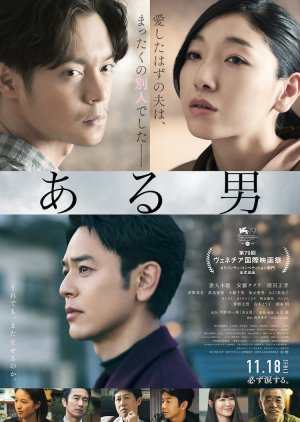
- Título original: ある男
- Também conhecido como: Aru Otoko , Um Homem
- Roteirista: Mukai Kosuke
- Diretor: Ishikawa Kei
- Gêneros: Mistério, Drama, Família
Onde assistir Um Homem

Subscription
Elenco e Créditos
-
") Tsumabuki SatoshiKido AkiraPapel Principal
Tsumabuki SatoshiKido AkiraPapel Principal -
") Ando SakuraTaniguchi RiePapel Principal
Ando SakuraTaniguchi RiePapel Principal -
") Kubota MasatakaTaniguchi DaisukePapel Principal
Kubota MasatakaTaniguchi DaisukePapel Principal -
") Seino NanaGoto MisuzuPapel Secundário
Seino NanaGoto MisuzuPapel Secundário -
") Mashima HidekazuTaniguchi KyoichiPapel Secundário
Mashima HidekazuTaniguchi KyoichiPapel Secundário -
") Koyabu KazutoyoNakakitaPapel Secundário
Koyabu KazutoyoNakakitaPapel Secundário










Resenhas

Esta resenha pode conter spoilers
Profoundly brilliant - what manner of man is this ɿ(・ه・)ɾ
WOW ... . this was a deep and mind blowingly good movie!! It reminded me a little of Blank 13. I thought I was going to watch a bit of a mystery but it turned out to be so much more than the mystery of a dead man's back story. It literally was an existential 'man hunt' ... a hunt for what it is that defines a man ... a person ... a hunt for identity.This was not apparent to me at first. The movie moved slowly and I wondered why are they going so slow ... hurry up and get to the juicy mystery bits. Then it jumped some years ... and then there were flashbacks ... and I was wondering what the point of it all was ... and then it hit me ... this was not just about "a" man hunt ... but a multiple man hunt and not just for the men but for their identities, both from an external point of view and an internal point of view. The movie then became entirely fascinating for me ... nothing was irrelevant ... the script was so good it allowed a gloriously deep dive into the existential ゚:・*・:◝(ᵔ‿ᵔ)◜:*:・゚.
"Identity' ... in one sense it is such a concrete thing and yet in another sense, it is elusive and ever evolving ... before we are even born we are automatically assigned an identity:
▪ identity from genetics of your biological parents
▪ identify from the time of your birth e.g. before/after marriage; the year / month / day
▪ identity from the order of your birth compared to your siblings ... even the order of birth of your parents in the broader family context
▪ identity from the geographical place of birth ... even the place of birth of your ancestors e.g. born in Japan but your great grandparents were Korean ...
▪ identity from race
▪ identify from culture
▪ identity from your gender
▪ identity from social institutions e.g. the school you went to, the religion you have, the occupation you have; the clubs you belong to; the music you listen to; the hobbies you have
▪ identity from your physical body - the 'perfectness' of it or the 'imperfectness' of it; who/what you look like ... I am the splitting image of my father ... you look like a Korean etc
▪ identity from your state of mind - sane / not sane; smart; stupid;
▪ identity from what your parents do/are - son of a murderer, daughter of a prostitute, son of a doctor etc
▪ identity from where you live, what you wear, the food you eat
▪ identity from your experiences - parenthood; singleness; military service etc
▪ the identity that others assign to you - "hurry up and go back to your 'old self'"
▪ the identity that you think you are ... or should be ... or want to be ...
"Identity" ... so abstract and yet it is such a very heavy thing ... a blessing in its inclusiveness and yet also a weapon of separation and destruction ... something innate and yet something thrust upon you without consent ... what choice do you have with it ... how much of it can you mold and how much of it do you just have to accept as is ... can you escape from it and thereby escape to a different way of life, a different way of being ... how many times have we modified our personality throughout our lives without even knowing ... how did we do that ... is it necessarily a bad thing (˙_˙)ゞ.
I loved the scripting ... as well as the symbolic imagery used throughout ... and the clues that were set up right from the beginning. I liked the different perspectives of a person's identity given from the children to the adults, to friends and family of the main characters ... even to that of strangers. It was very nicely done and the actors did it credit. The scripting was so loaded ... so mind blowingly good. For me this movie is definitely rewatchable. As for the score ... I got so consumed with the story line and all the thoughts that that generated in my mind, I don't even remember the score of the movie ... but I gave it a 10 anyway because whatever it was, it did not detract from the story line at all.
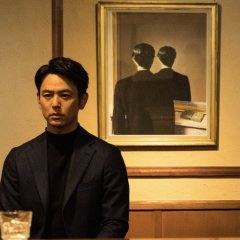
The final scene showing Kido's back as he looked at that painting ... profound. A brilliant movie ... I loved it.
Esta resenha foi útil para você?

Esta resenha pode conter spoilers
who is the real you?
I don’t think I can truly find the right words to explain what this movie is about, but what I can say is that it was absolutely amazing! I have a deep admiration for Sakura Ando and appreciate the projects she chooses; she is such an interesting actress with a remarkable range in her performances.This movie explores themes we don’t often discuss: identities. One's identity is the most important part of who we are, yet for most of us, it can become something we want to reject in order to be someone else. When we do that, who is the real you? This film not only addresses identities but also examines how society can persecute individuals based on who they are.
The movie also highlights a phenomenon known as "evaporation," which refers to how tens of thousands of people in Japan voluntarily disappear from their established lives each year without a trace. Driven by overwhelming social pressure, shame, debt, or failed relationships, these individuals abandon their families, jobs, and identities to live anonymously, often aided by a specialized industry of "night movers" and this pretty much what Mr X used ( fake Daisuke).
How much can societal labels affect you? I think we all understand that feeling when the world sees you as someone you are not and stamp on you label or an identity. This is illustrated through the character Daisuke Taniguchi, who, as the son of a convicted murderer, changes his identity to start anew after being defined by his father’s actions. We also see Akira, who was born and raised in Japan and speaks only Japanese, he is constantly belittled due to his Korean heritage and feels like an outsider. Similarly, Yuto struggles with his identity after his mother changes her surname following her divorce and remarriage, resulting in confusion about who he really is.
The film delves into the complexities of identity, often showing that people do not truly know one another. For example, Rie, who was married to a false Daisuke, wanted to uncover the identity of the man she thought she knew. Ultimately, she realized that she didn’t need to know the “truth”; Daisuke’s name became irrelevant because he was the person she knew at that time. This emphasizes that we can only truly know each other through interpersonal connections. A person can embody many identities at once or change quickly, and none of those identities are any less “real” than another.
This is just a beautifully crafted movie, and I can’t fully convey all its elements in this review. It is filled with depth, thought-provoking questions, and insightful answers. The story is powerful and made me reflect on my own identity. I highly recommend this film as a masterpiece of Japanese cinematography, and I hope it reaches the right audience to appreciate the gem it truly is.
One’s identity is a vital aspect of who we are; however, for some, it can define them in a way that makes them yearn to reject it and become someone else. If or when this transformation occurs, who is the real you?
My only complaint is that I wish Sakura Ando had more screen time. She is an extraordinary actress, and her expressiveness makes her performances uniquely talented.
Esta resenha foi útil para você?