1
1 1
1This review may contain spoilers
Finding Solace in Art!!
Art Heals! Art liberates! That's the whole review!The movie beautifully portrays this idea through the journey of Sousuke Aoyama. Despite suffering an incomparable loss, Aoyama finds solace and purpose in art, in this case painting.
While the story may feel familiar, the execution is done pretty well.
The movie doesn't shy away from depicting the raw and real nature of loss, whether big or small. It emphasizes that how we deal with them defines and shapes our identity.
One of the movie's most poignant messages is about individuality in artistic expression. It reminds us that being an artist doesn't mean mimicking others; our perceived flaws may be beautiful to the world.
Aoyama's journey is heart-wrenching at times yet uplifting. As an apprentice, his struggles with self-doubt are tangible and relatable. However, the moment he receives encouragement from people around him and begins painting, his smile becomes a beacon of hope. Aoyama's determination to paint every day, even when exhausted, serves as a powerful reminder that giving up isn't an option. The supporting cast also delivered remarkable performances overall adding authenticity and warmth to the overall experience.
The film beautifully exemplifies the importance of confronting emotions and persevering through misfortunes and hardship.
Was this review helpful to you?

 1
1 1
1 1
1This review may contain spoilers
Where Pain Meets the Brush: Finding Yourself in the Lines of Life
I went into The Lines That Define Me because I wanted to see someone finding meaning or healing through art. And that’s exactly what I got, which is why I ended up really loving it. I watched it, finished it, and then just sat there for a while. Not because anything huge happened, but because the feeling stayed with me.The movie is quiet and slow in a very intentional way. It doesn’t try to shock you or force emotions out of you. Everything happens gently, and a lot of it sinks in later rather than all at once. The way it shows grief and figuring life out feels real nothing dramatic or overdone, just steady and ongoing, like ink slowly spreading across paper.
At its heart, this story isn’t really about sumi-e painting. It’s about standing in front of an empty space and realizing you still exist, even after life has taken so much from you. Sosuke Aoyama isn’t chasing success or recognition. He doesn’t even know if art is his thing at first. He’s just drifting, unsure of what he wants, until life unexpectedly puts something in his path and asks him to try.
Sumi-e itself is simple and unforgiving: black ink, water, and space. No erasing, no fixing mistakes. Every stroke stays. And maybe that’s why it reaches Sosuke the way it does. When he encounters it for the first time, his body reacts before his mind can catch up. He breaks down without understanding why. That moment says everything: sometimes pain recognizes beauty before we’re ready to name it.
Kozan Shinoda, the master, isn’t the kind of teacher who lectures life into you. He embodies it. He paints the way some people breathe without panic, without apology. What he teaches Sosuke is deceptively simple and devastatingly profound: art is not about copying what’s in front of your eyes, but revealing what has already taken root inside you. Skill is secondary. Presence is everything.
And then there’s Chiaki brilliant, burdened, sharp edged with expectation. Living in the shadow of genius can dim even the brightest talent, and her struggle feels painfully real. Watching her move through self doubt, pride, resentment, and longing is like seeing someone untangle themselves from a legacy that both shaped and confined them. Her connection with Sosuke isn’t clean or romanticized it’s tense, awkward, and human. They help each other quietly through art, challenging one another, sharing small moments of understanding, and finding a way to stand on their own while still meeting in the space between ink and silence.
The visuals are impressive, and the acting is so good, really bringing the story to life.
What makes this film quietly devastating is how it understands contradiction. Love that nurtures and wounds. Care that exists beside cruelty. A past that both shapes you and suffocates you. Sosuke’s history marked by neglect, violence, sacrifice, and emotional whiplash doesn’t get neatly explained away. It lingers. It stains. Just like ink does.
The visual language mirrors this perfectly. Sumi-e paintings aren’t loud. They don’t beg for attention. They leave space. White space. Breathing room. And in that emptiness, meaning grows. Watching Sosuke paint feels like watching someone slowly grant themselves permission to live. Every brushstroke becomes an act of defiance against numbness.
This film believes something quietly radical: that people are not finished products. That we are unfinished lines, constantly redrawn by pain, love, chance, and choice. That even when life breaks us, it doesn’t erase us. It just changes the way we move across the page.
It isn’t flawless. It doesn’t try to be. Some moments are familiar, some emotions arrive softly instead of explosively. But that’s exactly why it works. Life rarely gives us climactic speeches. It gives us mornings we didn’t think we’d survive and somehow did.
By the end, The Lines That Define Me doesn’t leave you with answers. It leaves you with a feeling: that it’s okay to start where you are, with trembling hands and an unsteady heart. That meaning isn’t found it’s practiced. Daily. Imperfectly. Honestly.
Watching this film feels like borrowing someone else’s grief and realizing it fits disturbingly well. Like discovering that healing doesn’t always look like happiness sometimes it looks like sitting still long enough to let yourself feel again.
This isn’t just a coming of age story.
It’s a quiet reminder that even after everything, you are still a blank page.
And the lines you draw next are yours.
Was this review helpful to you?

Here, it’s mainly told from the point of view of a young man, whose past hold a tragic event, and who finds not only solace in painting but also a new way forward in life.
As such, this film is less straightforward about showing and explaining the art of Sumi-E than “Every Day A Good Day”, which introduced us to the art of tea making,. I still loved the many close-ups of the brushes painting ink on the paper and the insight the film gave us into the art. The connection between human and nature is much more subtle than in “Every Day A Good Day” but it’s still obviously there. The subtlety also makes the film not obnoxious about the message it carries (unlike in “The Zen Diary”).
Another thing that I liked was that there was no romance at all. I feared that there would be when they introduced the young woman, who is only two years younger than Sosuke – but they connect over their art and their struggles, and it all stays very, very platonic. I would have liked it more if the film had placed Sosuke firmly in the “still a beginner” category and have her stay on a much higher lever of expertise in the ending scene (as it is, it feels too much like the tired trope of the man who starts as a beginner and supersedes the female teacher in the end) – I do think the script made it clear that they both have learned that it’s painting their own lines that’s more important than any outside appreciation, but it was nevertheless slightly disappointing for me.
Having Sosuke as the beginner who is still not in the lime light would also have been a better fit for his overall humble personality.
As always, whatever is on JFF Theater, is of high quality regarding filming, editing and acting and with great attention to detail. I admit, I was a bit distracted by Sosuke’s hair – but even here, the way it was styled reflected his state of mind.
Was it good?
It was! It had a good story with a clear emotional arc and still gave insight into the art of Sumi-E.
Did I like it?
Surprisingly, yes. I wasn’t too sure about the subject – painting is really not something I connect to and the “Spirit of Dō” collection and all JFF films that get philosophical can feel too overbearing very quickly for me. I even shed a tear or two.
Who would I recommend it to?
To painters and appreciators of painting. But with the caveat that one should be in the right mood for a slow film.
Was this review helpful to you?

It's more than art, it's life itself!
If you're worried that it's gonna be a boring art movie, then I'm here to share that it's not.It's more than art. This movie reflects life itself. There are lots of life lessons that we can draw from this movie.
It's beautiful, inspiring and touching.
It's also very therapeutic to watch the lines being drawn and healing to feel through the emotions the ML go through.
In fact, the ending is so satisfying, especially the last scene when we get to see the ML draw his strokes!
Overall, it's a very well-hidden Jap Gem that needs more exposure!
Was this review helpful to you?

This review may contain spoilers
Finding Your Line: A Quiet Japanese Gem Worth Discovering
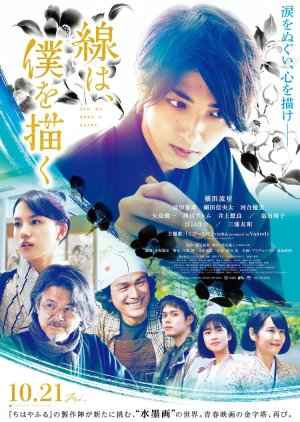
I actually stumbled across The Lines That Define Me after spotting the poster on JFF Theatre’s social media. It wasn’t even what I planned to watch that day — but 20 minutes in, I was completely hooked and couldn’t look away.Released in 2022, the film is directed by Norihiro Koizumi, with a screenplay by Sho Kataoka and Koizumi himself, adapted from the novel Sen wa, Boku wo Egaku by Hiromasa Togami. It was distributed in Japan by Toho.
The story follows university student Sōsuke Aoyama (played by Ryusei Yokohama), who is quietly carrying the weight of a devastating personal loss. While working part-time at an art gallery, he encounters traditional Japanese sumi-e (ink wash) painting — and something inside him shifts. That moment leads him to study under master artist Kozan Shinoda (portrayed by Tomokazu Miura), where art slowly becomes a pathway to healing. Along the way, he meets Chiaki (played by Kaya Kiyohara), Kozan’s granddaughter, who is wrestling with her own insecurities as an artist.
I’ll be honest — Japanese live-action films aren’t always at the top of my watch list (anime is a different story entirely). But there was something about this one that pulled me in. And I’m genuinely glad it did.
At its heart, this is a coming-of-age drama about grief, identity, and finding meaning through art. It’s quiet and intentionally paced. It doesn’t force emotion or rely on melodrama. Instead, it lets feelings unfold naturally — like ink spreading across paper. The storytelling is simple, but that simplicity is its strength.
Ryusei Yokohama delivers a beautifully restrained performance. His Sōsuke feels real — burdened, withdrawn, but slowly rediscovering life stroke by stroke. Kaya Kiyohara brings depth to Chiaki, capturing the pressure of living in a legacy while trying to define your own voice. Their dynamic feels grounded and human — not overly romanticised, just honest.
What struck me most is how the film treats sumi-e not just as an art form, but as a metaphor for life. Black ink. Water. Space. No erasing. Every line stays. The message is clear: you have to find your own line — and then use it to draw yourself.
The cinematography is understated but beautiful. The performances are pitch-perfect. Even the quiet humour, particularly from Kozan, adds warmth without undercutting the emotional weight. And the final scene? Genuinely satisfying and quietly powerful.
This film believes something simple yet profound — that we are not finished products. We are unfinished lines, constantly reshaped by loss, love, and choice. Healing isn’t loud. Sometimes it’s just showing up every day and picking up the brush again.
If you’re worried it might be a “boring art film,” don’t be. It’s more than art. It’s about life itself. Beautiful, reflective, therapeutic, and surprisingly moving.
A well-hidden Japanese gem that deserves far more attention.
Was this review helpful to you?

This review may contain spoilers
Find My Own "Line"
As an artist, the story spoke to my heart, though my artwork isn't sume-i.This story speaks of art not just as a pretty picture but of the heart of the artist. It conveys a story of the artist's life which the viewer may not see.
The story of Sosuke from being directionless to finding his 'line' does not only apply to artists. It speaks of becoming - the thought of a progressive transformation of finding one's calling.
From the opening of the movie, I had been curious as to why Sosuke was so teary-eyed just by looking at one painting. I asked myself, what moved him? Little do we know that the picture is connected to his family whom he lost in a tragedy.
I do not know Japanese actors. The characters were not the loud ones, but in their faces, you can see their emotions.
1. Sosuke - a young man drifting, not even sure if his course is the right one. His chance meeting with Master Kozan had given him a new lease in life. Only in the end do we see a happy Sosuke when he finally found his line.
2. Kozan - he sees something in Sosuke to take him in as apprentice. It was not his skill; it was his heart.
3. Chiaki - she has been working hard with her art; however, it was mechanical. Her encounter with Sosuke challenged her to find her own line as well.
It isn't just about art, but also about life, about moving forward despite of a tragedy.
It isn't just about being a student, but about finding your purpose in life.
A master can teach the basics, but still each one should find his own line. The skill to compose, to draw or create is not the essence of art. The artist's heart brings life to his art which moves us to appreciate life.
Now it inspires me to look beyond what I see and create my own line which speaks to the heart of man.
Was this review helpful to you?

Beautiful and inspiring
Before wanting to start this movie, I didn't really expected something and didn't read the synopsis but the title itself intrigued me a lot.Despite having somehow a slow pacing, I don't know how to describe it (but thinking again it was the right pace for this kind of movie lol), it still conveys a nice message and also showing some beautiful art.
As Sosuke said, I also want to know more about Sumi-e, I already know Chinese calligraphy which I sometimes practice in my own but didn't know anything about this Japanese art, Sumi-e.
It was kind of healing and heartwarming to see characters that are invested in this art and that can bring them new feels, a new version of them (I don't know if it makes sense..)
Anyway, a nice movie but maybe for not everyone, as I said it was somehow slow or maybe it lacks something so that's why I was a bit struggling to give a rating (but there's some moments later in the movie that change my mind).
Was this review helpful to you?

This review may contain spoilers
Wonderfully captured Japanese trad art film
Watched this for the first time from JFF. I'm a fan of its theme but unfortunately, it fell a bit short of my expectations knowing it's from the same prod as Chihayafuru's. The movie was good but I think it could've been executed better. Perhaps one reason was due to the postponement of its filming during the pandemic.While I love the soundtrack and cinematography, there were times when it felt more like a music video or a Japanese SP drama. Also the direction seemed confused on developing Sosuke's character. It just felt unnatural to me. Sosuke felt more like chosen and praised out of favoritism lol. And the supporting charas just seemed to be placed there for the actors' exposure (though I must say I love Yuumi haha).
Personally, it's Kaya who really shined through this film. She perfectly encapsulated Chiaki's aura. Ryusei did great in the opening scene but in other parts, it was okay-ish. Having read the manga, he interpreted Sosuke's chara differently. I think he could've performed better but maybe the writing/screenplay is also partly to blame. Expect preachy lines too.
Nonetheless, the pacing was good and my favorite scene (spoiler) was Nishihama's sumi-e. It was just beautifully drawn and I love his art. I'd say I liked it better than Kozan's lol
Was this review helpful to you?