


For an obscure reason, this was re-routed to an older same name 1994 movie/drama page ! So I have copied it back where it should belong, updating a little in response to comments, & checking for readability both in dark and light modes (last update is now June 17, 2026)
THE FIRST SHOT - Companion piece
To view the list of my other drama companion pieces (with links to them), check : HERE |
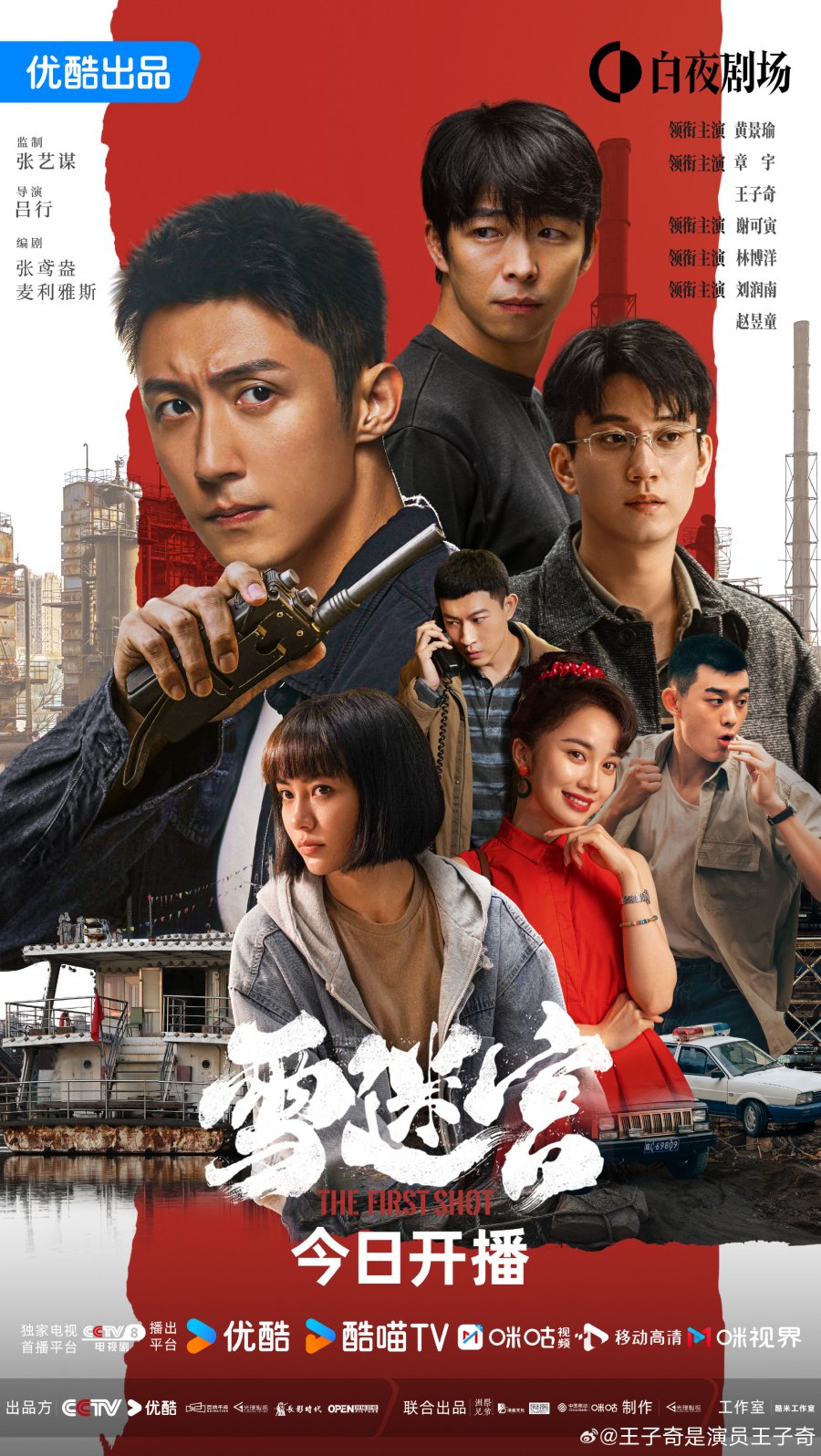
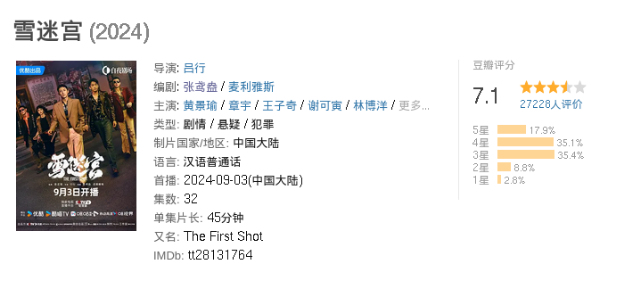
1. The First Shot : Synopsis and Production details
(32 episodes, 3-20 September 2024)
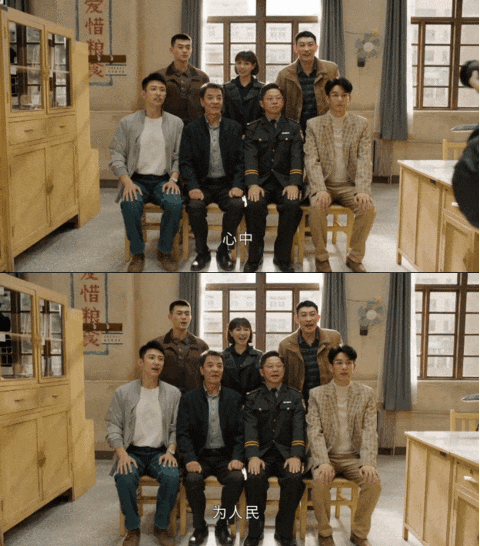
(*) Note : "shot" can mean a bullet into a target, like the ones featured in the drama and main leads' Weibo pages. It can also refer to a police themed drama, or to a "shot" of drugs, injected or drunk unawares or not with "shots" of alcohol. Or it may refer to the first shot (picture taken) of the team in their then new office, which was reminded of in the last episode, in Zhèng Běi 's memory, when the team finally moved on to new offices, and hung the picture on the wall. (see GIF below, in Section 3) |
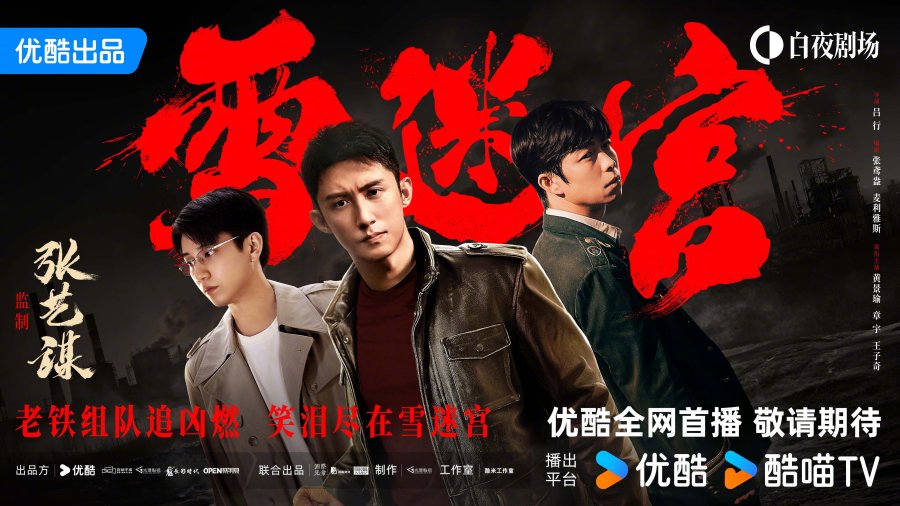
Synopsis from Youku :"The TV series "The First Shot," with Zhāng Yìmóu as a first-time producer and Lü Xing as director, tells the story of Halan in Northeast in 1997, before the establishment of the Narcotics Control Bureau. Faced with a sudden drug crisis, a makeshift elite team is assembled, each with their own strengths but clueless about the new drug... As they confront the ruthless drug trafficking syndicate and unravel their devious and bizarre drug trafficking schemes, they must also navigate the moral dilemmas of love and law, and the tests of justice and humanity. They stand by each other and overcome all obstacles and challenges, forging a heroic legend of fighting evil and upholding justice." |
Production details :
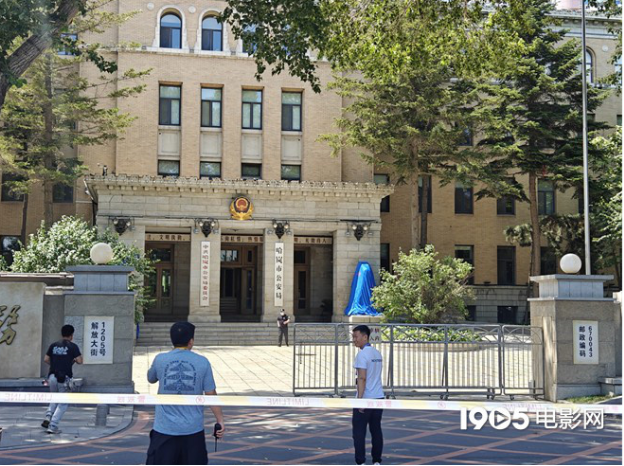
(*) Manchukuo was a puppet state of the Empire of Japan in Northeast China that existed from 1932 until its dissolution in 1945. Its capital was Chángchūn, with an imperial palace in which "emperor Pǔyí" resided with his wives, under the control of Japanese "advisors". |
Link back to Table of Contents Last updated 24-09-23
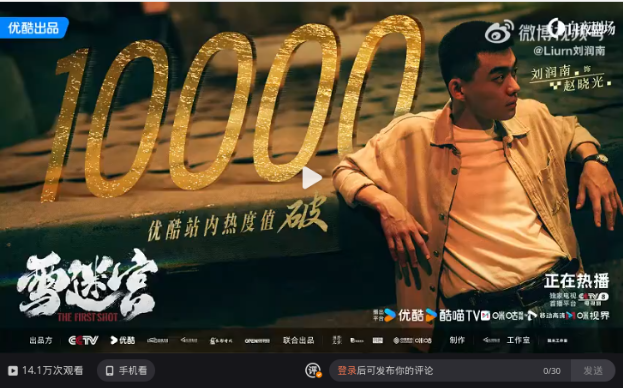
2. Airing and promo :The play was broadcast on CCTV 8 from September 3, 2024 + simultaneously on Youku and Migu videos platforms. Youku released the final episodes for streaming on September 20, 2024. Episodes have several languages subtitling options on Youku : Traditional and Simplified Hanzi, English, Spanish, Portuguese, Thai, Vietnamese, and Malay or Indonesian Bahasa languages. Youku also has a dedicated English channel on Youtube (but it is part paywalled and also slow to upload episodes). Other uploaders exist but they are unofficial and may not have English subtitles
|
|
|
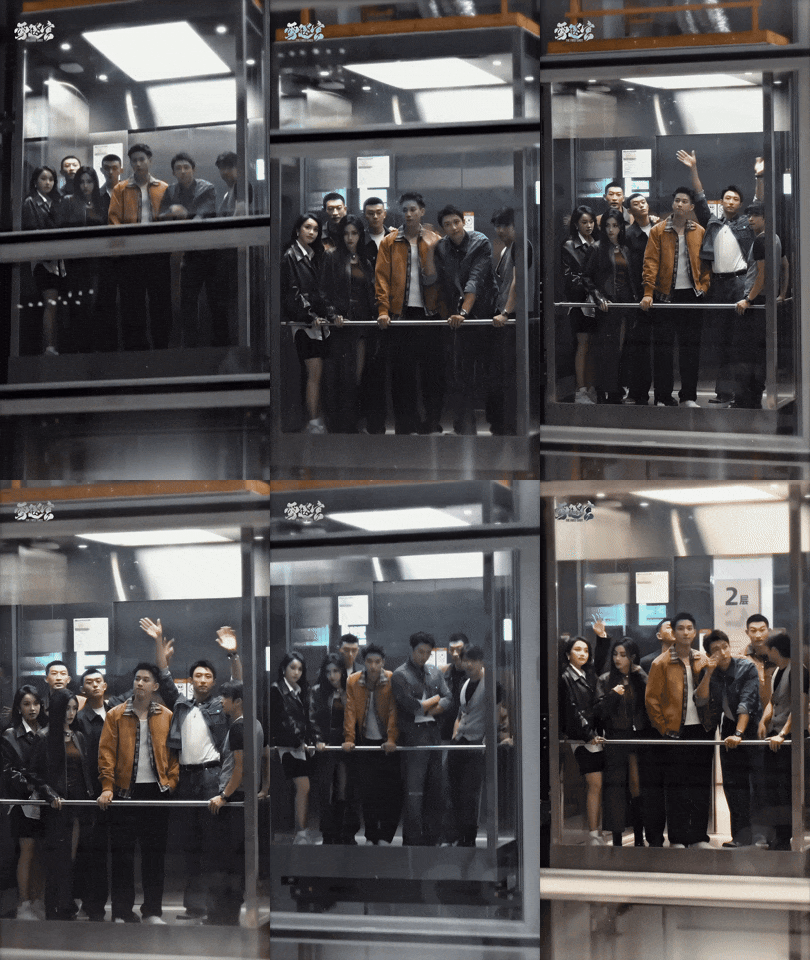
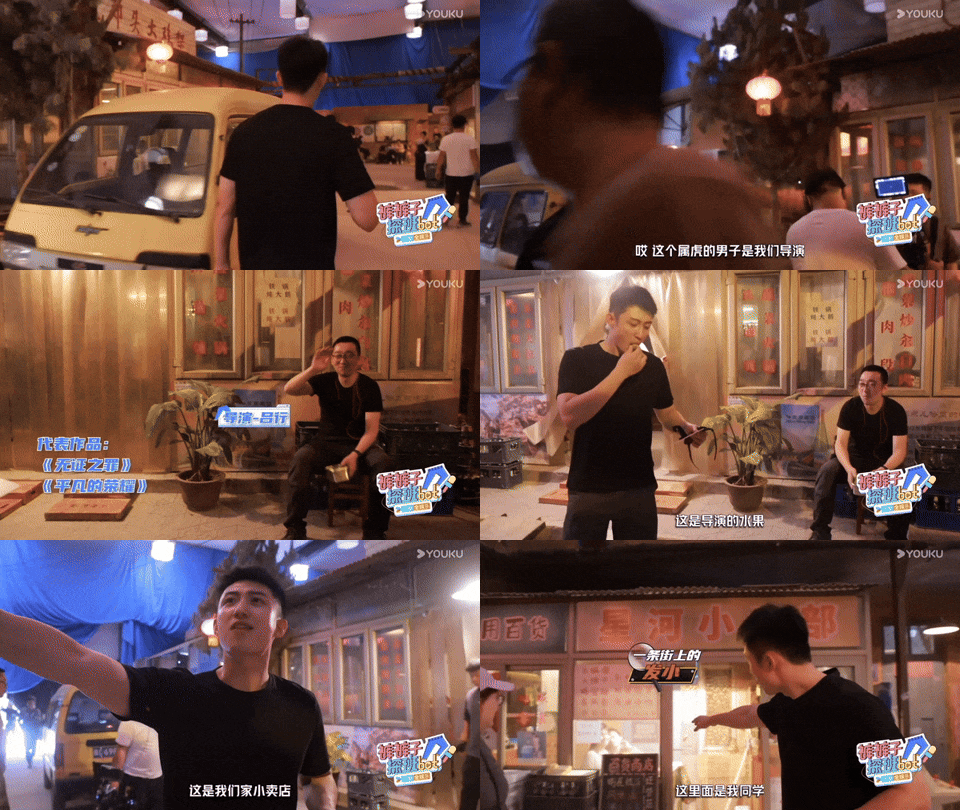
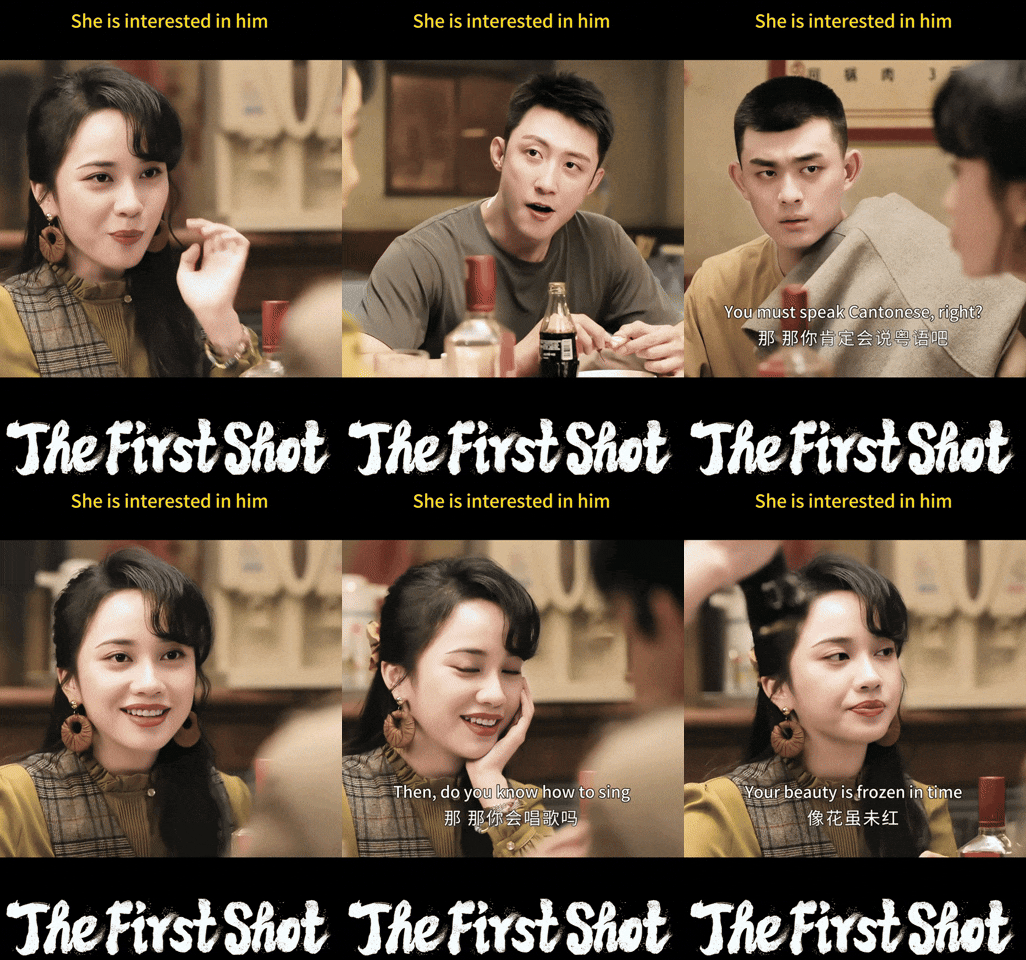
Next: Characters and Setting
Link back to Table of Contents Last updated 24-09-23
3. Characters and setting :
|
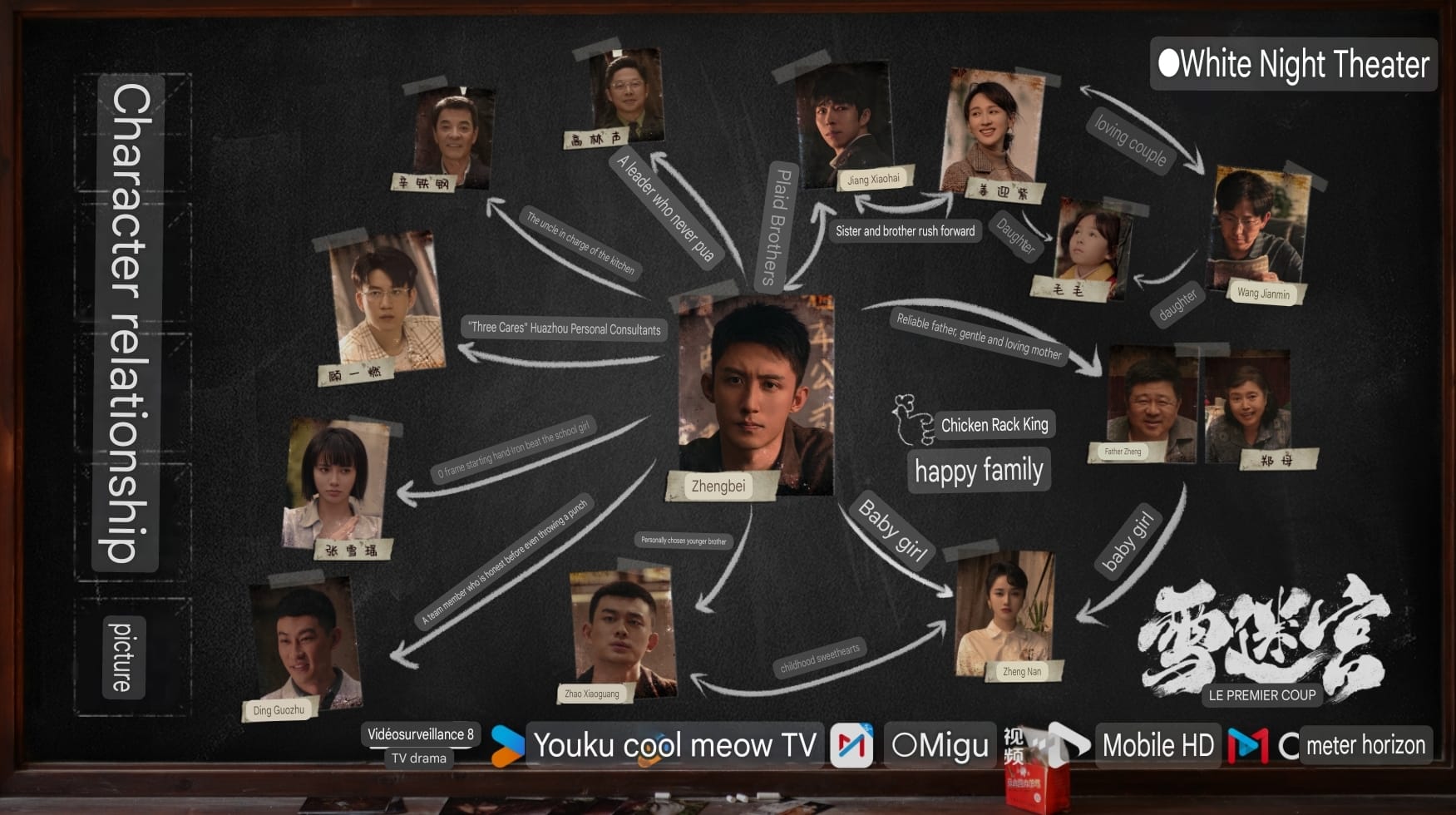
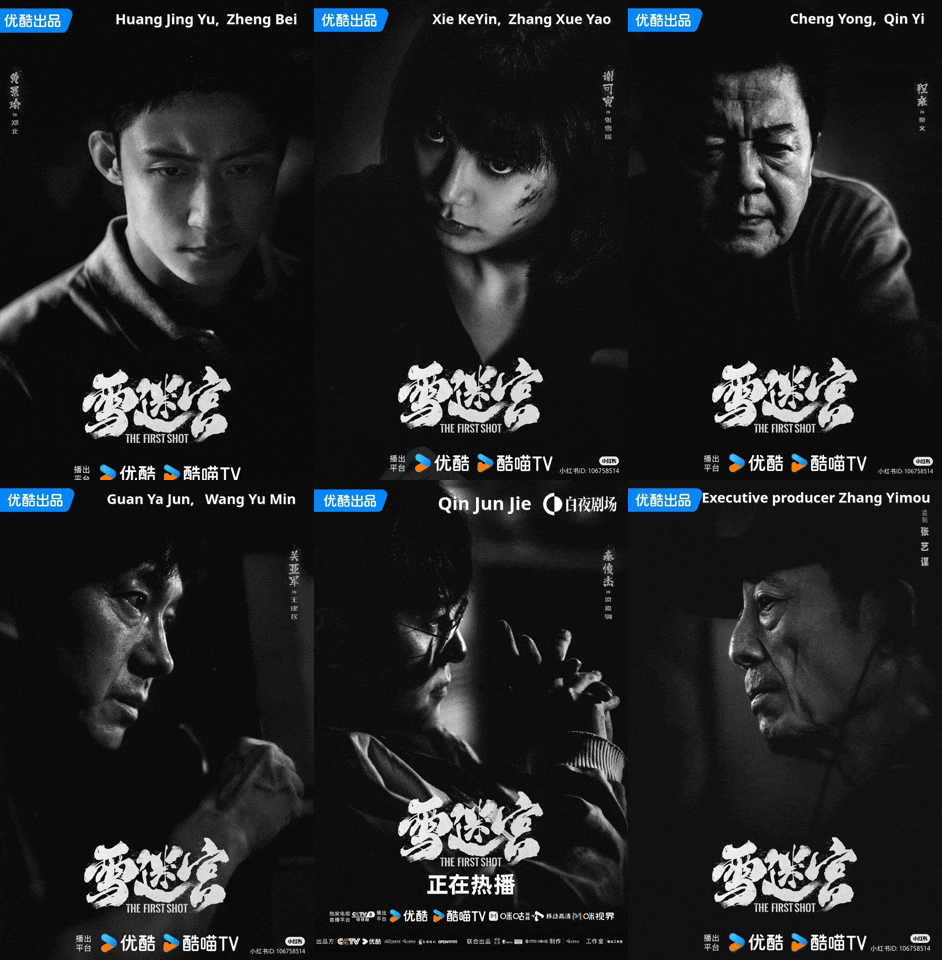
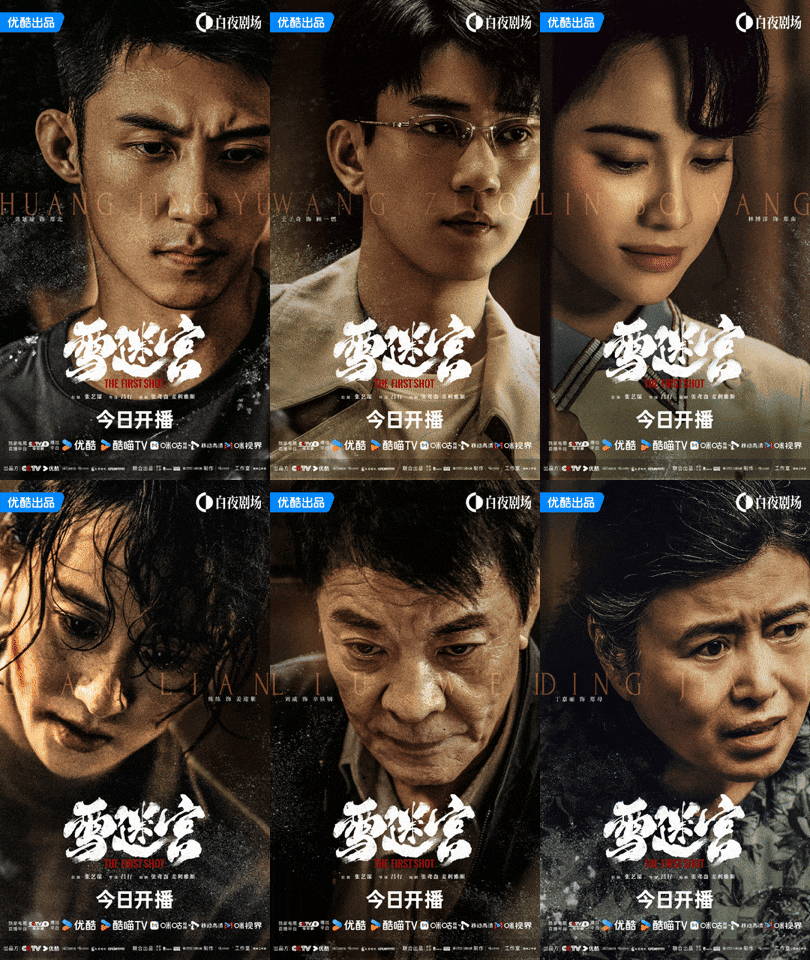

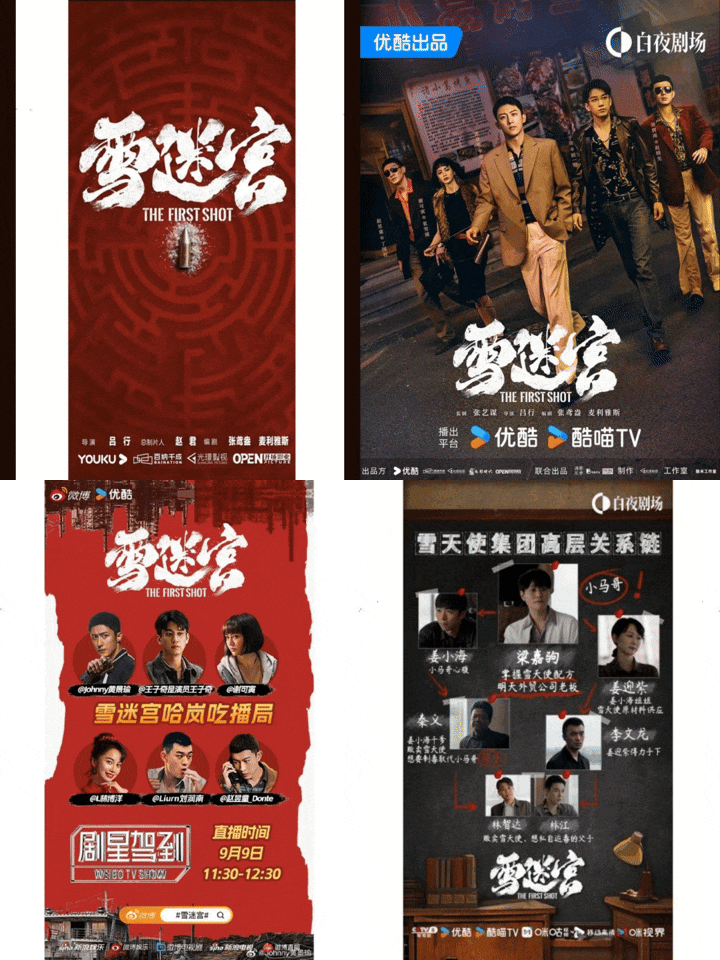
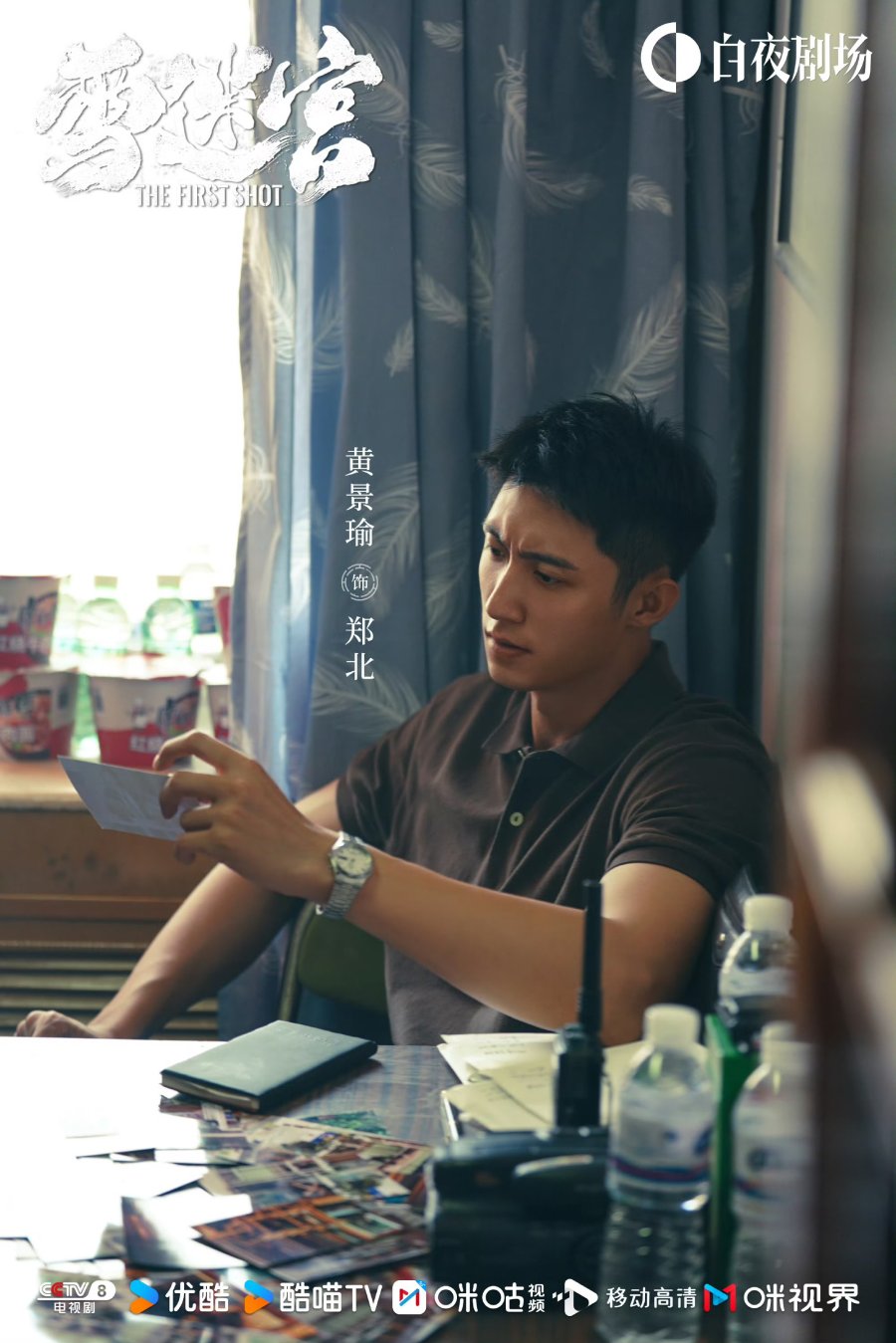

|
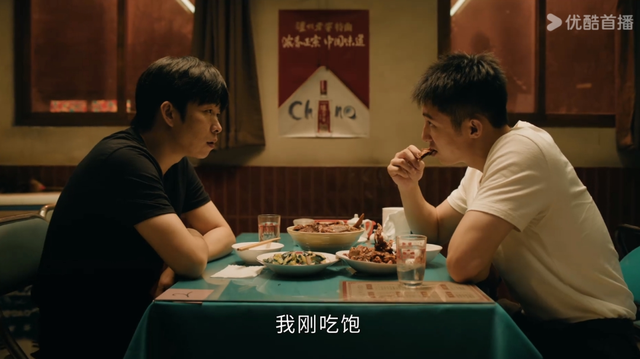
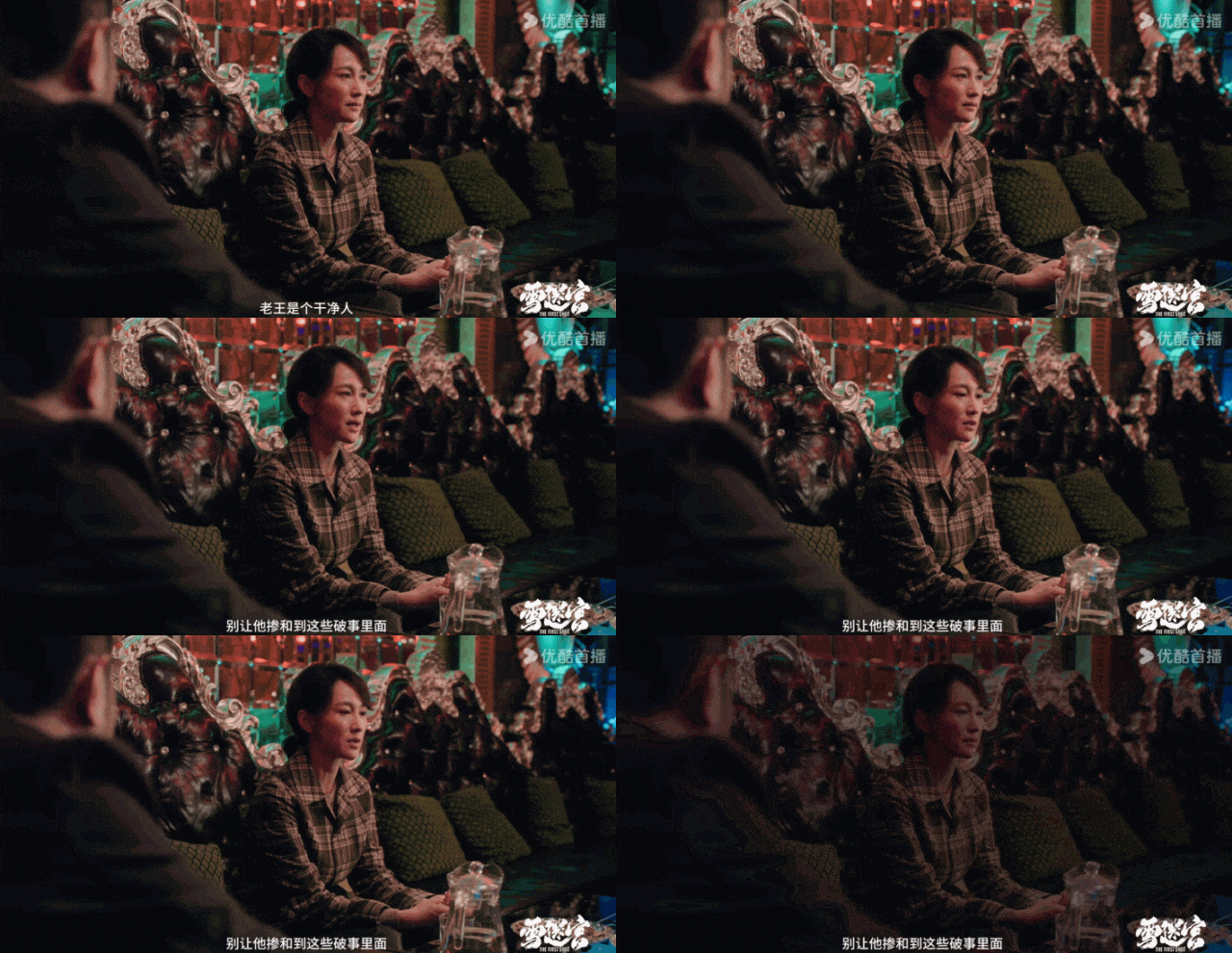
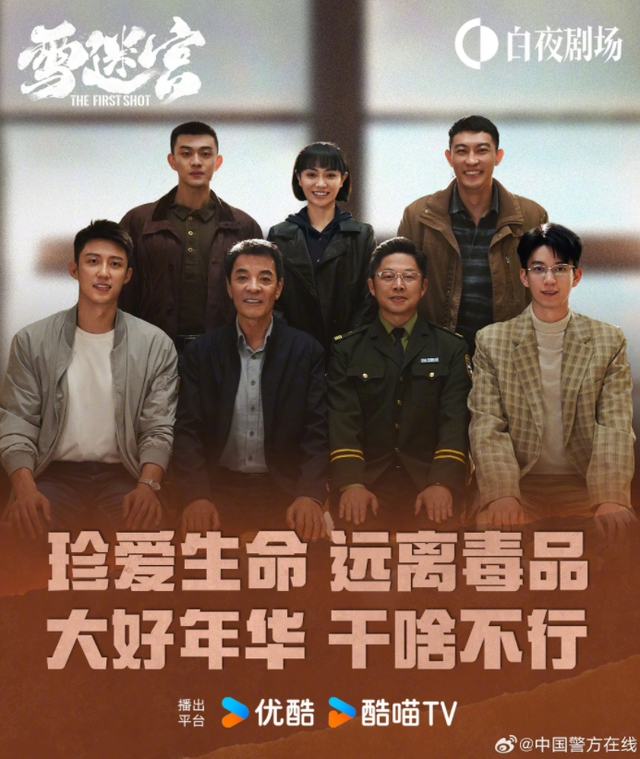
Link back to Table of Contents Last updated 24-09-23
4. Other Details :
1997 : the main event of that year was the handover of Hong Kong from the United Kingdom to the People's Republic of China on July 1st. This event ended 156 years of British rule in the former colony, which began in 1841. Drugs : "Red Dragon" 红龙 [hóng lóng] and "ecstasy " 摇头丸 [yáotóuwán] pills ; Methamphetamine 冰毒 [bīngdú] (nicknamed "Snow Angel" 雪天使 [xuě tiānshǐ] in Chinese, and "Lucifer" in the translation for subtitles). Red Dragon. 'Chasing the dragon' was a form of heroin (海洛因 [hǎi luò yīn]) smoking, originating in or near Hong Kong in the 1950s, and refers to the ingestion of heroin by inhaling the vapours which result when the drug is heated-typically on tin-foil above a flame. Ectasy ("E", "X", or "XTC"), aka MDMA (3,4-Methylenedioxymethamphetamine) was used to enhance psychotherapy beginning in the 1970s and became popular as a street drug in the 1980s. MDMA is commonly associated with dance parties, raves, and electronic dance music. Tablets sold as ecstasy may be mixed with other substances such as ephedrine, amphetamine, and methamphetamine. |
Link back to Table of Contents Last updated 24-09-23
5. Popularity and Reception of the drama
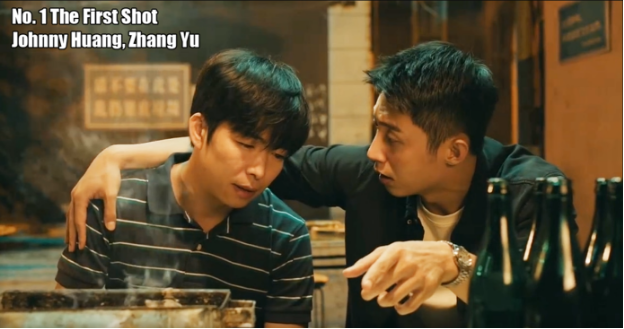
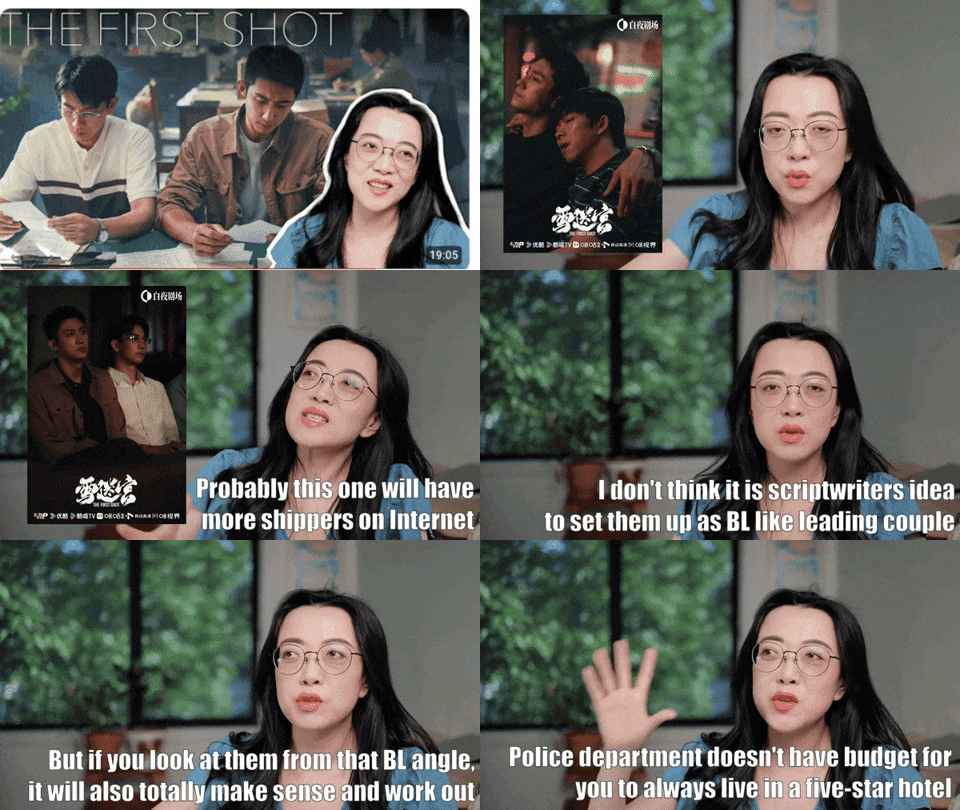
It's A Police Drama But You CAN Ship It Like CRAZY! - The First Shot Full Review (from Avenue X, September 25, 2024)The usually very picky and quick to drop dramas Avenue X admitted to have loved this one, despite some nitpicking about hair styles and small details that did not totally fit the 1997 setting (too modern), although she admitted that many props and details and the Dongbei accent were accurate to memory of the period. She was surprised that she watched all the episodes, despite the gripe from Netizens about the airing scheduling (2 episodes a day, then only one, without warning). She noted that Johnny Huang, who is not her favorite actor did not perform less well than Wáng Zǐqí, although she also was very impressed by the acting from Zhang Yu. She couldn't help mentioning that many Netizens were watching less for the uniforms than from a BL expectation about the two male pairs; and that Johnny Huang deftly downplayed such questions in interview. She watched it all without getting bored, because of the good pacing and technical expertise, even though she was wrapped up in playing Black Myth Wukong game : it is a testimony to the drama's appeal. Despite she could not muster awarding it her top "3 gold mines" rating, she added that this drama would rank among those she would best remember and advise for 2024. (Click on GIF excerpt above, for full video, duration : 19'04) |
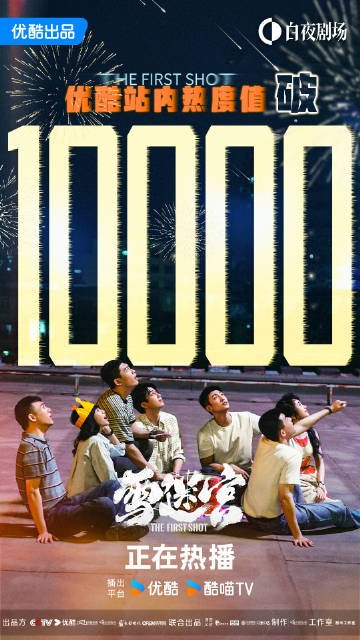

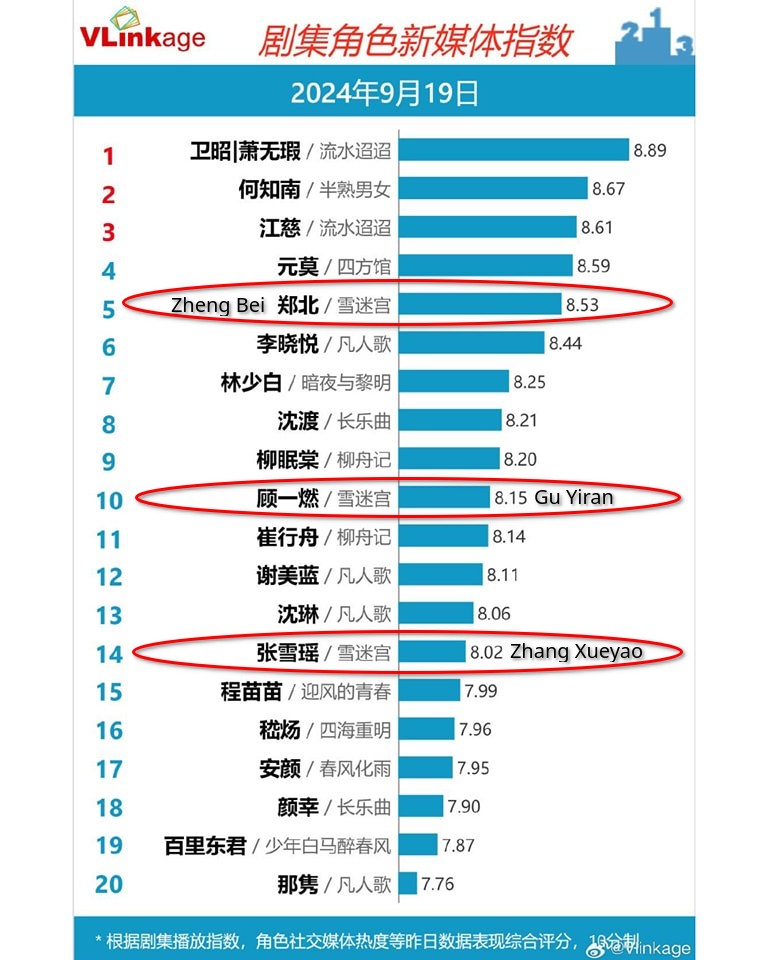
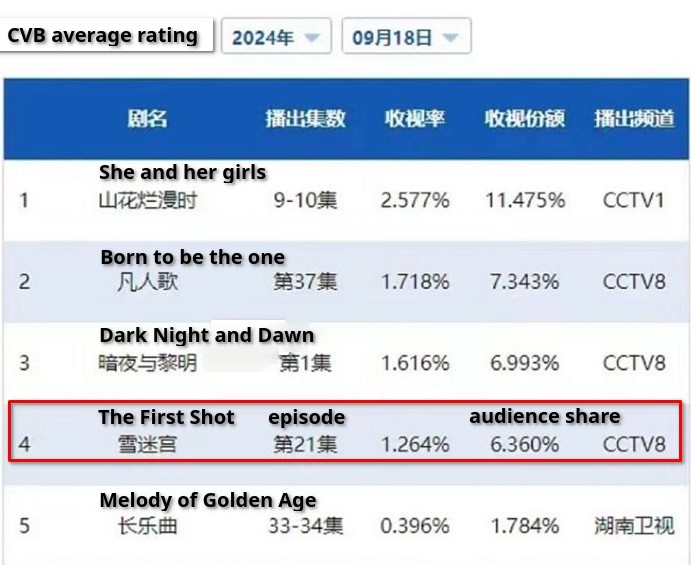
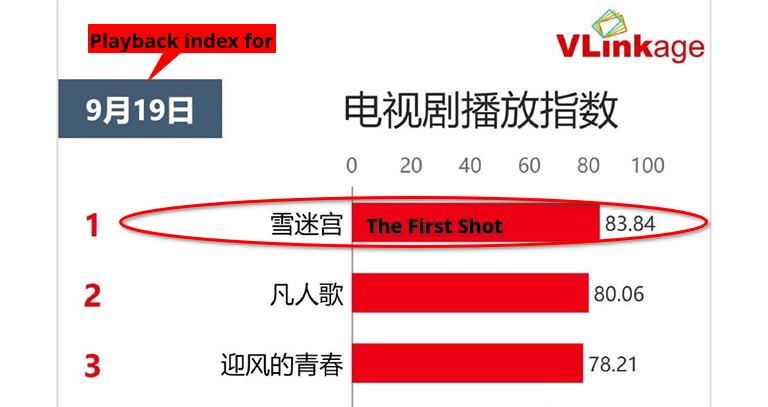
Link back to Table of Contents Last updated 24-12-01
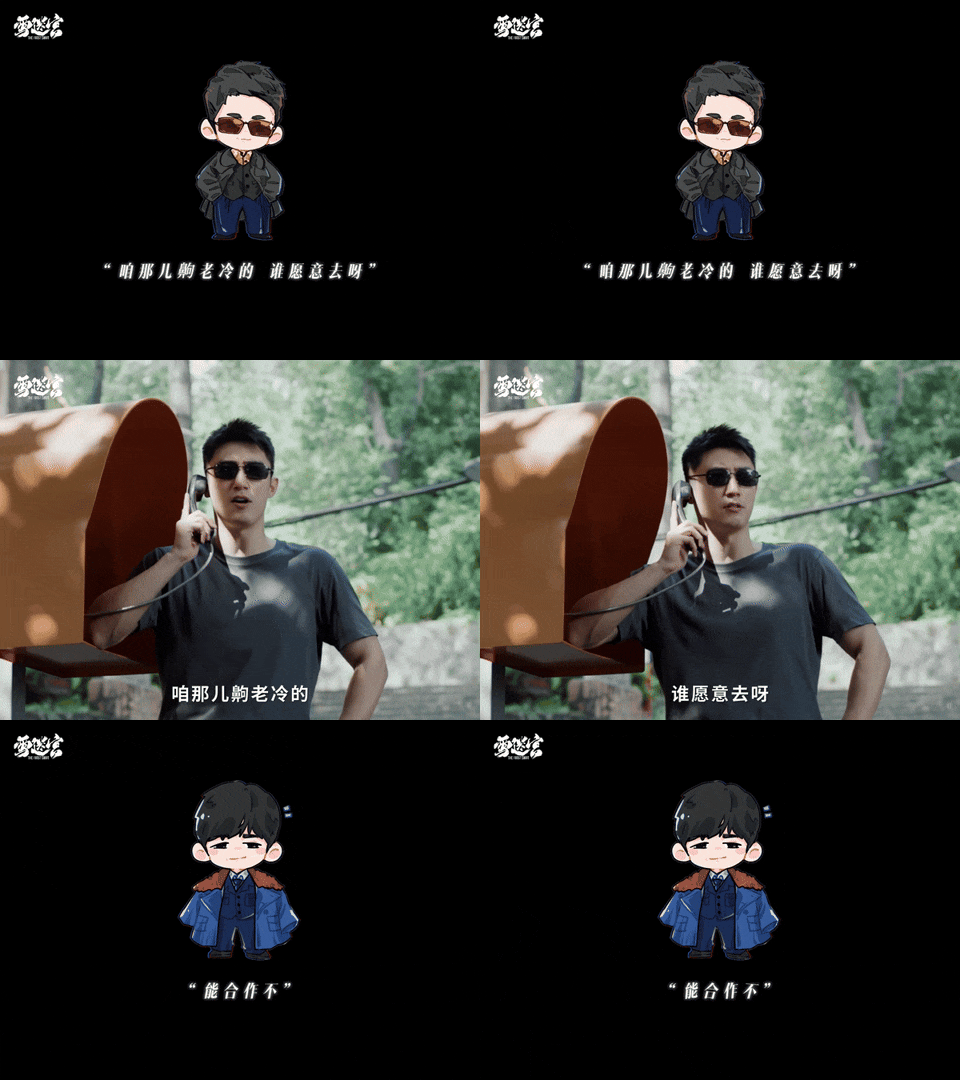
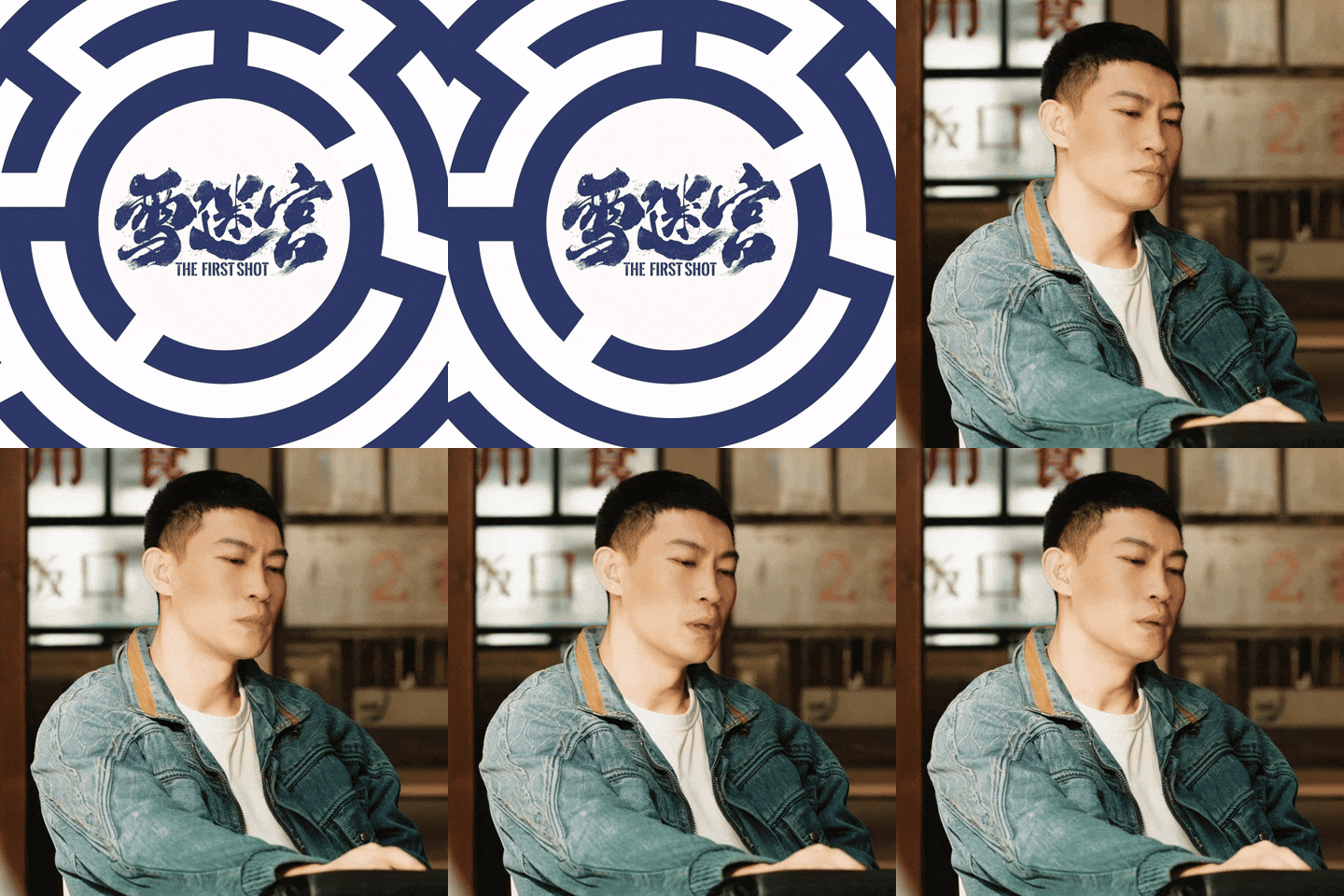
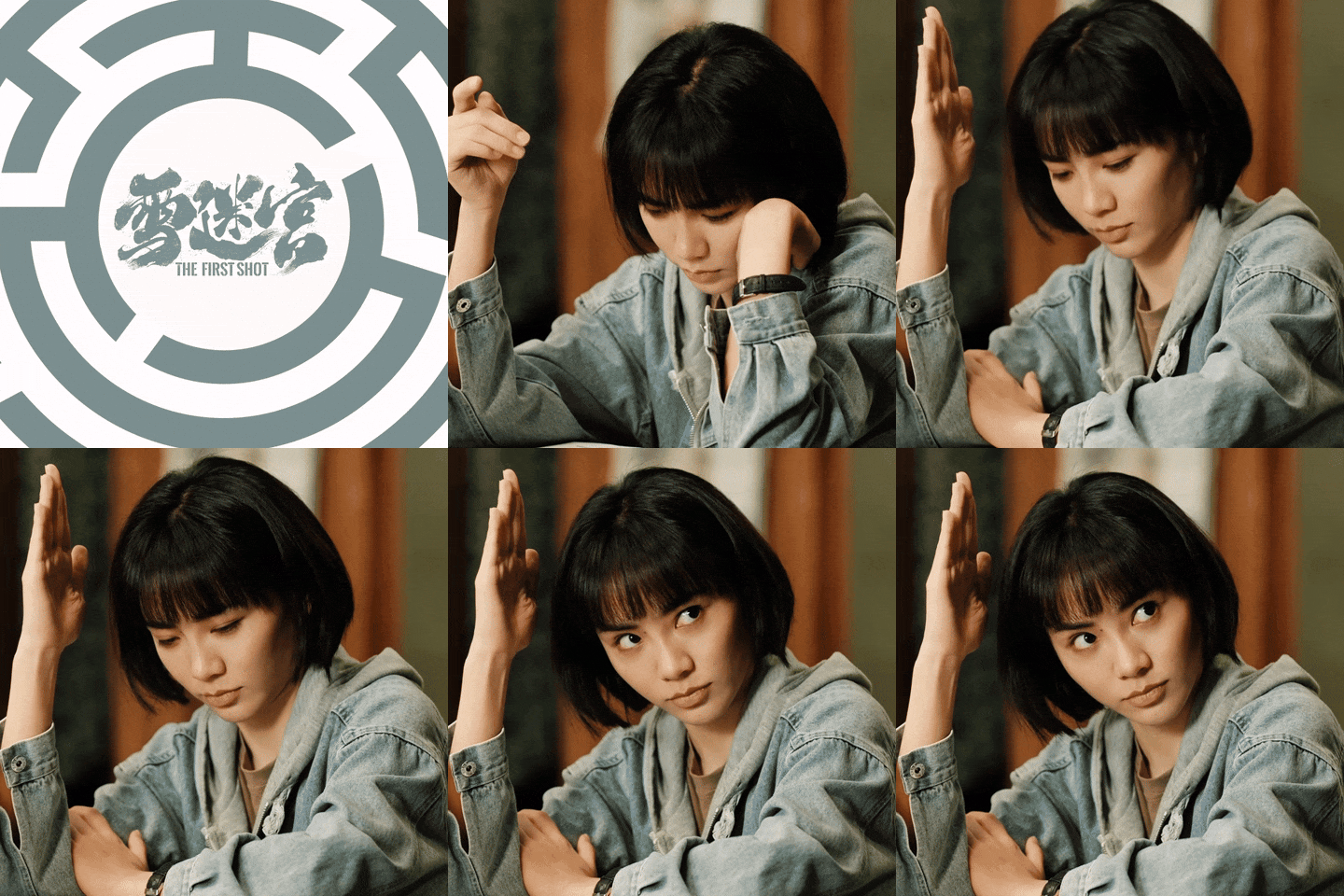
MazesShooting first, here is my GIF version of the interesting 9 linked "movie micro bits" posted to the Chinese social media Weibo account of Johnny Huang / Huang Jingyu, related to his latest aired work in 2024 : The First Shot (Snow Maze) the drugs-ring busting team thriller drama. |
|
|
|
|
|
|
|
|
|



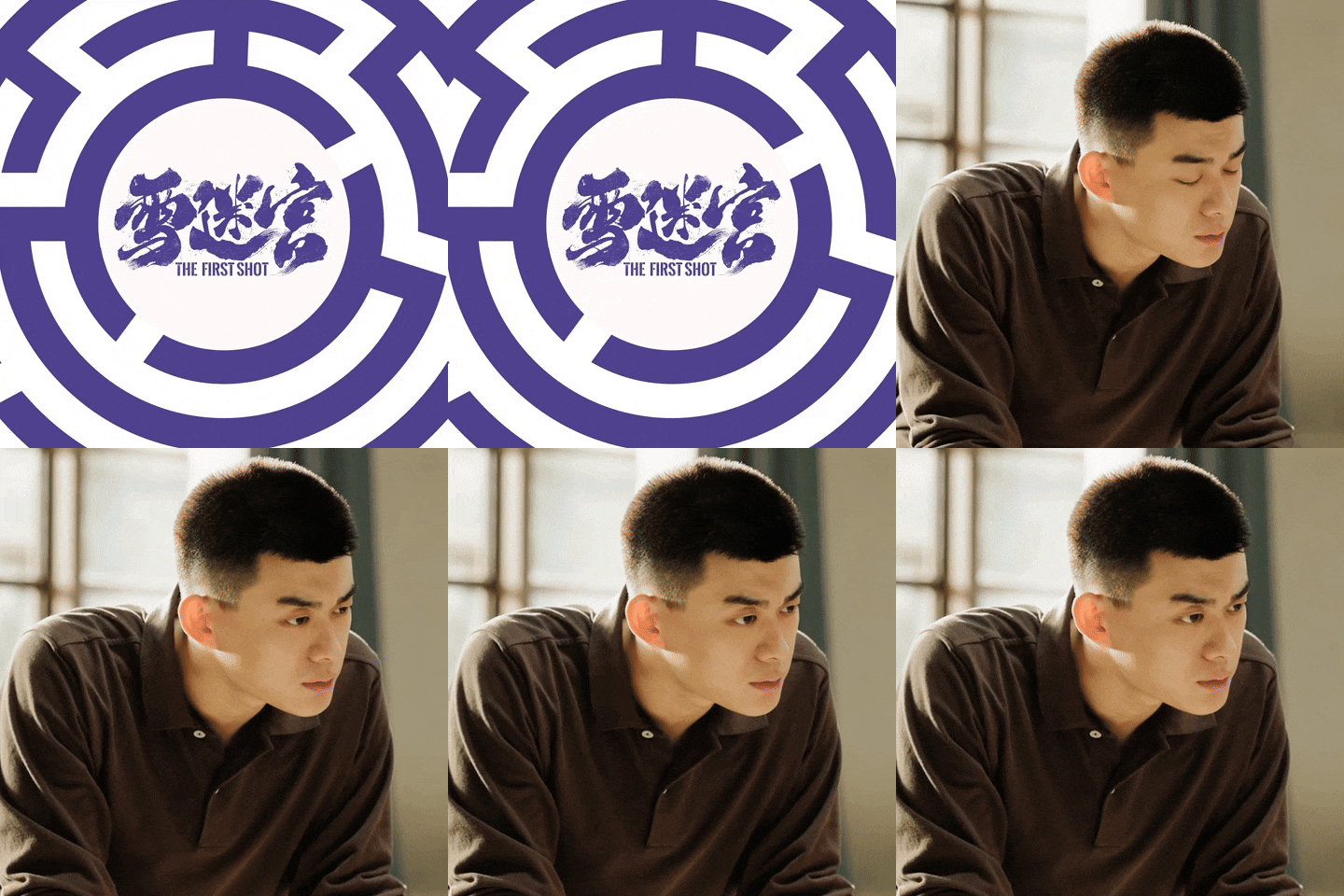
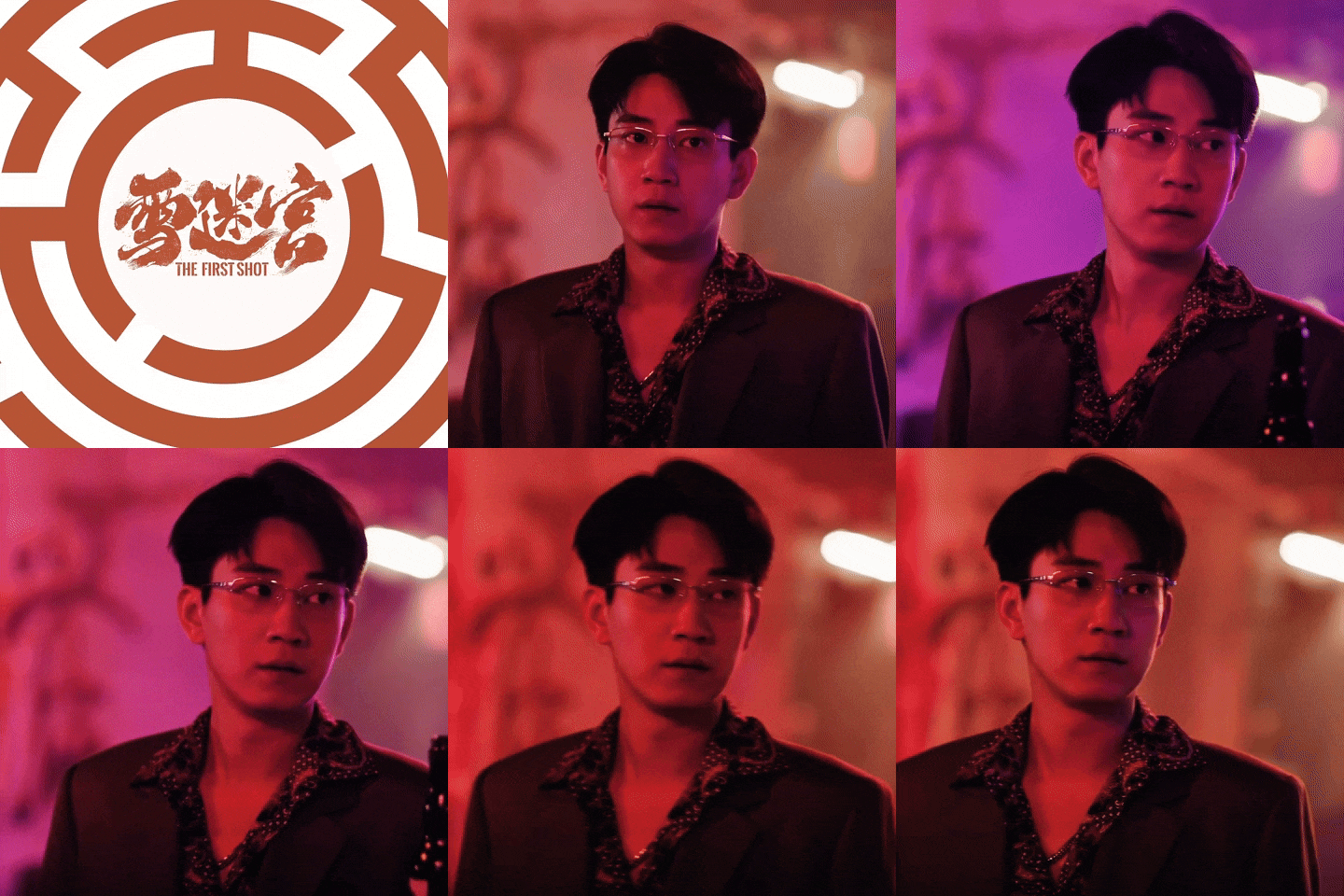
In the original post, the three last frames feature sentences that were said aloud, but I can't get sound in here. Click on links to find the spoken bits ! (2025 EDIT : Sorry: links are now obsolete...) See below in "More Actors / Actress mazes from Oct.3, 2024 " under Characters and Settings, the similar design "targets/mazes/round Chinese style design" or "blind boxes" from the Weibo pages of actors Wáng Zǐqí, Zhào Yù Tóng , Liú Rùnnán, and Xiè Kěyín for September 3. |
More Actors / Actress mazes from Oct.3, 2024 :
From: Zhào Yù Tóng Weibo ["Dīng Guózhù"] From : Xiè Kěyín Weibo ["Zhāng Xuěyáo"]
From: Liú Rùn Nán Weibo ["Zhào Xiǎoguāng"] From : Wáng Zǐqí Weibo ["Gù Yīrán"] |
































Link back to Table of Contents Last updated 24-09-23
7. OST Music(click on highlights to listen or for more information)
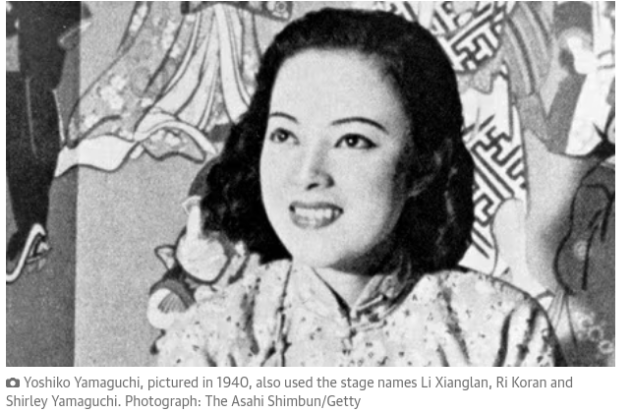
Some of these broadcasts were meant to taunt the Americans after Pearl Harbor. After the Second World War, despite being considered as a spy and a traitor in China, she still managed to stay on stage, became an actress working with famous director Akira Kurosawa, next as a journalist in Japan. She even worked as an actress the USA and Canada, as Shirley Yamaguchi on Broadway and in Hollywood (appearing in movies: 1952 "Japanese War Bride", 1955 "House of Bamboo", 1956 "Navy Wife". She was denied reentry in the US because she had befriended Charlie Chaplin. Next, she returned to film movies in Hong Kong. She lived for a while in Burma (now Myanmar) and returned again for good to Japan in 1969, until her death at age 94 in Tokyo on September 7, 2014. She was elected as a member of the Japanese parliament in 1974, and served for 18 years. She had used more than 10 names, Ri Koran being the one she herself wrote an autobiography for. |
Link back to Table of Contents Last updated 24-09-23
AnastasiaWun:
Wow, you must have loved and enjoyed this drama very much, considering the efforts you've dedicated in putting up this special tribute for TFS fans!
( •̀ .̫ •́ )✧
Yes I liked the tension, suspense, and twists in this series, as well as the cinematography and flashes of humor and human emotions that came in along the acting of Huang Jingyu and Zhang Yu, as "lost soulmates" and Huang Jingyu and Wang Ziqi as alternating "mentors" and "brothers-in-arms". It was an excellent one.
So, I had a look at the Weibo accounts for the drama and main leads, and my attention was drawn to the targets/maze designs that were so original and illustrative for the series, also with the snippets of spoken dialogue that unfortunately I couldn't translate into the GIFs. I still thought it would be nice to preserve these designs here, since Weibo, like much social media, is not accessible any longer after a while, even if there are links mentioned in comments or other. The GIFs (which are in are in special section 6 "Mazes") should be a way to perpetuate them in what I intended as a companion piece that can be skimmed, or delved in for chosen bits according to readers' tastes.
The companion pieces are designed according to a format which I have developed for about a score similar ones. But it can take much time to research and write, so at first I just thought I'd put those mazes in a "chapter" in the Johnny Huang "Profile". But the chapter expanded, and I saw that I needed to separate it as a stand alone full companion piece... As usual, I tried to think about all that could be asked : sources (book or original writing), dates, locations, OST music, characters gallery (sometimes I have a special section for them, by order of appearance, but it was not really necessary here : the two sets of posters should be sufficient, accompanied by a few GIFs from a BTS, a trailer, an event, and from moments in the drama. Since all pictures are linked to sources, it is possible to go watch these for full length).
Further to compiling info, I also added interpretations of my own, such as about the meaning of the title. Although I did not insist about the name chosen in subtitles for the drug: the devilish Lucifer is only for the non Chinese speaking audience, the Chinese speakers only knew it was a "special" blend of meth, known under its vernacular name of "Snow angel", like it is known as "ice" or "crystal" in Anglophone countries.
there's too much info to absorb/digest, but what i like most is the comic figure of Zheng Bei in sunglasses at the phone booth.
I don't think it is too much ?
The companion piece is broken down in sections to enjoy, according to whether you are more interested in pictures, posters (pin-up), data about popularity (Douban, viewcounts etc), data on where and when and why (and even then, I did this is a few days, so did not get around to add details about Changchun as a movie town - the best videos about it from the 1970s-1980s which could once be found posted to YouTube, have been lost in the general avalanche of miscellaneous long and short posts found there (not any longer just freely shared information, Wikipedian style, but for clicks which generate revenue to those who flood us with them : times changing...). You can watch only the section you are interested in, skim through, or read in full: it's a free read.
The commenters in other reviews about the drama did not pick up much about the importance of the geographical and historical setting, except stating tersely: "it's in the north-east", "they have an accent" (the figure you like is linked to examples of it in short sentences ; that video from Weibo is very interesting, but it has not been posted to YouTube (and once again, it is not possible to add sound recordings in this Discussions section). I am sorry if, despite the direct link, it is not easy to access for everyone...
I could have added more than just a map to pinpoint where exactly is the Dongbei /North-east, and which are the cities the names of which have been used as models : Harbin and Shenyang.
So, here goes:
Harbin, Changchun, Shenyang - The Dongbei in The First Shot - background information
Each of these cities have a rich history of their own.
1 HARBIN
2. SHENYANG
3. CHANGCHUN and its time honored movie studios
Harbin, Changchun, Shenyang - The Dongbei in The First Shot - background information
1 HARBIN
The first, Harbin, close to Russia, has since 19th century a role as a node for the troubled tides of people fleeing from Soviet Russia, or from Japanese invaded Korea, before becoming (like Changchun), an occupied city by the Japanese which had horrible internment camps there with "doctors" performing worse than those of Auschwitz in their experiments, on live Chinese prisoners, of vivisection, injection of various viruses, chemicals, gas, and drugs, to kill, not to heal. The purpose was to exterminate the Chinese, and replace them, use the railroads constructed to loot and export the natural resources which can be found in the region. (These natural resources made the Dongbei relatively prosperous, although also very polluted, in the 1970s to 1990s). The visit of the camps, now museums, is not always on tourists itinerary, the tourists prefer to visit the Siberian Tiger park, or the ice and snow festival held each year in January-February, or to admire brave Dongbei swimmers swim in pools carved out from the thick ice on the large Songhua river in winter (this river is part of a system of waterways that can be used until they ice over, and is briefly featured in the drama, under another thinly veiled name, and in the memories of Zheng Bei and Xiaohai running over the frozen river - the ice cover can be so thick that horses can draw sleds across). Although not very deep, it is 1 kilometer in width on average, and is frozen over from November to April. In warmer seasons, it is navigable from the Heilongjiang/Amur river by medium-sized ships, against the flow down from the glaciers and the volcanic Heaven Lake in North Korea where the Songhua river has its source.
It looks like this in reality and in the drama : my GIF of the Songhua in the 2020s and of the scene in ep19 , although k8cathy in comments about geography found that the location along the river is most likely to have been shot there instead of travelling up to Harbin, so I moved the Gif to Jilin City.
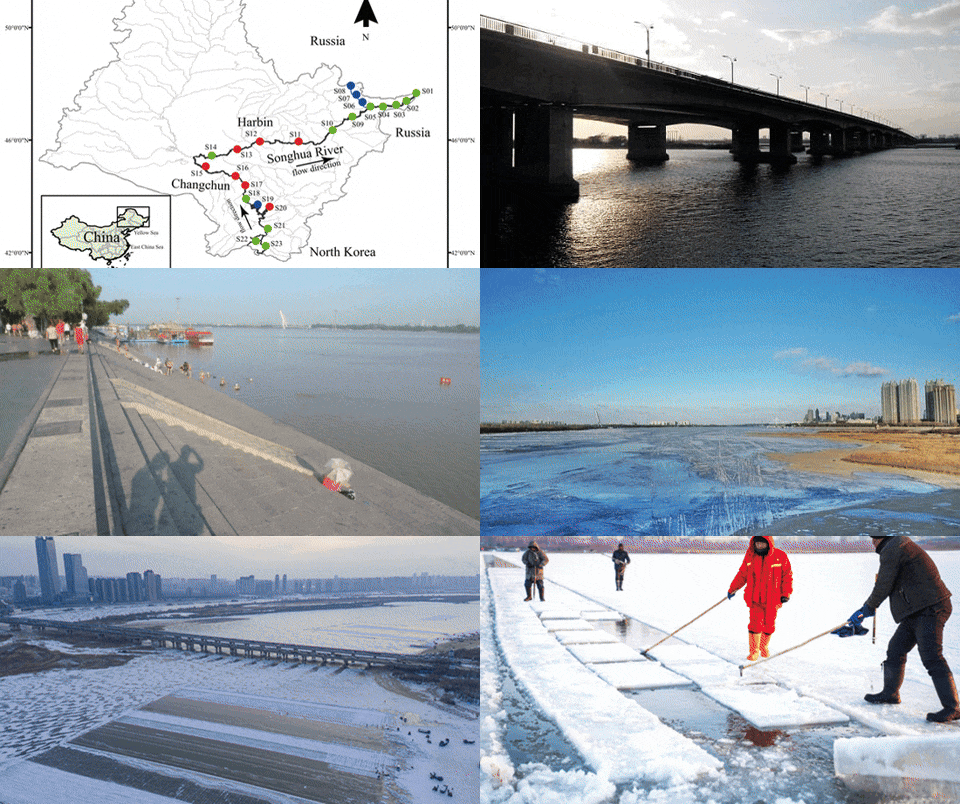 Pictures from several sources : map ; tripadvisor ; news feature about icing over ; about ice harvesting for the Ice and Snow festival sculptures, decorations, and buildings in the city (slabs are even used to build a temporary Ice café, sometimes restaurant or even hotel, where you can sample vodka, on ice of course!)
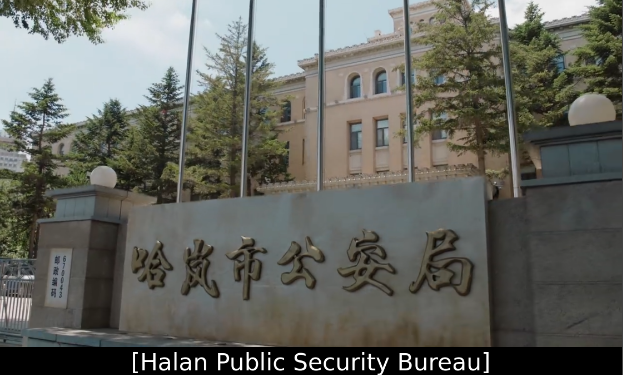
Harbin is a cold city, in winter, so people like to have well-heated dwellings. The heating system they use is not prominently featured in the drama, but I could have added info about the Russian stove or the "kang" platform, under which heated water or air from the private coal furnace, allowing people in village houses to keep comfortable, even to 25°C /77F. Or about heating in residential housing, which is often achieved through heaters, and/or reverse air conditioning powered by heat pumps or communal furnaces serving a whole quarter, not only one building, from November to March, at free or subsidized price based on rooms served. Stores and restaurants are accessed then through a double door entrance to keep the heat in. People shed their heavy coats and can sit comfortably for a meal in light clothing. Changchun, where the drama was filmed, is cold, but less so than Harbin, so the double door entrances and heating are only hinted at in a couple pictures from the restaurant and street, which were specially constructed in Changchun studios for filming purpose, although the "Halan" Public Security offices used a real building in the city, and some other filming locales were also from Changchun or nearby places in Jilin province.
Harbin, Changchun, Shenyang - The Dongbei in The First Shot - background information
2. SHENYANG
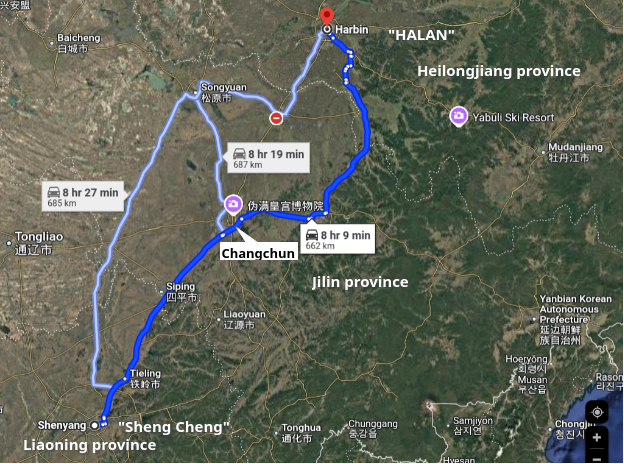
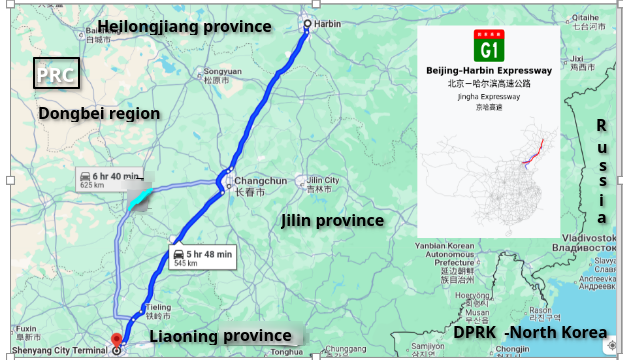
There is not much about Shenyang in The First Shot, except for the comedic copycat Special investigation team mirroring the Halan one, and the tiring, hours-long, roughly 500 km driving distance from "Halan"/Harbin (birds flight, or along a more direct road than on the map I showed earlier, when the direct G1 tollway had been temporarily closed) as witnesses the map below, reflecting current driving conditions. In the 1990s, these roads were already enlarged from the narrower, usually only two lanes, one southbound, one northbound, concrete base, with no easier on wheels and better waterproof asphalt, road conditions often years earlier. But speed limits still made the distance long in hours (and that has not changed much: max 80kmh /(50 mph). except expressway with more than 2 lanes each side: 110 km/h). Roads have since been further enlarged and are a main drive way for transport, aside from the railroad which has much evolved with high speed and bullet trains since the planning of the 2008 railway master plan. The Beijing-Shenyang-Changchun-Harbin stretch was modernized from the 2010s to 2021: today, bullet trains from Hong Kong to Beijing need only 9 hours to reach Beijing; and the stretch from other station in Beijing to Harbin takes about 7 hours. The whole train travel journey needs only about 16 hours.
Shenyang, despite it is only a city a long drive away, in the drama, has, just as Harbin, a historical and geographical importance. It had several names, one of which is Mukden (its name in Manchu), associated to the 1931 Mukden incident which sparked the invasion of the Dongbei region, at the time referred to as Manchuria, or Fengtian (from the name associated to Shenyang and its warlord who ruled over the three provinces now known as Liaoning, Jilin, and Heilongjiang). Shenyang had been, for a relatively brief period, the capital of the Jurchen tribe and later Jin dynasty, before it morphed into the Qing dynasty, that became the last one ruling China as it moved HQ to Beijing. Not long after, it became the HQ of the "Fengtian clique" led by a powerful warlord called Zhang Zuolin (nicknamed the "Tiger" or "Old Marshall"). After his assassination when his train was blown up on 4 June 1928 at a Japanese-guarded railway bridge (in a misguided move by the Japanese Kwantung army against their ally), his son "the young Marshall" Zhang Xueliang, took over the leadership of the clique. (His story is loosely romanticized in the early 2023 drama The Last Princess, for the period of his youth until 1937 for which I thought I had added a longer companion piece than the comments that will serve as, unless it somehow vanished: the drama was not extremely successful and overlong so I did not get back to repair that, although I liked the OST music). Zhang Xueliang preferred to work with the Kuomintang (which "ruled" China from Nanjing) rather than with the traitorous Japanese who had killed his father.
Harbin, Changchun, Shenyang - The Dongbei in The First Shot - background information
3. CHANGCHUN and its time honored movie studios
But Zhang Xueliang could not prevent the provinces be invaded by the Japanese, who established their Manchukuo puppet state (1932–1945) as a vassal empire headed by deposed Qing emperor Puyi, held prisoner in the "imperial palace" of Changchun (the palace can be visited by tourists, just like Zhang Zuolin's mansion in Shenyang can be too).
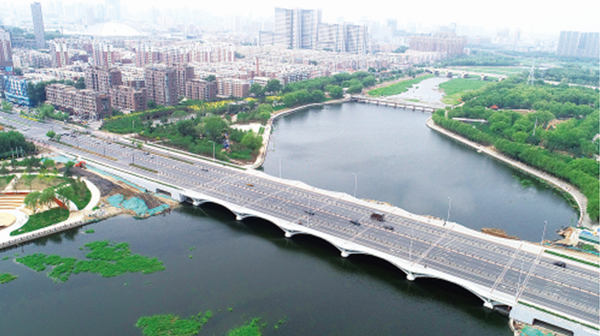
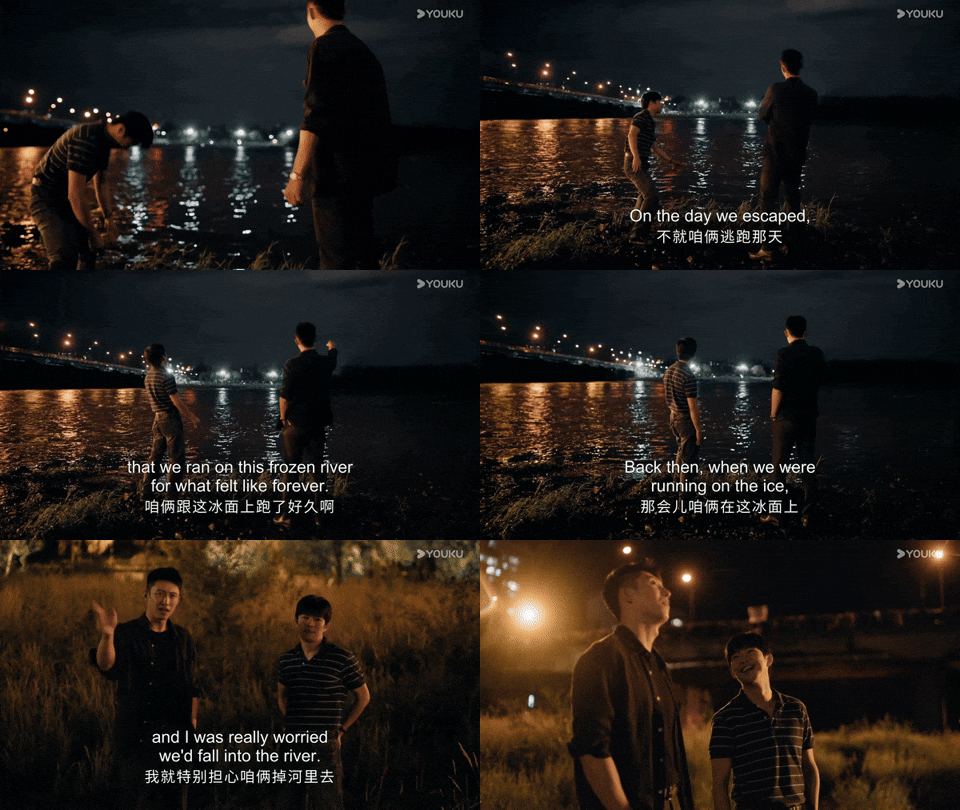
Changchun was then renamed as Xinjing (new capital) romanized as Hsinking. That city also has a river going through it, but it is much narrower than the Songhua, of which this Yitong river is a tributary; but it could still serve to film the scene where Zheng Bei and Xiaohai reminisce about their escape from the kidnappers when their were children (Gif above).
Here is a birds eye view of the Yitong river and bridges, one of which can be noticed on the GIF above.
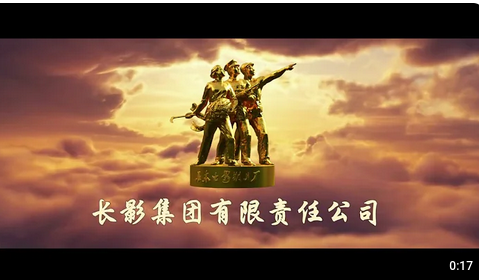
Under Manchukuo rule, a film studio was built, with headquarters in a building from 1937 as a replica of the German film studios Ufa GmbH. It produced Japanese propaganda films until 1944.
"The Changchun Film Studios were founded in 1950, integrating in 1955 the older Dongbei Film Studios (Northeast Film studios), which had settled in Changchun already during the civil war between 1945 and 1949. The Dongbei Studios’ history itself reaches back to even earlier times; they succeeded the former Manchukuo Film Association set up by the Japanese during the occupation of northeast China. Thus, historically speaking, the Japanese propaganda film studios became part of the earliest registered film studios in the People’s Republic of China.
The Changchun Film Studios – with a short break during the first part of the Cultural Revolution when no films could be made – produced propaganda movies until 1978. With the 3rd plenary session of the 11th Party Congress that year, Deng Xiaoping allowed for the “emancipation of the mind”, i.e. commercial movies could be produced as well, now. However, propaganda movies remained an important part of the production. [...] In 2000, the name of the studios was changed into Changchun Film Group Corporation." (source)
From the 1950s to the 1970s, these studios made many important movies of the period. The building is now housing the Changchun film museum (short visit in this video 2'23). Today, "Today the Changchun Film Group Corporation has one of the largest film production base in China. The production centers remain in northeastern Jilin province. In 2003 the company became a shareholder of Huaxia Film Distribution, which became an importer of foreign films. Prior to the founding of this distribution corp, the state-run competitor China Film Group Corp. had a near monopoly control on all foreign films going into the country. " (Wikipedia) Changchun continues to be a film base, although the largest studios are now in the southern province of Zhejiang, in Hengdian which is a film city larger than Hollywood.
|
|


|
|
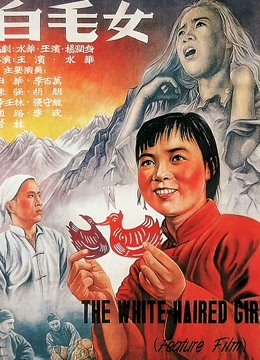
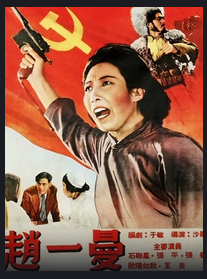
Watch the movie here with English subtitles, or the excerpt with the famous song (5'12); that song featured in the celebration flashmob of Wuhan back to normal in October 2020 (here). Many consider the song as an alternate national hymn, although some side with another one called "I love you, China 我爱你中国 Wǒ ài nǐ zhōngguó), also from a famous movie: A Loyal Overseas family 海外赤子 (1979, Pearl River Film Studio, available on YouTube 1h56 no Eng.subs) |


Changchun is not only a cinema city, but also a very industrial one, home of car makers (Volkswagen, Audi, general Motors, in addition to domestic brands like Hongqi and Bestune). Known as the "automotive heart of China," the city hosts the headquarters and major production bases for FAW Group (First Automotive Works), the second-largest of China's "Big Four" state-owned car manufacturers.
It is also the location of one of the largest factories where CRRC (China Railway Construction Corporation) manufactures bullet trains. In November 2016, CRCC Changchun unveiled the first bullet train carriages in the world that would have sleeper berths, and would be capable of running in ultra low temperature environments. Nicknamed Panda, they are capable of running at 250 kmph, operate at −40 degrees Celsius, have Wi-Fi hubs and contain sleeper berths that fold into seats during the day.
Jílín City 吉林市 [Jílín shì]
Jilin City was the provincial capital from 1949 to 1956 before that title was transferred to Changchun, only 113 km (70 mi) west of Jilin City. Located in the heavy industries part of the region, the city has suffered several instances of catastrophic floods and industrial pollution, like the benzene spill in the chemical plant explosions of 2005, which affected the river, and once again in 2010. Nevertheless, it is also a popular tourist destination for winter sports and observing rime in winter on trees along the river, which is very large there, although it seldom freezes totally over there, contrary to the part in Harbin. |
Most likely, the night scene by the river was filmed in Jilin City, which stands on the same Songhua River as Harbin. I'm writing a long post about the geography of The First Shot; I'm posting the translation on AO3. The section about the Songhua and the filming in Jilin is in the latest chapter so far, Where Halan Was Filmed. I'd be delighted if you'd take a look. ;) https://archiveofourown.org/works/83634131 |

Wow, thanks for your dedication to hunt up locations and pictures for this drama in Chapter 8 of your work, which I also went "virtually traveling" in ! I am happy that my Companion piece helped you on your way, and agree about the river location must be in Jilin city rather than actual Harbin. I too was puzzling about the bridge not being similar enough in the night pictures on screen, to the one in Harbin, but did not extend my search too much beyond the places mentioned then in the production, i.e. Changchun, with parts such as the old Manchukuo building used for the police headquarters and rest being "studio constructions". I was thrilled to journey in your essay to recognize other likely real filming locations such as the pharmacy., in the photos you hunted up.
You gave a plausible explanation of why real Harbin, the larger city and long time metropolis of the North, was not used when the story is so obviously set there under a thin name disguise, half disguise, since "Ha" 哈 is code-name for Harbin as many train travelers know.
But I don't think it was fear for a bad reputation. The Dongbei region has harsh memories anyway, with the acutely painful ones of the death camps 731, portrayed in "Man's Inhumanity To Man" recent drama, for which I also attempted another Companion piece. In that drama, the scattered villages coming under Harbin city are shown on the map. Since 731 is too big an elephant to be disguised, the place names in that series are all real.
Harbin although especially Shenyang is also part of the infamous "Rust Belt" that made people look down on the region in the Reform era until the end of the 2000s. The monster documentary movie 2003 "Tiexi Qu" although focusing on Shenyang, portrayed vividly the hardships of the workers in the decaying metallurgical industry ; even in recent 2026 drama "Our Dazzling Days" (also starring Johnny Huang) the story of the Tiexicheng factory is partly about the decay of the lifestyle and impoverishment of industry workers in crumbling and soon bankrupt state owned factories.
Your note about the interesting features of urban administration in China, very different from European or American divisions, reminded me also of the way mega cities like Chongqing and even Beijing include mountains and large parts of agricultural countryside under the "city" umbrella, only dividing further into "districts" (qu), "counties" (xian) and "villages" (cun). Digressing : a funny "village name" is that of Zhongguancun which is the high tech quarter of Haidian district in Beijing, close to the most prestigious universities and to the old and more recent Summer Palaces. -- I love how digging a little into dramas can make one travel virtually, harvest both topographical, historical, and cultural (even food related) details on the way.
I liked that you mentioned Zhang Yu's connection to Changchun, the old film city (today less active in active filming, but maintaining the heritage in the museum of cinema). Although he was born in Guizhou, he is a talented and versatile actor who has a significant connection to the Dongbei region, through his prominent roles in two 2022 films set in that area ("Sniper" and "Manchurian Tiger"). His interest in playing Dongbei roles and proficiency in Dongbei accents make him a "honorary citizen" of the region, in addition to the real born and bred there actors such as Johnny/ Huang Jingyu, born in Dandong, same city as Liu Yuning, the golden voiced singer and actor who graced so many OST, despite LYN did not add an OST song to TFS (and although Dandong is a remote part of Dongbei, almost North Korea, on the PRC side of the bridge over the Yalu river. ) The other actors played well even when they were not from the Dongbei. It was a memorable drama.
I hope many will read your writing for more enlightenment around this drama !
PS : k8cathy answered that the damage to reputation was a real concern for a city which has tourism industry and higher education, and a why the name was disguised. No city wants to be associated with drugs trouble, and therefore it is a real reason why the drama was not filmed in Harbin. I agree of course.
This is indeed why cities names are often disguised in Chinese movies and dramas almost as a rule, except for Shanghai or a few other ones, unless the drama or movie intends to showcase a real location so that people may come and visit it. This was the case for Hangzhou in "The Best Thing", Shen'ao village in some episodes of "You Are My Fateful Love", or Kashgar in "Bloom Life" recently .
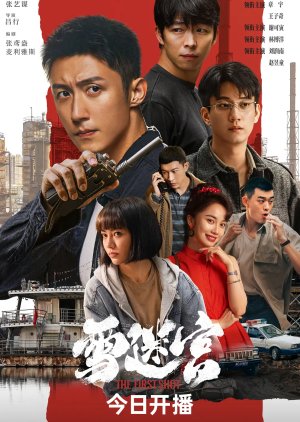
Details
- Title: The First Shot
- Type: Drama
- Format: Standard Series
- Country: China
- Episodes: 32
- Aired: Sep 3, 2024 - Sep 20, 2024
- Aired On: Monday, Tuesday, Wednesday, Thursday, Friday, Saturday, Sunday
- Original Network: CCTV, Youku
- Duration: 40 min.
- Genres: Thriller, Mystery, Drama
- Tags: Teamwork, Bromance, Friendship, Emotionally Strong Female Lead, Co-workers' Relationship, Police Department Setting, Senior-Junior Relationship, Police Captain Supporting Character, Cold Case, Detective Fiction
- Content Rating: Not Yet Rated
Statistics
- Score: 8.3 (scored by 837 users)
- Ranked: #1255
- Popularity: #4825
- Watchers: 4,091
- Favorites: 0
Top Contributors


Popular Lists
Related lists from users




Recently Watched By


