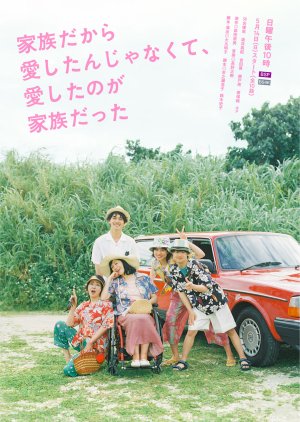
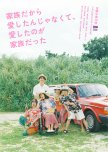
The Delightful Journey of the Kishida Family!
At the center of this drama are the members of the Kishida family, which includes the mother (Hitomi), the father (Kosuke), the grandmother (Yoshiko), the younger brother (Sota) and our protagonist and the daughter, Nanami.In my opinion, Nanami was initially a very chaotic character. A teen with emotional baggage, yet having a cheerful personality that is very unique to her. Life has not been easy on her and when things go awry constantly, we see our protagonist grow.
However, she doesn't grow alone...because the Kishida family doesn't work like that.
The entire family grows together. Sometimes helping each other and sometimes through the support of the supporting characters. They expand their horizons, overcome challenges and you will not be able to stop rooting for them.
As a family, their love for each other was genuinely beautiful. They are each other's best source of support and add the supporting characters to the mix, you get one of the most heartwarming line-up of people, who I believe, we all eventually find. Be it the mother's love for her family or the way the father still watches over them. You will find yourself with moist eyes at the end of mostly all episodes along with a cozy warm feeling seeping into your heart.
The acting of the entire cast was nothing short of perfection. The emotions of the characters come through very clearly and engage you so much that you will find yourself crying, laughing and smiling almost unconsciously, making you heavily emotionally invested in the drama.
A must watch for sure! You may not love it as much as I did, but I don't believe you will regret watching it either.
Was this review helpful to you?

The Warmth of The Family
Papa, Mama, this is your child, with all our shortcomings and mistakes, thank you for raising us and loving us as much as you can.The story itself is somewhat unusual. Because one of your children was diagnosed with Down syndrome, because your father suddenly died out of nowhere while you were arguing last night, and because you have a mother who has not been able to walk her whole life.
It's hard, life is so hard. But through these difficulties you can feel the warmth of your family, their love, affection and sincerity.
We will overcome this difficulty with patience and compassion, so that we can survive whatever happens.
Our family is the only treasure we have even though the cruelty of the world haunts us throughout our lives.
So appreciate them, and love them, because they are the only people who know us better inside and out. And be grateful for everything that happens in the world, because everything has value, even the smallest things in the world.
Was this review helpful to you?

This review may contain spoilers
387 viewers
Sometimes I wonder who is behind the limited reach of Japanese dramas outside their own country. Perhaps Japanese TV channels are not interested in exporting their stories, or they fail to reach agreements with streaming platforms. This website hardly ever promotes Japanese dramas, yet you can find news about the marriage of two Korean actors or the imprisonment of a third one, neither of which is intrinsically related to films or series. Sites like Kissasian and its various counterparts don't help, as they often steal the altruistic work of fansubbers without crediting them, who then have to upload their work to overly protected websites like Drama-Otaku (thanks to fatemasubs for subbing this drama). However, I believe many people simply consume a lot of mediocre stories and then complain about Japanese works in general, calling them amateurish or saying 'Japanese dramas are always like that,' neglecting stories like Kazoku Dakara Aishitan Janakute, Aishita no ga Kazoku Datta, which fall into oblivion on MDL. The result is 387 viewers and 70 ratings in one year. It’s an absolute shame considering the quality and deep impact this drama has on the viewer. This impression grows stronger knowing that it is a true story about Nami Kishida and her family, although the series slightly changes the names. Nami, portrayed by Yuumi Kawai, is changed to Nanami, and the Kishida family becomes the Kishimoto family.The story follows the daily adventures and misadventures of the Kishimoto family, led by Nanami Kishimoto, the older sister who looks after her mother, Hitomi, who is depressed after a life-or-death surgery that leaves her in a wheelchair, her brother Sota, diagnosed with Down’s Syndrome, and their grandmother Yoshiko, who will face age-related problems later in the series. Her father, Kosuke, died of a heart attack a few years ago. Under this pretext, it becomes clear that anyone’s life can change completely. At first, Nanami, driven by the innocence or naivety of a child, tries in the most honest and positive way to return to days that are unlikely to return. By the end of the fourth episode, she achieves her goal and brings new hope to her family, but life moves on and sometimes catches up with us in the worst way. When Nanami realises that there are no end credits for her story and unleashes the pain she’s been holding in for so long, she breaks down completely. The end of childhood gives way to a more realistic narrative, with its ups and downs, smiles and tears, exploring family dynamics, the limits and boundaries of each character, and mental health. The structure may be difficult to follow if you expect a more linear story, but like life itself, we move forward and backward in equal measure. Nanami’s emotional journey involves many returns to the beginning with all her problems.
In the end, all the family members come to accept their situation, gradually move on, and become independent, masters of their own lives. They are happy in their own way, because, as Nanami confesses to the illusion of her deceased father: 'Sota’s fine, Grandma’s fine, Mum’s not fine, and I’m not fine.' The story ends with the hope of forging a new path, perhaps reaching for the stars and beyond. The credits roll, but the life of the Kishimoto family continues, just as the Kishida family does in our reality.
I hope to see Yuumi Kawai more often in new productions because she is possibly one of the most promising actresses today.
Was this review helpful to you?

Masterpiece
I don't have much to say except what a beautiful way of explaining life.I started watching this thinking it was one of those japanese indie movies that seem like the writer has smoked something to create it (kinda like the taste of tea) , it had some weird cuts that made no sense, the friend from school and Nanami's personality... it was just so confusing, but it still caught me, and then the story starts making sense, you begin to understand everything, where is it all coming from, you follow Nanami and her family's journey through life and hardships, and then you find yourself embraced in a beautiful story of growth, acceptance and finding meaning in life.
The actors do an amazing job to make you feel part of the story.
You might think that some things are a tragedy, or something pitiful, however the characters will make you understand life is worth living. Yes, at times you will cry, but you will also laugh, and such is life.
PD: no life is pitiful, try and see other's point of view before you pity them.
Was this review helpful to you?

The Best Series On Netflix (at time of writing)
From the series description here on MDL and on Netflix you might think that this series is just another tepid or, perhaps, melodramatic slice-of-life from the third rate drama-producing nation, Japan. Instead, this series is an innovative, uplifting look at one woman's life from her early teens through her 20s, and is a stunningly beautiful depiction of her interesting family in Kobe.My Family is a slightly fictionalized version of the active essayist and humorist Kishida Nami and is based on her writings about her family. (She posts her essays at https://note.kishidanami.com/, and the website ALLWRITE in the series is clearly based on note.com. Most of her old posts are paywalled, but the most recent is generally available for free for a week or two and Google translate works on them reasonably well at this point.) The series was directed and co-written by Ohku Akiko who won Best Director for this series at the Japanese Television Drama Academy Awards.
Here Nami is called Nanami and is portrayed in a revelatory performance by Kawai Yuumi. The series explores how and why Nanami became a writer through a somewhat nonlinear but highly satisfying narration of various challenges that her family has had to face over the years. This series goes deep, and Kawai's performance masterfully exhibits a huge range. And we get two naked scenes of Kawai that will have women-kissers grabbing tissues ... well, along with everyone else: to dab their tears.
Sakai Maki delivers an equally amazing performance as Nanami's mother, Hitomi. She has the most physically demanding role in the piece and has to hit several emotional lows throughout the series which she does with complete commitment.
But beyond the leads, the depth of the acting bench is in this series, frankly, astounding. What does it say about the writing, directing and acting in a series when one of my favorite characters is simply the personal assistant (to the head of ALLWRITE) Saito played by 16th on the MDL call-sheet, Kabashima Hikari?
And, of course, there is Nanami's bff Multi played by Fukuchi Momoko. What can I say: she is delightful and fay.
The key, of course, is that all of the various characters in this series have their own stories that we get flashes of, and often interlock in unexpected but believable ways. They are all living their own lives over the years, and all have their own goals that often support and intersect Nanami's along her way.
And it cannot be said loudly enough: this is the kind of casual representation of differently-abled diversity that is sorely lacking in ALL media throughout the world. It's not just that there are at least 9 actors in this series with Down Syndrome. It's that frequently in the background there are wheel chair users, hearing impaired people signing, and a vision-impaired person just going about their lives.
I almost never touch on re-watchability in my reviews. Mostly, it is not relevant to my media consumption. But since this series was fansubbed a couple of years ago, I've watched through it a few times, and gone back to episode 8 in isolation a few time more. Not because that episode addresses an issue that I have faced in my family, but because the episode is that good. I will state that it still holds up on the Netflix version even though they did not fork out the dough for The Rolling Stones' She's A Rainbow which is the only change I could detect throughout the series from the original broadcast version. The score by Takano Masaki is otherwise excellent throughout.
Oh, and can we talk art direction for once? Look, I'm not sure exactly what blue and orange are supposed to represent here. The blue is clearly linked to the ocean and perhaps the subconscious (thanks, Jung). And maybe the orange is the activity in the world that Nanami represents. (It's certainly her color throughout the series.) But I do know that those two colors feature in many if not most shots, and that the series is visually intriguing throughout with Ohku often putting her camera in unusual places that are clearly chosen to make a point.
My Family is an extremely interesting and rewarding series to watch. Yes: there will occasionally be moments in the edit that you will not understand until later in the episode or the series as whole, but all the questions raised are resoundingly addressed and answered in ways that are often funny, moving, or tearful and quite often all three at the same time. The quintessential question of the series is: is Nanami okay? Watch the series and find out.
Was this review helpful to you?