Extremely disrespectful and disappointing drama!
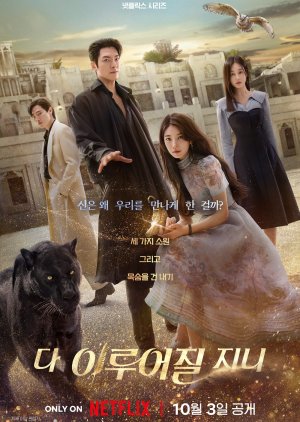
“Genie: Make a Wish” is a completely disappointing drama. In this series, they have portrayed the devil (Iblis) as a hero and shown angels in a lower position — which is totally unacceptable. The whole concept insults Islam and tries to glorify evil in a positive light.The story is meaningless, the message is offensive, and it clearly disrespects faith. Korean writers and directors often try to turn negative things into something admirable, but this time they have crossed all limits. Such concepts should never be promoted.
I strongly condemn this drama and hope that no one ever creates something so disrespectful in the future.
Was this review helpful to you?
my religion is not your costume
My religion is not your costume. This is incredibly disrespectful and deeply disappointing. We’ve waited years for a Woobin x Suzy reunion, expecting something meaningful, heartfelt, and worthy of their talent — not this mockery. Turning sacred symbols and religious imagery into aesthetic props is not creativity, it’s cultural and spiritual disrespect. People’s faiths are not trends or costumes for drama concepts. It’s exhausting to see our beliefs treated like this again and again. Do better.Was this review helpful to you?
Disgusting Story
Korean dramas are getting ridiculous and the actor and actress do not have any brain to decide which drama should they act on and which do not. Enlighten yourself stupid actors first!!Korean dramas are getting ridiculous and the actor and actress do not have any brain to decide which drama should they act on and which do not. Enlighten yourself stupid actors first!!
Korean dramas are getting ridiculous and the actor and actress do not have any brain to decide which drama should they act on and which do not. Enlighten yourself stupid actors first!!
Was this review helpful to you?
This review may contain spoilers
Progressive potential muddled by Orientalism and lack of follow through
The show is definitely making use of the Netflix platform to showcase a kdrama romcom that contain a lot edgier topics and portrayals than it usually can on it's mainstream broadcast and streaming platforms, but it's adherence to the false equivocation of being childish to being cute makes the moments eye rolling rather than it's intended effect. Both the actresses who played young and elder Mi Ju were fantastic. Both were standouts in their own way. Some of the dark physical humor is quite funny, like when Ejlael breaks through the windows to fly away and Irem horrifically cutting her tongue and her other senses in order to not give away information to Iblis since she cannot lie. The drama has a lot going on with portraying psychopathy, utilizing Islamic Arabian mythology, and also featuring a lesbian character.From what I understand of psychopathy wise, there's actually a lot of people that have it, especially in high level leader positions. The condition can be managed in a positive familial environment like shown with Ka Yeong. The show also shows the typical kdrama murder psychopath with another character that also grew up in the same village. He seemed to be undiagnosed, so never received treatment or care from the village that Ka Yeong got. It feels icky that the show made her unable to mask emotions when the other person was able to do so, just for comedic effect and so that she's "healed" with magic at the end when she is turned into a Jinniya. It seemed like they were were also veering into neurodivergence outside of psycopathy that they never address and she's completely changed. She might as well have been reincarnated as a fifth time rather than turning into a Jinniya out of nowhere.
The better way for the drama to have involved the Islamic Arabian mythology was to have actually featured a Arab actor to play Iblis for the entire story and have Arab consultants. Korea may be an ethnostate, but it's been intentionally exporting it's soft culture and interacting with other cultures for so many decades now, but it seems to fall into the same pitfalls again and again. There needs to be some sense of respect or otherwise it's just cultural appropriation and using another culture to be exotic. It's also frustrating that the show has Ka Yeong's past life say that Joseon also has genies. If that's true, that's what this show should have been about in the first place. There are graphic violent scenes where Arab people who are portrayed as enslaving two Korean children are beheaded and some visceral violence towards Korean characters as well, but they are at the hands of an Arab character that forcibly took over the body of a Korean child. The hero Iblis is only ever shown in Korean form. There's a weird undercurrent of Islamaphobia.
I don't agree with the MDL spoiler tag of the show having an LGBT character. The show doesn't hide it, Min Ji is not closeted. The show is cowardly though for not following through on the meet cute scenes that she has with both Irem and Mi Ju. Her scenes with the women are full kdrama romance tropes and she's seen dramatically locking eyes with her Korean TSA girlfriend. It's all one sided, Mi Ju never shows or expresses any attraction to her and Mi Ju doesn't even get a partner into old age, she's at the sand dune tour alone, watching her best friend being wind with her lover. It would not have cost them more for Mi Ju to have had a woman standing romantically next to her. They show that the reason her girlfriend broke up with her is because she point blank chose Ka Yeong over her. In the end lesbian Mi Ju was just devoted to her straight friend her whole life and even after the friend's death.
The dark humor storyline that worked the most was the little dog that wished for a human form and then wished for money and a human assistant, before tracking down his previous owners who he thinks of as family. He coughs out blood and it's implied that the owners had intentionally abandoned him because he was ill. His last wish was to turn back into a dog so he can reunite with his family as himself. Tragically the last we see is of the little doggy waiting next to the bus stop with the implication that he probably passed away without meeting them again. He had willed all his wish money to his assistant who has no memory of how it happened, but retains a sense of needing to devote himself to caring for stray dogs. It's so sweet and Daniel Henny absolutely went all out to play a dog in a human body and Kim Ji Hoon who I think may have been filming the american show Butterfly at the same time since he had the exact same styling was really funny as well as the stoic ex-military helper trying his best to help his boss.
Was this review helpful to you?
If you're looking for light comedy
Flash review--So the reception on this one is pretty mixed, and I will try to summarize why I think that is, as well as what I personally cared about.
*NOTE: I only watched 3 eps
OVERALL
If you like silly comedy and aren't going to take things too seriously, you may have a lot of fun.
Personally, I am not a big comedy person and have a hard time turning my brain off, so this was not for me. The rest of this review is about what I personally liked/disliked. So like, don't just take my opinion man, there is nothing wrong with liking what you like. Go have fun, hopefully the above review can help you make the decision as to whether its a good fit for you
THE GOOD
Suzy is pretty much good in this, maybe some things could be a bit better but I don't think she is a problem in this.
Her grandmother and the surrounding community are great. Both in being interesting to watch and what the writing does with their setup is interesting and potentially really important portrayal related to mental health and diversity.
The ML is hot. His acting is probably fine but, for me, the writing made him the focus of my problems with this show (See below)
THE BAD
The writing is just sloppy and half-hearted. Especially when it comes to the ML's motivations and behavior as well as the fundamentals of how magic works and what it means for the characters in the story. I had to turn my brain off and then turn my brain off again. And I still dropped it, because it was that pervasive.
The comedy is very ...well, I struggled (and failed) to think of an accurate way to describe it that wasn't mean. I don't want to bully people who like this type of comedy, but my eyes have limits to how much they can roll.
This show doesn't handle any topic with care. The flippant use of cultural stuff around genies is a pretty obvious issue that many people are accepting. But perhaps less talked about is the cartoonish portrayal of an actual mental health condition. It barely reflects the actual Antisocial Personality Disorder, and (as far as I watched) constantly plays it for laughs about the "psychopath". I am still a little hopeful that the rest of the show at least does SOMETHING good with the topic, which may actually be the case from what I saw about the community accepting her and raising her, but the comedy seems to mostly just play it for laughs.
Was this review helpful to you?
So boring can’t even get past the first few episodes!!!
This was meant to be one of the most hyped dramas of 2025. It was an utter disappointment I can’t even make it past episode 4. The chemistry is so lacking between them both and the visual effects for the genie genuinely look so cheap. Also barely anything happens in the first few episodes and the characters are so dull/boring. I find Bae Suzy’s acting incredibly lackluster and yeah this drama is not worth the hype overall. Considering how it’s only 13 episodes they shouldn’t drag out the initial eps so much.Overall I would not recommend.
Was this review helpful to you?
This review may contain spoilers
respect other religious
I started watching this drama with very high expectations. But sorry to say, after Episode 5 I was forced to drop it. This drama portrays many aspects related to our Islamic faith, but in a negative way, which I find offensive to our religion. As a Muslim, I was never taught by my faith to accept seeing my religion being degraded. After watching Episodes 4 and 5, the way Islam has been represented left me with no interest to continue, no matter how many high-profile actors or actresses appear in it. This drama is already controversial for its religious issues, and once again, I must emphasize that it contains concepts that go against our faith. Whether you watch it or not is up to you. Whether you like it or dislike it is also up to you. I simply explained my reason for not watching it further.Was this review helpful to you?
Dropped at ep9
I had been eagerly waiting for this drama, but it is not for me, AT LEAST.I expected a magical, Aladdin-style fantasy, but that’s not what it turned out to be.
I tried to separate the story from religion and treat it as pure fiction but I am not sure what the motive was behind portraying Iblis as a sympathetic victim especially in episode 9 when the script goes like "This is how far you'd go to avoid bowing to a human". The writer could have easily used a different name instead of referencing sacred figures (Izrael the angel of death and Iblis the disobedient jinn).
Was this review helpful to you?
Worst drama ever
“Genie: Make a Wish” is a drama that has sparked significant discomfort and criticism, especially among Muslim viewers who feel their faith has been misrepresented and trivialized. While fantasy and fiction have long drawn from mythologies and spiritual concepts, there is a line that should never be crossed — and this drama crosses it repeatedly.Religion should never be used as a tool for entertainment or fantasy. Sacred beliefs are not props for storytelling, nor are they playgrounds for romantic tropes. In Islam, jinn and Iblis are not whimsical beings to be flirted with or fantasized about. They represent serious theological realities tied to morality, temptation, and the unseen world. Romanticizing jinn and Iblis is deeply wrong — these are sacred and serious concepts in Islam. This is not “art”; it’s disrespectful to 1.5 billion Muslims 🚫.
The drama’s attempt to blend romance with supernatural elements rooted in Islamic theology feels tone-deaf and careless. It’s not just about creative freedom — it’s about cultural and religious sensitivity. When creators ignore the weight of these concepts and repackage them as love interests or misunderstood anti-heroes, they risk distorting public understanding and offending entire communities.
Respecting others’ beliefs means understanding the boundaries of representation. It means asking: “Is this portrayal accurate? Is it respectful? Is it necessary?” “Genie: Make a Wish” fails on all counts. Instead of fostering dialogue or insight, it indulges in shallow fantasy that undermines the gravity of Islamic teachings.
Art should challenge, inspire, and reflect truth — not exploit sacred symbols for ratings. This drama is a reminder that not everything is fair game for fiction. Some things are meant to be revered, not reimagined.
Was this review helpful to you?
Korean writers, now disappointing
Korea will soon be defeated by China very quickly. China has always focused on its own country, both in terms of history and deification. But Korea is too busy dealing with other people's religions, both in its idols and its dramas. Korea will get its downfall quickly. Siwon is the trigger, and this rotten drama is also the trigger.Was this review helpful to you?

horrendous
everything is a mess... from the pacing... cgi... and most especially the acting... zero immersion... nil chemistry... the comedy is so forced its absolute cringe... i can't decide if its overacting or underacting... but its definetely not even hitting the mediocre level...from poster to actual drama, its really a major disappointment...
Was this review helpful to you?
This review may contain spoilers
PPL lasts at least 5 episodes
I do have an old account and I have my bias profile. I come here with a new acc because I don't want to get my bias involved while giving an.opinion.Reviews up to episode 5 (Spoilers ahead)
Good things first
Visual effects - Great and totally a high budget production
Now to other things
*Storyline/Writing*
I don't know where it will be going . It is neither a heartfelt sob story, a swoony romance nor a good revenge story. It is so bland like a chicken soup without salt.
Since it is a high production drama with famous casts, famous writer, I will continue watching to know how it ends, but it is a drama with no known casts, I may have already dropped it.It is one of the dramas I want to be stubborn because I want to be clear about my opinion about the drama whether 'I Love it because it improves later ' or 'I Hate it because it is so bad' .
*Characters*
I don't feel connected neither with Genie male lead nor with psychopath female lead. Like they are strangers on the street who have nothing to do with me. Our female lead has abandonment issue ,yet I never sympathize with her. (Park Bo Gum character in 'I Remember You/Hello Monster' is a psychopath ,but I felt sorry for him.) Here,I feel nothing. Both are narcissistic individuals. I don't even understand why I should root for this couple.
Not only the leads ,also supporting characters are uninteresting -except they are plot device . There is not a particular one we should root for.
At first, I thought her grandma story would be the one that changed our female's story. But she was turned into a childish character.
*OST/Music*
There is not any memorable one up to episode 5 .
*Acting*
Nothing remarkable. Both Suzy and Kim Woo Bin can do better than that . But here they do nothing extraordinary except being models for beers and luxury brands .
Was this review helpful to you?