1
1Through Sick and Sin
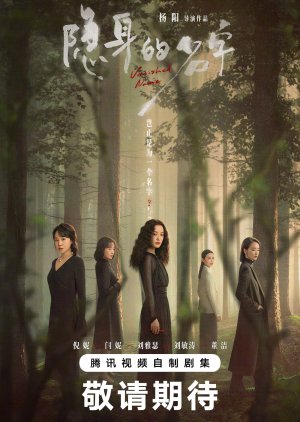
Vanished Name is a suspenseful story about women who have had their identities stolen or hidden for reasons not entirely within their control. The story opens with an infuriated and vengeful Ren Xiaoming, whose husband—acclaimed novelist Liu Xiaoran—has stolen and published her diary as his new coming-of-age novel. She is not amused by this gross violation of not only her privacy but also that of everyone she grew up with. Her cold fury, the way her eyes scrunch up vindictively, is more chilling than any tears or yelling. But this very foolish man thinks that the royalties from book sales will heal all wounds. The diary, along with the discovery of a long-hidden corpse, pulls Xiaoming back into old relationships and a past she long left behind.The core themes of the narrative are women's struggles and friendships spanning two generations over 36 years (1987–2023). It mostly alternates between Xiaoming's coming-of-age years around 2004 and the present (2023). Xiaoming was a difficult child—brilliant, prickly, selfish, and judgmental. Her mother, Ren Meiyan, whose life's mission seemed to be marrying her way down the list of 100 surnames, was my favorite character. Her ability to smile through her many struggles as if "the sky falls down to be used as her blanket" (天跌落嚟当被冚) moved me unaccountably. It baffled me how such a ditzy, optimistic, and joyful character could have produced such a pompous and narrow-minded daughter. The number of times I itched to smack Xiaoming for judging her and giving her such a hard time!
The narrative alternates between two timelines that reveal the ties binding two generations of women and their complex entanglements. This is one of those dramas I couldn't stop watching because so many questions popped up from the get-go. What on earth possessed Xiaoming to marry such a turd as Liu Xiaoran? How did the bright, mischievous sparkle in Bai Shu's eyes fade into such a dull, cold, and colorless person? I don't particularly like Liu Yase's acting, but her appearance as the grown-up Bai Shu screams that something soul-destroying must have happened to her—and it broke me. I needed to know what happened to her, to all of them.
The young actors got a huge amount of screen time, and they carried this drama. Wang Shengdi, of The Bad Kids fame (Pu Pu), is riveting as the adolescent Ren Xiaoming lashing out at the world (mostly her mom) with her frustration. Her natural and unique chemistry with Bai Shu, and how they came to understand and change each other's worlds for the better, made me smile. Na Yi is another young actor to watch—her transitions from careless joie de vivre to off-the-charts tension in her quiet, passive-aggressive rebellion against Ge Wenjun are flawless. The young He Yuqiong is the unsung hero of the group: generous to a fault and always there for Xiaoming.
The drama's biggest problem is that it was difficult to really see the child in the adults. Even though it's hard to find fault with Ni Ni or Zhou You's performances, I just couldn't see the young Xiaoming or Yuqiong in either of them. As for Zhang Fang, this role was completely miscast and took me out of the drama. I am usually a huge fan of Liu Mintao, but I found her acting a bit over the top here. Among the adult roles, Yan Ni (Ren Meiyan) and Dong Jie (Zhou Yun) delivered the most convincing performances. But by the time the adults took over the narrative, the kids had already gotten me too invested in the story.
The most laughable part of this drama is the suspense plot—it is a giant nothing burger. So if you are here for the mystery, best give it a skip. From the nameless corpse that remains genderless for the longest time to the dumb cop who refuses to read the book, this is far from a fast-paced crime thriller. Instead, it is a sober coming-of-age story about friendships that survive through sick and sin—the kind that get you through all the things you can't change in life. Yes, there is closure at the end, but twenty years later is just too late. So late that all the unlimited potential of youth had passed them all by.
I rate the main plot arc about women's struggles and friendship an 8.5/10, but the mystery and ending barely a 6.0/10—for an overall 7.5/10.
Was this review helpful to you?

Fragments of Memory, Flaws in Mystery
Vanished Name opens like a quiet whisper that slowly turns into an echo you cannot shake off. A hidden corpse surfaces just as Ren Xiao Ming tries to reclaim what was stolen from her, the copyright to a story her husband Liu Xiao Ran shamelessly plagiarized from her and Bai Shu’s diary. From that point on, the story spirals into a web of investigations, relationships, and long buried secrets tying together Xiao Ming, Bai Shu, Ren Mei Yan, and others. The opening sequence alone was interesting. A painting where the characters’ eyes and mouths are brushed over, paired with a melancholic instrumental, sets a haunting tone that lingers like a half remembered dream.What caught me off guard almost immediately was the narration. It feels poetic without trying too hard, descriptive yet easy to follow, almost like reading prose that breathes. Liu Xiao Ran’s opening lines, supposedly from his “new” book, establish the emotional and thematic core of the drama. The visuals complement this beautifully. The direction plays with lighting and framing in a way that feels simple but deliberate. A scene of two girls running through a forest stands out, not because it is loud, but because it quietly plants unease in your mind.
The structure leans heavily on flashbacks, and this is where the drama both shines and stumbles. The flashbacks do not function as clear clues for the investigation. Instead, they peel back layers of the characters, showing us how they became who they are. It is compelling in an emotional sense, but from a mystery standpoint, it feels like being handed puzzle pieces that do not seem to connect until the very end. Meanwhile, the present day investigation often feels like it is wandering in circles. Interviews lead nowhere, key details are overlooked, and some forensic conclusions raise more questions than answers. The most glaring example is the existence of the book itself, a giant clue sitting in plain sight, yet it takes far too long for Detective Li Meng to simply have her team read it. It is the kind of oversight that makes you want to shout at the screen.
Where the drama truly excels is in its portrayal of relationships, especially between mothers and daughters. Xiao Ming and Ren Mei Yan’s dynamic feels painfully real. Their love is undeniable, yet it is buried under years of resentment, poverty, and misunderstanding. Xiao Ming grows up feeling neglected and overshadowed, while Mei Yan struggles as a single mother who was never fully prepared for the role. Their interactions are explosive, but also deeply human. One small moment says everything: Mei Yan hanging her old, worn towel in a cramped space between her children’s neatly placed ones. It is such a tiny detail, yet it evokes frustration, guilt, and empathy all at once. They argue fiercely, never apologize, and somehow continue as if nothing happened. That cycle feels all too familiar.
Bai Shu and her mother Ge Wen Jun present a different kind of tragedy. Their relationship is rooted in control and psychological suffocation. Wen Jun’s obsessive tendencies manifest in strict rules, isolation, and a complete lack of privacy. It is unsettling in a way that makes you reflect on your own habits. Bai Shu, on the other hand, emerges as a surprising contrast, someone who radiates warmth despite the cage she grew up in. It raises a quiet question of how resilience takes shape in such conditions. The performance here can feel inconsistent, but the writing carries enough weight to make the dynamic impactful.
Some relationships, however, leave more confusion than clarity. Xiao Ming and Liu Xiao Ran’s marriage is one of them. It appears harmonious at first glance, but the emotional foundation is never fully explored. How they got there, what changed, and what truly connects them remain vague. Even the thread involving their child feels underdeveloped, like a story that was meant to matter more but got lost along the way.
Casting becomes another mixed bag, particularly with the transition from younger to older versions of the characters. The shift is abrupt and hard to adjust to. The younger actors bring such vivid energy and emotional clarity that they end up defining the characters more strongly than their older counterparts. Young Xiao Ming is portrayed with a frustrating intensity that makes her impulsiveness and anger feel authentic. Bai Shu’s younger version balances light and darkness beautifully. When the older versions take over, the emotional continuity weakens. The chemistry remains, but the connection feels thinner, like a copy of a copy.
The male characters suffer even more from this disconnect. Young Yu Qiong is charming to a fault, with a softness that draws you in effortlessly. His older version, however, lacks that same magnetism, making it difficult to stay invested. Zhang Fang’s older portrayal is another misstep, failing to leave any meaningful impression. It creates an imbalance where the past feels richer and more engaging than the present.
Interestingly, the drama offsets its heavy themes with an unexpected tonal balance. Bright, almost cheerful background music appears in scenes you would expect to be drenched in darkness. Instead of clashing, it creates a strange harmony that keeps the story from becoming overwhelmingly bleak. There are also moments of subtle comedy that land surprisingly well, like Xiao Ming casually presenting a document upside down before correcting it without a hint of embarrassment. Even serious conversations sometimes carry a sarcastic edge, making the dialogue feel dynamic rather than monotonous.
Unfortunately, the ending does not live up to the promise of its beginning. After building layers of mystery and emotional depth, the final revelations feel rushed and somewhat absurd. The investigation never quite earns its conclusions, and the resolution lacks the weight it should have carried. It leaves behind a sense of missed opportunity, especially for a story that started with such a strong grip.
In the end, Vanished Name is a drama that excels in atmosphere, character exploration, and emotional nuance, but falters in delivering a satisfying mystery. It is a journey worth taking for its performances, relationships, and storytelling style, even if the destination feels underwhelming. I found myself engaged, frustrated, and eventually speeding through the last stretch just to see how it all ends. It is not a perfect watch, but it is one that lingers, like a name you almost remember but cannot quite place.
Was this review helpful to you?

Left with a lot of unanswered questions & emotions.
This story tells that how much secret does a person hold, it eventually is revealed but with a lot of pain and memories, how a person can be so obsessed that in the race of proving their obsession, they hurt innocent people, very well written, and executed, love the friendship throughout, it has happiness, it has pain, lots of emotions, loved it!Was this review helpful to you?